locker und logisch – Details, episodes & analysis
Podcast details
Technical and general information from the podcast's RSS feed.
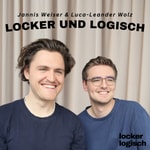

Recent rankings
Latest chart positions across Apple Podcasts and Spotify rankings.
Apple Podcasts
🇩🇪 Germany - comedyInterviews
27/07/2025#87🇩🇪 Germany - comedyInterviews
26/07/2025#66
Spotify
No recent rankings available
Shared links between episodes and podcasts
Links found in episode descriptions and other podcasts that share them.
See allRSS feed quality and score
Technical evaluation of the podcast's RSS feed quality and structure.
See allScore global : 53%
Publication history
Monthly episode publishing history over the past years.
#017 Der Abschied
Season 1 · Episode 17
jeudi 8 août 2024 • Duration 23:55
Nach 17 Folgen Podcast ist erst einmal Schluss - vorerst zumindest. In einer letzten Podcast-Partie erklären Jannis und Luca, was sich in Zukunft verändern wird.
Als Abschiedsgeschenk lassen euch die beiden Podcast-Propheten eine Anleitung für “gute” Abschiede da... Also worauf wartet ihr noch? Jetzt locker und logisch hören!
#016 Ein Hoch auf die Freundschaft
Season 1 · Episode 16
jeudi 1 août 2024 • Duration 33:49
Freunde sind die Familie, die man sich aussuchen kann. Grund genug, um zu feiern! Gut, dass es den internationalen Tag der Freundschaft (30.07.) gibt, den eure beiden Podcast-Palaberer ausgiebig zelebrieren.
Dabei besprechen Jannis und Luca in Folge 16 von locker und logisch unter anderem, warum es wichtig ist Freunde im Leben zu haben und worauf Männer und Frauen besonders Wert in einer guten Freundschaft legen.
Literatur
Hall, J. A. (2018). How many hours does it take to make a friend? Journal Of Social And Personal Relationships, 36(4), 1278–1296. https://doi.org/10.1177/0265407518761225
Holt-Lunstad, J., Smith, T. B. & Layton, J. B. (2010). Social Relationships and Mortality Risk: A Meta-analytic Review. PLoS Medicine, 7(7), e1000316. https://doi.org/10.1371/journal.pmed.1000316
Lewis, D. M., Conroy-Beam, D., Al-Shawaf, L., Raja, A., DeKay, T. & Buss, D. M. (2011). Friends with Benefits: The Evolved Psychology of Same- and Opposite-Sex Friendship. Evolutionary Psychology, 9(4), 543–563. https://doi.org/10.1177/147470491100900407
Waldinger, R. J. & Schulz, M. S. (2010). What’s love got to do with it? Social functioning, perceived health, and daily happiness in married octogenarians. Psychology And Aging, 25(2), 422–431. https://doi.org/10.1037/a0019087
#007 Track it till you make it
Season 1 · Episode 7
jeudi 23 mai 2024 • Duration 37:44
Push it to the limit! So könnte man das Leben von Jannis aktuell zusammenfassen. Weil er im September mit seinen Arbeitskollegen einen Marathon laufen möchte, kommt er schon jetzt ordentlich ins Schwitzen. Das größte Problem: Sein innerer Schweinehund...
Gerade Lauf-Tracking-Apps treiben ihn während des Trainings regelmäßig in den Wahnsinn. Und damit ist er nicht alleine, sagt zumindest Psychologe in spe Luca. Gemeinsam mit Jannis diskutiert er in der neuen Folge locker und logisch das Phänomen “Self-Tracking”.
Literatur
Attig, C. & Franke, T. (2020). Abandonment of personal quantification: A review and empirical study investigating reasons for wearable activity tracking attrition. Computers in Human Behavior, 102, 223–237. https://doi.org/10.1016/j.chb.2019.08.025
Feng, S., Mäntymäki, M., Dhir, A. & Salmela, H. (2021). How Self-tracking and the Quantified Self Promote Health and Well-being: Systematic Review. JMIR. Journal Of Medical Internet Research/Journal Of Medical Internet Research, 23(9), e25171. https://doi.org/10.2196/25171
Shin, D. & Biocca, F. (2017). Health experience model of personal informatics: The case of a quantified self. Computers in Human Behavior, 69, 62–74. https://doi.org/10.1016/j.chb.2016.12.019
#006 Wurm im Ohr
Season 1 · Episode 6
jeudi 16 mai 2024 • Duration 28:27
In der neuen Folge locker und logisch berichtet Jannis auf musikalische Weise von seinem Italien-Urlaub. Achtung: Ohrwurmgefahr!
Und damit sind wir auch schon mittendrin im Thema: Luca beantwortet in Folge 6 eures Lieblingspodcasts die Frage, wie Ohrwürmer eigentlich entstehen und wie wir sie schnellstmöglich wieder loswerden.
Literatur
Beaman, C. P., Powell, K. & Rapley, E. (2015). Rapid Communication: Want to block earworms from conscious awareness? B(u)y gum! The Quarterly Journal Of Experimental Psychology/Quarterly Journal Of Experimental Psychology, 68(6), 1049–1057. https://doi.org/10.1080/17470218.2015.1034142
Farrugia, N., Jakubowski, K., Cusack, R. & Stewart, L. (2015). Tunes stuck in your brain: The frequency and affective evaluation of involuntary musical imagery correlate with cortical structure. Consciousness And Cognition, 35, 66–77. https://doi.org/10.1016/j.concog.2015.04.020
Hyman, I. E., Burland, N. K., Duskin, H. M., Cook, M. C., Roy, C. M., McGrath, J. C. & Roundhill, R. F. (2012). Going Gaga: Investigating, Creating, and Manipulating the Song Stuck in My Head. Applied Cognitive Psychology, 27(2), 204–215. https://doi.org/10.1002/acp.2897
#005 Urlaub in Italien
Season 1 · Episode 5
jeudi 9 mai 2024 • Duration 19:53
Während ihr die aktuelle Folge eures Lieblingspodcasts hört, verbringt Jannis eine Woche in bella Italia. Genau in diesem Moment sitzt er wahrscheinlich mit einem Gelato-Bauch in der Sonne und gönnt sich einen Espresso-Martini. Logisch also, dass er in Folge 5 gemeinsam mit Luca locker über das Thema Urlaub quatscht. Die beiden Podcast-Propheten klären unter anderem, warum Urlaub eigentlich wichtig ist und wieso Reisen uns so verdammt gut tut.
Literatur Blasche, G. (2008). War Ihr Urlaub erholsam? Ergebnisse und Anwendungen der Erholungsforschung. Psychologie in Österreich, 3(4), 306-314.
De Bloom, J., Kompier, M. A. J., Geurts, S. A. E., De Weerth, C., Taris, T. W. & Sonnentag, S. (2009). Do We Recover from Vacation? Meta‐analysis of Vacation Effects on Health and Well‐being. Journal Of Occupational Health, 51(1), 13–25. https://doi.org/10.1539/joh.k8004
Gump, B. B. & Matthews, K. A. (2000). Are vacations good for your health? The 9-Year Mortality Experience after the multiple Risk factor intervention trial. Psychosomatic Medicine, 62(5), 608–612. https://doi.org/10.1097/00006842-200009000-00003
Syrek, C. J., De Bloom, J. & Lehr, D. (2021). Well Recovered and More Creative? A Longitudinal Study on the Relationship Between Vacation and Creativity. Frontiers in Psychology, 12. https://doi.org/10.3389/fpsyg.2021.784844
#004 Cringe, Diggah!
Season 1 · Episode 4
jeudi 2 mai 2024 • Duration 30:24
Kennt ihr das? Ihr beobachtet eine unangenehme Situation und alles in euch zieht sich zusammen? Ihr wollt euch sofort zusammenkauern und eine Decke über den Kopf ziehen? Willkommen im Cringe!
In Folge 4 sprechen die beiden Sabbel-Senatoren Jannis und Luca über unangenehme Situationen, sie diskutieren zum ersten Mal die Frage einer Hörerin und diskutieren, ob Kinder vielleicht Zombies sind.
Literatur
Müller-Pinzler, L., Rademacher, L., Paulus, F. M. & Krach, S. (2015). When your friends make you cringe: social closeness modulates vicarious embarrassment-related neural activity. Social Cognitive And Affective Neuroscience, 11(3), 466 475. https://doi.org/10.1093/scan/nsv130
Paulus, F. M., Müller-Pinzler, L., Jansen, A., Gazzola, V. & Krach, S. (2014). Mentalizing and the Role of the Posterior Superior Temporal Sulcus in Sharing Others’ Embarrassment. Cerebral Cortex, 25(8), 2065–2075. https://doi.org/10.1093/cercor/bhu011
#003 Wer hat den Größeren?
Season 1 · Episode 3
jeudi 25 avril 2024 • Duration 25:59
Na ihr Schlingel? Da seid ihr wohl in unsere Falle getappt. Natürlich geht’s in Folge 3 nicht um die Geschlechtsteile eurer Lieblings-Laberer, sondern um das Thema Clickbait und um das Geschäft mit der Aufmerksamkeit.
Neben der Frage, wer von Jannis und Luca den größeren Sinn für irreführende Überschriften hat, hört ihr, warum es in der Podcast-WG nach Elefantenscheiße stinkt und wieso Luca bald "Speaker" in seiner Bio stehen hat.
Literatur
Blom, J. N. & Hansen, K. R. (2015). Click bait: Forward-reference as lure in online news headlines. Journal Of Pragmatics, 76, 87–100. https://doi.org/10.1016/j.pragma.2014.11.010
Pengnate, S. (2019). Shocking secret you won’t believe! Emotional arousal in clickbait headlines. Online Information Review, 43(7), 1136–1150. https://doi.org/10.1108/oir-05-2018-0172
Theile, G. (2020). Verschärfte Werberichtlinien: Google verbietet Clickbait-Werbung. FAZ.NET. https://www.faz.net/pro/d-economy/verschaerfte-werberichtlinien-google-verbietet-clickbait-werbung-16819110.html
#002 Call me maybe besser nicht
Season 1 · Episode 2
jeudi 18 avril 2024 • Duration 32:55
Die einen machen es so oft wie möglich, die anderen vermeiden es, wo und wann es nur geht... Beim Telefonieren gehen die Meinungen stark auseinander. So auch bei Jannis und Luca: Während Jannis sich vornehm zurückhält, telefoniert Luca einfach drauflos.
In der zweiten Folge versuchen die beiden Podcast-Palaverer eine Antwort zu finden, warum bei Jannis vor dem Telefonieren die Stresspickel sprießen und warum Bewegung beim Telefonieren guttut.
Literatur
ICD-10-GM-2024: F40.- Phobische Störungen - icd-code.de. (o. D.). https://www.icd code.de/icd/code/F40.-.html
Hillman, C. H., Erickson, K. I. & Kramer, A. F. (2008). Be smart, exercise your heart: exercise effects on brain and cognition. Nature Reviews. Neuroscience, 9(1), 58–65. https://doi.org/10.1038/nrn2298
Hyman, I. E., Boss, S. M., Wise, B. M., McKenzie, K. E. & Caggiano, J. M. (2010). Did you see the unicycling clown? Inattentional blindness while walking and talking on a cell phone. Applied Cognitive Psychology (Print), 24(5), 597–607. https://doi.org/10.1002/acp.1638
Kupke, S. (2020). Die Angst vor dem Telefonieren wächst. https://www.forschung-und-lehre.de/zeitfragen/die-angst-vor-dem-telefonieren-waechst-2549
Stavrinos, D., Byington, K. W. & Schwebel, D. C. (2011). Distracted walking: Cell phones increase injury risk for college pedestrians. Journal Of Safety Research, 42(2), 101–107. https://doi.org/10.1016/j.jsr.2011.01.004
#001 Ball in die Fresse
Season 1 · Episode 1
jeudi 11 avril 2024 • Duration 34:01
In der ersten Folge sprechen die beiden pfiffigen Flausen-im-Kopf-Haber über das Thema Humor. Jannis Problem: Er findet Dinge vor allem dann lustig, wenn man sie eigentlich nicht lustig finden sollte...
Luca hält wissenschaftlich-routiniert dagegen und philosophiert über Humor-Theorien und empirische Studien. Mit Hilfe von flachen Witzen und hochtrabenden Ausdrücken nimmt er euch mit in die Welt des Lachens.
Literatur
Plessen, C. Y., Franken, F., Ster, C., Schmid, R. R., Wolfmayr, C., Mayer, A., Sobisch, M., Kathofer, M., Rattner, K., Kotlyar, E., Maierwieser, R. J. & Tran, U. S. (2020). Humor styles and personality: A systematic review and meta-analysis on the relations between humor styles and the Big Five personality traits. Personality And Individual Differences, 154, 109676. https://doi.org/10.1016/j.paid.2019.109676
Schneider, M., Voracek, M. & Tran, U. S. (2018). “A joke a day keeps the doctor away?” Meta‐analytical evidence of differential associations of habitual humor styles with mental health. Scandinavian Journal Of Psychology, 59(3), 289–300. https://doi.org/10.1111/sjop.12432
#015 Musik nur wenn sie laut ist
Season 1 · Episode 15
jeudi 25 juillet 2024 • Duration 34:39
Es ist Freitag. Heißt: locker und logisch meldet sich zurück mit einer frischen Folge eures Lieblingspodcasts! Luca ist (offenhörbar) frisch vom Festival zurück - hat aber natürlich trotzdem ein Psycho-Thema mit im Gepäck.
Zusammen mit Jannis bespricht er diese Woche das Thema Musik und klärt unter anderem folgende Fragen: Warum hören wir Musik? Und welche (positiven) Effekte hat das Hören von Musik auf uns?
Literatur
Baker, F. A. & MacDonald, R. A. R. (2013). Flow, identity, achievement, satisfaction and ownership during therapeutic songwriting experiences with university students and retirees. Musicae Scientiae, 17(2), 131–146. https://doi.org/10.1177/1029864913476287
MacDonald, R. A. R. (2013). Music, health, and well-being: A review. International Journal Of Qualitative Studies On Health And Well-being, 8(1), 20635. https://doi.org/10.3402/qhw.v8i0.20635
Pothoulaki, M., MacDonald, R. & Flowers, P. (2012). An Interpretative Phenomenological Analysis of an Improvisational Music Therapy Program for Cancer Patients. The Journal Of Music Therapy/Journal Of Music Therapy, 49(1), 45–67. https://doi.org/10.1093/jmt/49.1.45
Schäfer, T. & Sedlmeier, P. (2010). What makes us like music? Determinants of music preference. Psychology Of Aesthetics, Creativity, And The Arts, 4(4), 223–234. https://doi.org/10.1037/a0018374
Related Shows Based on Content Similarities