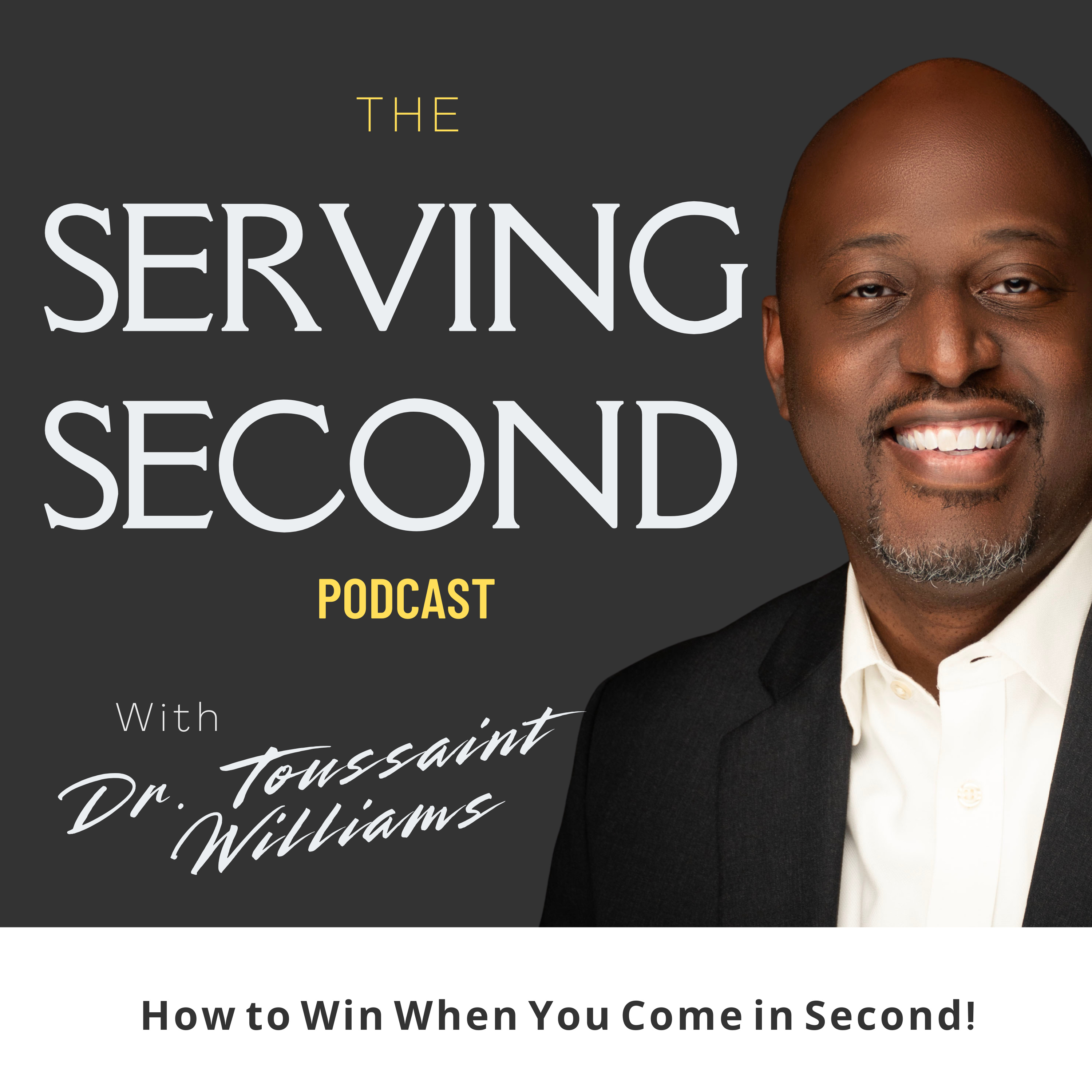
The Serving Second Podcast with Dr. Toussaint Williams celebrates the unsung heroes of leadership—the associates, assistants, vice presidents, and right-hand leaders who make vision possible from the second chair. Not everyone wears the top title, but every leader carries weight. Through biblical insight, leadership lessons, and practical takeaways, discover how to win—even when you come in second. Subscribe and be equipped to lead with confidence, clarity, and courage.
Site
RSS
Apple
Data updated on 05/08/2026
Recent rankings
Latest chart positions across Apple Podcasts and Spotify rankings.
Shared links between episodes and podcasts
Links found in episode descriptions and other podcasts that share them.
You went to bed thinking everything was fine. You woke up surrounded. In this solo episode, Dr. Toussaint Williams walks through 2 Kings 6, the story of Elisha's unnamed servant, to answer the question every second-chair leader eventually asks out loud: what am I supposed to do now?
This week Toussaint steps away from the interview chair for a solo teaching episode built around one of the most overlooked figures in scripture, the unnamed servant who serves the prophet Elisha. When a Syrian army surrounds the city hunting for Elisha, the servant is the first one to see it and the first one to panic. Toussaint uses that moment to unpack what it feels like to carry pressure you did not create, a reality every second-chair leader knows well. He also opens up about a difficult season his own family has walked through over the past few months, and the leadership lessons he is still working through in real time. The episode closes with a practical three-step framework for leading through a crisis without losing your footing.
In This Episode
Why the story of an unnamed servant in 2 Kings 6 says more to second-chair leaders than the story of the prophet does
What it means to carry pressure you did not create and did not ask for
A personal update on a season of family challenge Toussaint and his wife have been navigating
The difference between fear knocking on the door and fear getting a seat at the decision-making table
Why Elisha's first prayer was not for the problem to disappear, but for eyes to see clearly
A three-step framework for leading through a crisis: see clearly, seek perspective, move without panic
Timestamps
0:00 - The moment everything changes overnight
1:49 - The story behind the story: 2 Kings 6 and the unnamed servant
3:32 - The international crisis: the king of Syria hunts down Elisha
6:37 - The servant wakes up surrounded
9:47 - The most honest question in scripture: "What are we going to do?"
10:23 - Toussaint's personal story: a season of major family challenges
14:18 - What Elisha does not do, and why it matters
16:36 - Fear counts what is against you. Faith remembers who is for you.
19:04 - Elisha's prayer: "Open his eyes that he may see"
21:03 - The mountain was already full of horses and chariots of fire
22:16 - Calm is contagious. So is panic.
24:13 - The ending nobody expects: grace over violence
26:22 - Three steps for when you feel surrounded
28:37 - Closing encouragement
The Framework: When You Feel Surrounded
See clearly. Don't exaggerate the problem. Don't minimize it either. Call it what it is.
Seek perspective. Pause and pray. Invite wise counsel. Ask yourself what you might not be seeing right now.
Move without panic. Not without caution, not without prayer, but without panic. Take the next faithful step, then trust God with the one after that.
Connect with Dr. Toussaint Williams
Serving Second Podcast, helping leaders maximize the gifts in their hands and master the seat they currently occupy.
If this episode met you where you are, subscribe, leave a review, and share it with a second-chair leader who needs to hear it this week.
He Left Work at 5 PM Every Day for 34 Years and Still Got Promoted - E37
Episode 37
Friday, July 24, 2026 • Duration 17:39
Your boss walks the floor at 5:15 checking who's still at their desk. Kevin Wayne Johnson made sure his chair was already empty, every single day, for over three decades in federal government leadership. He still made director. Here's how leading from the second chair taught him that presence at home builds the same trust presence at work does.
Episode Summary
Kevin Wayne Johnson spent 34 years in federal acquisition and contract management, rising to a director-level role overseeing teams in New York, Los Angeles, and London. He is also the author or co-author of 24 books on faith, leadership, and the writing craft, and he leads the Johnson Leadership Group today.
In this episode, Kevin traces his leadership foundation back to fatherhood, specifically to a father who served in Vietnam and stayed connected through recorded voice tapes mailed home. That model of presence became the standard Kevin held himself to with his own two hour daily commute and his own kids. He explains the choice he made to leave work at 5 PM without exception, why his leadership earned him the room to do it, and how that same discipline shaped his writing career.
This conversation is for the leader who feels like showing up for family and showing up for the mission are in competition. Kevin's story is proof they are not.
What You'll Learn
Why presence, not perfection, is the trait that shapes the next generation of leaders
How to set a hard boundary at work without losing your boss's trust or your next promotion
What earns you the credibility to protect your personal life when everyone else is staying late
How to build a writing or coaching practice around your life instead of sacrificing your life for it
The mindset shift from doing impressive work to making a positive impact on the people around you
Timestamps
00:00 Welcome to Kevin Wayne Johnson 00:21 The one thing that shaped his leadership: fatherhood 01:07 What his own father modeled growing up 03:12 Voice tapes from Vietnam and why presence matters to a child 04:23 The difference in proximity: his commute versus his father's absence 06:31 Telling his bosses that family comes first 08:08 Earning the trust to leave at 5 PM every day 09:47 What his director-level role actually involved 11:41 From federal career to 24 published books 14:44 Why he never pigeonholes his writing schedule 15:13 Making a positive impact without needing the spotlight 16:34 Where to find Kevin and the Johnson Leadership Group
Connect with Kevin Wayne JohnsonAbout the HostKeywords
Stop Waiting for Your Turn: The Real Meaning of Serving Second - E36
Episode 36
Friday, July 10, 2026 • Duration 32:53
What if the seat you are waiting to leave is the very place where your leadership is being developed?
In this special solo episode, Toussaint resets and reintroduces the heart of Serving Second. After months of conversations with high-performing leaders, he recognized that the movement had been framed too narrowly. Serving Second is not about accepting a lesser position, becoming comfortable in the background, or waiting for your turn to lead.
It is about maximizing your gifts, mastering your current assignment, and creating first-place outcomes from whatever seat you occupy.
Drawing from the stories of Jonathan and David, Scottie Pippen and Michael Jordan, and CJ Quinney and Eric Thomas, Dr. Williams explores the security required to use your abilities to strengthen someone else. These leaders did not serve second because they lacked talent. They chose to leverage their talent for a mission bigger than personal recognition.
Dr. Williams also shares his own struggle with being overlooked for positions he believed should have been his. That disappointment forced him to confront a difficult question: Was he genuinely serving the mission, or was he quietly waiting to be chosen?
You will learn the difference between position and posture, service and negotiation, ambition and insecurity, and excellence and performance. You will also discover the four pursuits every leader must develop: character, competence, contribution, and calling.
Serving Second is a challenge to become greater in your stewardship, discipline, service, and impact.
In this episode:
Why Serving Second needed a reset
How titles distort our understanding of leadership
The difference between serving and waiting
Why disappointment exposes where your identity is rooted
How position differs from posture
Why quiet gifts still carry tremendous value
He Built Companies, Then Realized He Was the Problem - E35
Episode 35
Thursday, July 2, 2026 • Duration 43:08
Servant leadership is not soft leadership. It may be the most strategic way to get real results.
In this episode Toussaint sits down with Kurt Uhlir for a direct conversation about leadership, humility, business outcomes, and the hard personal work required to become the kind of leader people can trust.
Kurt started his first businesses at 14 years old. One was a lawn care company that grew so quickly he had friends and even adults working for him. Early on, he learned how to sell, organize systems, and produce results. But later, he had to face a painful truth. He was getting results, but he was not leading well.
Kurt shares the moment his mentor and his mother both told him the truth he did not want to hear. He had become a toxic authoritative leader. He was demanding outcomes, but creating fear. He was pushing people, but not truly developing them. He was leading in a way that caused bad information to stay hidden and good information to be filtered.
That wake-up call changed the way he viewed leadership.
This episode is not just about being nicer at work. Kurt makes the business case for servant leadership. He explains why fear-based leadership slows organizations down, why leaders miss critical information when people are afraid to speak honestly, and why serving people well can improve performance, trust, retention, and decision-making.
Dr. Williams and Kurt also discuss the power of being a second-chair leader, operator, and “kingmaker.” Kurt explains why he finds deep fulfillment in helping other leaders succeed instead of always trying to sit in the top chair himself. He also talks about what it takes to support a leader well, ask better questions, understand organizational outcomes, and serve the whole person, not just the employee.
One of the strongest moments in the conversation is Kurt’s reminder that leaders must create space for honest feedback. If people cannot tell you where you are wrong, your organization will eventually pay for it. Healthy conflict is not a threat to leadership. It is one of the ways leadership gets better.
The Science of Yes! - E34
Episode 34
Thursday, June 25, 2026 • Duration 59:39
The Science of Ethical Persuasion
Second-chair leaders don't always have the final say — but the most effective ones know how to influence without authority. In this episode, Dr. Toussaint Williams sits down with ethical persuasion expert and keynote speaker Patrick van der Burght (Melbourne, Australia) to unpack the science behind ethical influence and what it means for leaders in every sector.
🎯 What You'll Learn in This Episode:
Why persuasion is NOT manipulation — and why the difference matters for leaders
How Dr. Robert Cialdini's 7 Principles of Influence apply to real-world leadership
The "Unity" principle and why co-creation makes teams more loyal and forgiving
How loss language outperforms gain language when motivating behavior
A real case study: how one question boosted patient case acceptance by 33.5% across four dental clinics
Why knowledge alone isn't power — and what application skill actually looks like
👤 About the Guest: Patrick van der Burght is an ethical persuasion trainer, keynote speaker, and host of the Ethical Persuasion Unlocked podcast, based in Melbourne, Australia. He is a certified expert in the science of influence rooted in the research of Dr. Robert Cialdini.
🎙️ About the Serving Second Podcast: Hosted by Dr. Toussaint Williams — pastor, author, and executive leader — the Serving Second Podcast equips second-chair leaders to create first-place outcomes from wherever they serve.
Vision is Easy - Execution Needs a #2! - E33
Thursday, June 11, 2026 • Duration 39:05
What does it really mean to serve second with excellence?
Toussaint sits down with Derek Fredrickson, founder of The COO Solution, to talk about the power of operators, COOs, chiefs of staff, and second-in-command leaders who help turn big vision into real execution.
Derek shares how he left Wall Street to work alongside his wife in her successful business coaching company and discovered his gift for operations, systems, structure, and team leadership. He explains why the second-in-command role is not lesser leadership. It is strategic leadership.
This conversation is for every leader who knows they are wired to build, organize, execute, finish, and make other people’s ideas work.
Derek breaks down the role of a COO as the bridge between vision and execution. He explains why visionary leaders need operators who can create accountability, build structure, lead teams, protect focus, and help the organization move forward.
One of the strongest takeaways from this episode is simple: the world needs great second-in-command leaders.
Keywords
Fractional COO, Leadership, Second in Command, Business Growth, Personal Development, Trust, Accountability, Entrepreneurial Success
Takeaways
Embrace your unique strengths and gifts to excel in leadership roles.
Building trust is essential for effective team management.
Assessments like Colby and Strengths Finder help clarify your innate abilities.
A fractional COO can be a strategic bridge between vision and execution.
Understanding your zone of genius unlocks greater impact and fulfillment.
Sound bites
"We are the ones that finish what others start."
Building Generational Wealth - E32
Friday, June 5, 2026 • Duration 40:44
What if your money problem is not just about money?
In this episode, Toussaint sits down with Albert Butler, CPA, to talk about financial literacy, family legacy, entrepreneurship, purpose, and the responsibility of building something that lasts beyond you.
Albert brings nearly 30 years of experience in public accounting, private industry, entrepreneurship, and personal finance. But this conversation goes deeper than taxes and spreadsheets. It is about understanding your numbers, leading your family well, building a business with wisdom, and aligning your financial decisions with your purpose.
Albert shares why “accounting is the heartbeat of business,” why every family should think like a business, and why legacy is not just about what you leave for your children, but what you prepare for your children’s children.
Key Leadership Lesson
Money is not the mission. Money is a tool.
For second-chair leaders, entrepreneurs, pastors, business owners, and professionals, the deeper question is not just “How do I make more money?” The better question is, “Why am I building this, and who will benefit from it after me?”
Albert reminds us that strong leaders do not just manage numbers. They manage responsibility. They think about family. They think about structure. They think about legacy.
Albert’s Five Muscles of Enterprise
Albert breaks down five muscles every business, leader, and entrepreneur must develop:
Leadership - The vision, mission, goals, and objectives that guide the work.
Operations = How the business flows day to day.
Sales - How you take your product, service, or message to the market.
IT Infrastructure - The data, systems, and information flow that protect and support the organization.
Accounting - The heartbeat of the enterprise. Accounting tells the past, shows the present, and helps forecast the future.
Practical Takeaways
Have real money conversations with your children and family.
Guest InfoAbout Serving Second
Leadership in the AI Age - E31
Episode 31
Friday, May 29, 2026 • Duration 29:21
Most leaders think pressure reveals weak people.
But what if pressure actually reveals weak team systems?
In this episode of the Serving Second Podcast, Dr. Toussaint Williams talks with Daria Rudnik about how second-chair leaders can build teams that click under pressure, navigate disruption, and stay human in the age of AI.
If you serve behind the leader, carry team tension, or feel responsible for helping others succeed, this conversation will give you practical tools to lead with clarity, not control.
Key Leadership Lesson
The leader’s job is not to rescue the team.
The leader’s job is to facilitate the conversations that help the team rescue itself.
Daria makes the point clearly: outdated leadership says the leader must know everything, solve everything, and carry everything. Modern leadership requires something different. Leaders must create the conditions where the team can define purpose, build trust, make better decisions, share knowledge, and adapt together.
For second-chair leaders, this is a powerful shift. You do not need the top title to strengthen the team. You can help create the conversations, systems, and clarity that allow the team to perform.
Main Takeaways
Daria identifies five elements that make a team “click”:
Clear purpose A group does not become a team just because they report to the same manager. A team becomes a team when it has a shared purpose that cannot be accomplished by individual effort alone.
Linking connections Strong teams build trust internally and understand their connection to stakeholders outside the team.
Integrated work Teams need clarity around roles, norms, expectations, and how the work actually gets done.
Collaborative decisions Healthy teams know which decisions belong to the leader, which belong to individuals, which require group input, and which can be delegated or automated.
Stop Promoting Without Preparing - E30
Episode 30
Thursday, May 21, 2026 • Duration 30:59
What happens when a great employee gets promoted into leadership, but no one has prepared them to lead?
In this episode of the Serving Second Podcast, Dr. Toussaint Williams sits down with Rich Ashton, author of Growing Your Own: Common Sense Advice for Developing Leaders Within a Small Business, to talk about one of the biggest leadership gaps in small businesses and organizations: developing leaders from within.
Rich shares lessons from more than 45 years in leadership and ownership of eight businesses. He explains why hiring from the outside can threaten culture, why loyal employees still need leadership training, and why some people are more effective and fulfilled as strong number twos rather than chasing the top seat.
Keywords
second-chair leadership, leadership development, small business leadership, growing leaders from within, Rich Ashton, Growing Your Own, Serving Second Podcast, leadership training, number two leader, executive leadership, internal leadership development, organizational culture, developing employees, relational leadership, leadership podcast
Key Topics Covered
How small businesses hit a leadership ceiling as they grow
Why great employees are not automatically ready to lead
The risk of bringing in outside leaders who do not understand the culture
Why leaders should develop people to be themselves, not copies of the founder
The importance of being a strong number two
How transparency helps leaders have difficult conversations
Why trust is built before the hard conversation happens
How intellectual curiosity helps second-chair leaders keep growing
Best Quotes and Takeaways
“Just because someone is a good employee and loyal to you does not mean they can take the next step.”
“If I couldn’t be the best number one, I could be the best number two.”
Why This Matters for Second-Chair LeadersGuest InformationChapters
What's the Platinum Rule??? - E29
Episode 29
Thursday, May 14, 2026 • Duration 31:14
What if high performance did not have to come at the cost of people?
In this episode Toussaint sits down with Kathy Eastwood, CEO and creator of the E3 Leadership Code, to talk about what it really takes to lead from the second chair. Kathy brings years of experience as a Chief of Staff, Chief People Officer, COO, and leadership strategist. Her work focuses on helping leaders drive results while still building trust, engagement, and healthy team culture.
Kathy shares why the Chief of Staff role became one of her favorite leadership assignments. She describes it as the work of taking a leader’s vision and translating it into tangible results. That is exactly where many second-chair leaders thrive. They may not always be the public face of the vision, but they often carry the responsibility of making sure the vision lands, moves, and gets executed.
Leadership is not an either-or choice between results and people. Kathy challenges the idea that leaders must choose between delivering outcomes and caring for their teams. Her point is clear: you get better results by caring about your people.
Takeaways
Kathy explains that second-chair leaders often influence without direct authority. That means trust, clarity, and relationships matter more than control.
She introduces her “FEUD” framework: fear, ego, uncertainty, and doubt. These are the barriers that often keep people from buying in and moving forward.
One of the strongest moments in the episode is Kathy’s explanation of the Platinum Rule: treat people the way they want to be treated. This is a critical shift for leaders who assume their preferred communication style works for everyone.
Kathy also breaks down the E3 Leadership Code: Express, Engage, and Execute, powered by emotional qualities. She explains that strong leadership requires vision, people engagement, disciplined execution, and the emotional intelligence to connect with people in a real way.
Why This Matters for Second-Chair Leaders
Second-chair leaders are often asked to carry the weight between vision and execution. They hear the leader’s message more than once, clarify what is being communicated, interpret what is landing with the team, and help translate big ideas into practical action.
Memorable QuotesConnect with Kathy
Related Shows Based on Content Similarities
Discover shows related to The Serving Second Podcast, based on actual content similarities. Explore podcasts with similar topics, themes, and formats, backed by real data.
Dr. Toussaint Williams is a pastor, author, and leadership consultant, and the host of the Serving Second Podcast, the show for the leaders behind the leaders. Second-chair leadership is not lesser leadership. It is strategic leadership.
leadership development, second-chair leadership, leading from the second chair, work life balance for leaders, federal government leadership, executive leadership, influence without authority, faith-based leadership, associate pastor leadership, Serving Second Podcast
The four pursuits of extraordinary stewardship
Why the greatest leaders make everyone around them better
Key takeaway:
You are not powerless because you do not have the title you want. Your opportunity is already here. Your gifts are already enough. Your assignment has already begun.
Chapters:
00:16 – The pain of being misunderstood 01:30 – Where Serving Second missed the mark 03:50 – A reset for the movement 05:26 – The dangerous way we measure leadership 06:34 – Stop waiting for a better seat 08:04 – Watching Eric Thomas’s journey 10:35 – Why meeting CJ Quinney mattered 13:00 – Choosing to put someone else first 15:00 – Jonathan’s rightful claim to the throne 17:30 – Strengthening the person God selected 19:32 – Serving Second begins inside you 20:00 – When the position you expected never comes 21:39 – Proximity is not a promise 22:44 – Are you serving or waiting? 24:43 – When excellence becomes a bargaining chip 25:28 – Position versus posture 27:10 – Service, performance, and stewardship 28:17 – Learning to value quiet gifts 30:02 – Stewarding disappointment 31:18 – Becoming valuable right now 33:34 – The new direction of Serving Second 34:40 – Pursuit one: Character 35:58 – Pursuit two: Competence 37:05 – Pursuit three: Contribution 38:05 – Pursuit four: Calling
Reflection questions:
Am I faithfully serving, or am I quietly waiting to be chosen?
Have I confused proximity to a position with a promise of promotion?
What gift comes naturally to me that I may be undervaluing?
Subscribe to the Serving Second Podcast and share it with someone whose contribution deserves to be recognized.
Maximize your gifts. Multiply your impact. Keep Serving Second.
This conversation is for executives, entrepreneurs, ministry leaders, second-chair leaders, operators, and anyone who wants to lead with both excellence and humility.
In this episode: • Why early success can hide unhealthy leadership patterns • How Kurt moved from toxic authority to servant leadership • Why fear-based cultures block honest information • How servant leadership creates better business outcomes • Why leaders must care about the whole person • What it means to be a kingmaker or queen maker • How second-chair leaders can bring value without chasing the spotlight • Why healthy conflict must be modeled, not just talked about
Leadership Challenge: Ask yourself, “What am I wrong about right now that I think I’m right about?”
Then ask someone on your team, “What am I missing that I need to know?”
Do not defend yourself. Do not explain it away. Ask clarifying questions. Listen. Learn. Then lead better.
About Serving Second: Toussaint helps leaders maximize the gifts they already have in the seat they currently occupy. Second-chair leadership is not lesser leadership. It is strategic leadership. When you serve with clarity, excellence, humility, and skill, you can create first-place outcomes from wherever you lead.
Subscribe for more conversations on servant leadership, second-chair leadership, business leadership, ministry leadership, personal growth, and leading well from wherever you are.
Know what your tax return says about your financial life.
Build your business around structure, not just passion.
Lead with purpose, then let money serve that purpose.
Write down your dreams and identify the one that keeps pulling you forward.
Albert Butler, CPA Website: AlbertButler.com Connect with Albert on social media by searching Albert Butler CPA.
Serving Second helps leaders maximize the gifts they already have in the seat they currently occupy.
This podcast is for second-chair leaders, assistants, associates, vice presidents, ministry leaders, entrepreneurs, and anyone who wants to create first-place outcomes through service, skill, and excellence.
Knowledge sharing and feedback Teams must learn together, adapt together, and create feedback loops that help them improve over time.
Keywords
Leadership, Team Building, AI in Leadership, Global Work Experience, Authentic Leadership, Lifelong Learning, Team Dynamics, Second Chair Leadership
Chapters
00:00 Introduction and Background
03:38 Building Strong Teams
06:46 Leadership in Stressful Situations
09:49 Navigating Challenges as a Woman in Leadership
“The number one role can be isolating and lonely.”
“Trust is built through transparency.”
“If you are not pursuing intellectual curiosity, get on board with one.”
Second-chair leaders do not have to spend their whole career trying to become a copy of the person in the first chair. Rich makes it clear that leadership growth starts with self-awareness, integrity, and the willingness to develop your own leadership voice.
For some leaders, the goal is not always the top seat. Sometimes the greatest influence comes from becoming the trusted, capable, and grounded leader who helps the organization move forward from the second chair.
Guest: Rich Ashton Book: Growing Your Own: Common Sense Advice for Developing Leaders Within a Small Business Website: growingyourown.net Email: rich@growingyourown.net
00:00 Welcome to the Serving Second Podcast 01:12 Why growing businesses need more leaders 02:54 The leadership ceiling in small businesses 04:01 How Rich’s book started as leadership blogs 08:10 Developing leaders, not copies of yourself 09:54 Learning from mentors and relationships 12:42 The power of being the best number two 15:21 Growing your own leadership team 17:35 Integrity and relational leadership 20:03 Handling difficult leadership conversations 22:39 Trust, transparency, and decision-making 26:09 Intellectual curiosity as a leadership habit 28:28 How to connect with Rich Ashton
This episode is a reminder that the second chair is not a lesser seat. It is a strategic seat. It requires emotional intelligence, operational discipline, self-awareness, and the ability to influence people who may not report directly to you.
“Leadership is not either results or people. It is both.”
“You actually get your results by caring about your people.”
“Logic does not move people. Emotions do.”
“The number two role is taking a brilliant vision and translating it so it lands with each person.”
Learn more about Kathy Eastwood, the E3 Leadership Code, and her work at kathyeastwood.com or on LinkedIn.
Chapters
00:00 Introduction and Kathy's leadership journey
01:51 The role of Chief of Staff in driving change
03:05 Innate skills and leadership style
04:15 The value of vision and repetition
04:59 The importance of diverse skills in leadership
05:56 Clarity and communication in leadership
09:27 Understanding the feud: fear, ego, uncertainty, doubt
10:36 Building trust and influence without control
13:12 The platinum rule: treat others as they want to be treated
17:22 The E3 leadership code: express, engage, execute
23:20 The five-week bootcamp and ongoing development