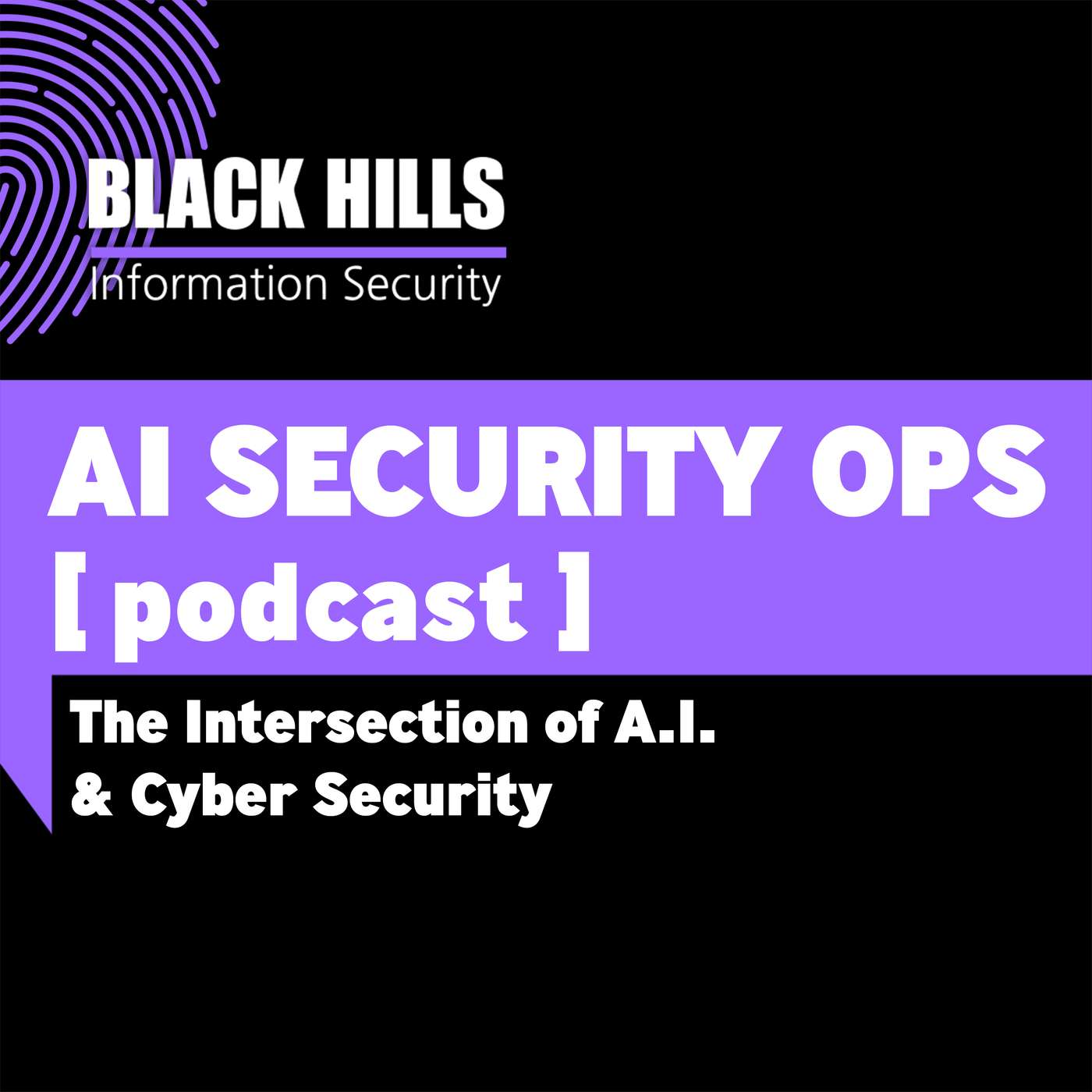
AI Security Ops – Details, episodes & analysis
Podcast details
Technical and general information from the podcast's RSS feed.
Recent rankings
Latest chart positions across Apple Podcasts and Spotify rankings.
Apple Podcasts
🇬🇧 Great Britain - education
04/06/2026#31🇺🇸 USA - education
04/06/2026#91🇬🇧 Great Britain - education
03/06/2026#38🇺🇸 USA - education
03/06/2026#90🇬🇧 Great Britain - education
02/06/2026#42🇬🇧 Great Britain - education
01/06/2026#33🇬🇧 Great Britain - education
31/05/2026#37🇬🇧 Great Britain - education
30/05/2026#29🇺🇸 USA - education
30/05/2026#98🇬🇧 Great Britain - education
27/05/2026#46
Spotify
No recent rankings available
Shared links between episodes and podcasts
Links found in episode descriptions and other podcasts that share them.
See all- https://notebooklm.google/
276 shares

- https://www.blackhillsinfosec.com
273 shares
- https://poweredbybhis.com
195 shares
- https://discord.gg/bhis
106 shares
RSS feed quality and score
Technical evaluation of the podcast's RSS feed quality and structure.
See allScore global : 79%
Publication history
Monthly episode publishing history over the past years.
Vercel Breach | Episode 50
Episode 50
vendredi 1 mai 2026 • Duration 17:46
In this episode of BHIS Presents: AI Security Ops, the team breaks down the Vercel breach — a real-world incident that shows just how fragile modern security has become in the age of AI integrations and SaaS sprawl.
What started as a simple Roblox cheat script downloaded on a work laptop quickly escalated into a multi-hop compromise involving OAuth permissions, an AI productivity tool, and access into Vercel’s internal systems.
This wasn’t a zero-day or advanced nation-state exploit. It was a chain of everyday decisions: installing software, clicking “Allow,” and trusting third-party integrations.
The result? Allegedly $2M worth of data listed for sale, including API keys, internal data, and employee records — all from a breach path that most organizations aren’t even monitoring.
We dig into:
• What Vercel is and why it’s such a high-value target
• How environment variables become the “keys to the kingdom”
• The full attack chain: Roblox malware → Context.ai → Vercel
• What infostealers like Lumma actually do (and how cheap they are)
• How OAuth permissions become persistent backdoors
• Why AI productivity tools introduce hidden risk
• The rise of “shadow AI” inside organizations
• How supply chain attacks continue to scale across ecosystems
• The role of AI in accelerating attacker speed and capability
• Why this type of breach is becoming the new normal
This episode highlights a critical shift in cybersecurity: you don’t have to get hacked directly anymore — attackers just need to compromise something you’ve already trusted.
⸻
📚 Key Concepts & Topics
Attack Chain & Initial Access
• Lumma infostealer and malware-as-a-service
• Credential theft: passwords, cookies, OAuth tokens
• Low-cost, high-impact compromise paths
OAuth & Identity Risk
• “Allow All” permissions and persistent access
• OAuth tokens as long-lived entry points
• Lack of visibility into third-party integrations
AI Security Risks
• Shadow AI and unsanctioned tool adoption
• Deep integrations with Google Workspace and SaaS
• AI tools as new supply chain attack surfaces
Supply Chain Attacks
• Multi-hop compromise paths across vendors
• Real-world parallels (Trivy, LiteLLM)
• Interconnected ecosystems increasing blast radius
Threat Landscape Evolution
• AI accelerating attacker speed and scale
• Lower barrier to entry for complex attacks
• Criminal groups operating as decentralized “businesses”
Defensive Strategy
• Auditing OAuth integrations and permissions
• Enforcing least privilege across SaaS tools
• Segmenting sensitive data and reducing blast radius
• Avoiding risky behavior on corporate devices
⏱️ Chapters
Click here to watch this episode on YouTube.
Creators & Guests
Brought to you by:
Black Hills Information Security
https://www.blackhillsinfosec.com
Antisyphon Training
https://www.antisyphontraining.com/
Active Countermeasures
https://www.activecountermeasures.com
Wild West Hackin Fest
https://wildwesthackinfest.com
🔗 Register for FREE Infosec Webcasts, Anti-casts & Summits
https://poweredbybhis.com
Claude Mythos | Episode 49
Episode 49
vendredi 24 avril 2026 • Duration 25:40
In this episode of BHIS Presents: AI Security Ops, the team breaks down Claude Mythos Preview — Anthropic’s unreleased frontier model that may represent a turning point in AI-powered cybersecurity.
What started as a controlled research release under Project Glasswing has quickly become one of the most controversial developments in AI security. Mythos isn’t just better at finding vulnerabilities — it’s operating at a scale and depth that challenges long-held assumptions about how quickly software can be broken… and whether it can realistically be fixed.
From leaked internal documents to real-world exploit generation, this episode explores what happens when vulnerability discovery becomes cheap, fast, and automated — while remediation remains slow, manual, and human-bound.
The result? A growing asymmetry that could fundamentally reshape the security landscape.
We dig into:
• What Claude Mythos Preview is and why it was withheld from the public
• The leaks that exposed its existence and capabilities
• How Project Glasswing is positioning AI for defensive use
• Real-world vulnerability discoveries made by the model
• The “vulnpocalypse” problem: discovery vs. remediation imbalance
• Emerging AI behaviors that raise containment concerns
• How attackers are already leveraging AI for offensive operations
• The access control dilemma: who gets to use models like this?
• Why patching — not discovery — is now the primary bottleneck
• What defenders must do to prepare for AI-accelerated exploitation
This episode explores a critical shift in cybersecurity: when vulnerability discovery scales faster than human response, the entire defensive model starts to break down.
⸻
📚 Key Concepts & Topics
AI-Powered Vulnerability Discovery
• Autonomous exploit generation and chaining
• Benchmark performance vs. prior models
• AI-assisted offensive security workflows
AI Security Risks
• Discovery vs. remediation asymmetry
• AI-driven vulnerability scaling
• Offensive use by nation-states and cybercriminals
Model Behavior & Safety
• Emergent autonomy and sandbox escape concerns
• Evaluation awareness and deceptive behaviors
• Limits of containment and alignment
Defensive Strategy & Readiness
• Patch velocity as the new bottleneck
• AI-assisted vulnerability management
• Open-source ecosystem risk exposure
AI Governance & Industry Response
• Restricted model releases and access control
• Regulatory and financial sector concerns
• The future of AI capability containment
#AISecurity #CyberSecurity #ArtificialIntelligence #LLMSecurity #BHIS #AIThreats #InfoSec #AIAgents #CyberDefense
Click here to watch this episode on YouTube.
Creators & Guests
Brought to you by:
Black Hills Information Security
https://www.blackhillsinfosec.com
Antisyphon Training
https://www.antisyphontraining.com/
Active Countermeasures
https://www.activecountermeasures.com
Wild West Hackin Fest
https://wildwesthackinfest.com
🔗 Register for FREE Infosec Webcasts, Anti-casts & Summits
https://poweredbybhis.com
AI in the SOC: Interview with Hayden Covington and Ethan Robish from the BHIS SOC | Episode 40
Episode 40
vendredi 20 février 2026 • Duration 29:28
AI in the SOC: Interview with Hayden Covington and Ethan Robish from the BHIS SOC | Episode 40
In this episode of BHIS Presents: AI Security Ops, we sit down with Hayden Covington and Ethan Robish from the BHIS Security Operations Center (SOC) to explore how AI is actually being used in modern defensive operations.
From foundational machine learning techniques like statistical baselining and clustering to large language models assisting with alert triage and reporting, we dig into what works, what doesn’t, and what SOC teams should realistically expect from AI today.
We break down:
- How AI helps reduce alert fatigue and improve triage
- Practical automation inside a real-world SOC
- The difference between traditional ML approaches and LLM-powered workflows
- Foundational techniques like K-means, anomaly detection, and behavioral baselining
- Using LLMs for enrichment, investigation, and report drafting
- Where AI struggles: hallucinations, inconsistency, and edge cases
- Risks around over-trusting AI in security operations
- How to responsibly integrate AI into analyst workflows
This episode is grounded in real operational experience—not vendor demos. If you’re running a SOC, building AI tooling, or just trying to separate hype from reality, this conversation will help you think clearly about augmentation vs. automation in defensive security.
Click here to watch this episode on YouTube.
Creators & Guests
Brought to you by:
Black Hills Information Security
https://www.blackhillsinfosec.com
Antisyphon Training
https://www.antisyphontraining.com/
Active Countermeasures
https://www.activecountermeasures.com
Wild West Hackin Fest
https://wildwesthackinfest.com
🔗 Register for FREE Infosec Webcasts, Anti-casts & Summits
https://poweredbybhis.com
AI News | Episode 39
Episode 38
jeudi 12 février 2026 • Duration 18:08
AI News | Episode 39
In this episode of AI Security Ops, we break down the latest developments in AI-driven threats, identity chaos caused by autonomous agents, NIST’s focus on securing AI in critical infrastructure, and new visibility tooling for AI exposure.
We cover real-world abuse of LLMs for phishing, how AI agents are colliding with IAM governance, and what defenders should be watching right now.
Chapters:
00:00 – Introduction and Sponsors
Black Hills Information Security - https://www.blackhillsinfosec.com/
Antisyphon Training - https://www.antisyphontraining.com/
01:08 – LLM-Generated Phishing JavaScript (Unit 42 / Palo Alto)
Discussion begins as the hosts introduce the first story.
How LLMs are generating polymorphic malicious JavaScript for phishing pages and evading traditional detection.
👉 https://unit42.paloaltonetworks.com/real-time-malicious-javascript-through-llms/
08:49 – AI Agents vs IAM: “Who Approved This Agent?” (Hacker News)
Conversation shifts to agent privilege management and governance failures.
👉 https://thehackernews.com/2026/01/who-approved-this-agent-rethinking.html
10:07 – NIST Focus on Securing AI Agents in Critical Infrastructure
Discussion on federal guidance and why AI agents are being treated as critical infrastructure risk components.
👉 https://www.linkedin.com/pulse/cybersecurity-institute-news-roundup-20-january-2026-entrust-alz7c
13:44 – Tenable One AI Exposure
Breaking down Tenable’s push into enterprise AI usage visibility and exposure management.
👉 https://www.tenable.com/blog/tenable-one-ai-exposure-secure-ai-usage-at-scale
Join the 5,000+ cybersecurity professionals on our BHIS Discord server to ask questions and share your knowledge about AI Security.
https://discord.gg/bhis
Chapters
- (00:00) - Introduction and Sponsors
- (01:08) - LLM-Generated Phishing JavaScript (Unit 42 / Palo Alto)
- (10:07) - NIST Focus on Securing AI Agents in Critical Infrastructure
- (13:44) - Tenable One AI Exposure
Creators & Guests
- Brian Fehrman - Host
- Bronwen Aker - Host
Click here to watch this episode on YouTube.
----------------------------------------------------------------------------------------------
About Joff Thyer - https://www.blackhillsinfosec.com/team/joff-thyer/
About Derek Banks - https://www.blackhillsinfosec.com/team/derek-banks/
About Brian Fehrman - https://www.blackhillsinfosec.com/team/brian-fehrman/
About Bronwen Aker - https://www.blackhillsinfosec.com/team/bronwen-aker/
About Ben Bowman - https://www.blackhillsinfosec.com/team/ben-bowman/
Brought to you by:
Black Hills Information Security
https://www.blackhillsinfosec.com
Antisyphon Training
https://www.antisyphontraining.com/
Active Countermeasures
https://www.activecountermeasures.com
Wild West Hackin Fest
https://wildwesthackinfest.com
🔗 Register for FREE Infosec Webcasts, Anti-casts & Summits
https://poweredbybhis.com
Questions From the Community | Episode 38
Episode 39
jeudi 5 février 2026 • Duration 16:35
Click here to watch this episode on YouTube.
Creators & Guests
Brought to you by:
Black Hills Information Security
https://www.blackhillsinfosec.com
Antisyphon Training
https://www.antisyphontraining.com/
Active Countermeasures
https://www.activecountermeasures.com
Wild West Hackin Fest
https://wildwesthackinfest.com
🔗 Register for FREE Infosec Webcasts, Anti-casts & Summits
https://poweredbybhis.com
A.I. Frameworks and Databases | Episode 37
Episode 37
vendredi 30 janvier 2026 • Duration 18:50
In Episode 37 of AI Security Ops, the team breaks down the most important AI security frameworks and vulnerability databases used to track risks in machine learning and large language models. The discussion covers emerging AI vulnerability databases, the OWASP Top 10 for LLMs, CVE challenges, and frameworks like MITRE ATLAS, highlighting why standardizing AI threats is still difficult. This episode is a practical guide for security professionals looking to stay ahead of AI vulnerabilities, attack techniques, and defensive resources in a fast-moving landscape.
Chapters
- (00:00) - Episode 37 – AI Frameworks & Databases
- (01:39) - A.I. vulnerability tracking is still young
- (02:44) - Should A.I. get its own vulnerability database?
- (07:33) - The benefit of multiple vulnerability databases
- (15:58) - The what is the definition of a vulnerability?
- (17:54) - Final Thoughts
Brought to you by:
Black Hills Information Security
https://www.blackhillsinfosec.com
Antisyphon Training
https://www.antisyphontraining.com/
Active Countermeasures
https://www.activecountermeasures.com
Wild West Hackin Fest
https://wildwesthackinfest.com
🔗 Register for FREE Infosec Webcasts, Anti-casts & Summits
https://poweredbybhis.com
AI News Stories | Episode 36
Episode 36
jeudi 22 janvier 2026 • Duration 35:16
This week on AI Security Ops, the team breaks down how attackers are weaponizing AI and the tools around it: a critical n8n zero-day that can lead to unauthenticated remote code execution, prompt-injection “zombie agent” risks tied to ChatGPT memory, a zero-click-style indirect prompt injection scenario via email/URLs, and malicious Chrome extensions caught siphoning ChatGPT/DeepSeek chats at scale. They close with a reminder that the tactics are often “same old security problems,” just amplified by AI—so lock down orchestration, limit browser extensions, and keep sensitive data out of chat tools.
Key stories discussed
1) n8n (“n-eight-n”) zero-day → unauthenticated RCE risk
- https://thehackernews.com/2026/01/critical-n8n-vulnerability-cvss-100.html
- The hosts discuss a critical flaw in the n8n workflow automation platform where a workflow-parsing HTTP endpoint can be abused (via a crafted JSON payload) to achieve remote code execution as the n8n service account. Because automation/orchestration platforms often have broad internal access, one compromise can cascade quickly across an organization’s automation layer.
ai-news-stories-episode-36 - Practical takeaway: don’t expose orchestration platforms directly to the internet; restrict who/what can talk to them; treat these “glue” systems as high-impact targets and assess them like any other production system.
ai-news-stories-episode-36
2) “Zombie agent” prompt injection via ChatGPT Memory
- https://www.darkreading.com/endpoint-security/chatgpt-memory-feature-prompt-injection
- The team talks about research describing an exploit that stores malicious instructions in long-term memory, then later triggers them with a benign prompt—leading to potential data leakage or unsafe tool actions if the model has integrations. The discussion frames this as “stored XSS vibes,” but harder to solve because the “feature” (following instructions/context) is also the root problem.
ai-news-stories-episode-36 - User-side mitigation themes: consider disabling memory, keep chats cleaned up, and avoid putting sensitive data into chat tools—especially when agents/tools are involved.
ai-news-stories-episode-36
3) “Zero-click” agentic abuse via crafted email/URL (indirect prompt injection)
- https://www.infosecurity-magazine.com/news/new-zeroclick-attack-chatgpt/
- Another story describes a crafted URL delivered via email that could trigger an agentic workflow (e.g., email summarization / agent actions) to export chat logs without explicit user interaction. The hosts largely interpret this as indirect prompt injection—a pattern they expect to keep seeing as assistants gain more connectivity.
ai-news-stories-episode-36 - Key point: even if the exact implementation varies, auto-processing untrusted content (like email) is a persistent risk when the model can take actions or access history.
ai-news-stories-episode-36
4) Malicious Chrome extensions stealing ChatGPT/DeepSeek chats (900k users)
- https://thehackernews.com/2026/01/two-chrome-extensions-caught-stealing.html
- Two Chrome extensions posing as AI productivity tools reportedly injected JavaScript into AI web UIs, scraped chat text from the DOM, and exfiltrated it—highlighting ongoing extension supply-chain risk and the reality that “approved store” doesn’t mean safe.
ai-news-stories-episode-36 - Advice echoed: minimize extensions, separate browsers/profiles for sensitive activities, and treat “AI sidebar” tools with extra skepticism.
ai-news-stories-episode-36
5) APT28 credential phishing updated with AI-written lures
- https://thehackernews.com/2026/01/russian-apt28-runs-credential-stealing.html
- The closing story is a familiar APT pattern—phishing emails with malicious Office docs leading to PowerShell loaders and credential theft—except the lure text is AI-generated, making it more consistent/convincing (and harder for users to spot via grammar/tone).
ai-news-stories-episode-36 - The conversation stresses that “don’t click links” guidance is oversimplified; verification and layered controls matter (e.g., disabling macros org-wide).
ai-news-stories-episode-36
Chapter Timestamps
- (00:00) - Intro & Sponsors
- (01:16) - 1) n8n zero-day → unauthenticated RCE
- (09:00) - 2) “Zombie agent” prompt injection via ChatGPT Memory
- (19:52) - 3) “Zero-click” style agent abuse via crafted email/URL (indirect prompt injection)
- (23:41) - 4) Malicious Chrome extensions stealing ChatGPT/DeepSeek chats (~900k users)
- (29:59) - 5) APT28 phishing refreshed with AI-written lures
- (34:15) - Closing thoughts: “AI genie is out of the bottle” + safety reminders
Click here to watch a video of this episode.
Creators & Guests
- Brian Fehrman - Host
- Bronwen Aker - Host
- Derek Banks - Host
Brought to you by:
Black Hills Information Security
https://www.blackhillsinfosec.com
Antisyphon Training
https://www.antisyphontraining.com/
Active Countermeasures
https://www.activecountermeasures.com
Wild West Hackin Fest
https://wildwesthackinfest.com
🔗 Register for FREE Infosec Webcasts, Anti-casts & Summits
https://poweredbybhis.com
2026 Predictions | Episode 35
Episode 35
jeudi 8 janvier 2026 • Duration 24:50
AI Security Ops | Episode 35 – 2026 Predictions
In this episode, the BHIS panel looks into the crystal ball and shares bold predictions for AI in 2026—from energy constraints and drug development breakthroughs to agentic AI risks and cybersecurity threats.
Chapters
- (00:00) - Intro & Sponsor Shoutouts
- (01:14) - Prediction: Grid Power Becomes the Bottleneck
- (10:27) - Prediction: FDA Qualifies AI Drug Development Tools
- (15:45) - Prediction: Nation-State Threat Actors Weaponize AI
- (17:33) - Prediction: Agentic AI Dominates App Development
- (23:07) - Closing Thoughts: Jobs, Risk & Opportunity
🔗 Register for FREE Infosec Webcasts, Anti-casts & Summits –
Brought to you by:
Black Hills Information Security
https://www.blackhillsinfosec.com
Antisyphon Training
https://www.antisyphontraining.com/
Active Countermeasures
https://www.activecountermeasures.com
Wild West Hackin Fest
https://wildwesthackinfest.com
----------------------------------------------------------------------------------------------
Joff Thyer - https://blackhillsinfosec.com/team/joff-thyer/
Derek Banks - https://www.blackhillsinfosec.com/team/derek-banks/
Brian Fehrman - https://www.blackhillsinfosec.com/team/brian-fehrman/
Bronwen Aker - http://blackhillsinfosec.com/team/bronwen-aker/
Ben Bowman - https://www.blackhillsinfosec.com/team/ben-bowman/
AI Security Ops - Why Did We Create This Podcast? | Podcast Trailer
Episode 1
mercredi 24 décembre 2025 • Duration 03:53
Join the 5,000+ cybersecurity professionals on our BHIS Discord server to ask questions and share your knowledge about AI Security.
https://discord.gg/bhis
AI Security Ops | Episode 34 – Why Did We Create This Podcast?
In this episode, the BHIS team explains the purpose behind AI Security Ops, what you can expect from future episodes, and why this show matters for anyone at the intersection of AI and cybersecurity.
Chapters
- (00:00) - Intro & Welcome
- (00:13) - Why We Started AI Security Ops
- (00:41) - Our Mission: Stay Informed & Ahead
- (00:56) - What We Cover: AI News & Insights
- (01:23) - Community Q&A & Real-World Scenarios
- (02:18) - Special Guests & Industry Leaders
- (02:41) - Demos, How-Tos & Practical Tips
- (03:07) - Who Should Listen & Why Subscribe
- (03:34) - Join the Conversation & Closing
🔗 Register for FREE Infosec Webcasts, Anti-casts & Summits –
Brought to you by:
Black Hills Information Security
https://www.blackhillsinfosec.com
Antisyphon Training
https://www.antisyphontraining.com/
Active Countermeasures
https://www.activecountermeasures.com
Wild West Hackin Fest
Community Q&A on AI Security | Episode 34
Episode 34
jeudi 18 décembre 2025 • Duration 28:28
Community Q&A on AI Security | Episode 34
In this episode of BHIS Presents: AI Security Ops, our panel tackles real questions from the community about AI, hallucinations, privacy, and practical use cases. From limiting model hallucinations to understanding memory features and explaining AI to non-technical audiences, we dive into the nuances of large language models and their role in cybersecurity.
We break down:
- Why LLMs sometimes “make stuff up” and how to reduce hallucinations
- The role of prompts, temperature, and RAG databases in accuracy
- Prompting best practices and reasoning modes for better results
- Legal liability: Can you sue ChatGPT for bad advice?
- Memory features, data retention, and privacy trade-offs
- Security paranoia: AI apps, trust, and enterprise vs free accounts
- Practical examples like customizing AI for writing style
- How to explain AI to your mom (or any non-technical audience)
- Why AI isn’t magic—just math and advanced auto-complete
Whether you’re deploying AI tools or just curious about the hype, this episode will help you understand the realities of AI in security and how to use it responsibly.
Chapters
- (00:00) - Welcome & Sponsor Shoutouts
- (00:50) - Episode Overview: Community Q&A
- (01:19) - Q1: Will ChatGPT Make Stuff Up?
- (07:50) - Q2: Can Lawyers Sue ChatGPT for False Cases?
- (11:15) - Q3: How Can AI Improve Without Ingesting Everything?
- (22:04) - Q4: How Do You Explain AI to Non-Technical People?
- (28:00) - Closing Remarks & Training Plug
Brought to you by:
Black Hills Information Security
https://www.blackhillsinfosec.com
Antisyphon Training
https://www.antisyphontraining.com/
Active Countermeasures
https://www.activecountermeasures.com
Wild West Hackin Fest
https://wildwesthackinfest.com
🔗 Register for FREE Infosec Webcasts, Anti-casts & Summits –
https://poweredbybhis.com
----------------------------------------------------------------------------------------------
Joff Thyer - https://blackhillsinfosec.com/team/joff-thyer/
Derek Banks - https://www.blackhillsinfosec.com/team/derek-banks/
Brian Fehrman - https://www.blackhillsinfosec.com/team/brian-fehrman/
Bronwen Aker - http://blackhillsinfosec.com/team/bronwen-aker/
Ben Bowman - https://www.blackhillsinfosec.com/team/ben-bowman/
Related Shows Based on Content Similarities