Where The Wild Thoughts Are – Details, episodes & analysis
Podcast details
Technical and general information from the podcast's RSS feed.
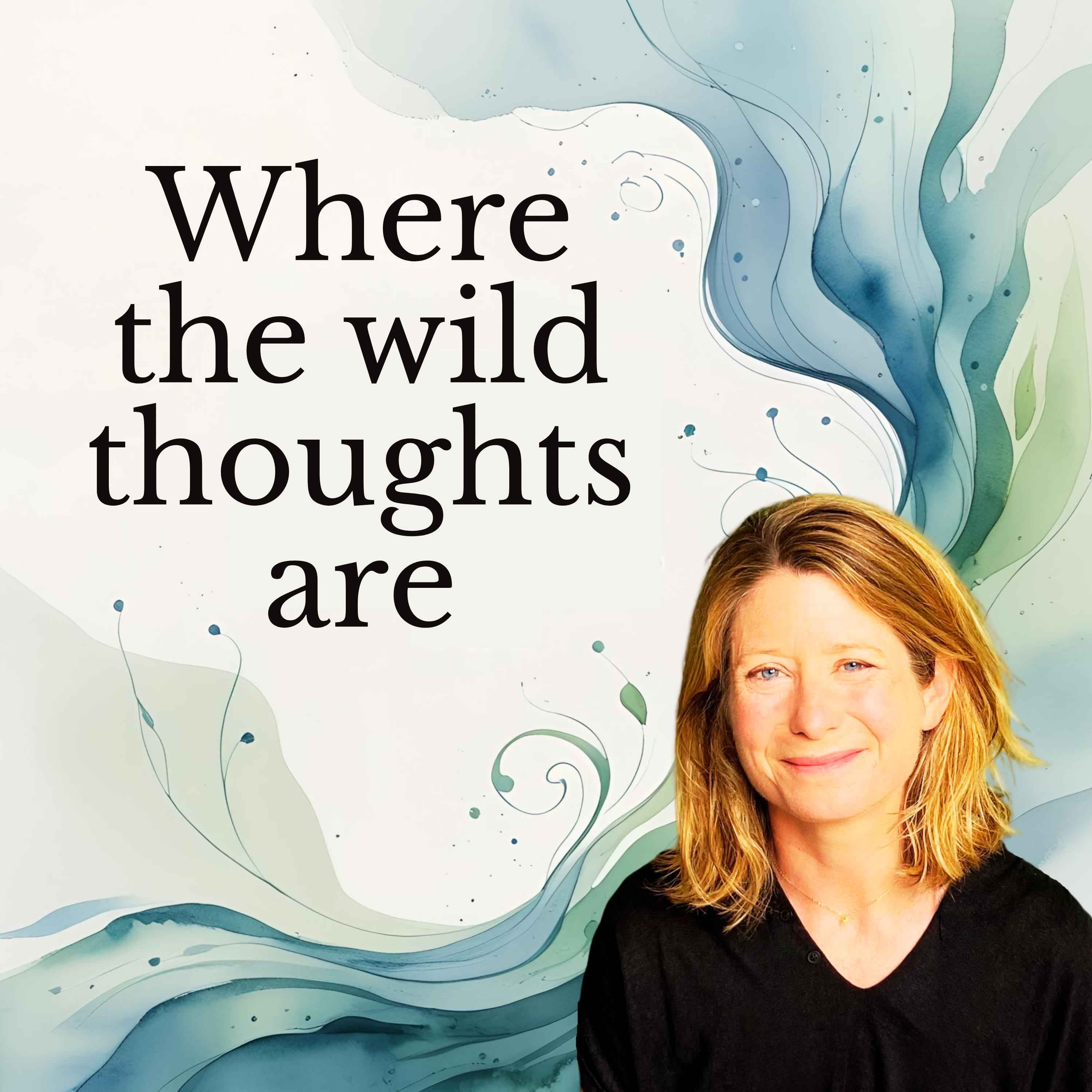

We’re talking about science. But not just any science...
Each episode, journalist Jo Marchant meets researchers who are doing things differently: challenging our assumptions, stretching our minds, and changing how we see the world.
We’ll be pushing boundaries from cosmology and quantum physics to neuroscience, archaeology, ecology… Jo’s guests are asking deep questions, chasing outrageous dreams, and exploring the world in completely new ways.
As well as learning about their pioneering ideas, we’ll hear their personal stories: what inspires their leaps of imagination; how they keep going despite the obstacles; the importance of thinking differently; and why we need creativity to survive. But most of all, Where The Wild Thoughts Are is about the wonder of peeking past supposed limits. Come into the wild with us, for a glimpse of what’s beyond…
Hosted on Acast. See acast.com/privacy for more information.
Recent rankings
Latest chart positions across Apple Podcasts and Spotify rankings.
Apple Podcasts
🇬🇧 Great Britain - nature
15/06/2026#91🇬🇧 Great Britain - nature
14/06/2026#70🇬🇧 Great Britain - nature
13/06/2026#46🇬🇧 Great Britain - nature
07/06/2026#74🇬🇧 Great Britain - nature
05/06/2026#30🇬🇧 Great Britain - nature
04/06/2026#46🇬🇧 Great Britain - nature
02/06/2026#77🇬🇧 Great Britain - nature
01/06/2026#51🇺🇸 USA - nature
27/05/2026#100🇨🇦 Canada - nature
20/05/2026#94
Spotify
No recent rankings available
Shared links between episodes and podcasts
Links found in episode descriptions and other podcasts that share them.
See all- https://www.yada-yada.net/
199 shares
- https://happywhale.com/home
37 shares
- https://www.projectceti.org/
30 shares
RSS feed quality and score
Technical evaluation of the podcast's RSS feed quality and structure.
See allScore global : 89%
Publication history
Monthly episode publishing history over the past years.
Where The Wild Thoughts Are - Coming soon
Season 1
vendredi 1 août 2025 • Duration 03:21
Listen to some clips from Jo Marchant's new science podcast in which she interviews scientists who are asking deep questions, chasing outrageous dreams, and exploring the world in completely new ways.
Hosted on Acast. See acast.com/privacy for more information.
Can plants think?
Season 1 · Episode 1
lundi 1 septembre 2025 • Duration 47:01
In this first episode of Where the Wild Thoughts Are, I chat to Paco Calvo, prof of cognitive science from the University of Murcia in Spain. He’s author of the fascinating Planta sapiens: Unmasking Plant Intelligence, and he researches the neurobiology of plants. From bean plants searching out supports to climb up, to parasitic vines chasing down prey, to slow-growing oak trees, Paco is convinced that not only are plants showing intelligent behaviour, they’re sentient, awake, aware.
Perhaps you’re convinced that of course plants aren’t thinking! But is that based on evidence? Could there be other routes to intelligence than the neurons we happen to find in our own brains?
Paco and I discuss how to tell if an organism is intelligent; some of plants’ most impressive abilities (my favourite is the chameleon vine); as well as the mechanics of botanical decision-making. And, of course, we talk about the ethical implications… What would it even mean to start considering our plant companions as sentient?
Paco’s lab at University of Murcia
https://www.um.es/mintlab/index.php/about/people/paco-calvo/
Paco’s book, Planta sapiens: The New Science of Plant Intelligence (written with Natalie Lawrence)
https://www.um.es/mintlab/index.php/publications/planta-sapiens/
‘Do plants behave?’: 2024 paper
https://osf.io/preprints/psyarxiv/kr69e_v1
‘Plant sentience revisited’: 2023 paper
https://www.wellbeingintlstudiesrepository.org/cgi/viewcontent.cgi?article=1830&context=animsent
‘The potential of plant action potentials’: 2023 paper
https://link.springer.com/article/10.1007/s11229-023-04398-7
‘A case study of learning in plants: Lessons learned from pea plants’: 2023 paper
https://journals.sagepub.com/doi/10.1177/17470218231203078
Video: ‘Reflections of a plant intelligence maverick’: 2025 lecture by Paco Calvo
https://www.youtube.com/watch?v=g-l1vJNm2H0&t=1s
Michael Pollan on how timelapse photography reveals the inner life of plants
https://www.youtube.com/watch?v=MPql1VHbYl4
*** Subscribe for new episodes every Monday
*** Follow us on Instagram @wildthoughts_pod
*** Edited highlights on YouTube
https://www.youtube.com/playlist?list=PLhB4lyBDyjTliuz_h5oHwN6H8HoxS7qWL
Where The Wild Thoughts Are is produced by Julian Mayers at Yada Yada
Hosted on Acast. See acast.com/privacy for more information.
What if there are no laws of physics?
Season 1 · Episode 2
lundi 1 septembre 2025 • Duration 57:32
When physicists investigate the very smallest components of reality – atoms and subatomic particles – they famously find all sorts of things that make no sense. Particles can apparently be in different places at once, and they have different properties depending on how we measure them. Spooky effects seem to act instantaneously, across vast distances. The decisions we make can even alter journeys that particles have already made.
Researchers have come up with different interpretations for what these weird results might mean. Maybe mysterious waves we can’t measure are guiding the course of the entire universe. Or maybe there are countless parallel universes, hosting different versions of ourselves...
What if none of these ideas is wild enough? My guest in this episode, quantum physicist Chris Fuchs from the University of Massachusetts, thinks physicists are still being boxed in by their assumptions about reality. Chris has pioneered a new interpretation of quantum mechanics, called QBism, which says that the probabilities and predictions of quantum physics were never describing physical entities out there in the world. Instead, he says, they are telling us about… us.
QBism is seen by many physicists as extreme, but it’s also wild, lawless, freeing and I love it! Our tour of the QBist universe took us from starships and black holes to party games, gambling and free will. Enjoy.
‘Introducing QBism’: 2014 paper by Chris Fuchs
‘QBism: Where next?’ 2023 research paper on the future of QBism
https://arxiv.org/abs/2303.01446
Nautilus feature article on Chris Fuchs and QBism
https://nautil.us/my-quantum-leap-238433/
Excerpt on QBism from Through the Wormhole with Morgan Freeman
https://www.youtube.com/watch?v=LQvCTZgNRNw
Documentary on QBism produced by the Essentia Foundation
*** Subscribe for new episodes every Monday
*** Follow us on Instagram @wildthoughts_pod
*** Edited highlights on YouTube
https://www.youtube.com/playlist?list=PLhB4lyBDyjTliuz_h5oHwN6H8HoxS7qWL
Where The Wild Thoughts Are is produced by Julian Mayers at Yada Yada https://www.yada-yada.net/.
Hosted on Acast. See acast.com/privacy for more information.
Is there life on Venus?
Season 1 · Episode 3
lundi 1 septembre 2025 • Duration 41:12
In the search for alien life, we don’t always hear much about Venus. There’s a lot of effort going into detecting possible signs of life on Mars, and looking for potentially habitable planets beyond our solar system. Venus seems a crazy place to look for aliens: its surface is burning hot, hot enough to melt lead; and it has clouds made of concentrated acid. But could a very different kind of life from ours be living in those cloud droplets?
My guest is astronomer Jane Greaves, from the University of Cardiff. A few years ago, she used a telescope in Hawaii to scan Venus’s clouds for a molecule called phosphine. On earth, phosphine is rare, its only natural source is microbes in certain oxygen-starved environments. We don’t currently know of any way it could be made on Venus, apart from life, but Jane figured why not just have a look anyway. And she found it…
Some findings immediately touch a nerve. Researchers immediately criticised her work, attacking the team scientifically and personally. But Jane and her colleagues have been working to gather more data and they’re building an ever-stronger picture that phosphine really is there in the clouds. That would mean either some really fascinating chemistry we’ve never thought of before – or potential life. And this just adds to a list of mysterious features on Venus, from strange particles in the clouds; to gases in amounts very different from what we’d expect; to something unexplained that is absorbing huge amounts of energy from the solar radiation hitting the planet...
Jane and I chat about her latest results, and what she thinks about the chances of life elsewhere, as well as the importance of going against the grain sometimes, to explore questions others might think are too crazy to ask.
Jane Greaves at Cardiff University
https://profiles.cardiff.ac.uk/staff/greavesj1
Jane and team’s 2020 paper reporting phosphine in Venus’s clouds
https://www.nature.com/articles/s41550-020-1174-4
The team’s response to criticisms of the 2020 paper
https://www.nature.com/articles/s41550-021-01424-x
Guardian story on 2024 evidence for Venus phosphine & maybe ammonia
https://www.liebertpub.com/doi/full/10.1089/ast.2023.0082
2024 review of unexplained features on Venus
https://www.liebertpub.com/doi/abs/10.1089/ast.2022.0060
2024 paper showing amino acids are stable in sulfuric acid
https://www.liebertpub.com/doi/full/10.1089/ast.2023.0082
*** Subscribe for new episodes every Monday
*** Follow us on Instagram @wildthoughts_pod
*** Edited highlights on YouTube
https://www.youtube.com/playlist?list=PLhB4lyBDyjTliuz_h5oHwN6H8HoxS7qWL
Where The Wild Thoughts Are is produced by Julian Mayers at Yada Yada
Hosted on Acast. See acast.com/privacy for more information.
How do you read a library turned to ash?
Season 1 · Episode 5
lundi 15 septembre 2025 • Duration 54:11
We're delving into one of the ancient world's biggest mysteries: the Herculaneum scrolls. Computer scientist Brent Seales of the University of Kentucky talks about a journey that has taken him from Mars to Beowulf to the Dead Sea and beyond. AI has been key to finally reading what's inside the scrolls -- but this is a story about human ingenuity, and what it takes to make an impossible dream come true.
The Herculaneum scrolls are hundreds of Greek and Latin papyri, buried by the Vesuvius eruption in 79 AD and dug up in the 1700s. The scrolls were crushed and carbonised; when anyone tried to read them, they crumbled. Scholars had to accept the rest would never be opened.
This is the only intact library we have from the classical world – complete texts, direct from the pens of ancient scribes. Yet we can’t read them.
Until now. These unopenable scrolls are now being read, through the Vesuvius Challenge, which offers prizes for teams using AI to find the ink in X-ray scans. I’ve written several articles on this, and the pace of discovery has been jawdropping: scholars could soon read the whole library.
But solving this problem hasn't just been about switching on AI. For me, the truly fascinating story is the 20 years of imagination, invention and persuasion that led to this point, all essentially due to one man who persevered even when everyone else thought the idea was crazy.
Brent Seales
https://educelab.engr.uky.edu/w-brent-seales
Vesuvius Challenge
Schmidt Sciences
https://www.schmidtsciences.org/focus-area-ai/
My articles:
Scaling up the Vesuvius Challenge: Apr 2025
https://www.nature.com/articles/d41586-025-01087-y
AI could rewrite history: Jan 2025
https://www.nature.com/articles/d41586-024-04161-z
First passages revealed: Feb 2024
https://www.nature.com/articles/d41586-024-00346-8
Brent Seales' quest: Jul 2018
Journal papers:
Reading En-Gedi scroll
https://www.science.org/doi/full/10.1126/sciadv.1601247
Recovering Herculaneum ink
https://journals.plos.org/plosone/article/?id=10.1371/journal.pone.0215775
*** To support us, please rate & review the show!
*** Subscribe for new episodes every Mon
*** Follow us on Instagram @wildthoughts_pod
*** Edited highlights on YouTube
https://www.youtube.com/playlist?list=PLhB4lyBDyjTliuz_h5oHwN6H8HoxS7qWL
WTWTA is produced by Julian Mayers at Yada Yada
Hosted on Acast. See acast.com/privacy for more information.
Can epilepsy reveal the secrets of perception?
Season 1 · Episode 4
lundi 8 septembre 2025 • Duration 34:31
We’re exploring the secrets of bliss – with neurologist and epilepsy specialist Fabienne Picard of the Medical School of Geneva.
Fabienne became fascinated by a rare condition called “ecstatic seizure” after reading the work of 19th century Russian novelist Fyodor Dostoevsky. He used his own experiences with epilepsy as inspiration, in particular a profound and intriguing feeling that would strike him just before the seizure itself. He wrote about how, for a few moments, all of his doubts and anxieties disappeared, and the world felt perfectly vivid and clear.
“I feel entirely in harmony with myself and the whole world,” he wrote, “and this feeling is so strong and so delightful that for a few seconds of such bliss one would gladly give up ten years of one’s life, if not one’s whole life.”
Fabienne asked her patients whether any of them had similar experiences, and found that some did, they’d just never had the opportunity to talk about it in conventional consultations. She has identified dozens of new cases, which has enabled her to pin down which part of the brain is involved, and even trigger this feeling in people who don’t have this kind of epilepsy.
I spoke to Fabienne about her patients, what she thinks is happening in their brains, and whether we might all one day be able to benefit from such episodes of bliss -- without the devastating seizures that follow.
LINKS
Fabienne’s home page at University Hospitals of Geneva
https://www.hug.ch/en/neurology/dr-fabienne-picard
Ecstatic or mystical experience through epilepsy: 2023 paper by Fabienne & colleagues
Insular stimulation produces mental clarity and bliss: 2022 paper by Fabienne & colleagues
https://onlinelibrary.wiley.com/doi/full/10.1002/ana.26282
Epilepsy and ecstatic experiences: 2021 paper by Fabienne & colleagues
https://www.mdpi.com/2076-3425/11/11/1384
Fabienne’s talk to the Buddhist monks at Plum Village
https://www.youtube.com/watch?v=M16k8Djz29A&t=1957s
Epilepsy in the artistic creation of Dostoevsky: 2014 review
https://www.sciencedirect.com/science/article/pii/S2173580814000686
Dostoevsky’s epilepsy: 1990 case report
https://pubmed.ncbi.nlm.nih.gov/2161565/
*** Subscribe for new episodes every Monday.
*** Follow us on Instagram @wildthoughts_pod
*** Find edited highlights on YouTube
https://www.youtube.com/playlist?list=PLhB4lyBDyjTliuz_h5oHwN6H8HoxS7qWL
Where The Wild Thoughts Are is produced by Julian Mayers at Yada Yada
Hosted on Acast. See acast.com/privacy for more information.
Can we sense magnetic fields?
Season 1 · Episode 6
lundi 22 septembre 2025 • Duration 41:33
We're digging into how living creatures – including us – sense and respond to magnetic fields with quantum biologist Margaret Ahmad of the University of Sorbonne in Paris.
For decades, biologists knew about striking examples of species apparently navigating by Earth’s magnetic field, from monarch butterflies to loggerhead turtles to racing pigeons. Yet for years, many physicists said any ‘magnetosense’ was impossible, insisting the Earth’s field is far too weak to affect any biological processes within living cells. And yet, life really had found a way, and Margaret was one of the key researchers who showed how.
Back in the 1990s, she discovered a blue light receptor in plants, part of a mysterious family of proteins called cryptochromes, and she has since has pioneered research showing how these receptors don’t just sense light but magnetic fields, too. Through quantum physical effects, these proteins magnify impossibly weak magnetic signals into measurable biological responses in a cell.
For Margaret, this connection with the magnetic fields around us is a fundamental characteristic of all life, that should transform our thinking about everything from bird migration, to plant growth, to health effects in humans – and might even lead to revolutionary medical treatments. I spoke to her about her research, what it’s like doing science ‘out on a limb’, as she puts it, and what to do when the evidence leads you off the beaten track…
Margaret Ahmad at Sorbonne University
https://www.ibps.sorbonne-universite.fr/en/ibps/directory/17216-Margaret-Ahmad
Hypersensitivity to man-made electromagnetic fields: 2024 case report
https://pubmed.ncbi.nlm.nih.gov/39108419/
2024 review on cryptochromes
https://pubmed.ncbi.nlm.nih.gov/38495372/
New Scientist story I wrote about Ahmad’s work in 2020 (£)
https://www.newscientist.com/article/2251835
2021 review on the bird magnetic compass
https://www.frontiersin.org/journals/physiology/articles/10.3389/fphys.2021.667000/full
Roswitha Wiltschko’s lab
https://www.goethe-university-frankfurt.de/47093824/Physiology_and_Ecology_of_Behaviour
Some bacteria sense magnetic fields via magnetite crystals. It's possible these play a role in other species too, maybe even humans
https://www.eneuro.org/content/6/2/ENEURO.0483-18.2019.abstract
*** To support us, please rate & review the show!
*** Subscribe for new episodes every Mon
*** Follow us on Instagram @wildthoughts_pod
*** Edited highlights on YouTube
https://www.youtube.com/playlist?list=PLhB4lyBDyjTliuz_h5oHwN6H8HoxS7qWL
Where The Wild Thoughts Are is produced by Julian Mayers at Yada Yada
Hosted on Acast. See acast.com/privacy for more information.
Can we talk to whales?
Season 1 · Episode 7
lundi 29 septembre 2025 • Duration 53:26
We're diving into the world of whales - as well as dolphins and other cetaceans - with biologist and filmmaker Tom Mustill, author of the fascinating book How to Speak Whale. I first learned about Tom’s work in 2023 when I attended a talk he gave at the British Library, and he began with the story of how on a kayaking trip he was almost crushed by a breaching humpback whale.
After that experience, and the discovery that the whale may actually have saved his life by twisting in the air to avoid him, Tom became fascinated by the inner lives of these creatures, and by the exploding potential of technology, including AI, to monitor and understand what they’re getting up to beneath the waves. And there was one question he wanted to answer most of all about their complex communications: could we ever learn to understand them, even talk to them?
That might seem a crazy question, but the availability of massive amounts of data, combined with AI algorithms, is now opening a door to decoding the patterns and structures in the vocalisations of all kinds of species, like a kind of Google Translate but for animals.
I caught up with Tom to talk about the latest results, as well as what it’s like to be caught underneath a falling humpback - and why we should stop comparing animals’ abilities to ours, and instead open our minds to other kinds of experiences, to the alien horizons of their lives and worlds.
Tom’s home page
Tom’s book, How To Speak Whale: A voyage into the future of animal communication
https://www.tommustill.com/how-to-speak-whale
Footage of the humpback whale landing on Tom and Charlotte
https://www.youtube.com/watch?v=ee79_7CZ0uM
How to be a whale: a half-hour listening journey
https://www.tommustill.com/howtobeawhale
Project CETI
Earth Species Project
Happy Whale
Tom’s humpback
https://happywhale.com/individual/1437
*** To support us, please rate & review the show!
*** Subscribe for new episodes every Mon
*** Follow us on Instagram: @wildthoughts_pod
*** Edited highlights on YouTube
https://www.youtube.com/playlist?list=PLhB4lyBDyjTliuz_h5oHwN6H8HoxS7qWL
Where The Wild Thoughts Are is produced by Julian Mayers at Yada Yada:
https://www.yada-yada.net/
Hosted on Acast. See acast.com/privacy for more information.
Why do placebos work?
Season 1 · Episode 8
lundi 6 octobre 2025 • Duration 46:01
Placebo effects are not about expectation, or positive thinking, and you don’t have to believe you’re taking a real drug to feel better. In fact, they are not in your mind at all, but your body.
This is what self-confessed ‘deviant’ Ted Kaptchuk wants you to know, after conducting decades of research that has shocked the medical establishment and turned upside down conventional thinking about placebos.
I’ve been a fan of Ted’s work ever since we first met in 2014, when I was researching my book Cure: A journey into the science of mind over body. He originally trained in Chinese medicine (one of the first westerners to do so in China), and he is now a professor of medicine at Harvard, where he directs Harvard’s Program in Placebo Studies and the Therapeutic Encounter.
Ted has been doing some wild things there: listening to patients; thinking carefully about what’s really making us better when we receive a treatment; and exploring what happens if you give people medicine without the drugs.
His trials break all the normal rules, but they show us how we might approach medicine differently, particularly for the very conditions that our drugs are usually worst at treating – from depression, fatigue, and anxiety to many skin conditions, gut problems and especially chronic pain. His results also dovetail perfectly with the latest results from neuroscience about how we perceive not just bodily symptoms, but our entire reality.
I asked Ted about his rebellious background, the inspirations for some of his craziest experiments, and how to unlock our inner pharmacy.
Ted Kaptchuk’s home page at Harvard:
https://ghsm.hms.harvard.edu/faculty-staff/ted-jack-kaptchuk
Ted’s website:
Lecture series I presented for The Great Courses on mind-body links in medicine (the first two are all about placebos, including Ted’s work):
https://www.thegreatcoursesplus.com/the-power-of-mind-over-body
Honest fakery: How placebos can treat chronic pain:
https://www.nature.com/articles/535S14a
Ted’s first 2010 trial on honest placebos:
https://journals.plos.org/plosone/article?id=10.1371/journal.pone.0015591&
Academic review on placebos for chronic pain (2020):
https://www.bmj.com/content/370/bmj.m1668.abstract
'The dress':
https://en.wikipedia.org/wiki/The_dress
*** To support us, please rate & review the show!
*** Subscribe for new episodes every Mon
*** Follow us on Instagram: @wildthoughts_pod
*** Edited highlights on YouTube
https://www.youtube.com/watch?v=Sor2-Jhuwvc&list=PLhB4lyBDyjTliuz_h5oHwN6H8HoxS7qWL
Where The Wild Thoughts Are is produced by Julian Mayers at Yada Yada:
Hosted on Acast. See acast.com/privacy for more information.
Can life transcend physics?
Season 1 · Episode 9
lundi 13 octobre 2025 • Duration 51:14
We’re talking about life, the universe and everything – literally!
My guest is cosmologist Marina Cortês of the University of Lisbon. Marina trained as a dancer before helping to shake up cosmology with some revolutionary ideas about the nature of time. As if that wasn’t enough – she’s now using the tools of theoretical physics to investigate the significance of life in the universe, in a new field that she and her colleagues call biocosmology.
Marina’s work goes against many of the normal assumptions of physics. Put simply, you could see the conventional approach as attempting to describe everything in the universe through a set of fundamental laws and equations. And if something that we experience in the universe – like the forwards flow of time, say, or our ability to make our own choices – doesn’t fit into those equations, the mainstream view would be to say, well, that thing is an illusion. No matter how important it might seem to us, it doesn’t really exist.
Marina is doing a different kind of cosmology, that puts life, and our experience of it, first. She’s asking, how can we use the mathematical tools of cosmology and theoretical physics to describe the universe we are actually living in?
I think that’s such an exciting question, and it’s leading to some fascinating findings that could transform how we see life: from a process that simply shuffles atoms into different arrangements towards a force that continually rewrites the playing field, bursting beyond the fundamental equations and laws of physics to create completely new possibilities at every stage.
I caught up with Marina for a tour of the “biocosmos”.
Marina’s home page
Introduction to biocosmology
https://marinacortes.org/cosmology-cortes-time-biocosmology-astrophysics-marina/#biocosmology
Marina launching biocosmology from Everest base camp
https://www.youtube.com/watch?v=e2HiNlqu0Lc
Short talk by Marina on biocosmology
https://www.youtube.com/watch?v=9TH4UsyE3fo&t=3s
2023 paper on biocosmology by Marina, Stuart Kauffman, Andrew Liddle & Lee Smolin
https://arxiv.org/abs/2204.09378
The universe as a process of unique events: 2014 paper by Marina Cortês & Lee Smolin
https://journals.aps.org/prd/abstract/10.1103/PhysRevD.90.084007
2021 paper on time and consciousness by Marina Cortês & Lee Smolin
https://www.ingentaconnect.com/content/imp/jcs/2021/00000028/f0020009/art00004
*** To support us, please rate & review the show!
*** Subscribe for new episodes every Mon
*** Follow us on Instagram @wildthoughts_pod
*** Edited highlights on YouTube
https://www.youtube.com/playlist?list=PLhB4lyBDyjTliuz_h5oHwN6H8HoxS7qWL
Where The Wild Thoughts Are is produced by Julian Mayers at Yada Yada
Hosted on Acast. See acast.com/privacy for more information.
Related Shows Based on Content Similarities