Circuit Breaker: Rewiring Your Decisions – Details, episodes & analysis
Podcast details
Technical and general information from the podcast's RSS feed.
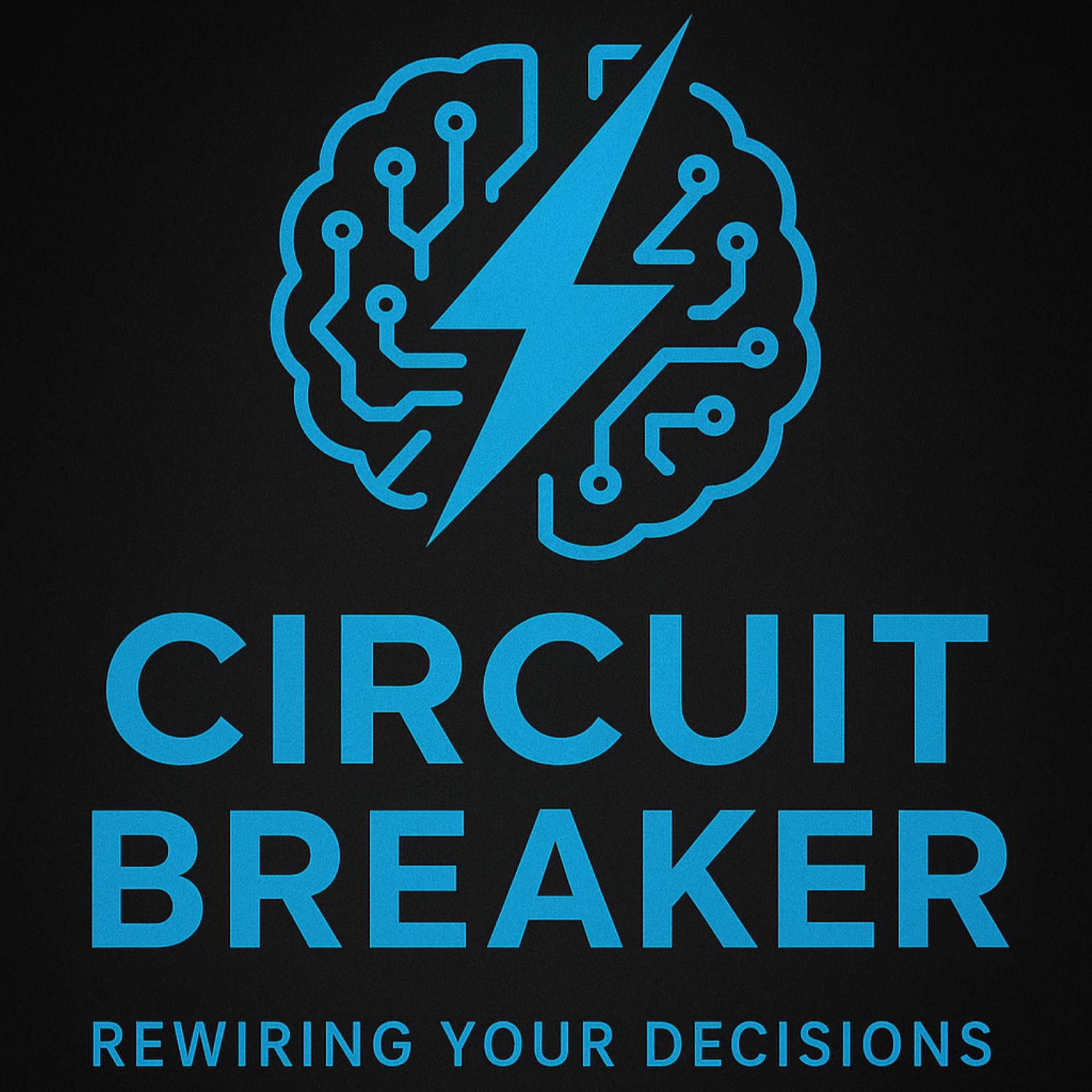

Welcome to Circuit Breaker: Rewiring Your Decisions — the podcast that helps you stop the old mental loops and start building a better life. Each episode decodes the psychology behind the choices you make, uncovering the hidden biases and invisible forces shaping your behaviour. We explore why your brain does what it does — and how to take back control. Circuit Breaker gives you the tools to think clearer, decide smarter, and break the circuit for good.
Recent rankings
Latest chart positions across Apple Podcasts and Spotify rankings.
Apple Podcasts
🇬🇧 Great Britain - socialSciences
30/04/2026#92🇬🇧 Great Britain - socialSciences
28/04/2026#63🇬🇧 Great Britain - socialSciences
27/04/2026#47🇬🇧 Great Britain - socialSciences
26/02/2026#93🇬🇧 Great Britain - socialSciences
25/02/2026#55🇬🇧 Great Britain - socialSciences
11/02/2026#91🇬🇧 Great Britain - socialSciences
10/02/2026#66🇬🇧 Great Britain - socialSciences
09/02/2026#51🇬🇧 Great Britain - socialSciences
15/12/2025#88🇬🇧 Great Britain - socialSciences
14/12/2025#67
Spotify
No recent rankings available
Shared links between episodes and podcasts
Links found in episode descriptions and other podcasts that share them.
See allRSS feed quality and score
Technical evaluation of the podcast's RSS feed quality and structure.
See allScore global : 48%
Publication history
Monthly episode publishing history over the past years.
The Bystander Effect
samedi 15 novembre 2025 • Duration 06:00
Why do people fail to step in during an emergency — even when they know someone needs help? In this episode of Circuit Breaker: Rewiring Your Decisions, we explore the psychology behind the bystander effect — the strange social phenomenon where the presence of others makes us less likely to take action. From classic studies by Darley and Latané to real-world moments where hesitation can have serious consequences, we uncover how responsibility gets diluted, how uncertainty freezes us, and how we take cues from those around us without even noticing.
Discover how to recognise the moments when you’re silently waiting for someone else to act — and how to break the paralysis so you can step forward when it matters most.
Studies and links:
Bystander Intervention in Emergencies: Diffusion of Responsibility | Journal of Personality and Social Psychology 1968, Vol. 8, No. 4, 377-383 Bystander intervention in emergencies: Diffusion of responsibility.
Bystander Effect In Psychology | Simply Psychology Bystander Effect In Psychology
Conforming to a Group
samedi 8 novembre 2025 • Duration 05:28
Why do we go along with the crowd, even when we know they might be wrong? In this episode of Circuit Breaker: Rewiring Your Decisions, we dive into the psychology of group conformity — the powerful social pull that makes us blend in, stay quiet, and follow others, often without realizing it. From classic experiments like Asch’s line test to everyday situations where peer pressure subtly shapes our choices, we uncover how group influence can override logic, independence, and even morality.
Discover how to spot when you’re conforming just to fit in — and how to break free from the herd when it matters most.
Studies and links:
Effects of Group Pressure Upon the Modification and Distortion of Judgments | gwern.net 1952-asch.pdf
Asch Conformity Line Experiment | Simply Psychology Asch Conformity Line Experiment
Obedience to Authority
samedi 1 novembre 2025 • Duration 06:23
Why do ordinary people follow orders that go against their morals? In this episode of Circuit Breaker: Rewiring Your Decisions, we look at the psychology behind obedience to authority. Through the lens of Stanley Milgram’s shocking experiment, we explore how power, pressure, and perceived responsibility can override personal judgment.
Learn what this reveals about human nature—and how understanding it can help you make decisions that are truly your own.
Studies and links:
Behavioral Study of Obedience | The Journal of Abnormal and Social Psychology Vol. 67, No. 4, 1963 milgram.pdf
Stanley Milgram Shock Experiment | Simply Psychology Milgram Shock Experiment | Summary | Results | Ethics
Addiction
samedi 6 décembre 2025 • Duration 05:24
Why do some people spiral into addiction while others — even with the same access — stay completely fine? In this episode of Circuit Breaker: Rewiring Your Decisions, we dive into Bruce Alexander’s groundbreaking work on addiction, namely, the famous Rat Park experiment. His research shows that addiction isn’t just about drugs — it’s about environment, connection, and purpose. Rats in isolated, barren cages became addicted, while those in enriched, social environments avoided drugs almost entirely.
Discover how social disconnection, loneliness, and lack of meaningful engagement can drive addictive behaviour — and how creating supportive, connected environments can help prevent or even reverse it. This episode will change how you think about addiction, shifting the focus from individual weakness to the power of context and human connection.
Studies and links:
What Does “Rat Park” Teach Us About Addiction? | Psychiatric Times What Does “Rat Park” Teach Us About Addiction? | Psychiatric Times
What can the Rat Park experiment teach us about addiction? | UK Addiction Treatment Centres What can the Rat Park experiment teach us about addiction? - UK Addiction Treatment Centres
Priming
samedi 29 novembre 2025 • Duration 05:43
Why do subtle cues in our environment quietly shape our thoughts, feelings, and decisions—often without us noticing? In this episode of Circuit Breaker: Rewiring Your Decisions, we dive into priming — the psychological phenomenon where exposure to certain words, images, or ideas can influence how we interpret the world and how we behave next. From tiny triggers that nudge our mood to hidden cues that shift our judgement or performance, we uncover how effortlessly our minds can be steered in a particular direction.
Discover what priming reveals about the automatic mind, how everyday environments quietly “set the tone” for your choices, and how becoming aware of these subtle influences can help you take back control of your decisions before they’re made for you.
Studies and links:
Automaticity of Social Behavior: Direct Effects of Trait Construct and Stereotype Activation on Action | Journal of Personality and Social Psychology 1996. Vol. 71, No. 2. 230-244 Bargh_et_al_1996_Automaticity_of_social_behavior.pdf
Priming a New Identity: Self-Monitoring Moderates the Effects of Nonself Primes on Self-Judgments and Behavior | Journal of Personality and Social Psychology, 2005, Vol. 89, No. 5, 657– 671 2005-jpsp-demarree-wheeler-petty.pdf
Washing Away Your Sins: Threatened Morality and Physical Cleansing | Science 313, 1451 (2006); - Zhong & Liljenquist 2006.pdf
The Stanford Prison Experiment
samedi 22 novembre 2025 • Duration 06:30
Why do ordinary people slip into cruel or submissive roles the moment power is handed out? In this episode of Circuit Breaker: Rewiring Your Decisions, we examine the Stanford Prison Experiment — the infamous study that revealed just how quickly authority, environment, and assigned roles can transform behaviour. From guards who escalated into aggression to prisoners who internalised obedience and distress, we explore how the situation—not personality—can push people into extremes they never imagined.
Discover what this experiment teaches us about the power of context, how easily we can lose ourselves in the roles we’re given, and how to stay grounded when a situation starts shaping you more than you realise.
Studies and links:
The Menace Within | Stanford Magazine The Menace Within | STANFORD magazine
Stanford Prison Experiment | Simply Psychology Stanford Prison Experiment
The Availability Error
samedi 13 décembre 2025 • Duration 04:55
Why do rare events feel far more common than they really are? In this episode of Circuit Breaker: Rewiring Your Decisions, we explore the availability error — the mental shortcut that makes us judge probability based on how easily examples come to mind. From dramatic news stories to personal memories that stick with us, we uncover how vivid or recent information can distort our perception of risk, influence our decisions, and quietly shape our fears and beliefs.
Discover how to spot when your judgement is being guided by what’s most memorable — not what’s most accurate — and how to recalibrate your thinking when it matters most.
Studies and links:
Availability Heuristic and Decision Making | Simply Psychology Availability Heuristic In Psychology: Definition & Examples
Availability: A Heuristic for judging Frequency and Probability | Amos Tversky and Daniel Kahneman Tversky availability.pdf
The Zeigarnik Effect
samedi 7 février 2026 • Duration 06:18
Why do unfinished tasks stick in our minds long after we've stopped working on them? In this episode of Circuit Breaker: Rewiring Your Decisions, we explore the Zeigarnik Effect - the psychological phenomenon where incomplete tasks are remembered more clearly than completed ones.
Discover why open loops create mental tension, how unfinished work captures your attention, and how to use this effect to stay motivated.
Studies and Links:
The Art of Sustainable Performance: The Zeigarnik Effect | Research Gate (PDF) The Art of Sustainable Performance: The Zeigarnik Effect
Zeigarnik Effect Examples in Psychology | Simply Psychology Zeigarnik Effect Examples in Psychology
Loss Aversion
samedi 31 janvier 2026 • Duration 06:50
Why does losing something hurt more than gaining the same thing feels good? In this episode of Circuit Breaker: Rewiring Your Decisions, we explore loss aversion - the psychological bias that makes losses feel more powerful, painful and important than equivalent gains.
Discover how fear of loss shapes decision-making and behaviour; why we cling onto what we already have; and how to overcome this bias to get rid of old ideals and create space for improvement.
Studies and Links:
Why do we buy insurance? | The Decision Lab Loss Aversion - The Decision Lab
Why do we value items more if they belong to us? | The Decision Lab Endowment Effect - The Decision Lab
Why are we likely to continue with an investment even if it would be rational to give it up? | The Decision Lab The Sunk Cost Fallacy - The Decision Lab
Loss aversion in riskless choice: a reference-dependent model | Amos Tversky and Daniel Kahneman | Oxford University Press | UFL Loss Aversion in Riskless Choice: A Reference-Dependent Model
Temporal Discounting
samedi 24 janvier 2026 • Duration 05:16
Why do we choose short-term rewards even when we know waiting would be better? In this episode of Circuit Breaker: Rewiring Your Decisions, we explore temporal discounting - the tendency to value immediate rewards more highly than future ones, even when the future payoff is larger or wiser.
Discover how time distorts our judgement, and how understanding this bias can help you make decisions that you future self will actually thank you for.
Studies and links:
Time Discounting and Time Preference: A Critical Review | Shane Frederick, George Loewenstein and Ted O'Donoghue | Journal of Economic Literature Vol. XL | Carnegie Mellon University TimeDiscounting.pdf
Related Shows Based on Content Similarities