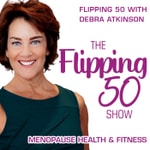
The podcast for women in menopause and beyond who want to change the way they age. Fitness, wellness, and health research put into practical tips you can use today. You still got it, girl!
Site
RSS
Apple
Données mises à jour le 04/07/2026
Classements récents
Dernières positions dans les classements Apple Podcasts et Spotify.
Liens partagés entre épisodes et podcasts
Liens présents dans les descriptions d'épisodes et autres podcasts les utilisant également.
The Book Busting Menopause Myths That Women (and Their Doctors) Believe
mardi 10 septembre 2024 • Durée 49:10
Busting Menopause Myths
Estrogen causes breast cancer, gaining weight and belly fat which are inevitable… Today we are busting menopause myths just like this.
In this episode, I interview a pair of authors offering refreshing insight to midlife and beyond women who are often sheltered from all the health options available to them and misinformed, or incompletely informed.
Stay tuned to the end, if fat burning is something you want to know more about … and I know.. Trick question right? Kristin and Maria present the concept of fat burning and becoming fat adapted in a way that makes it easy to understand why what you’ve been trying to do may not be working for you .. at all.
So join us in this episode for the menopause myth busting intel in this book and what’s inside which goes far beyond the valuable practical tips you’ll get from it, and why it’s about time you had this book.
Busting Menopause Myths from HRT to Supplements
My Guests:
Kristin Johnson, JD, BCHN FNTP is Board Certified in Holistic Nutrition through the National Association of Nutrition Professionals, is a Functional Nutritional Therapy Practitioner through the Nutritional Therapy Association, and is a “recovering corporate attorney.”
Maria Claps, FDN-P is a certified health coach through the Institute for Integrative Nutrition and is a Functional Diagnostic Nutrition Practitioner.
Together, Kristin and Maria have developed a deep specialty in perimenopause and menopause health through clinical mentorships with multiple medical doctors and naturopaths specializing in hormone replacement therapy.
They completed advanced training in functional testing modalities which they use in their clinical practice educating and helping midlife women. They created a professional training program for other midlife women’s health practitioners.
Questions We Answer in This Episode:
What prompted you to write the book? [00:03:51]
Let’s talk about the Priority … [00:04:26]
What did you mean by Menopause Gold Rush? [00:09:45]
You write about informed consent, what does that mean? [00:23:13]
What is oxidative priority in regards to burning fat in menopause? [00:35:15]
Was this episode on busting menopause myths helpful to you? If so, would you please share it with a friend or three?
Fit or Fat? Training and Measuring Fitness in Menopause
vendredi 6 septembre 2024 • Durée 36:13
Measuring fitness in menopause is complicated. I’m going to take a stab at this and let you know that if you’re not measuring beyond your weight, body composition, inches, and muscle mass at regularly scheduled intervals, you’re doing a disservice.
We get all up in the business of burning calories (wrong goal), having it “feel hard” (sometimes the wrong goal), and forget to measure strength (did you see Olympians test grip strength??? Impressive!) and how well your training is actually helping your HEART.
Let’s go there.
Yes, you want to gain lean muscle. It immediately improves your body composition and takes stress from your heart and joints. It also boosts your metabolism, energy, and blood sugar balance, decreasing insulin resistance and your metabolic health improves.
But your heart fitness IS important.
Mistakes in Measuring Fitness in Menopause and Beyond.
You don’t want or need to know your pace or that you did a mile while you’re doing it. Why? It gives you a false impression of “good” “bad” and means zero. When you’re going uphill, you’re going to go slower. When you’re doing an interval workout you also won’t go as fast as when you’re simply walking a steady state (because to do an interval right you should be recovering completely and that means going slower than your steady pace).
Only if you personally are doing the exact same trail or route you’ve done and you’re trying to go as fast as you can, would that be important.
Not knowing what your heart rate being higher or lower than normal exertion heart rates mean you may interpret it incorrectly as “good” or “bad.”
Measuring Fitness in Menopause During Heart Rate Zone Training
Unless you’ve been tested … on the treadmill or bike by an experienced trainer who can monitor your stages and interpret results… the zones shown are based on “average.”
For adults over 40, age-related predictions underestimate where you should be. You’re then going to get a red flag when potentially you shouldn’t.
Running Long in Midlife and Beyond One 50-mile Run for a 50th Birthday
mardi 3 septembre 2024 • Durée 47:44
50 miles for 50th bday?
Running long in midlife isn’t the first thing (or second) I recommend to women. But what happens when your peak estrogen levels were at least a decade ago? What if you’ve got a crazy goal, want to go for it, and you know how to interpret reactions and respond accordingly?
Come on this unique trail as I interview a friend and colleague around her idea of a fun birthday party that not all of us will appreciate the same way.
My Guest:
Margaret Floyd Barry is a functional nutritionist, author, speaker, educator and advocate of optimal health through nutrition of adult life. Seeing family members suffer the effects of chronic illness from a young age, Margaret helps others find a better way back to optimal health and wellbeing.
Margaret worked on complex cases of autoimmune, including her own. She established a powerful system for restoring health by addressing the root cause of illness. Margaret teaches fellow practitioners the proven system with life-changing results through Restorative Wellness Solutions, which has trained and certified over 1200 qualified health practitioners worldwide. She is the author of Eat Naked: Unprocessed, Unpolluted and Undressed Eating for a Healthier, Sexier You and The Naked Foods Cookbook.
Questions We Answer in This Episode:
What inspires a woman to run 50 miles for her 50th birthday? [00:05:30]
How long have you been running? [00:09:00]
Where are you in the menopause timeline? How much has that changed your training and recovery? [00:21:20]
How do you train for a 50 mile run differently than your previous marathons? What was the result? [00:21:20]
What were the key dietary strategies you used? What are the results? Were they different in the past? [00:26:50]
How did you manage autoimmune disease and training at this level, without triggering an all out autoimmune flare? [00:32:20]
How did recovery play into things? [00:26:10]
Would you do it again? Does longer appeal to you? [00:40:20]
Did training take a toll on energy for work or relationships? [00:24:40]
5 Non-Exercise Ways to Boost Fat Burn
vendredi 30 août 2024 • Durée 35:11
This simple list of non-exercise ways to boost fat burn has turned my YouTube channel subscribers upside down! Meaning they’ve flipped over them! It’s crazy! Secretly my hope is that YOU are using these as extra insurance, and not your only line of defense.
Increase Water Intake to Boost Hydration
Increase Protein Intake
Thermogenic effect of food - almost 30 percent of it goes to digest and breakdown
Muscle protein synthesis even - 30% of it toward digestion
Even without resistance training there is a muscle protein synthesis
Sleep More Consistently
Release of testosterone and growth hormone
Same wake time is the fastest way to reset your circadian rhythm
Limit or Eliminate Alcohol
Metabolizing alcohol all other metabolism stops (food gets stored as fat)
It’s metabolized as sugar, increasing blood sugar then insulin
The after effect is as bad: negatively impacts sleep, causes blood sugar issues the next day
Negatively impacts hydration levels
Decision-making skills are gone so making good choices is hard!
Move More Exercise Less
The variability between N.E.A.T. is up to 2000 calories a day between those who are active and sedentary. While you might burn 300 calories or even 600 in an ambitious workout, beware … it also can come back to bite some midlife women but having them sit more than ever.
Experts categorize NEAT into three main subcomponents comprising body posture, ambulation, and all other spontaneous movements including “fidgeting”
Natural Solutions to Restorative Sleep in Menopause
mardi 27 août 2024 • Durée 46:07
Natural Solutions to Restorative Sleep in Menopause
Restorative sleep in menopause can be elusive, I think we can all agree on that! Whether perimenopause or post, fluctuating hormones combined with chaos that midlife can be, can kiss sweet dreams goodbye.
But it’s the exact opposite of what you need to most easily make weight loss or muscle gain and focus easy to access again.
My Guest:
Dr. Eric Dorninger is a Registered Naturopathic Doctor and Licensed Acupuncturist, graduated from Bastyr University, after earning a B.A. in Kinesiology from the University of Colorado and completed EMT training in New Jersey.
In 2005, he founded Roots and Branches Integrative Health Care in Boulder, Colorado, focusing on uncovering the root causes of chronic illnesses. He is a certified Shoemaker practitioner, specializing in mold and biotoxin illness. He is dedicated to differential diagnosis and personalized treatment plans, emphasizing the importance of identifying underlying causes of illness.
In addition to his private practice, he teaches functional medicine, practices Jiu-Jitsu, skis, and supports his children's health journey.
He specializes in inflammatory and autoimmune diseases such as:
Hashimoto’s
Lupus
Mold and Biotoxin Illness (CIRS)
Autoimmune disease
Chronic fatigue
Gastrointestinal concerns
Mood disorders
Cardiovascular disease
Rheumatoid arthritis
Hormone balance
Chronic pain
Neurological conditions
Food sensitivities/intolerances
Complex chronic disease
Questions We Answer in This Episode:
Why is sleep harder for some with age or specifically with menopause? [00:39:00]
How do we set up for a restorative night of sleep? [00:35:00]
As we get older, what is important to ensure healthy sleep? [00:34:50]
What is the science behind CBD aiding in both falling asleep and staying asleep through the night? [00:24:30]
Research About Menopause: What's Real and What’s Marketing?
vendredi 23 août 2024 • Durée 41:29
Research about menopause right now is finally beginning to really get its moment. Or is it? What’s something you can trust? And what’s stated as “science-based” or “science-backed”?
What can you trust and what should you question?
Think of this as a crash course in Research 101. In fact, I think that was a required course my first semester in grad school. The content is as important or more today when you have influencers talking about studies, in fact sponsoring their own to back up their products. You see both experts and influencers on line and are left to sort out one from the other yourself.
Questions We Answer in this Episode:
How to know if a source is credible? [00:36:00]
What determines a peer-reviewed journal? [00:18:50]
Are all studies on PubMed or Science Direct peer-reviewed? [00:36:00]
Are all studies from Google Scholar (AI) peer-reviewed? [00:37:00]
What makes some research studies better than others? [00:04:50]
In short this will be a bit like a vocabulary lesson so you can filter news regarding research about menopause for yourself.
The spoiler alert is this: the gold standard in health research are those that are interventional, randomized, double-blind, placebo-controlled studies.
In the planning stages and then results and discussion these things will be considered and determined:
Reliability is at least 3 independent experiments giving the same results.
Relevant to you with subjects just like you.
Recency is often within the last 10 years with exception
Validity is about how well findings apply to those not in the study. (discussion is about communicating things that may interfere with it being applicable to a diagnosis or a protocol or treatment)
Confidence level aiming at 95% confidence level requires a result across a large number of subjects to show it
Sample size A good maximum sample size is often around 10% of the population, as long as it doesn't exceed 1,000 people. At least 100 subjects. Larger than 30, less than 500. The answers vary considerably.
How To Defy Aging Naturally without Needles or Knives
mardi 20 août 2024 • Durée 42:43
Do you want to defy aging naturally and not with botox or fillers? This is a no-judgment zone. I am guessing that if you have opted for Botox or filler, you think twice about it. Wondering about somewhere more fun to spend that $500 with no toxic effect or superficial fake and dead-giveaway that a frozen face is?
This is your episode if you love health, wellness and you want to look and feel your most beautiful.
My Guest:
Trina Felber is a Clean Beauty Expert and the Founder of Primal Life Organics, where she creates natural dental and skincare products. She empowers women to achieve youthful, radiant skin without Botox, fillers, or surgery. Through her Bold Beauty Course, she educates women on how to defy age naturally. Trina is also a best-selling author of "Beauty’s Dirty Secret" and a prominent advocate in the clean beauty movement, promoting health and wellness from the inside out.
Questions We Answer in This Episode:
Why is beauty so important? [00:05:20]
Why are signs of skin aging so hard to prevent? [00:14:50]
What are the primary goals of women in maintaining youthful skin? [00:05:50]
At what age does the skin naturally start to decline? [00:30:20]
What’s the main problem with the skincare on the market? [00:24:00]
What is the allure of botox, fillers and surgery when it comes to beauty? Are there risks? How much do they cost? [00:10:00]
How do these procedures work and are there any ramifications to our health and long-term beauty? [00:14:00]
What are the 5 root causes of aging skin? [00:14:30]
Are there any long-term natural treatments? [00:11:30]
The short answer is yes. The long answer here in this episode is how.
Using a weighted vest with osteoporosis comes up frequently as a question. Whether or not you have osteoporosis, stay with me, as I will talk about the overall benefits and science that’s been out since at least 2000, perhaps as long as I’ve been using my weighted vest.
Questions I’ll Answer in this Episode:
Can you use a weighted vest with osteoporosis? [00:06:20]
If so, how do you get started safely? [00:09:30]
What weight should you be using? [00:39:00]
What if you have already fractured? [00:06:30]
What if you have chronic upper back and neck pain? [00:40:20]
Within this episode I’ll show some images of my weighted vest and what you want to look for. They’re so much better now than they used to be! It was an injury weighting (see what I did there?) to just put one on two decades ago. And they definitely were not made for women.
I’ve been lecturing about osteoporosis and osteopenia since 1995. That first adult education class I taught was the first time I left my house without my infant son, I think!
Back then I had to draw pictures on the chalkboard of modeling and remodeling of bone, explain these then, new terms, and what was happening.
And… we had a list of contraindications that are no longer the best science we have.
While much of the decade-by-decade steps to build bone and then prevent or slow loss still are true, the veil of doom has been lifted.
We no longer have to pop someone into bubble wrap.
But you might think so because a search online will bring up ALL the content over decades. You’ll think you are a delicate flower and that oh, my you shouldn’t do rotation ever.
And this fear mongering has to end - not that you shouldn’t be informed about how to exercise correctly and what starting and progression looks like.
Breaking Barriers Using Weighted Vest with Osteoporosis
TRAVELING ALONE AFTER 50 OR WITH FRIENDS? Safe vs Not Safe
mardi 13 août 2024 • Durée 40:42
Dreaming of traveling but your friends aren’t? How can we step up our game and really get the adventure and bucketlist life we want? I challenge you… and me to take the trip we want. Traveling alone is not just a destination trip, it’s very possibly a destination to yourself. How liberating would that be.
My Guest:
Peter Mangan is a visionary leader in the positive aging sphere, bringing a wealth of experience in fostering meaningful connections with older adults and igniting their passion for travel. Inspired by his father, Peter's journey highlights the transformative power of travel for individuals in their golden years.
As the founder of Freebird Club, an emerging social and travel community for people over 50, he has created a vibrant platform where members can connect, share travel tips, arrange meet-ups, and book affordable homestays with other members. Peter is redefining the way older adults experience travel and community, making a significant impact on their lives.
Questions We Answer in This Episode:
Can you share a bit about yourself and your personal journey? What inspired you to focus on positive aging and travel for older adults? [00:04:50]
What is Freebird Club, and how can people get involved with it? [00:32:30]
What sparked the idea for Freebird Club? Can you share a memorable story from the early days of starting it? [00:08:20]
What has been one of the most surprising or heartwarming stories you've encountered from Freebird Club members? [00:17:50]
How do you envision the future of Freebird Club and the positive aging movement? Are there any upcoming initiatives or projects you're excited about that our listeners should know about? [00:13:30]
What words of encouragement would you offer to older adults who may be hesitant about traveling or joining a community like Freebird Club? [00:34:50]
And the last Question, Debra asked you! Please listen, then respond inside the Facebook group!
Connect with Peter:
Truths and Myths: Lifting Heavy in Menopause for Bones & Body Comp
vendredi 9 août 2024 • Durée 37:35
Have you ever wondered if it’s possible to begin lifting heavy weights during midlife, perimenopause, or menopause? Let’s talk about how lifting can be very beneficial to your bones, connective tissues, and everyday life.
For beginners, you have to start slowly and surely, lifting until we feel that sweet spot. And for those lifting for some time now, let’s discuss the safe progression of lifting weights.
Notable notes in lifting during midlife:
Don’t rush going heavy. Let your connective tissues adapt.
Understand your muscle fatigue and know when to stop.
Listen to your body when to increase weights, increase reps and/or increase power.
Do no harm to yourself. Do not underestimate recovery. For older women or those with injuries, keep in mind the 72 hours of rest in between workouts.
Explore light activities during the recovery period like yoga.
Consider cortisol tests to check on your body.
Strength training beginning phase and progression is different per body.
Join me in this episode for the in-depth details on how you lift heavy, create a routine and how to progress your workout during midlife, perimenopause and menopause.
Let’s redefine what it means to age.
Coming up next week… wearing a weighted vest with osteoporosis?
Questions we answer in this episode:
Are women in midlife supposed to be lifting HEAVY weights? [00:03:30]
How to safely start lifting weights? [00:02:50]
When should I start progressing my strength training? Is it better to lift heavier weights or increase more reps? [00:08:20]
How often should I lift weights? [00:28:30]
Other Episodes You Might Like:
What They Don’t Teach Women About Strength Training and should:
On an interval day, you’re not “working too hard” simply because your breathlessness exceeds some arbitrary heart rate not based on you. If it doesn’t feel like a fit, get tested. (more below)
But on a recovery day, you absolutely could be working too hard even if you “feel fine.”
All signs should be assessed, not just one.
How do I know this?
Less from 40 years of exercise physiology education (and 25 as an educator/master trainer of other trainers)…
And more from time training as a triathlete.
From day 1 that I decided I wanted to be (I was 20 working at a health club in the south my summers in college) to the point I actually did begin training (I thank 4-0 for making me take action), I was working with a science-geek coach who daylighted/moonlighted as an engineer at a university and a USAT coach to some pros as well as age-group weirdos like me who went to the country club pool… to swim laps, got up at 3am at USAG (golf) events with my son to run miles in the dark before his tee-time. You get the idea.
Had I not experienced the ability to test both in clinical settings (I did years of VO2 max testing on students every semester after having done it myself in undergrad and grad school) and more accessible predicted and associative zone testing that can be done using Heart Rate monitors and treadmill protocols to arrive at personal zones, I would have severely UNDER or OVER trained. My post here is to help you avoid doing that. And avoid what you THINK is ideal based on the “peer pressure” from social media that may be less supportive than it is distractive.
Measuring Fitness in Menopause (what we think)
Always working as hard as possible when exercising
Completely relying on “feels like” for recovery status between sessions
Getting heart rate high in a long endurance workout
The more intervals the better
Doing weightlifting and cardio intervals alternately
It feels hard
It makes me lose weight
Measuring Fitness in Menopause and beyond (What is Really Good)
Knowing how hard to push for 4 mins vs 30 seconds
Knowing how to do a recovery day and keep heart rate low
Not allowing heart rate to creep up during a recovery workout
Using high intensity intervals on specific days
Reaching muscle fatigue with a muscle-specific workout (followed by 48 hrs min recovery)
Reaching breathlessness in interval training when you’re fresh for optimal speed, resistance or power (depending on the mode)
Understanding bike, rowing, and swim heart rates will differ from on your feet but breathlessness doesn’t lie
The bottom line is this…
A good fitness program improves:
strength
absolute skeletal muscle
body composition (decreases body fat)
energy levels throughout the day
speed
heart rate response at the same effort level (lower heart rate at same effort over time)
heart rate recovery rate after exercise
So, if you aren’t TESTING, before you start and periodically, let’s get that started right now, shall we?
[in our member’s area there is a self-test protocol that we’ll help you interpret if you share results]
Doing a more comprehensive test (like the one using stages of speed and or incline or both) to record heart rate response is the way to determine heart rate zones.
The following options won’t do that. But they will give you a way to gather information on how you’re doing now, compared to averages or not.
A Few Facts on Measuring Fitness in Menopause:
Heart rate on a bike will be about 10 beats lower than corresponding “work” on your feet (treadmill). So, if you test on a bike, you need to know “bike heart rates” vs “treadmill heart rates.”
Want to Test So You Can Measure Fitness in Menopause and Beyond ?
VO2 testing is uncomfortable. The last time I did it was December 2018. You don’t have to go to a university, but chances are if they have an exercise physiology lab or an extensive athletic program, you can test there. Other fitness and health pros also offer this, most often on a bike. But if that feels like too much or too expensive, you can establish a way to learn if your fitness is working.
If you have no access to protocol [our member’s area or an experienced coach who can do this] start here:
Keep it simple.
What is your resting heart rate? First thing in the morning. (average of 3 days)
What is your heart rate before this test?
Do a mile walk test. (For a more elaborate test that was originally published in 1987, see the Rockport Walking Test, see the resource below). Do it on a flat course that you can repeat exactly. Even though we all have the ability now to do a mile and know, it needs to be repeatable. Same start, same course. A track would be ideal. A treadmill is not.
When it’s a test you should be pushing it to find out what your fastest walk pace is. Without your feet leaving the ground (this is running), what is your mile walk time?
What’s your final heart rate?
Then how soon does your heart rate come back to the rate you were pre-test? Record that time.
Measuring Fitness in Menopause
Whether you do this simple test or you use the ROCKPORT test you begin to understand all of the components that measure true fitness. Skinny is not fit. Fat is not unfit. There are health complications with each for both now and later.
What you want, no matter your weight, is strong, and getting so will improve your heart too.
Now you have data at least to measure whether your fitness is improving.
And yes, there is a way to compare yourself to others, however, right now that’s not the point. The point is YOU. Is you now fitter than you last year? Is you in six months – let’s make a date to do this again by putting it on your calendar – more fit than now?
Look, life happens. A virus may happen, as I write, we just saw that again globally at the Olympics. Your smooth sailing life will have babies and funerals and interruptions. But from time to time check in and consider how it’s going for you.
And how refreshing to actually stop looking at weight and fat for just a second and look at your heart.
Note: the Rockport test suggests you can use a treadmill. I prefer the outdoors. The treadmill is doing a degree of the work for you moving that belt. However, if it’s the only safe option, do the pre and post test in the same way. Try not to hold on (this should be true always! And definitely don’t hold on and lean back!)
Go to the journal (not the article to find out). The journal website includes information for authors about the publication process. A board of experts review and evaluate before acceptance for publication in peer-reviewed journals.
Two Additional Terms to Know Regarding Research About Menopause
Qualitative - descriptive is more loosely gathered data that might be polls or surveys and interpreting the responses without giving a percentage. This might also come from a review of literature which isn’t actually conducting a study but is reviewing a pool of studies to seek common denominators about the research methods and results.
Quantitative - based on numbers and is going to result in for instance a percent of muscle lost on average each decade, or over 80% of women describe libido issues.
Mixed - including both
There are many types of studies starting with observational and interventional.
Observational studies look at what effects habits, beliefs or events affect certain outcomes.
For instance, a study that reported an association between increased meat eating and cancer. However, the study was conducted based on a survey where participation was compensated. Participants in such studies may be motivated by the ease of collecting $20 for reporting their habits but might be consuming hot dogs and bologna and Spam, unlike you who are choosing other options that are organic, grass-fed and finished wild options.
The headlines? Satisfy a great need by the media to get views, clicks and engagement.
Interventional studies, just as it sounds, provide some kind of imposed change to subjects. For instance, providing an example on research about menopause, a study published in Obesity on post menopausal women in a weight loss program divided groups into long sleepers vs short sleepers. They compared results from the change in sleep while other conditions (eating and exercise) were controlled.
Though this may not fall directly under current research about menopause, a recently published study in JAMA in July 2024 found older adults (av age 71) who lifted heavy weights for 1 year retained their strength for 4 years while those doing moderate weight training did not. This was a randomized longitudinal study.
Types of Research About Menopause
Longitudinal vs Cross sectional
Looking at the same co-hort over time checking in periodically to see what results occur vs look at different segments of the population one time.
In research about menopause, perhaps none is more well-known than The Nurses Health Study. It is a longitudinal observational study looking at the effects of certain habits over time.
Some of Dr Loren Fishman’s studies on 12 yoga poses have been longitudinal studies showing increase in bone density over time. Some also were retrospective looking back at what happened in women who had done yoga more than every other day. New studies that would take specific poses and see which of those were most beneficial would be prospective, or going forward in time.
Active treatment vs placebo studies are where all receive the treatment vs some subjects receive the actual drug or treatment and others receive a placebo sugar pill. Sometimes this is an exercise intervention. Where the actual protocol tested is resistance training exercise and the placebo also does resistance training but without protocol
Control group means that a subset group does not have the treatment or follow protocol. For instance in Fishman’s studies an experimental group would have done the yoga poses and a control group was also post menopausal but did not do the yoga poses.
Open vs Blind/Double Blind: everyone knows who is in which group (experimental, placebo or control) vs subjects or researchers don’t know vs neither researchers nor subjects know which is which.
Back in 1996 I started working with one client, and then another would be diagnosed with osteoporosis. If you’re listening, Mary, you were the first to break some barriers and overcome the fear. You had a good doctor who understood the whole person, and the real way healed.
If I were concerned about osteoporosis, what I would do:
Resistance training - progressive overload to as heavy as safely possible. My preferred is 5 x 5 reps
Employ power in those workouts
High Impact - at least 4 sets of 10-20 impacts a day most days of the week
Moving during the day, breaking up sedentary periods of time, on non-exercise or recovery days (from strength training and HIIT with impact) the addition of weighted vest during walks or movement around house
Whole Body Vibration use most days of the week (in conjunction with strength training and for balance or core exercise. (I use the Move: https://www.flippingfifty.com/powerplate and you can get 20% off with code Flipping50)
Yoga consistently for the anti-gravity benefit of unique positions (and maintenance of mobility crucial to stability)
Though wearing a weighted vest did not have a significant positive impact on the lumbar spine, Whole Body Vibration does.
“lumbar spine BMD (MD: - 0.01; 95% CI [- 0.02, - 0.01]) reduced significantly when aerobic exercise training was used as intervention compared with RCTs that utilized resistance training, combined training, and WBV. By contrast, these analyses did not have significant effect on change in femoral neck BMD. WBV is an effective method to improve lumbar spine BMD in older PMW.”
References:
Mohammad Rahimi GR, Smart NA, Liang MTC, Bijeh N, Albanaqi AL, Fathi M, Niyazi A, Mohammad Rahimi N. The Impact of Different Modes of Exercise Training on Bone Mineral Density in Older Postmenopausal Women: A Systematic Review and Meta-analysis Research. Calcif Tissue Int. 2020 Jun;106(6):577-590. doi: 10.1007/s00223-020-00671-w. Epub 2020 Feb 13. PMID: 32055889.
Snow CM, Shaw JM, Winters KM, Witzke KA. Long-term exercise using weighted vests prevents hip bone loss in postmenopausal women. J Gerontol A Biol Sci Med Sci. 2000 Sep;55(9):M489-91. doi: 10.1093/gerona/55.9.m489. PMID: 10995045.
Shaw JM, Snow CM. Weighted vest exercise improves indices of fall risk in older women. J Gerontol A Biol Sci Med Sci. 1998 Jan;53(1):M53-8. doi: 10.1093/gerona/53a.1.m53. PMID: 9467434.
Découvrez des podcasts liées à The Flipping 50 Show. Explorez des podcasts avec des thèmes, sujets, et formats similaires. Ces similarités sont calculées grâce à des données tangibles, pas d'extrapolations !