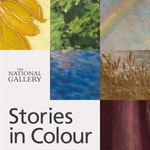
These are the stories of how colour has changed the world. 'Stories in Colour’ is a vibrant new podcast from the National Gallery in London.
In each episode, we uncover the hidden mysteries woven into colour from antiquity to the present day.
Along the way, you'll hear from curators, scientists, historians, artists, and more experts, looking at humanity’s efforts to make colour and make meaning with it.
And amongst these stories, you will see - and hear - the National Gallery’s paintings in a whole new spectrum of light.
https://www.nationalgallery.org.uk/podcast
Site
RSS
Apple
Classements récents
Dernières positions dans les classements Apple Podcasts et Spotify.
Liens partagés entre épisodes et podcasts
Liens présents dans les descriptions d'épisodes et autres podcasts les utilisant également.
How has colour changed the world? A vibrant new podcast from the National Gallery, Stories in Colour launches with our first two episodes on Wednesday 28 May 2025.
The Times ★★★★ ‘There’s lots to enjoy here.’
In each episode, we uncover the hidden mysteries woven into colour from antiquity to the present day.
Along the way, you'll hear from curators, scientists, historians, artists, and more experts, looking at humanity’s efforts to make colour and make meaning with it.
And amongst these stories, you will see - and hear - the National Gallery’s paintings in a whole new spectrum of light.
The first modern synthetic pigment
Saison 1 · Épisode 2
mercredi 28 mai 2025 • Durée 44:28
Meet an enigmatic pigment discovered entirely by accident at the start of the 18th century. Its story involves a rogue inventor with an unlikely connection to Doctor Frankenstein, a characterful trio of Johanns, and a renowned Botticelli forgery.
This pigment came to be known as Prussian blue or Berlin blue. Before its discovery, a range of blue pigments existed but each had a significant flaw: natural ultramarine was prohibitively expensive, smalt discoloured, azurite turned green and indigo faded.
Join colour specialist Evie Hatch and National Gallery host Beks Leary for a conversation about the pigment most famously seen in the blue revolution of Japanese woodblock printing, which inspired the Impressionists, as well as in earlier Rococo painting.
Evie Hatch is an art historian specialising in the history and characteristics of artist pigments. She is the writer and presenter of Jackson's Art Pigment Stories series.
Katsushika Hokusai, Under the Wave off Kanagawa (Kanagawa oki nami ura), also known as The Great Wave, from the series Thirty-six Views of Mount Fuji (Fugaku sanjūrokkei), about 1830-32. The Metropolitan Museum of Art, New York https://www.metmuseum.org/art/collection/search/45434
*Note – Prussia was officially dissolved by the Allied Control Council of occupied Germany on 25 February 1947
-----
Episode credits:
Guest: Evie Hatch
Host and executive producer: Beks Leary
Producer: Harry Rosehill
Researcher: Hannah Rogers
Technicians: Ian Warren, Jon Sheldon, Ash Baker, Steven Pasquale, Tom Gulliver and Timothy Carpenter
Editors: Jeanne Kenyon and Amber Akaunu
Theme music: Theo Elwell
Do you see the same colour I see?
Saison 1 · Épisode 1
mercredi 28 mai 2025 • Durée 53:46
Welcome to Stories in Colour! We're starting at the very beginning to ask an age-old question: are the colours you see, the same as the colours I see?
Join Professor Anya Hurlbert from Newcastle University and National Gallery host Beks Leary as they ask whether colour is real and how exactly we see it, stopping off to look at paintings from the National Gallery along the way. We go back to the viral dress that divided the internet in 2015 – was it blue and black, or was it white and gold? This was the moment so many of us discovered that colour is our own – in Anya’s words – personal possession.
Anya is a Professor of Visual Neuroscience and Dean of Advancement at Newcastle University. Her research focuses on human visual perception: how and why we see what we see. As Scientist Trustee at the National Gallery from 2010-2018, she worked with us on our 2014 ‘Making Colour’ exhibition – bringing together art and science to explain how artists overcame the technical challenges involved in creating colour.
Pierre-Auguste Renoir, The Skiff (La Yole), 1875. The National Gallery, London
How bugs turned the world red
Saison 1 · Épisode 3
mardi 3 juin 2025 • Durée 58:53
We're on the search for the 'perfect red' with a pigment and dye that was so prized that it inspired international espionage and piracy, carried the death penalty if exported without a license, and built empires. But today you might find it in your strawberry yoghurt.
This is the story of how bugs turned the world red with historian and writer Amy Butler Greenfield and National Gallery host Beks Leary.
Amy is the granddaughter and great-granddaughter of dyers, and her award-winning history of cochineal, 'A Perfect Red', has been published in eight languages. A popular speaker on radio and television programs, Amy was born in Philadelphia, studied history at Oxford, and now lives with her family in Oxfordshire.
We're asking how we feel about colour – or more accurately how colours make us feel – and whether that's the same for all of us.
Join colour specialist Zeynep Sagir and National Gallery host Beks Leary to get emotional about colour. Along the way, we talk about Pablo Picasso’s ‘Blue Period’ and Derek Jarman’s final film ‘Blue’, the calming green of John Constable’s ‘The Cornfield’, and Mark Rothko’s colour field abstractions. And we’ll see just how cultural our perception of colour really is.
Zeynep is an artist, colour consultant, and founder of The Colour Club. She holds a Master’s degree from Central Saint Martins and spent two years researching colour psychology. Since graduating, she has gone on to become a certified colour consultant and colour therapist. Through The Colour Club, Zeynep runs workshops, hosts events, and offers consultancy, as well as publishing articles and interviews.
John Constable, ‘The Cornfield’, 1826. The National Gallery, London
Don’t eat your deadly greens
Saison 1 · Épisode 5
mardi 17 juin 2025 • Durée 01:00:26
Why does the colour green remind you of poison and radioactivity? We're telling the story of two toxic green pigments to find out. Their stories interact with artists like Berthe Morisot, Dante Gabriel Rossetti and William Morris, as well as the less likely figure of Napoleon Bonaparte. And we go for a very good nosy around Victorian libraries.
Join cultural historian Kassia St Clair and National Gallery host Beks Leary to ask just how deadly these historic pigments really are!
Kassia is the author of books including 'The Secret Lives of Colour', 'The Golden Thread' and 'Liberty: Design. Pattern. Colour'. She specialises in telling stories about the overlooked and every day.
Where did all the colour go? And how might Western culture have feared it, or deemed it superficial, in art and philosophy? We celebrate the 25th anniversary of seminal book ‘Chromophobia’ with its author David Batchelor, who reflects on these ideas a quarter of a century on.
David speaks to National Gallery host Beks Leary about ideas of colour from philosopher Plato and artist Paul Cezanne, to the film ‘The Wizard of Oz’, photojournalist Don McCullin and pop artist Andy Warhol. They also ask the pressing question: ‘is beige a passive aggressive colour?’
David Batchelor is an artist and writer based in London, who, for thirty years, has been concerned with our experience of colour within the modern urban environment, and with historical conceptions of colour within Western culture. His work comprises sculpture, installation, drawing, painting, photography and animation.
Jean-Auguste-Dominique Ingres, ‘Madame Moitessier’, 1856. The National Gallery, London
How snails made purple a royal colour
Saison 1 · Épisode 7
mardi 1 juillet 2025 • Durée 52:36
Why do we see purple as the colour of royalty? It all starts on the Mediterranean coast with some unassuming, and eventually very unfortunate, seasnails.
Travel back to ancient times with colour specialist Victoria Finlay and National Gallery host Beks Leary to trace the story of Tyrian purple through time.
Victoria has written several books about colour – including 'Colour, Travels through the Paintbox' and 'The Brilliant History of Color in Art' – which involved travelling across the globe to the very places that ancient pigments and dyes came from. Her most recent book is about the hidden histories of fabric.
What exactly is a rainbow and how is it formed? Why does it have seven colours? And what have rainbows symbolised in mythologies and art?
Join colour expert Dr Alexandra Loske, National Gallery Principal Scientist Joseph Padfield and National Gallery host Beks Leary as they cover rainbows from Noah’s Ark to Olafur Eliasson, and Pink Floyd's Dark Side of the Moon to Georges Seurat’s ‘The Rainbow’ study.
Alexandra is a colour expert, art historian and museum curator. Her exhibition 'Colour: A Chromatic Promenade through the Royal Pavilion' is on display at The Royal Pavilion in Brighton until October 2025. She is also author of 'The Artist's Palette' and 'Colour: A Visual History'.
Joseph is a Principal Scientist at the National Gallery. He brings a wealth of expertise across multiple domains, including data management, digital infrastructure, conservation documentation, digital imaging, web development, preventive conservation, museum lighting, colour science, and the technical examination of paintings.
Welcome to a new miniseries of ‘Stories in Colour’. The National Gallery’s vibrant podcast returns to tell the story of a rare, sparkling and glistening colour – or should we say material?
It's been called the tears of the gods, the sweat of the sun, a barbaric relic and a universal language. Join us as we trace the use of gold across the ages! From the tombs of Ancient Egypt to Renaissance altarpieces, all the way to a currently missing golden toilet.
The first episode in our three-part miniseries releases on Wednesday 19 November 2025. Episodes will release weekly, finishing on 3 December 2025.
Amy Butler Greenfield, ‘A Perfect Red: Empire, Espionage, and the Quest for the Color of Desire’, 2005
For more information on ‘The Virgin and Child ('The Madonna with the Iris')’ by Workshop of Albrecht Dürer with Hans Baldung Grien, please see the following volumes of the National Gallery’s Technical Bulletin:
To find out more about research conducted during the 2004 Olympic Games in Athens on how ‘Red enhances human performance in contests’ see: https://www.nature.com/articles/435293a
Wassily Kandinsky, Concerning the Spiritual in Art, [1911]
Find out more about the ‘Poison Book Project’ – an interdisciplinary research initiative at Winterthur Museum, Garden & Library and the University of Delaware: https://sites.udel.edu/poisonbookproject/
Thomas Forster, Researches about Atmospheric Phaenomena, [1815]
-----
End credits:
Guests: Dr Alexandra Loske and Joseph Padfield
Host and executive producer: Beks Leary
Producer: Harry Rosehill
Researcher: Hannah Rogers
Technicians: Ian Warren and Tom Gulliver
Editor: Jeanne Kenyon and Paul Frankl
Theme music: Theo Elwell
Podcasts Similaires Basées sur le Contenu
Découvrez des podcasts liées à Stories in Colour. Explorez des podcasts avec des thèmes, sujets, et formats similaires. Ces similarités sont calculées grâce à des données tangibles, pas d'extrapolations !