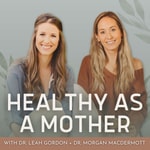
Healthy As A Mother is a podcast for becoming and being a mother, hosted by Dr. Leah Gordon and Dr. Morgan MacDermott, two naturopathic doctors passionate about helping women navigate fertility, pregnancy, birth, postpartum, and motherhood through a natural health lens.
Each week, we share conversations and education designed to help you become the healthiest mother possible through evidence-based and holistic approaches to wellness. From preconception and pregnancy preparation to postpartum recovery and motherhood, we cover the topics many women are not hearing elsewhere.
Real conversations. Honest education. Support for every stage of motherhood.
Site
RSS
Apple
Données mises à jour le 29/10/2026
Classements récents
Dernières positions dans les classements Apple Podcasts et Spotify.
Liens partagés entre épisodes et podcasts
Liens présents dans les descriptions d'épisodes et autres podcasts les utilisant également.
Gut Health Is Hormone Health: Peptides, Bloating & Painful Periods with Dr. Paria | #188
Saison 12 · Épisode 188
mercredi 28 octobre 2026 • Durée 53:43
Bloating after every meal, painful periods, PMS, acne, eczema: what if your gut is the common thread? In this episode, we sit down with Dr. Paria, a naturopathic doctor in San Diego who specializes in women’s health, hormones, digestive health, and autoimmune conditions. We break down how the gut microbiome drives inflammation, why so many women struggle with gut issues, and what’s really happening when your list of “safe” foods keeps getting shorter.
Dr. Paria explains how she uses stool testing to build a targeted plan, and why she sees more patients with too little good bacteria than with overgrowth. She also covers how herbal antimicrobials differ from antibiotics, and how she uses the peptides BPC-157 and KPV to calm gut inflammation and repair the gut lining. We discuss how these peptides differ from GLP-1s, whether they’re safe long-term, and why sourcing them through a doctor matters right now.
We also dig into the gut’s connection to painful cramps, PMS, estrogen dominance, skin conditions, fertility, Hashimoto’s, histamine, “period flu,” and even morning sickness. Dr. Paria shares the beneficial species she most often sees depleted (Akkermansia, Faecalibacterium, Bifidobacterium, and Lactobacillus) and the polyphenol-rich foods that feed them. She also covers which probiotics actually colonize, digestive bitters vs. enzymes, and simple daily habits to start supporting your gut today.
0:00 Trailer & Intro
3:39 Meet Dr. Paria
5:35 The Gut & Women's Health Connection
7:00 Why So Many of Us Have Gut Problems
8:30 Bloating & Food Sensitivities
10:49 Good vs. Bad Bacteria
12:25 Stool Testing & Gut Healing Approach
14:37 Antimicrobials vs. Antibiotics
16:00 Peptides for Gut Inflammation: KPV & BPC-157
Vasectomy & Vasectomy Reversal: Risks, Pain, Testosterone & Success Rates with Dr. Philip Werthman | #187
Saison 12 · Épisode 187
mercredi 21 octobre 2026 • Durée 01:17:35
Vasectomy is one of the most requested topics we've ever had, and in this episode we finally get answers from someone who has done thousands of them. Dr. Philip Werthman is a Los Angeles microsurgeon whose practice focuses exclusively on vasectomy reversal and male infertility. He explains how the male reproductive tract works, what actually happens during a no-scalpel vasectomy, and why ejaculation looks and feels the same afterward.
We go through the concerns you sent in on Instagram: failure rates, post-vasectomy pain syndrome, autoimmune reactions to sperm, prostate and testicular cancer, Alzheimer's, testosterone, libido, and erectile function. Dr. Werthman gives his honest clinical perspective on how often these issues really show up in practice. He also covers the treatment options when chronic pain does happen.
In the second half, we dive into vasectomy reversal. We cover how surgeons reconnect a tube about the size of spaghetti under a microscope, realistic timelines for sperm returning and conception, and why success rates range from about 60% to 98%. He also explains why some reversals "fail" because the right operation wasn't done. We finish with sperm agglutination, cost, choosing a surgeon, his favorite sperm-supporting supplements, and a thoughtful conversation about qi, regret, older fathers, and making this deeply personal decision as a family.
00:00 Trailer & Intro
02:27 Why We’re Talking Vasectomy
04:22 Meet Dr. Philip Werthman
06:00 What Is a Vasectomy?
08:29 How the Vas Is Cut & Sealed
10:07 No-Scalpel Vasectomy Explained
12:40 Does Ejaculation Change?
13:27 Risks & Failure Rates
14:46 Why Men Skip the Follow-Up Sperm Check
Miscarriage: What No One Tells You About Loss, Recovery & Trying Again | #186
Saison 12 · Épisode 186
mercredi 14 octobre 2026 • Durée 01:18:02
Going through a miscarriage is heartbreaking, and then you're asked to make a big medical decision while you're still processing the news. In this episode, Dr. Leah Gordon and Dr. Morgan MacDermott walk through the three options for managing a miscarriage: expectant management (letting your body pass the pregnancy on its own), medication (mifepristone and misoprostol), and a D&C (dilation and curettage). They cover the pros, cons, success rates, and risks of each, so you can make an informed choice that feels right for you.
They also talk about the things most women aren't told ahead of time. That includes how intense passing a pregnancy at home can be, when bleeding is too much and you need the ER, and why HCG can stay in your system and cause a positive pregnancy test weeks later. They explain retained tissue, how ectopic pregnancy is treated differently, and how testing the pregnancy tissue can give you answers after a loss.
Finally, they cover the "mini postpartum" that follows a pregnancy loss. Topics include hormone shifts, when your cycle returns, when it's safe to try again, how to replenish your body, and ways to honor your baby. Whatever you're feeling after a loss is valid. You don't have to go through it alone.
0:00 Trailer & Intro
3:34 Miscarriage Explained
6:10 Why Community Matters After Loss
8:04 It's Not Your Fault
8:36 The Three Miscarriage Options
10:55 The Hard Language of Miscarriage
13:24 Grieving a Failed IVF Transfer
14:49 Option 1: Expectant Management
18:42 What Is a Missed Miscarriage?
22:36 You Don't Have to Decide Right Away
26:06 Feeling Empowered in Your Choice
How to Protect Your Kids From Predators & Grooming: A Survivor's Guide for Parents with Mandi Pagliarini | #185
Saison 12 · Épisode 185
mercredi 7 octobre 2026 • Durée 01:24:33
How do you talk to your kids about body safety without scaring them? And how do you actually keep them safe? In this episode, we're joined by Mandi Pagliarini (@MandiTalksPredators), a writer, speaker, educator, and mother of two. Mandi is a survivor of sexual assault and child trafficking, and her advocacy focuses on prevention and harm reduction. She gives parents survivor-informed education about grooming and how predators operate.
Mandi explains why body safety should be an ongoing series of small conversations, like the way you teach manners, instead of one big talk. She also covers why the words you choose matter: say "share" instead of "tell," and leave out "hurt" and "abuse." She shares her "even if" statements, which let kids know they can come to you no matter who is involved or how the experience felt. We also talk about why boys may be more at risk than we realize, why teaching kids to "say no and fight back" often fails because of the freeze response, and what to teach them instead.
We also get into how grooming really works. Predators often groom the parents as well as the child, and they play a long game. Mandi walks through red flags to watch for, like an adult seeking time alone with your child or your child suddenly talking about one adult all the time. She shares practical steps for reducing risk, including open-door playdates, never leaving a child alone with an adult, and avoiding sleepovers. She also talks about how to stay body-positive with little ones without creating shame.
Mandi also shares parts of her own story, and why emotional regulation is the foundation that makes kids feel safe enough to come to you.
00:00 Trailer & Intro
02:00 Welcome Mandi Pagliarini
04:29 Why Body Safety Matters Today
06:30 Why Boys May Be More at Risk
09:17 Who Abusers Really Are
Women’s Health Labs Your Doctor Isn’t Running but Should Be | #184
Saison 12 · Épisode 184
mercredi 30 septembre 2026 • Durée 01:06:30
What labs should women actually be asking for, and what do those numbers really tell you about your health? In this episode of Healthy As A Mother, Dr. Leah Gordon breaks down the key labs she believes women should understand, from blood sugar and fasting insulin to thyroid, iron, inflammation, reproductive hormones, vitamin D and more. She explains what these markers can reveal about metabolic health, fertility, energy, hormones, symptoms and overall health, and why looking at a single lab without the right context can sometimes miss the bigger picture.
The conversation also dives into reproductive hormone testing, including estradiol, progesterone, FSH, LH, AMH, testosterone, SHBG and DHEA, with a major emphasis on understanding where you are in your menstrual cycle when certain labs are drawn. Leah and Morgan discuss why cycle tracking and understanding ovulation can give women important context about their own health, whether they are trying to conceive, trying to avoid pregnancy, navigating postpartum or breastfeeding, or approaching perimenopause.
They also cover thyroid markers, ferritin and iron studies, hs-CRP and inflammation, cortisol, vitamin D, ANA, and the importance of considering a partner’s semen analysis when trying to conceive. The episode ultimately comes back to one central idea: learning the basics of your own health can help you ask better questions, recognize when something deserves further investigation, and become more informed about what is happening in your body.
00:00 Trailer + Introduction
03:26 Understanding Women’s Health Labs
04:58 Why Testing Matters for Women’s Health
09:29 Blood Sugar, Insulin & Metabolic Health
16:34 Thyroid Labs: TSH, T3, T4 & Antibodies
23:18 Iron & Ferritin: What Women Should Know
29:10 Inflammation & hs-CRP
Eczema in Babies & Kids: Gut, Food, Mold & More with Abbie Bradford | #183
Saison 12 · Épisode 183
mercredi 23 septembre 2026 • Durée 01:27:11
Eczema is incredibly common in babies and children, but what if the skin is only showing us part of the story? In this episode, Dr. Morgan MacDermott sits down with holistic nurse, clinical herbalist, and pediatric eczema practitioner Abbie Bradford to unpack the many factors that can contribute to eczema and why there isn't one universal cause or solution. They discuss the connection between eczema, gut health, food allergies and sensitivities, the microbiome, antibiotics, C-sections, breastfeeding, environmental exposures, and mold. Abbie also explains why the last thing that happened before a flare isn't necessarily the root cause, when food-based topicals may be problematic for babies, how to think about probiotics and stool testing, and which practical changes parents can start with at home. They also cover mold testing, breastfeeding and elimination diets, allergy testing, topical care, red light, bathing, and why some children may eventually "grow out" of eczema without actually addressing what was happening underneath. Most importantly, this conversation gives parents a framework for thinking about eczema without getting overwhelmed by the endless list of possible triggers. Rather than chasing one cause, Abbie explains how to look at the whole picture and identify the factors that may be contributing to a child's individual presentation.
00:00 Trailer + Introduction
02:47 Why Eczema Is More Than a Skin Problem
06:00 How Common Is Childhood Eczema?
09:40 Eczema Is a Symptom, Not the Root Cause
11:00 Can Food-Based Lotions Make Eczema Worse?
13:28 Vaccines, Immune Reactivity & the “Bucket” Analogy
19:42 Are Food Allergies Causing Eczema?
21:44 When Baby Rashes Are Normal vs. Concerning
23:09 The Gut-Eczema Connection
Birth Control & the War on Female Biology: How We Learned to Suppress the Menstrual Cycle | #182
Saison 12 · Épisode 182
mercredi 16 septembre 2026 • Durée 01:15:22
What happens when we stop viewing the menstrual cycle as an essential part of female biology and start treating it as something to suppress? In this episode, Dr. Leah Gordon and Dr. Morgan MacDermott take a deeper look at the history and culture surrounding hormonal birth control, how women came to view their cycles as inconvenient or problematic, and what can happen when symptoms like painful periods, PMS, acne, irregular cycles, or heavy bleeding are suppressed instead of investigated.
They discuss the difference between contraception and treating the root cause of hormonal symptoms, fertility awareness and modern cycle tracking, potential side effects and risks of hormonal birth control, informed consent, fertility, and why individualized care matters. Most importantly, this isn't an argument that every woman should avoid birth control, it's a conversation about understanding your body, knowing your options, and making intentional decisions about your reproductive health.
00:00 — Trailer & Introduction
03:38 — The War on Female Biology
07:05 — The History of Birth Control
11:08 — Is Birth Control Fixing the Problem?
13:58 — The Fire Alarm Analogy
16:40 — Informed Consent & Birth Control
19:21 — When Birth Control Has a Place
24:22 — A Personal Experience With Birth Control
30:21 — What Is “Woman Essence”?
34:54 — Fertility Awareness vs. Birth Control
40:10 — The Truth About the Rhythm Method
41:58 — Public Health vs. Individualized Care
44:42 — Can Birth Control Mask Fertility Problems?
45:32 — The Potential Risks of Hormonal Birth Control
ADHD in Motherhood: How Hormones, Pregnancy & Postpartum Affect Your Brain with Dr. Carrie McMillin | #181
Saison 12 · Épisode 181
mercredi 9 septembre 2026 • Durée 01:21:33
ADHD can look very different in women and motherhood: hormonal shifts, pregnancy, and postpartum can dramatically change how those symptoms show up. In this episode, we’re joined by integrative ADHD specialist Dr. Carrie McMillin to unpack the ADHD brain, including executive function, task initiation, working memory, hyperfocus, dopamine, and emotional regulation.
We dive into how estrogen and progesterone interact with dopamine throughout the menstrual cycle, why some women notice more ADHD symptoms during the luteal phase, and what can happen during pregnancy and postpartum. Dr. McMillin explains why the postpartum period can be especially challenging, including the effects of the dramatic estrogen drop, prolactin, breastfeeding, sleep deprivation, and the increased demands of caring for a baby.
We also discuss how to distinguish ADHD from normal motherhood overwhelm, anxiety, and sleep deprivation; how ADHD is diagnosed in adults; medications and supplements; iron, B vitamins, L-tyrosine, and other potential supports; the importance of building systems around your individual executive-function struggles; and why small sources of genuine joy can be an important part of supporting your brain.
Finally, we talk about perimenopause, irritability and PMDD, caffeine, screen time, and practical ways women with ADHD can work with their brains instead of constantly fighting against them. The biggest takeaway? Understanding what's happening in your brain can replace shame with self-compassion and help you build systems that actually work for you.
00:00 —Trailer & Introduction
03:06 —The ADHD Brain Isn't Broken
06:15 —The 3 Types of ADHD
11:02 —Task Initiation, Motivation & Executive Function
12:06 —Hyperfocus & Dopamine
Are IVF Babies Less Healthy? What the Research Really Shows | #180
Saison 12 · Épisode 180
mercredi 2 septembre 2026 • Durée 01:07:51
In this episode of Healthy As A Mother, Leah and Morgan unpack one of the biggest fears many women have when considering IVF: Are IVF babies less healthy? They explore what the research actually shows around premature birth, low birth weight, NICU admissions, congenital heart defects, allergies, eczema, asthma, and autism.
More importantly, they ask whether those outcomes can truly be attributed to IVF itself. They discuss the many variables that can complicate the research, including the underlying causes of infertility, parental age, sperm and egg health, metabolic and autoimmune conditions, pregnancy complications, and the amount of medical intervention surrounding IVF. They also cover epigenetics, microbiome health, induction and C-sections, baby aspirin, pregnancy monitoring, and why optimizing both parents' health before IVF may matter.
Ultimately, this is a conversation about moving beyond fear and black-and-white thinking to look at IVF with more nuance, critical thinking, and hope. The hosts also share their personal experiences with IVF and why they believe it can be an important tool when it is truly needed, while still questioning how intentionally it is used.
00:00 – Trailer & Introduction
03:45 – Are IVF Babies Less Healthy?
05:34 – The Fear of IVF and Baby Health
07:05 – What the Research Actually Shows
09:26 – Relative Risk vs. Absolute Risk
10:33 – Is IVF Really the Cause?
10:59 – The Underlying Causes of Infertility
14:32 – Sperm Health, Egg Selection & Epigenetics
17:47 – Could IVF Itself Affect Health?
20:09 – Does IVF Bypass Natural Selection?
22:29 – How Parental Health Can Affect the Baby
Dr. Morgan's Fifth Home Birth Story | #179
Saison 11 · Épisode 176
mercredi 26 août 2026 • Durée 01:38:17
Dr. Morgan is back with her fifth baby, and this time, she's sharing the full, unfiltered story of her fifth home birth. From going past her due date and days of early contractions to the moment labor suddenly intensified, she walks Leah through what labor actually felt like, how she used breath, movement, and visualization to cope with contractions, and the transition that she says is one of the hardest and least talked-about parts of birth. She also shares the moment baby McLean was born, what it was like having her older children present, and the emotional experience of catching her own baby.
But the conversation doesn't end with birth. Morgan also opens up about her first 10 days postpartum, including the routines, nutrition, movement, sleep strategy, and support system that have made this her best postpartum recovery yet. She also shares an unexpected realization about her baby's positioning and why pelvic floor physical therapy may have been the missing piece during pregnancy.
00:00 — Trailer & Introduction
01:43 — Going Past Her Due Date
06:34 — The Hardest Part of Pregnancy
11:15 — Early Labor Begins
15:29 — Walking Through Early Labor
21:37 — Labor Starts Intensifying
24:54 — The Cervical Check
26:46 — Getting Baby Into Position
32:24 — What a Contraction Really Feels Like
37:37 — The Transition Into Active Labor
39:49 — Breath, Movement & Visualization
43:48 — Back Labor Begins
45:30 — Getting Into the Birth Tub
50:19 — The Hardest Transition of Labor
Healthy As A Mother, podcast de Dr. Morgan MacDermott & Dr. Leah Gordon - Statistiques, épisodes et classements - My Podcast Data
Découvrez des podcasts liées à Healthy As A Mother. Explorez des podcasts avec des thèmes, sujets, et formats similaires. Ces similarités sont calculées grâce à des données tangibles, pas d'extrapolations !