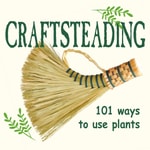
Save money, get happy, and expand your creativity by making stuff out of plants you grow, forage or buy. And even monetize your hobbies! Craftsteading is about self-sufficiency and traditional skills. It’s about prepping for survival or enjoying calming handicrafts.
Grow your own brooms, cordage, dyes, baskets, containers and more. Each month we’ll bring you a new podcast, so be sure to “follow” us.
Website: www.craftsteading.com
YouTube: https://tinyurl.com/craftsteading
Pinterest: https://www.pinterest.com/craftsteading/
Instagram: www.instagram.com/craftsteading
Site
RSS
Apple
Données mises à jour le 04/07/2026
Classements récents
Dernières positions dans les classements Apple Podcasts et Spotify.
Liens partagés entre épisodes et podcasts
Liens présents dans les descriptions d'épisodes et autres podcasts les utilisant également.
16. Part 2 MONETIZING YOUR CRAFTSTEADING HOBBIES. Where can you sell your Craftsteading products and skills online? What about packaging supplies and freight shipping calculators?
Saison 1 · Épisode 15
mercredi 23 novembre 2022 • Durée 10:57
You can sell handmade products online with very little expense in at least 5 ways:
* your own store built with a platform such as Shopify, Squarespace, Wix, BigCommerce, Weebly, Ecwid or Shift4Shop.
* your own WordPress website with Paypal buttons or the Woo Commerce plugin
* third-party marketplaces like Amazon and eBay
*social media sites like Instagram and Facebook.
* niche sites like Etsy and Big Cartel, Amazon Handmade (US), and more.
Here's a list of some more useful online craft sales websites:
ArtFire (US), eCrater, Handmade Artists’ Shop (US),
Folksy (US), Misi (US), Dawanda, Zibbet (US),
iCraft (Canada), Bonanza, Made It Myself,
LocalHarvest (an online directory for organic and local food providers),
Meylah, Indiecart (US), CrateJoy, HyeanaCart
Sourcing Handmade (It helps independent makers find places to sell their products wholesale),
GLC Arts and Crafts Mall,
Madeit (Australia)
Felt (New Zealand)
AFTCRA (US) is the only marketplace dedicated to handmade, and the only marketplace featuring goods made in America http://www.aftcra.com.).
A list of freight shipping calculators in some countries around the world:
USA
USPS (United States Postal Service) Use the USPS Shipping Calculator to compare rates for sending parcels. https://postcalc.usps.com/
UPS USA https://www.ups.com/us/en/Home.page
CANADA
Canada Post https://www.canadapost-postescanada.ca/cpc/en
UPS Canada https://www.theupsstore.ca/shipping-cost-calculator/
UK
The Royal Mail https://www.royalmail.com/
Shipping Calculator/price finder https://www.royalmail.com/price-finder
AUSTRALIA
Australia Post https://auspost.com.au/
Shipping Calculator https://auspost.com.au/parcels-mail/calculate-postage-delivery-times/#/
NEW ZEALAND
New Zealand Post https://www.nzpost.co.nz/
Rate Finder https://www.nzpost.co.nz/tools/rate-finder
- - - - - - - - - - - - - -
See our photos on Instagram at Mill Cottage, the Little House on the Peninsula
Watch our videos on YouTube at Craftsteading
Visit our website at www.craftsteading.com
15. Part 1 MONETIZING YOUR CRAFTSTEADING HOBBIES. What products or skills can Craftsteaders sell? Where can you sell them in the real world? And how do you set your prices?
Saison 1 · Épisode 14
mercredi 19 octobre 2022 • Durée 10:39
Whether you’ve grown your own gourds and decorated them, grown your own broomcorn and made artisan brooms, grown your own Jobs Tears and made botanical jewellery, grown your own willow or bamboo and made baskets, grown your own wax myrtles and made fragrant candles, or simply grown your own Craftsteading materials ready for others to use in their crafts, you could end up with a wide range of unique and gorgeous products to sell, as well as some skills that you can teach others.
What products or skills can Craftsteaders sell? Where can you sell them in the real world? And how do you set your prices? I'll answer these questions in this episode.
Remember to tune in next time, to Part 2 of MONETIZING YOUR CRAFTSTEADING HOBBIES to hear the answers to more questions:
Where can you sell your Craftsteading products and skills online?
How do you use Paypal buttons?
What about packaging supplies and freight shipping calculators?
Happy Craftsteading!
See our photos on Instagram at Mill Cottage, the Little House on the Peninsula
Watch our videos on YouTube at Craftsteading
Visit our website at www.craftsteading.com
14. NETTLES - YOU WON’T BELIEVE THEIR USES! From food and medicine to cosmetics, paper, cordage, textiles, dyes, fertilizer and insecticide!
Saison 1 · Épisode 15
mercredi 21 septembre 2022 • Durée 13:10
The humble and underrated stinging-nettle (Urtica dioica) has some amazing secrets. From food and medicine to cosmetics, paper, cordage, textiles for clothing and household linen, dyes, fertilizer and insecticide, nettles have a wide range of uses.
I'll tell you how to make nettle tea, nettle cordage, nettle paper and more.
More than just a weed, nettles are a wonder-plant for craftsteaders.
See our photos on Instagram at Mill Cottage, the Little House on the Peninsula
Watch our videos on YouTube at Craftsteading
Visit our website at www.craftsteading.com
13. LEMON - YOU WON'T BELIEVE ITS USES! It’s a common fruit but it has a wide range of uses other than as a decoration for a cocktail or a garnish for seafood dish!
Saison 1 · Épisode 12
mercredi 24 août 2022 • Durée 08:14
This episode is about lemons, Citrus limon. I’ve chosen lemons because it’s pretty likely that most listeners will have access either to lemons the fruit, or a lemon tree, or both.
You can eat the pith, juice, rind and even the flowers of the lemon. Lemons are popular as food and drink but they also have medicinal properties. They can be used as an insect repellent, for metal polishing, or as a bleach. Lemon tree wood is prized for woodworking.
Learn more about this amazing fruit that so many of us take for granted!
See our photos on Instagram at Mill Cottage, the Little House on the Peninsula
Watch our videos on YouTube at Craftsteading
Visit our website at www.craftsteading.com
12. PLANTS USED FOR LIGHTING. Many plants you can grow in your garden produce a wax or an oil that can be used as lighting fuel or candle wicks.
Saison 1 · Épisode 11
mercredi 20 juillet 2022 • Durée 14:32
Plant Oils, Waxes and Wicks for Alternative Lighting:
Many plants you can grow in your garden can be used to provide lighting. Some of these plants produce a wax or an oil that can be made into candles, some yield an oil that can be burnt to produce a bright flame, and others can be used as wicks for candles or lamps.
SHOW NOTES
Oil rich plants you can grow in your garden
Brassica napus – Colza, Oilseed Rape: A hardy annual plant native to the Mediterranean, growing to about four feet tall (just over a metre). The seed contains up to 45% of an edible semi-drying oil that is used for lighting, as a lubricant, in soap making, and as a vegetable wax substitute.
Carthamus tinctorius - Safflower: Grows well in a poor, dry soil in a sunny position. The seeds are oil rich and the flower petals are sometimes used as a substitute for saffron.
Fagus sylvatica - Beech: A hardy, deciduous tree. You can press a semi-drying oil from the seed and use it as a fuel for lighting, as a lubricant, or for polishing wood.
Glaucium flavum - Horned Poppy: Another hardy perennial. This plant grows in any good garden soil. The oil from its seeds is used as a lighting fuel, and burns cleanly. You can also use the oil in soap-making.
Guizotia abyssinica - Ramtil: This hardy annual requires a tropical climate but it has been known to grow in temperate zones. It needs to grow in well-fertilised soil. You can extract a drying oil from the seeds and use it as a lighting fuel or in soap-making.
Lallemantia iberica: Dragon's Head: This is a plant in the mint family that grows to about half a metre (one and a half feet). The seed contains up to 30% of a drying oil that you can use for lighting, as a varnish, in paints, as a lubricant as a wood preservative, or as an ingredient of oil-based paints, furniture polishes, printer's inks and soap.
Sinapis alba - White Mustard: The seed contains up to 35% of a semi-drying oil that you can use as a lubricant or for lighting.
Other wax yielding plants
Aleurites moluccanus, the Candlenut, is a flowering tree that’s also known as Candleberry. Some people even string the seeds together and light them, like a string of little candles.
Ceroxylon alpinum, the Andean Wax Palm, also known as the Andean wax palm. A wax obtained from the trunk is used for making candles.
Euphorbia antisyphilitica, the Candelilla or wax plant. A shrubby little plant with thickly clustered, almost leafless stems covered in wax that you can obtain by simmering the stems, especially in winter, and skimming the wax off the water.
Some members of the Rhus genus have seeds that you can squeeze oil from. At normal temperatures the oil goes semi-soft like tallow, and you can shape it into candles. They include: Rhus chinensis, Chinese Gall, or Chinese sumac.
Rhus succedanea, the Wax Tree and Rhus trichocarpa, Bristly Fruit Sumac.
Santalum acuminatum - Quandong. You can press oil out of the seeds as use it as a lighting fuel.
Sapium sebiferum - Chinese Tallow Tree. The seed is coated with a wax that you can use to make candles and soap, or as a lighting fuel.
Stipa tenacissima and Lygeum spartum, Esparto Grass. You can extract a hard, useful vegetable wax from it.
Copernicia prunifera, Brazilian Wax Palm, Carnauba Palm, Carnauba Wax. The undersides of the leaves are coated with a very useful wax, and you can express oil from the seeds.
Saccharum officinarum, Sugarcane, Purple Sugar Cane. Amazingly, you can get wax from sugar cane.
Copernicia alba, Caranday Palm, or Caranda Palm. You can obtain a high quality wax from the leaves, and use it in polishes or for lighting. Visit our website at www.craftsteading.com and search for Craftsteading on YouTube.
11. HOW TO USE NATURE’S COLORS. How to find, preserve and enhance nature’s extraordinary colors when you make stuff out of plants.
Saison 1 · Épisode 10
mercredi 22 juin 2022 • Durée 20:02
How to find, preserve and enhance nature’s colors when you make stuff out of plants.
How can you make multi colored cordage?
Can you stop the colored patterns on gourds from disappearing when you dry them?
How can you preserve the beautiful emerald green of freshly cut bamboo? And if you can't preserve it, can you replace it?
How can you weave willow baskets of many colors, without using dyes?
Find out the answers to these questions in this episode.
See our photos on Instagram at Mill Cottage, the Little House on the Peninsula
Watch our videos on YouTube at Craftsteading
Visit our website at www.craftsteading.com
9. BASIC BASKETRY TOOL SET, AND WEAVING YOUR OWN TRAY (Basketry Pt 3 of 3)
Saison 1 · Épisode 9
mercredi 20 avril 2022 • Durée 13:12
What’s in the cheapskate’s basic basketry tool kit? What is a tension tray and why is it tense? And how can you make your own beautiful Catalan tray from foraged materials? All this and more!
If you’re new to basketry you don’t have to outlay a lot of money for tools. You can buy tools online or you can use common household and workshop tools as substitutes. I tell you how to assemble a basic basketry tool set.
One of the easiest basket-weaves to begin with, if you’ve never tried basketry before, is the Catalan tray or tension tray. This works well with either bought, home grown or foraged materials. They can be made any size and from most woody materials, such as dogwood, beech, spruce, willow, larch, ivy honeysuckle or grapevine. Anything that grows long slender flexible shoots can be used. They have a round or oval frame, with two pairs of cross ribs, and numerous closely spaced weavers at right angles to the cross ribs.
This is the third of the Craftsteading Basketry episodes.
See our photos on Instagram at Mill Cottage, the Little House on the Peninsula
Watch our videos on YouTube at Craftsteading
Visit our website at www.craftsteading.com
8. BASKETRY METHODS AND BASKET NAMES (Basketry Pt 2 of 3) What different methods can you use to make baskets? What does randing, waling and scarfing mean? What on earth is a creel, a trug or a tattie
Saison 1 · Épisode 8
mardi 22 mars 2022 • Durée 11:11
Over thousands of years people have developed numerous different basket making styles and methods, in addition to the many colourfully named traditional styles and designs of the baskets themselves. There are 5 main basketry methods: Coiled basketry, Plaiting basketry, Twining basketry, Wicker basketry, and Splint basketry. But what does randing, waling and scarfing mean? What is a creel, a trug or a tattie scull? Find out the answers and more, in this episode.
See our photos on Instagram at Mill Cottage, the Little House on the Peninsula
Watch our videos on YouTube at Craftsteading
Visit our website at www.craftsteading.com
7. PLANTS USED FOR BASKETRY (Basketry Pt 1 of 3) Grow your own basket-making materials or forage for them. The list of basketry plants is much longer than you’d have thought!
Saison 1 · Épisode 6
lundi 21 février 2022 • Durée 14:55
The ancient rhythms of basket weaving are so therapeutically satisfying and peaceful, you’ll want to have basket-making as your new relaxing hobby. And you end up with beautiful, useful creations to show off to your friends. Baskets can be made from a variety of fibrous or pliable materials—anything that will bend to form a shape. Plants for a Future, (PFAF) lists over 300 plants used for basketry. These include, for example, various vines, rushes, palms, reeds, bamboos, irises, willows, grasses, dogwoods, hazels, broom and heather, flax lilies, pines, firs and cottonwoods, bracken and yuccas. The wood of certain trees, such as ash or white oak, can be split into fine wooden splints. You can also use strips of the inner bark of trees to weave baskets. Suitable species include linden, cedar, birch and poplar. We recommend growing your own basketry materials in your garden, or foraging for them (ethically and sustainably) in the wild. Try making baskets with blackberry brambles, Honeysuckle, Hop (Humulus lupus), Ivy (Hedera spp), Periwinkle (Vinca spp), Roses (Rosa spp) Virginia creeper (Parthenocissus quinquefolia) Winter flowering jasmine (Jasminum nudiflorum) Wisteria Akebia, Boston ivy (Parthenocissus trisupidata), morning glory. Thin whippy Garden prunings Cotoneaster Dogwood grapevine young shoots of eucalyptus (gum trees) hazel and even sweetcorn husks.
See our photos on Instagram at Mill Cottage, the Little House on the Peninsula
Watch our videos on YouTube at Craftsteading
Visit our website at www.craftsteading.com
6. DYE PLANTS: Grow dye plants in your own garden, to dye textiles in a rainbow of beautiful natural colours.
Saison 1 · Épisode 5
mercredi 19 janvier 2022 • Durée 16:45
Cornerstone dye plants
Throughout history the plants that produce the best dyes include indigo, madder, woad, weld, turmeric, saffron, noni, and henna. I’m growing many of these cornerstone dye plants in my garden, and depending on your climate, you might be able to grow them too.
I'll tell you about these wonderful dye plants and some of the dyeing basics you need to know.
Non-cornerstone dye plants
A huge range of other plants, not usually considered dye plants, contain substances that impart colour to textiles. Some work better than others. Your colour results will be best if you use white or unbleached natural material such as cotton, linen, or wool. The colours you’ll end up with will vary greatly depending on such variables as the plants used, the time the fabric spends in the dye bath, the mordant you use and whether you do more than one dip.
I'll give you a list of colours, along with the plants that can produce those colours for you to use in your home made dye bath.
See our photos on Instagram at Mill Cottage, the Little House on the Peninsula
Watch our videos on YouTube at Craftsteading
Visit our website at www.craftsteading.com
Podcasts Similaires Basées sur le Contenu
Découvrez des podcasts liées à CRAFTSTEADING - Use Plants to Make Anything. Explorez des podcasts avec des thèmes, sujets, et formats similaires. Ces similarités sont calculées grâce à des données tangibles, pas d'extrapolations !