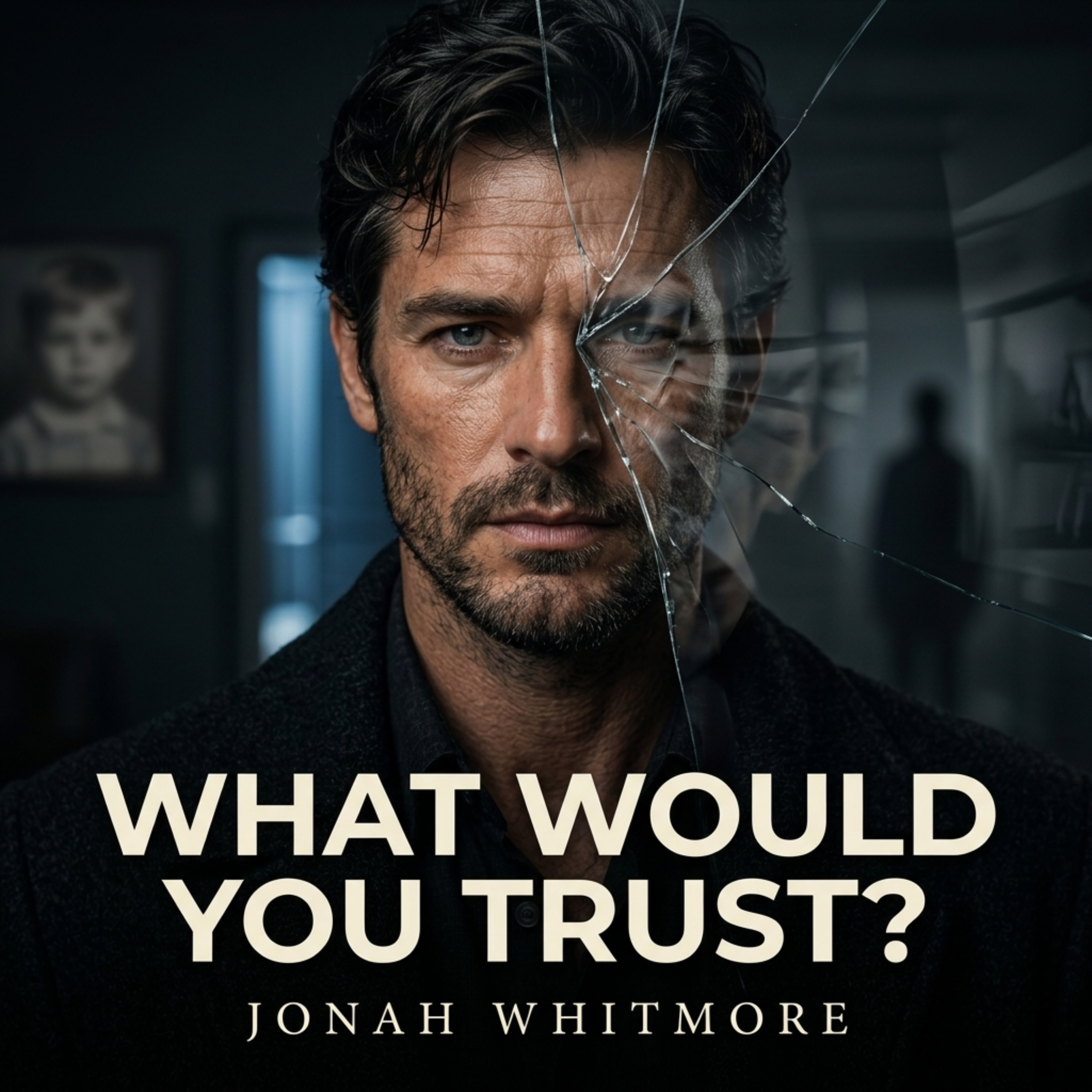
WHAT WOULD YOU TRUST?
A psychological fiction podcast by Jonah Whitmore exploring memory, identity, consciousness, trust, and choice — and the stories we tell ourselves.
Each episode begins with a question:
What if you couldn't trust your own memories?
Memory can change. Evidence can disappear. Choices can be influenced. And sometimes the truth is the one thing you were never meant to remember.
For readers and listeners drawn to psychological science fiction, thrillers, dark philosophical fiction, and thought experiments about what makes us who we are.
Site
RSS
Apple
Data updated on 31/10/2026
Recent rankings
Latest chart positions across Apple Podcasts and Spotify rankings.
Shared links between episodes and podcasts
Links found in episode descriptions and other podcasts that share them.
Discover shows related to WHAT WOULD YOU TRUST?, based on actual content similarities. Explore podcasts with similar topics, themes, and formats, backed by real data.
What If You See Yourself Differently Than Everyone Else? | WHAT WOULD YOU TRUST? — Season 2, Episode 02
Season 2 · Episode 2
Friday, October 30, 2026 • Duration 07:25
What if the person you believe yourself to be is not the person everyone else experiences?
You think you are being honest. Someone else experiences you as cruel.
You believe you are helping. They feel controlled.
You see yourself as patient, confident, or independent. But what do other people see when they look at you?
In the second episode of Season 2, we explore the gap between our own self-image and the way others experience us.
Because knowing your intentions is not the same as understanding your impact.
And sometimes, the most difficult person to see clearly is yourself.
• Why our intentions can differ from other people's experiences • How self-perception creates blind spots • Why we call our own behavior by different names • Whether other people's opinions can reveal something we cannot see • How to distinguish useful feedback from an unfair judgment • What happens when the person you believe yourself to be contradicts the person others describe
If everyone who knows you described you differently than you describe yourself, would you trust your own understanding — or would you begin to question it?
And what would you be most afraid to discover?
What If You See Yourself Differently Than Everyone Else? Season 2 · Episode 02 · Self-Perception
WHAT WOULD YOU TRUST? is a psychological podcast by Jonah Whitmore exploring memory, identity, consciousness, trust, and choice.
A series about the questions we rarely ask ourselves — and the answers we may not be ready to hear.
━━━━━━━━━━━━━━━━━━
WHO AM I, REALLY? An Inquiry into Personal Identity
What makes you the same person over time? Explore the questions that shape our understanding of who we are.
Do You Really Know Yourself? | WHAT WOULD YOU TRUST? — Season 2, Episode 01
Season 2 · Episode 1
Thursday, October 29, 2026 • Duration 05:00
You believe you know yourself. But what if the person you understand the least is yourself?
In the opening episode of Season 2, we explore the gap between who we believe we are and what our actions reveal about us.
Why do we explain away our mistakes? Can we distinguish an honest explanation from an excuse? And what happens when our actions contradict the values we claim to hold?
Perhaps knowing yourself isn't about achieving complete certainty. Perhaps it begins with questioning the story you tell yourself.
IN THIS EPISODE
• How we construct stories about our own character • Why knowing what you do isn't the same as knowing why • How self-image influences our interpretation of choices • The difference between self-knowledge and certainty • Whether we're willing to question our beliefs about ourselves
QUESTION FOR YOU
If you discovered that your understanding of yourself was wrong, would you change who you are — or what you believe?
ABOUT THIS EPISODE
Do You Really Know Yourself? Season 2 · Episode 01 · Self-Perception
WHAT WOULD YOU TRUST? is a psychological podcast by Jonah Whitmore exploring memory, identity, consciousness, trust, and choice.
━━━━━━━━━━━━━━━━━━
EXPLORE PERSONAL IDENTITY
WHO AM I, REALLY? An Inquiry into Personal Identity
What makes you the same person over time? Explore the questions that shape our understanding of who we are.
If You Couldn't Trust Your Memories, Would You Trust Your Choices? | WHAT WOULD YOU TRUST? — Episode 30
Season 1 · Episode 30
Friday, October 23, 2026 • Duration 07:02
What if you couldn't fully trust your memories — but still had to decide what to do next?
Throughout our lives, we use memories to understand who we are, whom we trust, and what we believe is possible. Our past experiences help shape our choices. But what happens when the stories we rely on are incomplete, uncertain, or open to another interpretation?
In the Season 1 finale of WHAT WOULD YOU TRUST?, we bring together the central questions of memory, identity, consciousness, trust, and choice.
How much of the person you believe yourself to be is shaped by the memories you carry? Can you learn from the past without allowing it to control your future? And can you make meaningful choices without having absolute certainty about why you think and feel the way you do?
IN THIS EPISODE
• How memories shape the stories we tell about ourselves • Why certainty doesn't always mean we have the complete picture • The relationship between past experiences and present choices • How to question old beliefs without dismissing your experiences • What personal responsibility means when we don't control everything that shapes us • Whether we can choose differently without resolving every question about the past
You don't need to distrust every memory. You don't need to solve every mystery about yourself.
Perhaps the goal is to become more thoughtful about what you believe, more open to what you may have misunderstood, and more willing to reconsider the stories that shape your life.
QUESTION FOR YOU
If you couldn't fully trust your memories, would you trust your choices?
Share your perspective in the episode poll or comments. There is no single answer — and sometimes the questions we ask ourselves matter as much as the answers we find.
━━━━━━━━━━━━━━━━━━
What If You Remember Choosing Something You Never Chose? | WHAT WOULD YOU TRUST? — Episode 29
Season 1 · Episode 29
Thursday, October 22, 2026 • Duration 06:31
What if you clearly remember making an important choice… but you never actually made it?
You remember the conversation. You remember your reasons. You remember the moment you decided to walk away, say no, or leave something behind.
But what if the choice you remember was never yours?
In Episode 29 of WHAT WOULD YOU TRUST?, we explore the unsettling relationship between memory, personal responsibility, and the choices we believe define us.
Imagine discovering evidence that contradicts a decision you have remembered for years. You were certain you made the choice yourself. You may have blamed yourself for it, defended it, or built your identity around it. But the evidence suggests that someone else made the decision — or that events unfolded very differently from the way you remember them.
What happens when a memory that shaped your life turns out to be unreliable?
IN THIS EPISODE
• How a remembered choice can shape your identity, even when the details are wrong • Why a vivid memory is not the same as proof • How we can carry guilt for decisions we may never have made • What happens when evidence challenges the story we tell about ourselves • Why the consequences of a mistaken memory can still be real • Whether understanding the past can help us make different choices in the present
You don't need to doubt every memory. And discovering that a memory may be inaccurate doesn't erase everything you experienced afterward.
Perhaps the important question isn't only whether you made the choice you remember.
Perhaps it's also whether you are still allowing that memory to make choices for you.
QUESTION FOR YOU
If you discovered that a major choice you remember making was actually made by someone else, would it change how you see yourself?
How Much of Your Choice Is Actually Yours? | WHAT WOULD YOU TRUST? — Episode 28
Season 1 · Episode 28
Sunday, October 18, 2026 • Duration 08:39
Think about the last important decision you made.
You probably had your reasons. You considered the possibilities, weighed the risks, and eventually chose what seemed right.
But how much of that decision was really yours?
In Episode 28 of WHAT WOULD YOU TRUST?, we explore the hidden influences behind our choices — the memories, fears, habits, and expectations that shape what we want and what we believe is possible.
Two people can face exactly the same opportunity and see completely different futures. One sees freedom. The other sees danger. Both believe they are responding to reality, but their past experiences may be shaping what they see.
Sometimes, a familiar reaction becomes a habit. A habit becomes part of our personality. And eventually, we stop questioning it. We simply say, "That's who I am."
But what if some of the choices we consider uniquely our own are actually patterns we learned long ago?
IN THIS EPISODE
• How past experiences influence present decisions • Why the same opportunity can feel exciting to one person and dangerous to another • How inherited expectations shape our desires • When habits become so familiar that we mistake them for personality • Why understanding a decision can change how we see ourselves • Whether recognizing our influences can help us choose differently
You don't need to question every decision you make. And being influenced by your past doesn't mean your choices are meaningless.
Perhaps freedom isn't about making decisions untouched by experience.
Perhaps it begins when we recognize the influence of the past — and decide what role it should play in our future.
QUESTION FOR YOU
Did Your Memories Make the Choice for You? | WHAT WOULD YOU TRUST? — Episode 27
Season 1 · Episode 27
Saturday, October 17, 2026 • Duration 05:24
Think about a decision you made recently.
You chose to trust someone. You turned down an opportunity. You stayed with what felt familiar instead of trying something new.
You probably had your reasons.
But how much of that decision belonged to the present — and how much came from your past?
In Episode 27 of WHAT WOULD YOU TRUST?, we explore the hidden relationship between memory and choice.
Our memories help us learn from mistakes, recognize danger, and understand the people around us. But they can also shape what feels safe, what seems possible, and what we are willing to risk.
A past betrayal can influence how we see someone new. A previous failure can make an opportunity feel impossible before we even try. Sometimes, a decision feels so natural that we never question where it came from.
We call it instinct. We call it experience. We tell ourselves we know what's right.
But what if a memory is influencing our choice in ways we don't fully recognize?
IN THIS EPISODE • How past experiences influence present decisions • Why familiar situations can feel safer than unfamiliar possibilities • When memory helps us — and when it limits us • How to distinguish present evidence from expectations shaped by the past • Whether recognizing our influences can help us choose differently
You don't need to doubt every decision you make. Your memories contain valuable lessons, and experience matters.
But a situation that resembles an old mistake doesn't always have the same ending.
Perhaps freedom doesn't mean escaping the influence of the past. Perhaps it begins when we recognize that influence and decide what to do with it.
Your past is part of your story. But it doesn't have to write every next chapter.
Did You Really Choose? | WHAT WOULD YOU TRUST? — Episode 26
Season 1 · Episode 26
Saturday, October 17, 2026 • Duration 06:11
Think about a decision you made recently.
You considered your options. You made a choice. And you probably felt that the decision was yours.
But why did you choose that particular option?
Was it careful reasoning? A feeling you couldn't explain? A fear you didn't fully recognize? Or something you learned long before you ever faced that decision?
What if the influences behind your choices are not always visible to you?
In Episode 26 of WHAT WOULD YOU TRUST?, we explore free will, personal responsibility, and the hidden influences that shape the decisions we make.
Our past experiences, habits, fears, and beliefs can affect what feels natural, safe, or right. Sometimes, we recognize those influences. Other times, we simply follow a familiar instinct and assume we know exactly why we acted as we did.
But does being influenced mean that we aren't free to choose?
And if our decisions are shaped by experiences we never chose in the first place, where does our freedom begin?
Perhaps freedom doesn't mean being completely independent of every influence. Perhaps it begins when we learn to recognize those influences, question them, and decide which ones deserve to guide us.
Still, one difficult question remains.
When you make a decision and feel certain that it was your own, does that feeling prove that it was?
In this episode, we explore:
• The hidden influences behind everyday decisions • How past experiences and habits shape what feels right • The difference between influence and control • Whether understanding our motives can change how we see ourselves • What it means for a choice to truly belong to us
You don't need to doubt every decision you make. But occasionally, it may be worth asking why one possibility felt inevitable while another seemed impossible.
What If Everyone Remembers the Same Event Differently? | WHAT WOULD YOU TRUST? — Episode 25
Season 1 · Episode 25
Friday, October 16, 2026 • Duration 08:08
Imagine that you and two other people witness the same event.
A few days later, you talk about it. One person remembers a sentence you don't remember hearing. Another insists that someone was angry. And you remember a detail that both of them say never happened.
Nobody seems to be lying. Everyone believes their memory is accurate.
What if everyone remembers the same event differently?
In Episode 25 of WHAT WOULD YOU TRUST?, we explore what happens when people remember the same experience in different ways — and why conflicting memories don't necessarily mean that someone is lying.
Human memory isn't a perfect recording. Our attention, emotions, expectations, and interpretations influence what we remember and how we understand it.
Two people can experience the same conversation and come away with different impressions. Over time, those differences can change how they understand their relationships, their choices, and their shared past.
But what happens when everyone is convinced that their version is correct?
Does confidence make a memory more reliable? Should we trust the majority? And how do we distinguish between what we remember, what we believe, and what we can actually establish?
Sometimes, evidence can help us understand what happened. Sometimes, important details remain uncertain.
The challenge is to question our assumptions without automatically dismissing our own memories — and to listen to someone else's account without immediately accepting it as the truth.
If everyone remembers the same event differently, what would you trust?
ABOUT THIS EPISODE
What If Everyone Remembers the Same Event Differently? Season 1 · Episode 25 · Trust
When Does Trust Become Self-Deception? | WHAT WOULD YOU TRUST? — Episode 24
Season 1 · Episode 24
Friday, October 16, 2026 • Duration 05:06
Imagine continuing to trust someone even when something doesn't feel right.
You've noticed the broken promises. You've heard the explanations. Perhaps you've even begun to question what this person tells you.
But every time doubt appears, you find a reason to push it aside.
Maybe they were under pressure. Maybe you misunderstood. Maybe things will be different next time.
And slowly, the question changes.
Instead of asking whether you can trust this person, you begin asking yourself why you find it so difficult to stop.
When does trust become self-deception?
In Episode 24 of WHAT WOULD YOU TRUST?, we explore the moment when trust begins to protect our beliefs rather than reflect what we see.
Trust is not necessarily a mistake just because someone disappoints us. People make mistakes. They change. Sometimes, giving someone another chance is the right thing to do.
But what happens when the same pattern keeps repeating?
When every broken promise comes with another explanation, and every new doubt becomes something you feel compelled to dismiss, it may become difficult to distinguish loyalty from denial.
Perhaps the hardest part isn't discovering that someone has disappointed you.
Perhaps it's admitting that the evidence has been there for a while, and that you've been finding reasons not to accept it.
Because changing your mind about someone can mean questioning more than their honesty. It can mean questioning your own judgment, the choices you've made, and the story you've told yourself about the relationship.
How do you recognize the difference between giving someone another chance and refusing to see a pattern?
And when you continue trusting someone despite your doubts, what are you really trying to protect?
Can You Trust Someone Who Has Lied to You? | WHAT WOULD YOU TRUST? — Episode 23
Season 1 · Episode 23
Thursday, October 15, 2026 • Duration 06:02
Imagine discovering that someone you trust has lied to you.
Not a stranger. Not someone you barely know. Someone whose words you've believed, whose explanations you've accepted, and perhaps whose honesty you've defended.
At first, the lie may seem small. Then you discover something else. And suddenly, you begin looking back at conversations that once seemed perfectly ordinary.
What else might not be true?
Can you trust someone who has lied to you?
In Episode 23 of WHAT WOULD YOU TRUST?, we explore what happens when dishonesty changes the way we see another person.
Not every lie has the same meaning. Someone may lie out of fear or shame. Someone else may deliberately hide the truth to influence what you believe. Both have lied, but what happens afterward can reveal something important.
An apology may be sincere. Regret may be real. But words alone cannot always restore the trust that has been broken.
And the experience of being deceived can change more than one relationship. It can make ordinary silences feel suspicious and honest explanations harder to believe.
How do you protect yourself without allowing one person's lie to determine how you see everyone else?
Perhaps rebuilding trust begins not with believing someone again, but with paying attention to what they do next.
Can trust be rebuilt through actions, or does a lie change a relationship forever?
ABOUT THIS EPISODE
Can You Trust Someone Who Has Lied to You? Season 1 · Episode 23 · Trust
WHAT WOULD YOU TRUST? is a psychological podcast by Jonah Whitmore exploring memory, identity, consciousness, trust, and choice through questions that challenge how we understand ourselves.
THE MEMORY INVESTIGATION The Practical Workbook for Exploring Your Memories
A practical workbook with exercises for examining your memories, reflecting on your interpretations, and exploring how past experiences shape your understanding of yourself.
The goal isn't to assume that your memories are false. It's to look at them more thoughtfully.
WHAT WOULD YOU TRUST? is a psychological podcast by Jonah Whitmore exploring memory, identity, consciousness, trust, and choice.
Through questions about the mind and human experience, the show examines how we understand ourselves, how we interpret the past, and how we make decisions when certainty is impossible.
QUESTION FOR YOU Are you choosing what you genuinely want — or protecting yourself from something that happened before?
ABOUT THIS EPISODE Did Your Memories Make the Choice for You? Season 1 · Episode 27 · Choice
WHAT WOULD YOU TRUST? is a psychological podcast by Jonah Whitmore exploring memory, identity, consciousness, trust, and choice.
EXPLORE YOUR OWN MEMORIES THE MEMORY INVESTIGATION A Practical Workbook for Exploring Your Memories The goal isn't to assume that your memories are false. It's to look at them more thoughtfully.
Because perhaps the most difficult question isn't whether you had a choice.
It's whether you understand the person who made it.
What do you think? Are your choices truly your own, or are they shaped by influences you may never fully recognize?
ABOUT THIS EPISODE
Did You Really Choose? Season 1 · Episode 26 · Choice
WHAT WOULD YOU TRUST? is a psychological podcast by Jonah Whitmore exploring memory, identity, consciousness, trust, and choice through questions that challenge how we understand ourselves.
EXPLORE YOUR OWN MEMORIES
THE MEMORY INVESTIGATION A Practical Workbook for Exploring Your Memories By Jonah Whitmore
Your memories tell a story. Learn to examine it.
The goal isn't to assume that your memories are false. It's to look at them more thoughtfully.
THE FIRST ARCHIVE — A psychological science-fiction thriller about memory, truth, and what remains after something has been erased. https://www.amazon.com/dp/B0HHHHGBQ2
Can trust become a way of deceiving ourselves, even when we sincerely believe we're doing the right thing?
ABOUT THIS EPISODE
When Does Trust Become Self-Deception? Season 1 · Episode 24 · Trust
WHAT WOULD YOU TRUST? is a psychological podcast by Jonah Whitmore exploring memory, identity, consciousness, trust, and choice through questions that challenge how we understand ourselves.
This episode examines self-deception, repeated disappointment, loyalty, personal judgment, and the difficult moment when we must decide whether our trust still reflects reality.
EXPLORE YOUR OWN MEMORIES
THE MEMORY INVESTIGATION A Practical Workbook for Exploring Your Memories By Jonah Whitmore
Your memories tell a story. Learn to examine it.
The goal isn't to assume that your memories are false. It's to look at them more thoughtfully.
THE FIRST ARCHIVE A psychological science-fiction thriller about memory, truth, and what remains after something has been erased. Amazon: https://www.amazon.com/dp/B0HHHHGBQ2
THE FIRST ARCHIVE A psychological science-fiction thriller about memory, truth, and what remains after something has been erased. Amazon: https://www.amazon.com/dp/B0HHHHGBQ2