The COG Review: Building Better Clinical Studies – Details, episodes & analysis
Podcast details
Technical and general information from the podcast's RSS feed.
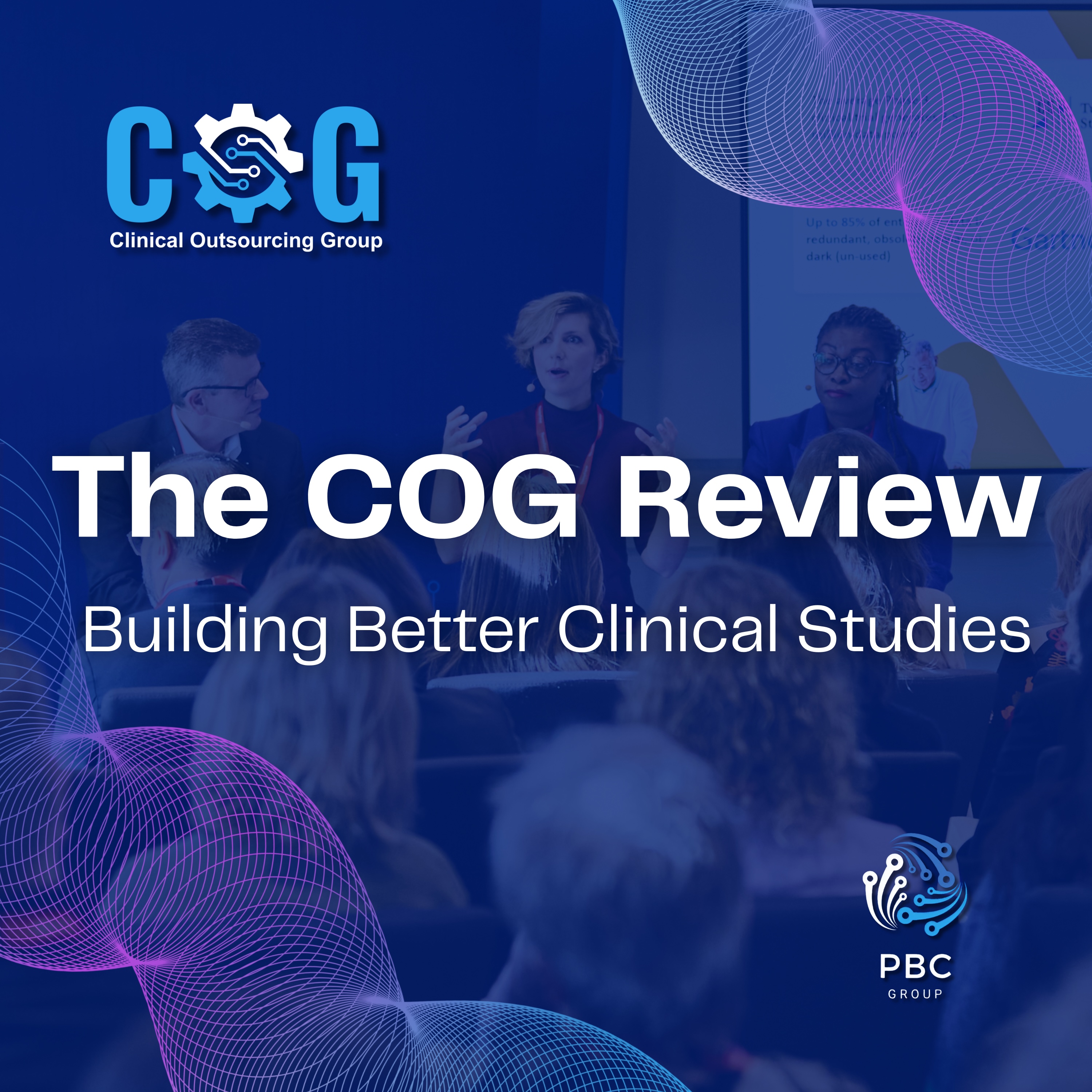
The COG Review: Building Better Clinical Studies
The PBC Group
Frequency: 1 episode/13d. Total Eps: 13

Recent rankings
Latest chart positions across Apple Podcasts and Spotify rankings.
Apple Podcasts
🇬🇧 Great Britain - lifeSciences
27/05/2026#85🇬🇧 Great Britain - lifeSciences
26/05/2026#72🇬🇧 Great Britain - lifeSciences
25/05/2026#54🇬🇧 Great Britain - lifeSciences
24/05/2026#38🇬🇧 Great Britain - lifeSciences
23/05/2026#30🇬🇧 Great Britain - lifeSciences
15/03/2026#97🇬🇧 Great Britain - lifeSciences
14/03/2026#83🇬🇧 Great Britain - lifeSciences
13/03/2026#64🇬🇧 Great Britain - lifeSciences
12/03/2026#47🇬🇧 Great Britain - lifeSciences
11/03/2026#29
Spotify
No recent rankings available
Shared links between episodes and podcasts
Links found in episode descriptions and other podcasts that share them.
See all- https://www.novartis.com/
40 shares

- https://thepbcgroup.com/blog
33 shares
- https://thepbcgroup.com
19 shares
RSS feed quality and score
Technical evaluation of the podcast's RSS feed quality and structure.
See allScore global : 78%
Publication history
Monthly episode publishing history over the past years.
Introducing The COG Review: Building Better Clinical Studies
Season 1
lundi 8 décembre 2025 • Duration 01:18
Better trials. Fewer delays. Improved outcomes.
The COG Review: Building Better Clinical Studies brings you the strongest sessions from the COG meeting series, recorded on site and selected for what helps teams move now.
Senior leaders, study owners, and problem solvers share what works so effective treatments reach patients sooner.
What you will hear across the season:
- Study design and feasibility
- Start-up speed
- Country and site activation
- Patient recruitment and retention
- Site partnerships and vendor collaboration
- Data quality and inspection readiness
- Leadership choices that move the needle
If you work in clinical operations or outsourcing, and you own delivery targets, this is built for you. Episodes run around 25 minutes and focus on insights you can use right away.
Follow The COG Review: Building Better Clinical Studies in your podcast app.
Learn more by heading to thepbcgroup.com.
Leveraging Key Opinion Leaders in Clinical Research Strategy and Execution With Thierry Schulmann
Season 1 · Episode 8
jeudi 26 février 2026 • Duration 23:09
Discover how early engagement with key opinion leaders transforms clinical trial outsourcing decisions, reduces program risk, and optimizes clinical operations for higher-impact trial outcomes.
Guest- Thierry Schulmann, Senior Director, Medical Affairs Strategy, Sumitomo Pharma (LinkedIn)
Episode Overview
This episode—recorded live at COG Europe—features Thierry Schulmann, Senior Director, Medical Affairs Strategy at Sumitomo Pharma, in a highly practical session focused on the operational value of engaging key opinion leaders (KOLs) early in clinical research.
Listeners will gain a clear framework for involving KOLs at each stage of clinical trial outsourcing, from initial design and feasibility to trial execution and market access. Drawing from real-world case studies, Thierry Schulmann illustrates how underestimating KOL input can lead to misalignment on endpoints, failed market launches, or unmet regulatory expectations—even in otherwise well-executed trials.
The discussion covers:
- Why CRO selection should account for KOL expertise and therapeutic alignment
- How to use KOL engagement to build patient-centered protocols and enhance feasibility, recruitment, and retention
- The impact of KOLs on regulatory strategy, payer acceptance, guideline inclusion, and real-world implementation
For clinical operations professionals, outsourcing leads, and vendor managers, the episode provides actionable strategies to protect trial value, avoid program pitfalls, and ensure the commercial relevance of new therapies through smarter stakeholder engagement and clinical study optimization.
Key Moments00:02:10 – Framing the risks: Why approved products still fail to launch due to misaligned trial endpoints and weak stakeholder input
00:03:13 – Case study: The commercial impact of not localizing active comparators for European market expectations
00:04:58 – Why strategic KOL engagement is a form of "outsourcing" critical expertise beyond CRO selection
00:07:13 – Clinical operations best practice: Focusing on endpoints that drive real-world adoption, not just statistical significance
00:09:28 – Bridging gaps: KOLs as operational connectors between academic protocols, regulatory requirements, and patient needs
00:10:40 – Regulatory navigation: How global KOL networks inform region-specific trial design and submission strategies
00:13:19 – Leveraging KOL and patient group relationships for evidence generation in rare and serious diseases
00:14:47 – Ensuring real-world effectiveness: The role of KOLs in validating trial design beyond controlled settings
00:18:30 – Lessons learned: When missed KOL input on comparator choice, unmet need assessment, or side effect profiles led to program failures
00:21:36 – When to engage KOLs: Practical recommendations for biotech and pharma, starting as early as Phase 1
Top 3 Takeaways- Proactive KOL engagement in early trial design is essential for successful clinical trial outsourcing and market access—don't wait until later phases to bring real-world and regulatory perspectives into protocol development.
- Aligning clinical study endpoints and comparators with both therapeutic practice and payer requirements optimizes trial relevance and supports smoother regulatory acceptance—a key consideration in clinical operations best practices and CRO selection.
- Building cross-functional collaboration with KOLs bridges gaps among sponsors, CROs, patient groups, and regulatory bodies, minimizing risk of costly rework and maximizing the practical value of clinical study optimization.
Quotes
"Making a study without launching it in the markets doesn’t make sense. Involve key opinion leaders early to ensure you’re not just building a study for science, but for real patient impact." — Thierry Schulmann
"Endpoints matter, but they must be clinically relevant. KOLs help ensure that what is statistically significant is also meaningful for adoption and payer acceptance." — Thierry Schulmann
"KOLs are not just scientific advisors—they bridge patient, regulatory, and market realities with sponsor strategy, reducing the risk of misaligned or commercially unviable trials." — Thierry Schulmann
"The reason products don’t launch isn’t always technical failure—it’s often weak alignment to the actual unmet need, pricing pressure, or irrelevance to local practice. KOL insight is the antidote." — Thierry Schulmann
"If you have a product, even in Phase 1, you should start discussing with KOLs. Don’t wait—disease awareness and unmet need education set the foundation for successful trial and market outcomes." — Thierry Schulmann
-----------
Further content and agendas: hhttps://thepbcgroup.com
Copyright 2026 The PBC Group
Navigating Biotech’s First-in-Human Trial in Rare Disease With Jurate Lasiene
Season 1 · Episode 7
jeudi 19 février 2026 • Duration 26:26
Learn how small biotech’s can streamline clinical trial outsourcing, optimize CRO selection, and establish truly patient-centered operations for rare disease studies—while maintaining high data quality and speed.
Guest- Jurate Lasiene, VP Clinical Operations, North Sea Therapeutics
- LinkedIn: Jurate Lasiene
Episode Overview
This episode of The COG Review: Building Better Clinical Studies is recorded live at COG Europe in Amsterdam. Jurate Lasiene, VP Clinical Operations at North Sea Therapeutics, shares firsthand insights from managing a first-in-human, early-phase rare disease trial with a small, agile biotech team. The session explores critical decision points and real-world solutions in clinical trial outsourcing, CRO selection, and effective sponsor–vendor collaboration.
Key topics include designing adaptive, patient-first protocols for challenging rare disease populations, the shift from traditional full outsourcing models to targeted FSP (Functional Service Provider) or hybrid approaches, and optimizing budget, speed, and quality by retaining operational control in-house where it matters most. Jurate Lasiene offers a practical breakdown of site and partner selection, early regulatory and KOL engagement, and hands-on clinical operations best practices.
This episode equips clinical research professionals in biotech, pharma, and CROs with actionable frameworks for clinical study optimization—especially useful for those navigating complex trials with lean teams and limited resources. Listeners gain concrete guidance on the sponsor-side leadership choices and process refinements that reduce common failure points and accelerate study timelines.
Key Moments00:01:40 – The unique operational challenges of rare disease trials: small, dispersed patient populations and high rates of trial discontinuation
00:03:41 – Why small biotech’s are driving the majority of clinical trial starts and how their outsourcing strategies have evolved
00:04:31 – Clinical trial protocol design: avoiding rigid endpoints and restrictive eligibility to improve enrollment and retention
00:05:16 – The necessity of integrating patient and caregiver input early for truly patient-centered clinical trials
00:06:45 – How to select clinical trial sites: speed, fit, and operational capacity versus academic prestige
00:08:31 – Practical cost-savings from targeted FSP models: 30% budget reduction by outsourcing only specialty capabilities
00:10:23 – Engaging KOLs and patient advocacy groups at the protocol development stage for better outcomes
00:11:41 – Keeping oversight in-house with dedicated monitors/PMs: advantages for quality and site engagement
00:13:27 – Building a “meshwork” of specialist partners to keep small teams agile, responsive, and in control
00:16:46 – Simulating the patient journey to optimize protocol, logistics, and site operations for clinical study optimization
Top 3 Takeaways- Early and deep integration of clinical operations into trial and protocol design is essential for avoiding downstream roadblocks—making this a core clinical operations best practice.
- Targeted outsourcing and deliberate CRO selection (favoring fit and flexibility over scale alone) enables small teams to maintain control, ensure sponsor oversight, and optimize budgets.
- Mapping the exact patient (and caregiver) journey—through direct simulation and advocacy group input—prevents oversights, reduces participant burden, and improves enrollment and retention in rare disease studies.
Links & Resources
- Rare Disease Clinical Trials Toolkit – Clinical Trials Transformation Initiative (CTTI)
- Clinical Operations Best Practice Resources—PBC Group Blog
Quotes
“Protocol and study design cannot be rigid—it’s critical your endpoints are meaningful and achievable for rare disease populations.” – Jurate Lasiene
“We developed a strong sponsor-site-vendor collaboration... Different partners were extensions of our in-house team exactly where and when needed.” – Jurate Lasiene
“Walking the patient journey ourselves—wheelchairs, waiting rooms, paperwork—changed how we approached the protocol entirely. You don’t know the burden unless you see it firsthand.” – Jurate Lasiene
“Small biotech’s can run early-phase rare disease trials successfully if they combine patient-first design, deep clinical operations knowledge, and targeted FSP outsourcing.” – Jurate Lasiene
“It’s important to choose partners that work for you, with you—not just imposing their way of doing things.” – Jurate Lasiene
-----------
Further content and agendas: hhttps://thepbcgroup.com
Copyright 2026 The PBC Group
From Outsourcing to Orchestrating: The Clinical Mesh Playbook with Maria Expósito Lorido
Season 1 · Episode 6
jeudi 12 février 2026 • Duration 27:33
Discover operational strategies to move beyond traditional clinical trial outsourcing—learn how the clinical mesh approach can optimize study speed, oversight, and cost efficiency for today’s clinical operations leaders.
Guest- Maria Expósito Lorido (LinkedIn)
- Venture Partner, Vu Venture Partners
- Extensive experience in clinical development, clinical trial outsourcing, and operational leadership within pharma/biotech
Episode Overview
This live session from COG Europe in Amsterdam features Maria Expósito Lorido, a leading venture partner with hands-on experience designing and implementing innovative clinical outsourcing strategies. Maria offers a compelling presentation shifting the conversation from conventional CRO selection and outsourcing models to a new paradigm: sponsor-led orchestration through the clinical mesh playbook.
Listeners gain practical guidance on clinical operations best practices by contrasting traditional outsourcing with platform and ecosystem-based models. Maria reveals why most studies fall short on recruitment, what it costs, and how an orchestrated mesh of specialized partners can reduce delays and increase value for sponsors and patients alike.
Specific areas covered include how to tailor sourcing architecture to your study’s needs, which operational components to retain or externalize, and ways to apply clinical study optimization principles for faster, more flexible trial delivery. The episode also addresses implementation steps, measurable KPIs, and critical sponsor responsibilities in this emerging model.
Ideal for clinical operations, outsourcing managers, and vendor strategy professionals seeking to future-proof their approach to CRO selection and clinical trial outsourcing.
Key Moments00:03:00 – Why 80% of clinical studies miss recruitment targets and the financial impact of delays
00:05:00 – Comparing small, agile biotech teams vs large pharma R&D models for clinical trial delivery
00:06:55 – The Nvidia platform analogy: platform business models vs linear development pipelines
00:07:10 – Introduction to the “clinical mesh” model: moving from fixed structures to reconfigurable networks
00:08:33 – Three sourcing architecture types—full-service CRO, functional service provider, and clinical mesh—and when each works best
00:11:23 – Governance challenges and sponsor responsibilities under the mesh model
00:14:04 – Early-stage oncology case study: cost, timelines, and screen failure rate compared across outsourcing models
00:16:27 – Quality management, risk, and safety oversight: what sponsors must own when orchestrating a clinical mesh
00:18:57 – KPIs for clinical study optimization: measuring cost per qualified patient, time to first contact, and more
00:19:43 – 90-day roadmap for piloting a clinical mesh approach with stepwise best practices
Top 3 Takeaways- Orchestrate, don’t just outsource: Sponsors retain strategy, quality, and data oversight even when leveraging a network of specialized vendors—this increases flexibility and operational control compared to traditional outsourcing.
- Match sourcing architecture to study needs: Evaluate each study to determine the best-fitting sourcing model (full-service CRO, hybrid/FSP, or clinical mesh), rather than defaulting to a single approach for all trials.
- Pilot and measure for impact: Implement outcome-based KPIs (e.g., cost per qualified patient, time to last patient in) and compare mesh-driven pilots to traditional models for real-world evidence of clinical operations best practices.
Links & Resources
Quotes
“Instead of asking which CRO to use, we should define the right sourcing architecture based on the study’s maturity and needs.” — Maria Expósito Lorido
“This is a wake-up call. The value lies in building platforms and ecosystems, not just pipelines.” — Maria Expósito Lorido
“In the mesh model, sponsors own quality management, integrated risk plans, and data integrity—it’s orchestration, not abdication.” — Maria Expósito Lorido
“You don’t need a revolution, just a well-designed first pilot. Start small; scale what works.” — Maria Expósito Lorido
“The future belongs to platform thinking. The winners will be those who can compose the right ecosystem for each study.” — Maria Expósito Lorido
-----------
Further content and agendas: hhttps://thepbcgroup.com
Copyright 2026 The PBC Group
Global Shift: Outsourcing Clinical Trials In A Changing World with Heike Schoen
Season 1 · Episode 5
jeudi 29 janvier 2026 • Duration 28:01
Navigating Global Clinical Trial Outsourcing: Risk, Strategy & CRO Partnerships in a Changing World
Gain operational clarity on the evolving landscape of clinical trial outsourcing—discover the risk factors, partnership models, and geographic strategies reshaping CRO selection and clinical operations.
Guest- Heike Schoen, CEO, Loomis International (LinkedIn)
- 20+ years in clinical operations, global trial strategy, and vendor management
- Bart Scheerder, Host
- Authority in European clinical operations and outsourcing trends
- David Jones, Head of Content, The PBC Group
Recorded live at COG Europe, Amsterdam.
Episode OverviewThis episode of The COG Review: Building Better Clinical Studies features Heike Schoen, CEO of Loomis International, in a keynote session from COG Europe. The discussion centers on the global shift in clinical trial outsourcing, with a sharp focus on how sponsors and CROs are adapting to rapid changes in regulation, geopolitics, and technological innovation.
Heike Schoen explores the evolution of sponsor–CRO partnerships, from transactional service agreements to nuanced hybrid models, where flexibility and deep therapeutic expertise are essential for success. Practical examples from Novartis–PPD and Moderna–Medidata illustrate both functional service partnerships and the impact of digital, decentralized trials.
Key areas include CRO selection strategies for emerging markets, navigating regulatory changes, and building operational agility in the face of supply chain fragility and geopolitical risk. Insights are tailored for professionals involved in clinical operations best practices, outsourcing decisions, and those seeking to optimize clinical studies through smarter partnerships and technology use.
The session closes with real-world challenges and live audience questions on how to structure outsourcing models, respond to regulatory shifts, and future-proof location choices for clinical trials.
Key Moments00:03:37 – Global clinical trial outsourcing market growth and drivers
00:04:45 – The rise of hybrid CRO partnerships: strategic alliances vs. modular models
00:06:06 – Digital platforms and AI: boosting operational efficiency in decentralized trials
00:07:00 – CROs must demonstrate deep therapeutic expertise and flexible service models
00:08:15 – Geographic diversification: assessing emerging markets for clinical study optimization
00:10:06 – AI’s impact on CRO value pools: standardization and resource allocation
00:12:09 – Comparative advantages of clinical outsourcing in the US, Asia-Pacific, Europe, Latin America, Africa, and the Middle East
00:14:24 – Geopolitical risks in outsourcing: contingency planning for disruption and instability
00:16:08 – Supply chain fragility and cross-border data management: lessons for clinical operations best practices
00:18:10 – Key drivers for outsourcing strategy: cost pressure, patient diversity, regulatory speed
00:19:49 – Location strategy essentials and what sponsors should expect from CROs
00:24:29 – Guidance for small biotechs on engaging CROs and designing flexible outsourcing models
Top 3 Takeaways- Hybrid CRO partnership models are becoming standard—sponsors should seek partners who can offer both full-service and functional capabilities to improve flexibility and execution speed.
- Geopolitical risk mitigation and supply chain planning are now core to clinical trial outsourcing decisions; build contingency plans and select CROs with multi-jurisdictional expertise.
- Digital technology and real-time data analytics are advancing clinical study optimization; prioritize CRO selection processes that assess digital readiness and regulatory adaptability.
Links & Resources
- The PBC Group – Events & Blog
- Boston Consulting Group: AI in CRO Value Pools
- Medidata Decentralized Trials Resource
Quotes
“CROs are no longer simply generalists—they’re expected to offer deep therapeutic specialization and the agility to scale services as sponsors’ needs change.” — Heike Schoen
“Location strategy matters more than ever before. Regulatory and political stability are now core criteria in both site and CRO selection.” — Heike Schoen
“The shift to hybrid outsourcing models allows sponsors to retain expertise in-house while leveraging CRO resources for specialized functions, giving teams more flexibility to manage complex trials.” — Heike Schoen
“The impact of AI on CROs will disrupt up to 30% of traditional value pools, from monitoring to medical writing, driving efficiency but requiring teams to rethink resource allocation.” — Heike Schoen
“Contingency planning for geographic disruption isn’t optional anymore—it’s essential for every sponsor managing clinical trial outsourcing in a volatile world.” — Heike Schoen
-----------
Further content and agendas: hhttps://thepbcgroup.com
Leadership Insights into Pipeline Strategy with Emily Roberts-Thomson, Raj Patel, Nikhil Dube, and Mukhtar Ahmed
Season 1 · Episode 4
jeudi 22 janvier 2026 • Duration 26:02
Pipeline Strategy: Balancing Science, Feasibility, and ROI in Clinical Development Decisions
What does it take to make confident, cross-functional pipeline decisions that drive approval speed and sustainable value for companies in today’s clinical research landscape?
Moderated by Emily Roberts-Thomson, Development Operations Leader
Featuring:
• Raj Patel, Chief Operating Officer, ReacX Pharmaceuticals
• Nikhil Dube, Lifecycle Management Strategy Lead, Biogen
• Mukhtar Ahmed, Director, Project and Portfolio Strategy, Greenstone Biosciences
Recorded live at COG Bay Area, this panel brings together senior voices from leading biotech and pharma organizations to tackle the realities of pipeline prioritization and clinical operations best practices. Moderated by Emily Roberts-Thomson, the discussion centers on actionable frameworks and leadership judgment required for effective clinical trial outsourcing, CRO selection, and cross-functional portfolio management.
The panelists break down how organizations decide which programs to advance, weighing scientific potential against development feasibility, market factors, risk, and resource constraints. They candidly explore trade-offs inherent to outsourcing strategies, clinical study optimization, and how changes in ROI, timelines, or operational setbacks impact pipeline decisions.
Essential listening for clinical operations leaders, outsourcing specialists, and study owners, the episode delivers practical insights on moving from scientific conviction to commercial success—and ensuring alignment across sponsors, CRO partners, and governance bodies in a rapidly shifting environment for clinical trial outsourcing.
Key topics include:
- Balancing science, feasibility, and business drivers in pipeline advancement decisions
- Managing cross-functional alignment across R&D, clinical operations, and commercial teams for better governance
- The critical role of financing, investor expectations, and real-world feasibility in CRO selection and vendor management
Key Moments
00:03:20 – Emily Roberts-Thomson frames the multifactor decision: “It’s never just about how good the science is. It’s about feasibility, market dynamics, and resource allocation.”
00:04:00 – Raj Patel outlines a practical pipeline selection matrix: fastest to approval, least cost, minimal risk—plus the real-world influence of boardroom priorities and investor interests.
00:05:00 – Nikhil Dube shares a three-pronged approach: scientific value, clinical development feasibility, and commercial opportunity—all critical for clinical study optimization and vendor selection frameworks.
00:06:37 – Mukhtar Ahmed describes a hybrid model leveraging academic depth and operational agility, focusing on robust human data and milestone-driven inflection points for outsourcing viability.
00:08:02 – Panel debate: How companies trade off first-in-class scientific programs against downstream commercial opportunity when making outsourcing or CRO selection decisions.
00:13:28 – Emily Roberts-Thomson and Raj Patel candidly discuss the reality of reprioritizing clinical studies based on changing business needs and operational feasibility—impacting CRO and vendor engagement.
00:14:29 – Achieving cross-functional consensus: Lessons from balancing scientific advocacy, operational feasibility, and business priorities in pipeline governance.
00:17:05 – Raj Patel on how investors and shifting market landscapes dictate which programs move forward—and how funding realities drive clinical outsourcing strategies.
00:19:13 – Nikhil Dube unpacks how project leads in large pharma orchestrate collaboration across research, development, commercial, and outsourcing teams for better governance and vendor alignment.
00:22:56 – Mukhtar Ahmed on the importance of transparent, all-hands communication and real-world feasibility checks with KOLs and clinical trial site experts when planning outsourcing for early-phase studies.
Top 3 Takeaways- Balance Science and Feasibility with Business Realities
- Even the most promising science requires practical validation against operational costs, study feasibility, and commercialization potential—crucial for smart clinical trial outsourcing and CRO selection.
- Cross-Functional Collaboration Drives Success
- Early, transparent input from R&D, clinical operations, and commercial leaders creates alignment and sets up clinical operations best practices for study optimization and outsourcing partnerships.
- Investor and Market Pressures Shape Pipeline and Outsourcing Choices
- Shifts in funding, risk tolerance, and evolving market needs can upend study priorities—requiring agile, milestone-based approaches and robust clinical outsourcing governance.
Links & Resources
Clinical Outsourcing Group (COG) Events – https://thepbcgroup.com/cog-events
Biogen – https://www.biogen.com
Greenstone Biosciences – https://greenstonebio.com
ReacX Pharmaceuticals – https://reacxpharma.com/
National Institute on Drug Abuse – https://nida.nih.gov
Quotes“It’s never just about how good the science is. It’s about balancing the potential with feasibility, market dynamics, and resource allocation.” – Emily Roberts-Thomson
“You have to make some tough decisions… which product will give you the fastest approval, for the least money, with minimal risk.” – Raj Patel
“Every company uses the same three pillars: scientific conviction, development feasibility, and commercial opportunity.” – Nikhil Dube
“If you don’t have the funds, you might have the best science, but you’re not going to get anywhere.” – Raj Patel
“We try to always come back to how quickly we can get human-relevant data, early on. That’s what drives both scientific confidence and investor capital.” – Mukhtar Ahmed
“Cross-functional alignment is near and dear… silos have no place in small biotech.” – Mukhtar Ahmed
-----------
Further content and agendas: hhttps://thepbcgroup.com
Copyright 2026 The PBC Group
AI Integration: Outsourcing Now and Next with Paulius Ojeras
Season 1 · Episode 3
mercredi 14 janvier 2026 • Duration 32:19
AI Integration in Clinical Trial Outsourcing: Best Practices for Operational Efficiency and CRO Selection
Learn how AI agents are reshaping clinical study optimization, enhancing quality and scalability in clinical trial outsourcing—and what you need to know for smarter CRO selection and oversight.
Featuring:
- Paulius Ojeras, Head of Clinical Operations, Perceive Biotherapeutics (LinkedIn),
- 18+ years’ experience in biotech and global CRO management; specialist in innovative trial designs, outsourcing strategy, and the operational application of emerging technologies.
This live session, recorded at COG Bay Area, features Paulius Ojeras, Head of Clinical Operations at Perceive Biotherapeutics, as he shares hands-on insights about integrating AI agents into clinical operations and outsourcing models. The discussion is grounded in practical experience, with real examples from Perceive’s studies.
The core theme revolves around how clinical trial outsourcing strategies evolve—and sometimes fundamentally change—when sponsors adopt AI-driven solutions for process automation, team scalability, and quality management. Paulius Ojeras breaks down where AI makes the biggest difference, from TMF (Trial Master File) management to site startup and document QC, offering lessons learned for sponsor teams evaluating new outsourcing approaches.
Key topics include frameworks for CRO selection, managing vendor relationships in an AI-enabled environment, and de-risking operational transitions. The episode emphasizes clinical operations best practices—particularly how to balance technology adoption with oversight, accountability, and regulatory requirements—giving actionable guidance for teams focused on clinical study optimization and sponsor–CRO partnership models.
Key Moments00:02:43 – Why the real question isn’t if AI will disrupt clinical trials, but how smart and fast sponsors will adopt AI solutions
00:05:00 – Breakdown of AI integration levels: from basic automation to autonomous, agentic AI teammates in clinical operations
00:09:47 – Case study: Applying AI agents to TMF management—quality gains and lessons from real deployment at Perceive Biotherapeutics
00:13:43 – AI-driven QC finds up to 25% errors in TMF documentation, challenging norms in clinical trial outsourcing
00:15:13 – Real-time document feedback and task tracking—how automation improves speed and regulatory compliance
00:18:11 – Vendor selection due diligence: key criteria for assessing AI-focused clinical trial outsourcing partners
00:21:31 – Addressing the challenge of outcome consistency: why it’s critical for regulated clinical trials and CRO selection
00:24:38 – Rethinking process design for end-to-end automation, not just adding tools to legacy workflows
00:25:37 – The importance of training internal teams for AI literacy and prompt engineering to maximize value from technology
00:26:31 – Final guardrail: Success depends on thoughtful, disciplined AI adoption—not just speed or hype
Top 3 Takeaways- Prioritize solutions over tools: When evaluating clinical trial outsourcing options, select vendors who offer true operational support (setup, oversight, supervision), not just technology. This is key for effective CRO selection and minimizing added complexity.
- Redesign processes for automation: For clinical operations best practices, rethink workflows to fully leverage AI agents—instead of layering automation on top of manual processes—to drive scalability and quality in study delivery.
- Validate consistency and accountability: In any clinical study optimization strategy, ensure AI-enabled solutions meet regulatory demands for outcome consistency and clear accountability. Always demand testing, independent benchmarks, and a robust oversight framework from vendors.
Links & Resources
The PBC Group: https://thepbcgroup.com
Perceive Biotherapeutics: https://perceivebio.com
Quotes“Clinical operations remain very human-intensive—yet with agentic AI, we can rethink how we execute trials, building scalability and quality into every step.” — Paulius Ojeras
“When assessing emerging vendors, look for live deployments, reference use cases, and financial runway. Don’t buy the hype—buy the solution your team actually needs.” — Paulius Ojeras
“In highly regulated environments, consistency is the hardest challenge for AI. Ask your vendor how they independently verify the outcome of their agents.” — Paulius Ojeras
“Human intelligence is essential to set up and oversee AI teammates—everything else should be designed for autonomous, high-quality delivery.” — Paulius Ojeras
-----------
Further content and agendas: hhttps://thepbcgroup.com
Copyright 2026 The PBC Group
Meaningful Patient Engagement in Clinical Trials: Beyond Tokenism to True Value with Lisa Lea
Season 1 · Episode 2
vendredi 9 janvier 2026 • Duration 20:36
Embedding the Patient Voice: Best Practices for Patient Engagement in Clinical Trial Outsourcing
Discover how integrating meaningful patient engagement strategies throughout clinical trial outsourcing can drive study optimization, reduce recruitment delays, and create more inclusive, effective clinical research.
Guest- Lisa Lea
- Director of Patient Insights, Merck
- Over 20 years of biotech and clinical expertise
- Specialist in pulmonary arterial hypertension and patient-centered trial design
Episode Overview
This episode, recorded live at COG Bay Area, features Lisa Lea, Director of Patient Insights at Merck, sharing actionable frameworks for incorporating real patient perspectives into every stage of clinical trial outsourcing and operations. In a session tailored to trial sponsors, CROs, and operational leaders, Lisa Lea draws on two decades of industry and clinical site experience to address the operational and strategic value of authentic patient engagement.
You'll gain a grounded perspective on how early, frequent patient input enhances CRO selection and clinical study optimization. From adjusting inclusion criteria and endpoint selection to reducing recruitment challenges and addressing protocol burdens, learn how patient-centered approaches create efficiencies and improve outcomes across the outsourced trial lifecycle.
Key topics include:
- The regulatory evolution of patient engagement, with lessons for clinical outsourcing models
- Operational benefits, such as fewer delays and more relevant data through improved trial design
- Practical methods for embedding patient voice in trial protocols and vendor collaboration
- This session offers both strategic guidance and frontline examples you can apply to clinical operations best practices, CRO selection, and effective sponsor–CRO–patient partnerships.
Key Moments
00:02:45 – Defining “patient engagement” and why it matters for clinical trial operations
00:03:59 – The real-world operational risks of omitting patient voice: recruitment shortfalls and study delays
00:06:55 – Historical drivers: How patient advocacy reshaped regulatory expectations and clinical outsourcing approaches
00:08:08 – Balancing patient risk–benefit preferences in protocol and CRO/vendor collaboration
00:09:07 – Impact of patient engagement on diverse recruitment, site selection, and CRO performance
00:10:42 – Actionable steps: Where and how to embed patient insights in the clinical development and outsourcing pathway
00:13:03 – Real example: Protocol design oversights leading to lost sites, and learnings for sponsor–CRO study teams
00:14:40 – Participants’ desire for real influence, not token feedback—building feedback loops for operational improvement
00:16:09 – Key regulatory guidances and industry resources for patient-centric trial design and clinical outsourcing decisions
00:17:15 – Overcoming practical barriers: Internal advocacy, framework creation, and pilot programs for patient engagement
Top 3 Takeaways- Early and frequent patient input—starting before CRO selection—can preempt recruitment failures and reduce costly protocol amendments, directly supporting clinical study optimization.
- Establishing structured patient engagement frameworks and closing the feedback loop with trial participants strengthens sponsor–CRO collaboration and drives operational excellence.
- Prioritizing patient-relevant endpoints and burden reduction creates more diverse, successful trials—delivering greater value to sponsors, CROs, and, most importantly, patients.
Links & Resources:
- The PBC Group: https://thepbcgroup.com
- EUPATI (European Patients’ Academy): https://www.eupati.eu
- FDA Patient-Focused Drug Development Guidance: https://www.fda.gov/drugs/development-approval-process-drugs/fda-patient-focused-drug-development-guidance-series-enhancing-incorporation-patients-voice-medical
- DIA Patient Engagement e-Learning: https://www.diaglobal.org/en/course-listing#
Quotes:
“Clinical trials are ultimately about people. If the design, conduct, and measurement don’t resonate with patients, participation and retention—as well as the relevance of the trial—really pay a price.” – Lisa Lea
“Engaging with patients early and often is really going to help the process and improve your clinical trials. It’s not just a nice-to-have—it’s more and more a need-to-have.” – Lisa Lea
“There’s about 80% of clinical trials that fail to meet their recruitment goals. A lot of that can be attributed to patient burden—something we can address through stronger engagement.” – Lisa Lea
“Patients do not want to feel like they’re checking a box. They want to feel like their input is valued. So providing some sort of feedback loop is key.” – Lisa Lea
“To do clinical outsourcing well, incorporating the patient voice is crucial—not just possible.” – Lisa Lea
-----------
Further content and agendas: hhttps://thepbcgroup.com
Copyright 2026 The PBC Group
Optimizing Stakeholder Engagement for Timely Completion of Clinical Trials with Kimberly Guedes
Season 1 · Episode 1
mardi 16 décembre 2025 • Duration 31:51
Optimising Stakeholder Engagement: Clinical Trial Outsourcing, CRO Selection, and Delivery Best Practices with Kimberly Guedes
Discover actionable strategies to align incentives, clarify roles, and streamline communication for faster, more predictable clinical trial delivery—essential listening for anyone involved in clinical trial outsourcing, CRO selection, or operational leadership.
Guest- Kimberly Guedes
- Vice President, Clinical Operations, Intensity Therapeutics
- 30+ years’ experience in global drug development across preclinical to Phase IV studies
- Leader in process improvement, vendor management, and clinical operations strategy
Episode Overview
Recorded live at a Clinical Outsourcing Group (COG) Bay Area event and introduced by David Jones, this episode features Kimberly Guedes, VP Clinical Operations at Intensity Therapeutics. In her keynote, Kimberly addresses the operational realities and leadership challenges of optimising stakeholder engagement in clinical trial delivery.
The session offers practical insight into the core factors behind study delays, the importance of early alignment, and communication strategies that underpin successful clinical trial outsourcing programmes. Clinical operations professionals, outsourcing leads, and vendor managers will find a grounded framework for ensuring clarity between sponsors, CROs, service vendors, and research sites.
Topics include:
- The dynamics of stakeholder collaboration in clinical outsourcing models
- Criteria for effective CRO selection and ongoing governance
- Methods for bridging communication gaps and achieving clinical study optimisation
- Handling team changes, fostering trust, and responding to practical constraints
This episode is designed for those seeking proven clinical operations best practices to help accelerate timelines, improve outsourcing partnerships, and enhance delivery outcomes.
Key Moments00:03:20 – Defining stakeholder engagement in the context of clinical trial outsourcing and delivery
00:04:11 – Understanding unique perspectives and constraints of sponsors, CROs, vendors, sites, and patients
00:05:09 – Building predictability and trust through early, honest communication
00:06:54 – Risks of poor engagement: delays, rework, low morale, and project failure
00:08:02 – The importance of joint project planning and cross-functional team training
00:10:03 – Creating a culture of mutual respect, transparency, and recognition with partners
00:12:03 – Establishing clear roles, responsibilities, and governance for effective CRO/vendor partnerships
00:14:56 – The impact of understanding team members' strengths, backgrounds, and communication styles
00:18:16 – Shifting from reactive blame to collaborative problem solving in clinical operations
00:19:26 – Empowering all stakeholders to ask questions and contribute new ideas for study optimisation
00:27:15 – Best practices for engaging remote or distributed teams in clinical outsourcing delivery
Top 3 Takeaways- Initiate open, honest conversations about constraints and expectations early in the outsourcing process to set realistic study timelines and avoid costly delays (CRO selection and clinical trial outsourcing).
- Establish—and regularly review—clear roles, responsibilities, and escalation pathways with all stakeholders to drive accountability and ensure effective governance (clinical operations best practices).
- Foster ongoing, two-way communication and inclusivity across sponsor, CRO, and site teams, recognising the value of both formal meetings and informal, human connection to enhance engagement and project continuity (clinical study optimisation).
Links & Resources
Quotes
“We’re all a team and we all have something to gain here and we have a lot to lose here—we build more rapport and trust if we can have honest conversations, even if they’re not always easy.” – Kimberly Guedes
“If you don’t know the constraints of your partners, or the timelines they can realistically deliver, then you’ve failed already—those conversations need to happen before your protocol is even finalised.” – Kimberly Guedes
“It’s not about blame; it’s about how we pick up the ball and work together to get to the end zone—focus on solutions rather than pitfalls.” – Kimberly Guedes
“Being clear in your communications—what needs to be done, by whom, and when—creates predictability and reduces costly rework. Ambiguity is the enemy of timely delivery.” – Kimberly Guedes
“Everyone wants to feel like they are part of something. Empowering sites, participants, CROs, and sponsors—all stakeholders—not only improves retention, it’s the mark of successful clinical outsourcing.” – Kimberly Guedes
-----------
Further content and agendas: hhttps://thepbcgroup.com
Copyright 2026 The PBC Group
Strategic CRO Selection & Vendor Partnerships: Real-World Approaches for Emerging Biopharma
Season 1 · Episode 12
mardi 12 mai 2026 • Duration 38:29
Learn practical strategies and insights from experts on how to outsource clinical trials and choose CROs, aimed at helping clinical operations leaders improve study execution and strengthen relationships with vendors.
Speakers- Nara Daubany – CEO & Co-Founder, Phaim Pharma
- Graeme Duncan – Head of Clinical Development, Neurocentrix
- Claire Herholdt – VP Clinical Operations, Levicept
- Bradley Norton – VP Clinical Operations, Gylden Pharma
- Sarah Whalley – Director Clinical Operations, Uploid Biotechnologies
- Deirdre Flaherty – VP Product Strategy & Clinical Operations, Alchemab Therapeutics
- Julia Vassiliadou – VP Clinical Operations, F2G
Episode Overview
Recorded live at COG UK, this panel brings together senior clinical operations leaders from emerging biopharma and specialty biotech companies to share their operational realities, decision frameworks, and lessons learned in clinical trial outsourcing and CRO selection.
Panelists reveal how small, lean teams evaluate CRO fit beyond price, integrating clinical operations best practices to ensure continuity, ownership, and transparency throughout the study lifecycle. The discussion examines differences in working with small- and mid-sized CROs versus the Big Five providers, including non-negotiables in vendor selection and the impact of global studies on CRO partnership decisions.
Key questions addressed include:
- How do sponsors prioritize CRO selection criteria beyond cost?
- What practical signals indicate a CRO’s operational capacity, therapeutic expertise, and partnership mindset?
- How do sponsors manage global clinical outsourcing, regional complexity, and adapt outsourcing models for rare disease, vaccines, or novel therapeutic areas?
The session offers a real-world look at study startup, site activation, patient recruitment, and the evolving landscape of sponsor, vendor collaboration, all with a focus on clinical study optimization and actionable takeaways for operations, outsourcing, and stakeholder teams.
Key Moments00:01:49 – Defining the scope: clinical trial outsourcing, vendor fit, and operational efficiency
00:09:18 – Key decision levers for study location and CRO selection, balancing funding, patient access, and regulatory challenges
00:12:18 – Sponsor “killer questions” for CROs: assessing experience, partnership, and project de-risking
00:13:29 – Site selection frameworks: the role of specialty CROs in pain and OA studies, evidence-based site/country choice
00:14:43 – Global partnerships for vaccine trials: aligning CRO selection with endemic regions and collaborative partners
00:17:29 – Rare disease clinical outsourcing: CRO global presence, therapeutic expertise, and sponsor oversight
00:21:10 – Fitting the CRO model to novel, non-traditional clinical trial designs (e.g., IVF, women’s health)
00:24:31 – Weighing small/mid-sized versus large CROs: sponsor risk, project fit, and operational agility
00:27:28 – Sponsor oversight with large CROs: importance of clear communication, consistency, and global reach
00:29:12 – Transparency and adaptive CRO selection across study phases and pivotal trials
00:31:33 – Risk-sharing and creative contracting: milestone payments, outsourcing models, and sponsor independence
00:34:34 – Panel’s “non-negotiables”: continuity, ownership, proactive risk management, and transparent relationships
Top 3 Takeaways- Deep partnership matters more than price in CRO selection. Sponsors should prioritize operational fit, core team continuity, and shared ownership for clinical study optimization.
- Clinical trial outsourcing models are not one-size-fits-all. Consider therapeutic complexity, geographical spread, internal capabilities, and need for oversight when choosing between small, mid-sized, or global CROs.
- Early, collaborative protocol engagement with CROs reduces downstream amendments and fosters sponsor–vendor alignment, empowering teams to manage risk and accelerate delivery.
Links & Resources
- The PBC Group – Clinical Outsourcing Group events
- Phaim Pharma
- Neurocentrix
- Levicept
- Gylden Pharma
- Uploid Biotechnologies
- Alchemab Therapeutics
- F2G
Quotes
“Fit when they come into the room in that bid defense means a lot. Your ability as a small team to know that you can work with this other group of people collaboratively—that partnership is built through paper as well as formal interactions.” – Deirdre Flaherty
“The traditional setup of the biggest CROs… the worse your project is doing, the more money they make. If you have to add sites or amend, it translates into more cost. That’s untenable for small biotechs.” – Claire Herholdt
“The non-negotiable is the core team assigned to the project. My expectation is during award, that person remains on the study throughout.” – Graeme Duncan
“For rare disease, every patient counts. We needed a CRO with global presence and proven therapeutic expertise, plus strong sponsor oversight.” – Julia Vassiliadou
“It’s rarely cost. What matters to our investors is how fast you can get to a value inflection—how quickly you can get data. All those factors roll into what we want in a CRO partner.” – Deirdre Flaherty
-----------
Further content and agendas: hhttps://thepbcgroup.com
-----------
Further content and agendas: hhttps://thepbcgroup.com
Copyright 2026 The PBC Group
Related Shows Based on Content Similarities