The #1 Musical Experience – Details, episodes & analysis
Podcast details
Technical and general information from the podcast's RSS feed.
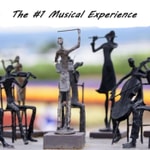

Longer instrumental works are often divided into self-contained pieces, called movements, often with contrasting characters or moods. For instance, symphonies written during the Classical period are usually divided into four movements:
( 1) An opening Allegro in sonata form, a slow movement,
a minuet or scherzo (in a triple metre, such as 3
4), and a final Allegro.
These movements can then be further broken down into a hierarchy of smaller units: first sections, then periods, and finally phrases.
Performers who have studied classical music extensively are said to be "classically trained". This training may come from private lessons from instrument or voice teachers or from completion of a formal program offered by a Conservatory, college or university, such as a Bachelor of Music or Master of Music degree (which includes individual lessons from professors). In classical music, "...extensive formal music education and training, often to postgraduate [Master's degree] level" is required.
Performance of classical music repertoire requires a proficiency in sight-reading and ensemble playing, harmonic principles, strong ear training (to correct and adjust pitches by ear), knowledge of performance practice (e.g., Baroque ornamentation), and a familiarity with the style/musical idiom expected for a given composer or musical work (e.g., a Brahms symphony or a Mozart concerto).
The key characteristic of European classical music that distinguishes it from popular music and folk music is that the repertoire tends to be written down in musical notation, creating a musical part or score. This score typically determines details of rhythm, pitch, and, where two or more musicians (whether singers or instrumentalists) are involved, how the various parts are coordinated. The written quality of the music has enabled a high level of complexity within them: fugues, for instance, achieve a remarkable marriage of boldly distinctive melodic lines weaving in counterpoint yet creating a coherent harmonic logic.
The use of written notation also preserves a record of the works and enables Classical musicians to perform music from many centuries ago.
Although Classical music in the 2000s has lost most of its tradition for musical improvisation, from the Baroque era to the Romantic era, there are examples of performers who could improvise in the style of their era. In the Baroque era, organ performers would improvise preludes, keyboard performers playing harpsichord would improvise chords from the figured bass symbols beneath the bass notes of the basso continuo part and both vocal and instrumental performers would improvise musical ornaments.
Johann Sebastian Bach was particularly noted for his complex improvisations. During the Classical era, the composer-performer Mozart was noted for his ability to improvise melodies in different styles. During the Classical era, some virtuoso soloists would improvise the cadenza sections of a concerto. During the Romantic era, Beethoven would improvise at the piano.
classical music ,classical music news ,classicalmusicworldusic youtube ,classical music composers ,classical music radio ,music history ,classicalmusic lover ,classicalmusicblog ,classical music downloads ,classical music concerts ,classical music for babies ,classical music for studying ,classical music for kids ,classical music online ,classical music of... Get bonus content on Patreon
Hosted on Acast. See acast.com/privacy for more information.
Recent rankings
Latest chart positions across Apple Podcasts and Spotify rankings.
Apple Podcasts
🇨🇦 Canada - performingArts
04/06/2026#88🇨🇦 Canada - performingArts
03/06/2026#48🇫🇷 France - performingArts
16/05/2026#97🇫🇷 France - performingArts
15/05/2026#90🇫🇷 France - performingArts
07/05/2026#89🇫🇷 France - performingArts
06/05/2026#82🇫🇷 France - performingArts
05/05/2026#73🇫🇷 France - performingArts
04/05/2026#62🇨🇦 Canada - performingArts
03/05/2026#84🇫🇷 France - performingArts
03/05/2026#48
Spotify
No recent rankings available
Shared links between episodes and podcasts
Links found in episode descriptions and other podcasts that share them.
See all- https://www.chosic.com/free-music/all/
3494 shares
- https://ourtownlive.net
54 shares
RSS feed quality and score
Technical evaluation of the podcast's RSS feed quality and structure.
See allScore global : 49%
Publication history
Monthly episode publishing history over the past years.
Jazz Love-Romantic
vendredi 14 octobre 2022 • Duration 05:38
Hosted on Acast. See acast.com/privacy for more information.
I - Allegro Schubert String Quintet
jeudi 8 septembre 2022 • Duration 16:35
The String Quintet in C major, D. 956 - and often referred to as Op. posth. 163- was Franz Schubert's final chamber work. It is a cello quintet, in the sense that it is scored for a standard string quartet lineup plus an additional cello -with the viola being by far the most common choice. The work has been described as a chamber music masterpiece, and since its public performance in 1850 and its publication in 1853, it has gained status as one of Schubert's finest works. Get bonus content on Patreon
Hosted on Acast. See acast.com/privacy for more information.
Violin Partita no. 2, BWV 1004 - 5. Chaconne [Piano arrangement]
lundi 13 juin 2022 • Duration 15:24
Hosted on Acast. See acast.com/privacy for more information.
Vivaldi Storm - Portrait of a Lady on Fire Version
samedi 22 mai 2021 • Duration 01:01:21
Hosted on Acast. See acast.com/privacy for more information.
George Gershwin Classics-Cuban Overture, Prelude #1, Others
lundi 17 mai 2021 • Duration 34:16
Born:
Jacob Bruskin Gershowitz, September 26, 1898, Brooklyn, New York City, U.S.
Died:
July 11, 1937, Los Angeles, California, U.S.
Resting place:
Westchester Hills Cemetery Get bonus content on Patreon
Hosted on Acast. See acast.com/privacy for more information.
Rachmaninoff - Piano Concerto No. 2, Op. 18 (Rubinstein)
vendredi 14 mai 2021 • Duration 33:09
Sergey Vasilyevich Rachmaninov, born in Semyonovo, Russia, on April 1, 1873, came from a music-loving, land-owning family; young Sergey's mother fostered the boy's innate talent by giving him his first piano lessons. After a decline in the family fortunes, the Rachmaninovs moved to St. Petersburg, where Sergey studied with Vladimir Delyansky at the Conservatory. As his star continued to rise, Sergey went to the Moscow Conservatory, where he received a sound musical training: piano lessons from the strict disciplinarian Nikolay Zverev and Alexander Siloti (Rachmaninov's cousin), counterpoint with Taneyev, and harmony with Arensky. During his time at the Conservatory, Rachmaninov boarded with Zverev, whose weekly musical Sundays provided the young musician the valuable opportunity to make important contacts and to hear a wide variety of music. Get bonus content on Patreon
Hosted on Acast. See acast.com/privacy for more information.
Four Seasons ~ Vivaldi
lundi 10 mai 2021 • Duration 42:30
The Four Seasons (Italian: Le quattro stagioni) is a group of four violin concerti by Italian composer Antonio Vivaldi, each of which gives musical expression to a season of the year. They were written around 1716–1717 and published in 1725 in Amsterdam, together with eight additional concerti, as Il cimento dell'armonia e dell'inventione (The Contest Between Harmony and Invention).
The Four Seasons is the best known of Vivaldi's works. Though three of the concerti are wholly original, the first, "Spring", borrows patterns from a sinfonia in the first act of Vivaldi's contemporaneous opera Il Giustino. The inspiration for the concertos is not the countryside around Mantua, as initially supposed, where Vivaldi was living at the time, since according to Karl Heller they could have been written as early as 1716–1717, while Vivaldi was engaged with the court of Mantua only in 1718.
They were a revolution in musical conception: in them Vivaldi represented flowing creeks, singing birds (of different species, each specifically characterized), a shepherd and his barking dog, buzzing flies, storms, drunken dancers, hunting parties from both the hunters' and the prey's point of view, frozen landscapes, and warm winter fires.
Unusual for the period, Vivaldi published the concerti with accompanying sonnets (possibly written by the composer himself) that elucidated what it was in the spirit of each season that his music was intended to evoke. The concerti therefore stand as one of the earliest and most detailed examples of what would come to be called program music—in other words, music with a narrative element. Vivaldi took great pains to relate his music to the texts of the poems, translating the poetic lines themselves directly into the music on the page. For example, in the middle section of "Spring", when the goatherd sleeps, his barking dog can be heard in the viola section. The music is elsewhere similarly evocative of other natural sounds. Vivaldi divided each concerto into three movements (fast–slow–fast), and, likewise, each linked sonnet into three sections. Get bonus content on Patreon
Hosted on Acast. See acast.com/privacy for more information.
Brandenburg Concerto No. 2 in F Major-Trumpet by Winston Marsalles
vendredi 7 mai 2021 • Duration 05:54
The trumpet part is still considered one of the most difficult in the entire repertoire, and was originally written for a clarino specialist, almost certainly the court trumpeter in Köthen, Johann Ludwig Schreiber. After clarino skills were lost in the eighteenth century and before the rise of the historically informed performance movement of the late twentieth century, the part was usually played on the valved trumpet, and sometimes on a modern F trumpet, a French horn, or even a B♭ piccolo trumpet.
The clarino does not play in the second movement, as is common practice in baroque era concerti. This is due to its construction, which allows it to play only in major keys. Because concerti often move to a minor key in the second movement, concerti that include the instrument in their first movement and are from the period before the valved trumpet was commonly used usually exclude the trumpet from the second movement.
The first movement of this concerto was chosen as the first musical piece to be played on the Voyager Golden Record, a phonograph record containing a broad sample of Earth's common sounds, languages, and music sent into outer space with the two Voyager probes. The first movement served as a theme for Great Performances in the early-to-mid 1980s, while the third movement served as the theme for William F. Buckley Jr.'s Firing Line; a revival featuring Margaret Hoover would also use the first movement.
Recent research has revealed that this concerto is based on a lost chamber music version for quintet called "Concerto da camera in Fa Maggiore" (Chamber Concerto in F major): catalogue number is BWV 1047R. It's similar to the orchestra version, in that the trumpet, flute, oboe and solo violin parts are the same, but the orchestra part has been arranged for basso continuo (or piano) by Klaus Hofmann. This reconstructed quintet arrangement is also the very first piano reduction of the 2nd Brandenburg Concerto ever published by Bärenreiter Verlag (Product Number BA 5196). Get bonus content on Patreon
Hosted on Acast. See acast.com/privacy for more information.
Baroque Music for All Ages
jeudi 6 mai 2021 • Duration 01:36:52
The term "baroque" is generally used by music historians to describe a broad range of styles from a wide geographic region, mostly in Europe, composed over a period of approximately 150 years. Although it was long thought that the word as a critical term was first applied to architecture, in fact it appears earlier in reference to music, in an anonymous, satirical review of the première in October 1733 of Rameau's Hippolyte et Aricie, printed in the Mercure de France in May 1734. The critic implied that the novelty in this opera was "du barocque", complaining that the music lacked coherent melody, was filled with unremitting dissonances, constantly changed key and meter, and speedily ran through every compositional device.
Jean-Jacques Rousseau, who was a musician and composer as well as philosopher, wrote in 1768 in the Encyclopédie: "Baroque music is that in which the harmony is confused, and loaded with modulations and dissonances. The singing is harsh and unnatural, the intonation difficult, and the movement limited. It appears that term comes from the word 'baroco' used by logicians." Rousseau was referring to the philosophical term baroco, in use since the 13th century to describe a type of elaborate and, for some, unnecessarily complicated academic argument.
The systematic application by historians of the term "baroque" to music of this period is a relatively recent development. In 1919, Curt Sachs became the first to apply the five characteristics of Heinrich Wölfflin's theory of the Baroque systematically to music. Critics were quick to question the attempt to transpose Wölfflin's categories to music, however, and in the second quarter of the 20th century independent attempts were made by Manfred Bukofzer (in Germany and, after his immigration, in America) and by Suzanne Clercx-Lejeune (in Belgium) to use autonomous, technical analysis rather than comparative abstractions, in order to avoid the adaptation of theories based on the plastic arts and literature to music. All of these efforts resulted in appreciable disagreement about time boundaries of the period, especially concerning when it began. In English the term acquired currency only in the 1940s, in the writings of Bukofzer and Paul Henry Lang.
As late as 1960, there was still considerable dispute in academic circles, particularly in France and Britain, whether it was meaningful to lump together music as diverse as that of Jacopo Peri, Domenico Scarlatti, and Johann Sebastian Bach under a single rubric. Nevertheless, the term has become widely used and accepted for this broad range of music. It may be helpful to distinguish the Baroque from both the preceding (Renaissance) and following (Classical) periods of musical history. Get bonus content on Patreon
Hosted on Acast. See acast.com/privacy for more information.
Camille Saint-Saëns-The carnival of the animals-The Swan
lundi 3 mai 2021 • Duration 01:03:47
time you talk with your kids about the sea and the underwater world, add some music to your story – play them “The Aquarium – Carnival of the Animals“The Aquarium – Carnival of the Animals” by Camille Saint-SaënsC. If they like it and want more, let them listen “Hens and Roosters”, “Royal March of the Lion”, “Kangaroos”, “The Elephant”… Tell them that they can even hear how different spring, summer, fall and winter sound on a violin. Get bonus content on Patreon
Hosted on Acast. See acast.com/privacy for more information.
Related Shows Based on Content Similarities