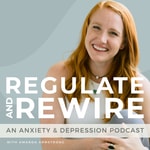
Millions of people struggle with anxiety & depression every single day. Regulate & Rewire is where Amanda, a nervous system focused and trauma-informed practitioner, teaches you the lessons she learned on her healing journey and the tangible research-based tools she uses with clients everyday to help them regulate their nervous system & rewire their mind – in hopes of helping you do the same. Each episode features specific takeaways for you to apply to your healing journey today.
Website: www.regulatedliving.com
Site
RSS
Apple
Data updated on 29/09/2026
Recent rankings
Latest chart positions across Apple Podcasts and Spotify rankings.
Shared links between episodes and podcasts
Links found in episode descriptions and other podcasts that share them.
Discover shows related to Regulate & Rewire: An Anxiety & Depression Podcast, based on actual content similarities. Explore podcasts with similar topics, themes, and formats, backed by real data.
What a Flat, Numb Response (To a Cancelled Flight) Taught Me About Healing
Season 1 · Episode 174
Tuesday, September 22, 2026 • Duration 23:21
In this episode, Amanda tells the story of a cancelled flight, three kids, a dog, and three extra days away from home, and the strangely flat, checked-out response she had to it. Instead of treating that numbness as a problem, she breaks down why it was her nervous system doing exactly its job. Along the way, she offers a new way to actually measure healing (hint: it's not whether you still get anxious), a guardrail against turning nervous system work into one more thing to grade yourself on, and a look at what quietly builds the kind of capacity that was working in the background long before she needed it.
3 Takeaways:
Regulation doesn't mean not reacting. A healthy nervous system still moves into activation, frustration, or even mild shutdown under stress. The goal is flexibility, not permanent calm.
Measure healing by distance and speed, not by absence. Instead of asking whether you still get anxious or still shut down, ask how far you go, how long you stay there, and how quickly you find your way back.
Capacity is built quietly, long before you need it. The unglamorous, consistent inputs, regulation, movement, sleep, nourishment, and connection, are what determine how you land on your hardest days.
CLICK HERE for the full show notes, resources, and 3 tangible takeaways!
*Want me to talk about something specific on the podcast? Let me know HERE.
—
Disclaimer: This podcast is for informational and educational purposes only and is not a substitute for professional medical or mental health advice, diagnosis, or treatment.
In this final episode of our Back to the Basics series, we bring together all the key concepts we've explored over the past eight episodes. From understanding your nervous system to creating a personalized path to healing, this episode serves as both a review and a roadmap for moving forward with confidence and clarity.
3 Takeaways:
Whole-Human Approach: True healing comes from integrating both physiology and psychology – one that explores and acknowledges how your body, mind, relationships, and environment all interconnect in your mental health. Understanding the interplay between your nervous system, stress bucket, reactive and proactive regulation creates a comprehensive framework for healing that honors your unique experiences and needs. If you’ve been feeling stuck in your healing…
Which area of your life (physical, mental, relational, or environmental) feels most neglected in your current healing approach, and what small step could you take to address it?
Your Symptoms Likely Make Sense: Your symptoms make perfect sense given your past lived experiences and current life circumstances—they’re not signs of brokenness but messages from a system trying to protect you and understanding this helps you shift from self-blame to self-compassion.
How might your perspective shift if you approached your symptoms with curiosity rather than judgment, asking “what happened to me?” instead of “what’s wrong with me?”
If you were to apply the equation ‘Current Nervous System State = Past Lived Experiences + Current Life Circumstances’ to your own experience, what’s one key insight you gain about why you might be struggling the way you are?
Strategic Path Forward: Real healing comes from a balanced approach that includes both in-the-moment tools and deeper, proactive changes that address the root causes of dysregulation. The journey of healing, viewed through a nervous system lens, is ultimately about reconnecting with your authentic self, accessing your inner resources, and creating a life where you feel safe, resilient, and whole.
What’s one reactive tool you can practice this week when you notice dysregulation, and one proactive change you feel ready to explore to address something in your stress bucket?
Bloodwork & The Chemical Imbalance Theory (Part 8: B2B Series)
Season 1 · Episode 172
Tuesday, September 8, 2026 • Duration 37:27
In this episode, we’re continuing with Part 8 of the Back to the Basics series by exploring the vital role that comprehensive lab work plays in healing anxiety and depression. I break down why we take a physiology-first—but not physiology-only—approach, the truth behind the outdated “chemical imbalance” theory, and how functional labs can uncover real root causes that are often missed in standard care.
3 Takeaways:
Physiology First, Not Only: There’s an interplay between physiology and psychology but if your body is depleted or stressed, it changes how your brain functions. You can’t mindset your way out of a nervous system stuck in survival mode.
The Chemical Imbalance Theory is outdated and debunked. This oversimplified narrative can prevent people from exploring the root causes of their symptoms and keeps many stuck in medication-only treatment plans that don’t fully support their healing.
Comprehensive Lab Work can take out some of the guesswork. It helps uncover hidden imbalances—like nutrient deficiencies or hormone issues—that may be driving anxiety or depression. It gives you clear, personalized data to support your healing.
CLICK HERE for the full show notes, resources, and 3 tangible takeaways!
—
Ps. This is a re-run of this series. It originally aired in February 2025, and is still the series I hear back about the most. Since there’s been a wave of new listeners joining lately, I wanted to bring it back around.
And for those of you who were here the first time, I invite you to listen again through the lens of where you are right now, it’s likely shifted over the last year and a half, and just see what lands differently.
Looking for more personalized support?
1:1 Coaching (RESTORE): Learn more or (HSA/FSA eligible & includes comprehensive bloodwork)
Proactive Regulation: Long-Term Strategies for a Resilient Nervous System (Part 7: B2B Series)
Season 1 · Episode 171
Tuesday, September 1, 2026 • Duration 26:42
In Part 7 of our Back to Basics series, we explore proactive regulation as the long-term approach to healing anxiety and depression through a nervous system lens. Building on our previous discussion of reactive tools, this episode examines how to address the root causes of your symptoms.
3 Takeaways:
Proactive regulation is about root causes, not symptom chasing. It’s the long game of building a sustainable, regulation-supportive life.
The most effective healing path is personal. Your next step depends on what’s in your bucket and what feels doable now.
Consistency beats overhaul. Small, well-supported changes (especially with guidance) create the biggest long-term impact.
CLICK HERE for the full show notes, resources, and 3 tangible takeaways!
—
Ps. This is a re-run of this series. It originally aired in February 2025, and is still the series I hear back about the most. Since there’s been a wave of new listeners joining lately, I wanted to bring it back around.
And for those of you who were here the first time, I invite you to listen again through the lens of where you are right now, it’s likely shifted over the last year and a half, and just see what lands differently.
Regulated Living Membership: A mental health membership and nervous system healing space (sliding scale pricing available). Join here.
Reactive Regulation in Real Life (Part 6: B2B Series)
Season 1 · Episode 170
Tuesday, August 25, 2026 • Duration 30:49
This morning I wanted to flush my kid down the toilet, it was just one of those mornings. It made me realize that while last week we had a great chat about reactive regulation, it was a bit heavy on the theory vs practical application. I'm extending that conversation today to share some real life examples of how I use these tools in my everyday life, how I used them this morning with my son. So, here's Part 6 of my Back to the Basics Series.
3 Takeaways:
Tools work better when they’re practiced in low-stakes moments. Amanda didn’t magically regulate during a meltdown—she had practiced those steps in less charged settings first.
You don’t have to fully shift your state to call a tool successful. If it takes the edge off enough to help you stay present, it’s working.
Use different tools for different goals. Some tools shift your physiology. Others help you stay with emotion. Both are valid.
CLICK HERE for the full show notes, resources, and 3 tangible takeaways!
—
Ps. This is a re-run of this series. It originally aired in February 2025, and is still the series I hear back about the most. Since there’s been a wave of new listeners joining lately, I wanted to bring it back around.
And for those of you who were here the first time, I invite you to listen again through the lens of where you are right now, it’s likely shifted over the last year and a half, and just see what lands differently.
Regulated Living Membership: A mental health membership and nervous system healing space (sliding scale pricing available).
Reactive Regulation: Your In-The-Moment Nervous System Toolkit (Part 5: B2B Series)
Season 1 · Episode 169
Tuesday, August 18, 2026 • Duration 37:35
In part 5 of our Back to Basics series, we explore reactive regulation, a powerful approach to managing your nervous system in moments of anxiety, overwhelm, or shutdown. Learn how to use your body's natural stress responses to create a personalized toolkit for finding more calm and intentionality amidst life's challenges.
3 Takeaways:
Reactive Resourcing: Reactive regulation is like a first-aid kit for your nervous system – a set of tools that provide temporary safety cues to help you bridge the gap between stress and regulation in moments of dysregulation.
Meet Your System: The principle of “meeting your nervous system where it is” and “tool layering” is essential – rather than forcing calm when activated or high energy when shut down, acknowledge your current state first and then incrementally guide yourself toward regulation.
Proactive Practice: Proactively practicing your reactive regulation tools in low-stress situations makes them more accessible and effective when you’re facing bigger challenges.
CLICK HERE for the full show notes, resources, and 3 tangible takeaways! *click here to view the impala video I referenced in the episode
—
Ps. This is a re-run of this series. It originally aired in February 2025, and is still the series I hear back about the most. Since there’s been a wave of new listeners joining lately, I wanted to bring it back around.
And for those of you who were here the first time, I invite you to listen again through the lens of where you are right now, it’s likely shifted over the last year and a half, and just see what lands differently.
Looking for more personalized support?
1:1 Coaching (RESTORE): or (HSA/FSA eligible & includes comprehensive bloodwork)
Assessing Your Stress Bucket (Part 4: B2B Series)
Season 1 · Episode 168
Tuesday, August 11, 2026 • Duration 38:32
In part 4 of our Back to Basics series, we explore the "stress bucket" analogy to help you understand why you might be feeling overwhelmed, anxious, or depressed. Learn how to assess your unique stress load and discover personalized pathways to healing.
3 Takeaways:
You have a unique stress capacity. When your bucket overflows, symptoms show up. That doesn’t mean you’re failing—it means your body is communicating with you.
Identify your stressors. List both baseline and daily stressors. This simple awareness offers a more personalized path forward.
Healing is about balance. You don’t have to eliminate all stress. Add support, increase capacity, and shift what you can.
CLICK HERE for the full show notes, resources, and 3 tangible takeaways!
—
Ps. This is a re-run of this series. It originally aired in February 2025, and is still the series I hear back about the most. Since there’s been a wave of new listeners joining lately, I wanted to bring it back around.
And for those of you who were here the first time, I invite you to listen again through the lens of where you are right now, it’s likely shifted over the last year and a half, and just see what lands differently.
Why We Get Stuck (in Anxiety & Depression): Understanding Nervous System Dysregulation (Part 3: B2B Series)
Season 1 · Episode 167
Tuesday, August 4, 2026 • Duration 30:31
In part 3 of our Back to Basics series, we explore why we get stuck in states of dysregulation and why anxiety and depression persist. Learn how modern living patterns and past experiences shape our nervous system responses, and discover a compassionate approach to understanding your symptoms.
3 Takeaways:
Your symptoms make sense. Anxiety and depression are often normal responses to overwhelm. Recognize your patterns without pathologizing them.
Biology matters. The way you live—your sleep, stress, food, and relationships—can either support or sabotage your nervous system. Start small by changing one supportive habit.
Safety is learned. If your body perceives the world as dangerous, even safe moments will feel threatening. Begin identifying your “parts” and their protective roles to shift how you relate to stress.
CLICK HERE for the full show notes, resources, and 3 tangible takeaways!
—
Ps. This is a re-run of this series. It originally aired in February 2025, and is still the series I hear back about the most. Since there’s been a wave of new listeners joining lately, I wanted to bring it back around.
And for those of you who were here the first time, I invite you to listen again through the lens of where you are right now, it’s likely shifted over the last year and a half, and just see what lands differently.
Regulated Living Membership: A mental health membership and nervous system healing space (sliding scale pricing available).
6 Nervous System States & Their Stories (Part 2: B2B Series)
Season 1 · Episode 166
Tuesday, July 28, 2026 • Duration 38:03
In this second episode of the "Back to Basics" series, we explore the six nervous system states and how understanding them can transform your approach to anxiety and depression healing.
3 Takeaways:
Your state determines your story. How you feel physically shapes how you think emotionally. Track your state, not just your thoughts.
You experience each state differently. Start noticing your own patterns. When do you feel buzzy and urgent? When do you go flat or withdrawn? That awareness is your first step toward change.
Try the paper-on-the-door check-in. Write “What state am I in right now? How do I know?” on a piece of paper. Tape it somewhere visible. Ask it daily. This builds awareness fast—and gently.
CLICK HERE for the full show notes, resources, and 3 tangible takeaways!
—
Ps. This is a re-run of this series. It originally aired in February 2025, and is still the series I hear back about the most. Since there’s been a wave of new listeners joining lately, I wanted to bring it back around.
And for those of you who were here the first time, I invite you to listen again through the lens of where you are right now, it’s likely shifted over the last year and a half, and just see what lands differently.
Regulated Living Membership: A mental health membership and nervous system healing space (sliding scale pricing available). Join here.
Get To Know Your Nervous System (Part 1: Back to the Basics Series)
Season 1 · Episode 165
Tuesday, July 21, 2026 • Duration 27:53
In this first episode of the “Back to Basics” series, Amanda dives into the core of what drives anxiety and depression: your nervous system. When you better understand how this mind-body system works you can work with it towards healing.
3 Takeaways:
Your symptoms are protective, not personal. Your nervous system isn’t trying to ruin your life. It’s trying to keep you safe. The more fluently you speak its language, the less you’ll feel at war with yourself.
Self-compassion is non-negotiable. Understanding your nervous system can help dissolve self-blame and shift you into a posture of curiosity instead of criticism. That shift alone can change your healing trajectory.
You’re likely carrying more than anyone ever taught you to hold. When Amanda describes the nervous system as holding a “bucket” of stressors, it clicks: Most of us are carrying too much with too little support. Of course we’re tired. Of course we’re stuck. The work isn’t to toughen up—it’s to learn how to carry differently.
CLICK HERE for the full show notes, resources, and 3 tangible takeaways!
—
Ps. This is a re-run of this series. It originally aired in February 2025, and is still the series I hear back about the most. Since there’s been a wave of new listeners joining lately, I wanted to bring it back around.
And for those of you who were here the first time, I invite you to listen again through the lens of where you are right now, it’s likely shifted over the last year and a half, and just see what lands differently.
Regulate & Rewire: An Anxiety & Depression Podcast, a podcast by Amanda Armstrong - Stats, Episodes and Rankings - My Podcast Data
“What does ‘coming home to yourself’ mean to you, and what’s one small practice or action you could incorporate into your daily life to cultivate a stronger sense of connection with yourself?”
CLICK HERE for the full show notes, resources, and 3 tangible takeaways!
—
Ps. This is a re-run of this series. It originally aired in February 2025, and is still the series I hear back about the most. Since there’s been a wave of new listeners joining lately, I wanted to bring it back around.
And for those of you who were here the first time, I invite you to listen again through the lens of where you are right now, it’s likely shifted over the last year and a half, and just see what lands differently.
*Want me to talk about something specific on the podcast? Let me know HERE.
—
Disclaimer: This podcast is for informational and educational purposes only and is not a substitute for professional medical or mental health advice, diagnosis, or treatment.
*Want me to talk about something specific on the podcast? Let me know HERE.
—
Disclaimer: This podcast is for informational and educational purposes only and is not a substitute for professional medical or mental health advice, diagnosis, or treatment.
**Referenced Sources: Moncrieff, J., Cooper, R. E., Stockmann, T., Amendola, S., Hengartner, M. P., & Horowitz, M. A. (2022). The serotonin theory of depression: A systematic umbrella review of the evidence. Molecular Psychiatry, 28(8), 1–14. https://doi.org/10.1038/s41380-022-01661-0
*Want me to talk about something specific on the podcast? Let me know HERE.
—
Disclaimer: This podcast is for informational and educational purposes only and is not a substitute for professional medical or mental health advice, diagnosis, or treatment.
*Want me to talk about something specific on the podcast? Let me know HERE.
—
Disclaimer: This podcast is for informational and educational purposes only and is not a substitute for professional medical or mental health advice, diagnosis, or treatment.
*Want me to talk about something specific on the podcast? Let me know HERE.
—
Disclaimer: This podcast is for informational and educational purposes only and is not a substitute for professional medical or mental health advice, diagnosis, or treatment.