Leaving Well: nonprofit leadership guidance for workplace exits and transitions – Details, episodes & analysis
Podcast details
Technical and general information from the podcast's RSS feed.
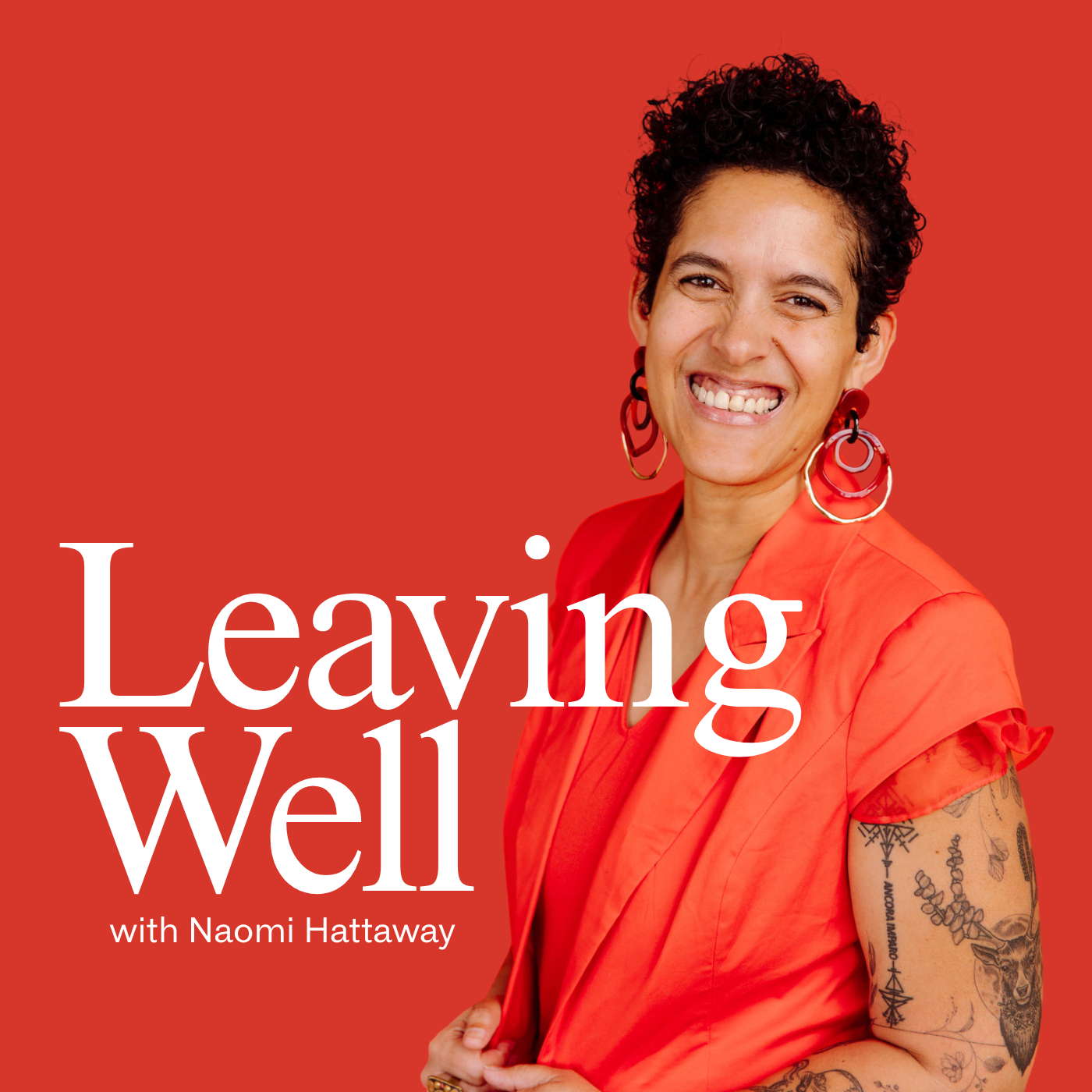
Leaving Well: nonprofit leadership guidance for workplace exits and transitions
Naomi Hattaway
Frequency: 1 episode/10d. Total Eps: 99

Recent rankings
Latest chart positions across Apple Podcasts and Spotify rankings.
Apple Podcasts
🇨🇦 Canada - careers
02/12/2025#100🇨🇦 Canada - careers
01/12/2025#42🇨🇦 Canada - careers
27/11/2025#88🇨🇦 Canada - careers
05/02/2025#93
Spotify
No recent rankings available
Shared links between episodes and podcasts
Links found in episode descriptions and other podcasts that share them.
See all- https://www.naomihattaway.com/
255 shares
- https://sarahhartleyco.com/freelance
96 shares
- http://naomihattaway.com/quiz
76 shares
RSS feed quality and score
Technical evaluation of the podcast's RSS feed quality and structure.
See allScore global : 68%
Publication history
Monthly episode publishing history over the past years.
98: The Exit Hook - What You Owe (And Don't Owe) When You Leave (Series Part Four)
Episode 98
mardi 3 mars 2026 • Duration 23:03
Navigate voluntary departures, involuntary exits, and long tenures that have lasted too long. Understand transition obligations, severance negotiations, and how to leave well without leaving everything.
---
The Off the Hook Framework: A Leadership Series on Accountability, Delegation, and Leaving Well
You're exhausted. You're the only one who knows how the donor database works. Board members text you on weekends. Your team escalates every decision to you. You haven't taken a real vacation in three years.
And everyone tells you how dedicated you are. How committed. How essential.
Here's what they're not saying: your indispensability is an organizational liability.
This is the accountability paradox at the heart of nonprofit leadership. The leader who won't get off the hook—who holds every responsibility, hoards every relationship, controls every decision—isn't demonstrating commitment. They're creating a single point of failure with a nonprofit tax status.
Real accountability isn't about how much you personally deliver. It's about ensuring delivery continues without you.
Because here's the truth no one wants to say out loud: You're temporary. Your tenure will end—through retirement, new opportunity, burnout, termination, or death. The only question is whether your organization will be ready.
I bring a specific lens to this work: I'm an interim leader. I provide temporary executive leadership for nonprofits in transition. Every engagement I take begins with an exit date. I'm hired knowing I'm leaving. I've learned to lead with non-attachment—caring deeply about the work and the people while holding my departure lightly. I document everything. I build systems that run without me. I transfer relationships that belong to the organization, not to me personally. This isn't because I care less. It's because I care about sustainability more than being indispensable. What I've learned from being professionally temporary is that every leader should operate with an interim mindset. Because functionally, you are interim. Your tenure is temporary even if you don't know the end date yet.
This series is for nonprofit CEOs and Executive Directors who know intellectually they should delegate but can't seem to actually do it. It's for board members who don't know what hooks they're on—or who are on hooks that belong to staff. It's for funders and foundation program officers who see organizations struggling with leadership transitions and want to support better succession planning. It's for anyone who's ever said "if I don't do it, it won't get done right" and meant it.
Everything in this series is succession planning work—just not the way most people think about it. Succession planning isn't just creating a document for when you leave. It's how you lead every day while you're staying.
It's documenting your decision-making frameworks so they're transferable. It's building redundancy in critical relationships. It's developing your team's strategic capacity instead of protecting them from complexity. It's getting yourself off hooks you've held so long you've forgotten they don't belong to you.
Most nonprofits don't have written succession plans. Most leadership transitions are managed as crises instead of planned transitions. Most organizational knowledge walks out the door when leaders leave because it was never captured.
This series is about changing that—one hook at a time. The greatest act of nonprofit leadership isn't being indispensable. It's building something that doesn't need you to be great. Welcome to The Off the Hook series. Let's get to work.
97: Getting Off the Hook Without Abandoning Ship (Series Part Three)
Episode 97
mardi 24 février 2026 • Duration 21:20
Address the guilt, shame, and fear keeping you on hooks you should release. Learn to distinguish between healthy disengagement and abandonment, and discover what you actually owe when you step back.
---
The Off the Hook Framework: A Leadership Series on Accountability, Delegation, and Leaving Well
You're exhausted. You're the only one who knows how the donor database works. Board members text you on weekends. Your team escalates every decision to you. You haven't taken a real vacation in three years.
And everyone tells you how dedicated you are. How committed. How essential.
Here's what they're not saying: your indispensability is an organizational liability.
This is the accountability paradox at the heart of nonprofit leadership. The leader who won't get off the hook—who holds every responsibility, hoards every relationship, controls every decision—isn't demonstrating commitment. They're creating a single point of failure with a nonprofit tax status.
Real accountability isn't about how much you personally deliver. It's about ensuring delivery continues without you.
Because here's the truth no one wants to say out loud: You're temporary. Your tenure will end—through retirement, new opportunity, burnout, termination, or death. The only question is whether your organization will be ready.
I bring a specific lens to this work: I'm an interim leader. I provide temporary executive leadership for nonprofits in transition. Every engagement I take begins with an exit date. I'm hired knowing I'm leaving. I've learned to lead with non-attachment—caring deeply about the work and the people while holding my departure lightly. I document everything. I build systems that run without me. I transfer relationships that belong to the organization, not to me personally. This isn't because I care less. It's because I care about sustainability more than being indispensable. What I've learned from being professionally temporary is that every leader should operate with an interim mindset. Because functionally, you are interim. Your tenure is temporary even if you don't know the end date yet.
This series is for nonprofit CEOs and Executive Directors who know intellectually they should delegate but can't seem to actually do it. It's for board members who don't know what hooks they're on—or who are on hooks that belong to staff. It's for funders and foundation program officers who see organizations struggling with leadership transitions and want to support better succession planning. It's for anyone who's ever said "if I don't do it, it won't get done right" and meant it.
Everything in this series is succession planning work—just not the way most people think about it. Succession planning isn't just creating a document for when you leave. It's how you lead every day while you're staying.
It's documenting your decision-making frameworks so they're transferable. It's building redundancy in critical relationships. It's developing your team's strategic capacity instead of protecting them from complexity. It's getting yourself off hooks you've held so long you've forgotten they don't belong to you.
Most nonprofits don't have written succession plans. Most leadership transitions are managed as crises instead of planned transitions. Most organizational knowledge walks out the door when leaders leave because it was never captured.
This series is about changing that—one hook at a time. The greatest act of nonprofit leadership isn't being indispensable. It's building something that doesn't need you to be great. Welcome to The Off the Hook series. Let's get to work.
88: Katya Fels Smyth on Normalizing Endings
Episode 88
mardi 4 novembre 2025 • Duration 46:25
Katya Fels Smyth is an advocate / activist for shifting power and perspective so we all have a fair shot at wellbeing. She is the founder and CEO of the Full Frame Initiative, now in its final stages of winddown after more than 15 years of national social change work; and is the founder and former Executive Director of On The Rise, a 30 year-old community of and by women who are unhoused and who have not found community or support in traditional social services. She's a mom, spouse, and a person to almost 20 animals who share a 25 acre farm, where the people grow and sell artisanal garlic and the animals live the good life.
Find Katya:
Steward the Forest, Not Save Every Tree
If We Care About Justice, We Must Care About Endings
Quotes:
"We never have control over things. But what we can do is pay a lot of attention to relationships and energy more than control what others are going to do moving forward."
"Whether you are an individual leaving a relationship, or a board deciding to close an organization, or a funder deciding to end a funding relationship, the decision to leave is an expression of power."
"We remember endings. We remember the high and the low of our experience, whether it's a surgery, hospitalization experience, or a work experience. And we remember how it felt when it ended."
"Your legacy is as much about how you left people feeling and doing and equipped, and did you respect them enough to not walk out on them if you had the opportunity to stay with them and hand things over to them."
To learn more about Leaving Well, visit https://www.naomihattaway.com/
To support the production of this podcast, peruse my Leaving Well Bookshop or buy me a coffee.
This podcast is produced by Sarah Hartley.
87: Nani Jansen Reventlow on Intentionally Funding Leadership Transitions
Episode 87
mardi 28 octobre 2025 • Duration 33:02
Find Nani:
Quotes:
"If you trust someone to build an organization, why wouldn't you trust them to also make sure that that work can continue without them?"
"I want to set up the organization for further success because I invested in building it. I want it to thrive as I leave. That means not only looking after my 'legacy', but also making sure that the incoming executive director is set up for success and that there's sufficient space for them."
"There's not going to be a successful leadership transition if we lose the team along the way. So making sure that there's someone who's looking out for everyone and for the people who are not making themselves heard. Change is uncomfortable for us humans. There needs to be someone who's mindful of the different feelings and dynamics that come up."
To learn more about Leaving Well, visit https://www.naomihattaway.com/
To support the production of this podcast, peruse my Leaving Well Bookshop or buy me a coffee.
This podcast is produced by Sarah Hartley.
86: Kate Harris on Structural Change as a Tool for Social Change
Episode 86
mardi 21 octobre 2025 • Duration 32:39
Quotes:
"When we use scary words like merger or dissolution, or the way that we soften dissolution by talking about sunsetting and winding down, it sounds great, but the reframe is that all that is structural change."
"Your mission is important. Your vision is important. That's your destination. That's where you're going. Structure is the vehicle you're taking to get you there."
"Mergers are an excellent tool for getting an organization to inventory every single thing that they are about. You cannot leave any stone unturned. You don't get to do that in a structural change. And that's why I love it as a tool. Because even if at the end of the day we decide that these two organizations shouldn't merge, each organization is stronger for having gone through the process of exploring that potential collaboration. They understand their unique value better. They understand each other better and where they can collaborate."
"Mission resilience is how you actually make sure that even if the structure changes, even if the name changes, the whole reason we are here to do any of this is because of the people at the center that we care about. And we're not gonna leave anybody behind."
"My whole reason for doing this work is that structural change is a tool. It's a tool for social change. It's underutilized in the nonprofit sector. So I want to normalize this conversation."
Find Kate:
LinkedIn - KHG Nonprofit Strategy
To learn more about Leaving Well, visit https://www.naomihattaway.com/
To support the production of this podcast, peruse my Leaving Well Bookshop or buy me a coffee.
This podcast is produced by Sarah Hartley.
85: Althea Seloover on Detoxing from Workaholism + Finding Congruence
Episode 85
mardi 14 octobre 2025 • Duration 34:50
Althea Seloover is a poet, a relational map-maker, a story teller, an advocate, an abolitionist, an investigator, an entrepreneur, a creative thinker, a hope holder, a griever, a dreamer, and a friend. She provides work in the realm of prisoner liberation, self-parenting & life history investigation work in the world. She lives in Eugene, Oregon with her fiancé, two cats & lots of books.
Find Althea:
For over 18 months, Althea has been passing the collection plate for a Palestinian family taking refuge in Cairo, Egypt. If you'd like to contribute to these monthly efforts, you can donate here.
Quotes:
When I make the decision to do things differently, whether that's by choice or the circumstances have changed, to stay with the humbling, and at times humiliating, learning process of 'I am out of my element, or I feel a little incompetent, or I don't know the answer right off the top of my head, or I don't know which direction to move in.' Really honoring those moments as opportunities to do exactly what I have had the joy and opportunity to do for others is important.
Grief creates anxiety. It creates these spaces, these little sinkholes, in the relational fabric of things.
The elements that nurture safety, in my experience, are a sense of agency, a sense of self and connection, an understanding of the environment, the connections between things.
The way that we're able to shift the way that our systems work, the way that we work, the way the norms of our culture is by doing what we believe should be happening. It's making small changes. It's embodying the values.
To learn more about Leaving Well, visit https://www.naomihattaway.com/
To support the production of this podcast, peruse my Leaving Well Bookshop or buy me a coffee.
This podcast is produced by Sarah Hartley.
84: Astronomer Meets Coldplay
Episode 84
mardi 7 octobre 2025 • Duration 09:57
A CEO steps down after a viral scandal, and within 72 hours, a new interim leader is named. While the world focused on the drama, we're focusing on what really matters: how Astronomer's board pulled off one of the fastest leadership transitions we've seen. Nonprofit leaders: this is your wake-up call.
In this episode, Naomi breaks down:
-
Why internal leadership benches matter more than dream candidate lists
-
Why speed is more important than perfection during a crisis
-
How to craft crisis communications that inspire confidence (not chaos)
-
Why your mission must stay front and center, even in moments of disruption
Whether you're an Executive Director or on a nonprofit board, this is your playbook for succession readiness—before a crisis hits.
Quotes:
"Most nonprofit boards think that succession planning means having a dusty binder somewhere with outdated emergency contacts. But modern crises move at the speed of social media, not board meetings."
"So my question for you is: who is on your current team that could run your organization tomorrow? Not perfectly, not permanently, but competently enough to maintain operations while you figure out the long term. If your answer is nobody, then that's your first succession planning priority."
"You need to craft your messaging around leadership transition around these three points: number one, what happened? Keep it brief. Number two, what you're doing about it. Keep it concrete. And number three, how you're protecting the mission that's forward looking."
"In a world where crises moves at internet speed, your succession planning better be just as fast."
To learn more about Leaving Well, visit https://www.naomihattaway.com/
To support the production of this podcast, peruse my Leaving Well Bookshop or buy me a coffee.
This podcast is produced by Sarah Hartley.
83: Lauren Andraski on the Best Ways to Bring Consultants into Your Organization
Episode 83
mardi 30 septembre 2025 • Duration 32:25
Lauren Andraski is a collaborative community builder who champions equitable communities in every area of her life - from launching a community of nonprofit consultants to starting a string quartet in her living room. As the founder of Consultants for Good, she has created a thriving network of over 1,100 nonprofit consultants across 6 continents.
Quotes:
"We've found that capacity building usually takes at least three years to actually give organizations time to implement and start seeing evidence of that impact. Setting the clear expectation that just because we don't see it right away doesn't mean that nothing's happening, and we should stay the course on the things we're trying to implement."
"Consultants aren't often cheap, but they're an incredible investment if you're clear on where you actually want to start."
"When you're hiring a consultant, one of the benefits is that the consultant is not already on your team. They're not part of the power dynamics. They are not part of the culture—in a really positive way. I think sometimes it feels like they'll never understand us. But in fact, that can be really helpful."
Find Lauren:
To learn more about Leaving Well, visit https://www.naomihattaway.com/
To support the production of this podcast, peruse my Leaving Well Bookshop or buy me a coffee.
This podcast is produced by Sarah Hartley.
82: Elizabeth DiAlto on Getting Fully Rooted into Who You Are
Episode 82
mardi 23 septembre 2025 • Duration 33:03
Known for her inclusive, humorous, and uniquely transformative approach to spirituality and the healing arts, Elizabeth DiAlto has been helping people tap into self love, healing, wholeness, and liberation since 2013. The Founder of the House of E, The School of Sacred Embodiment, and Wild Soul Movement™, Elizabeth's distinctive medicine weaves together mystical + erotic intelligence, sensual + embodied movement, and integrative healing + energy work. Her methods are a potent synthesis of various trainings as well as ancestral tools + practices from the mixed/multiple lineages of her Caribbean, Indigenous, and European heritages. From 2015-2024, Elizabeth hosted the beloved Embodied Podcast, currently co-hosts the Mystical Aunties Show, and is soon launching Heat & Honey with Louiza "Weeze" Doran.
Elizabeth is the proud owner of one of the most contagious laughs around (if you know, you know!). In 2018 + 2019, she did stand-up comedy for fun, performing on stages in LA and NYC. Her favorite social activities are salsa dancing and karaoke. She loves driving her Mini Cooper, is the queen of parallel parking, and most recently, she's elated to be back in the "motherland"— NYC, where she lives in a cozy and light-filled Brooklyn studio.
Quotes:
I always encourage people to think: what are you rooting into? We're much more easily swayed if we're not rooted. Someone could push you over if you're not rooted. Someone could bully you. When you're rooted in something, it's deep and there's practice and devotion to back it up.
When something might upset folks, you can acknowledge these things. One of the most inclusive practices out there is just acknowledgement.
Grief is an emotion that gets masked by other things. More socially acceptable things. Anger is often such a great mask for grief, because anger feels powerful. The reason people don't allow themselves to feel grief is because it feels weak. A lot of people associate grief or sadness or depression with weakness. It is not, it is so human. It's the most human thing.
In a world that is so inhumane and so dehumanizing, we have to ask how do we be human together? How do we honor the humanity? How do we rehumanize if we're constantly being dehumanized? Grief is one of the ways. Grief is the great tenderizer. It softens us in the places where we're hard. When you let yourself grieve, it's connective tissue to your own self, your own soul, your own ethics, morals, and values.
Find Elizabeth:
To learn more about Leaving Well, visit https://www.naomihattaway.com/
To support the production of this podcast, peruse my Leaving Well Bookshop or buy me a coffee.
This podcast is produced by Sarah Hartley.
81: Wellesley Michael on Amplifying the Work of Vice President Harris
Episode 81
mardi 16 septembre 2025 • Duration 33:33
Wellesley Michael has the sweetest little rescue pup Petunia, and they do everything possible together. Always looking for a new Lego set, she will forever be a theatre kid, and enjoys taking in D.C.'s vast theatre scene.
Wellesley formed a passion for community organizing purely out of a search for hope, support, and community after the murder of George Floyd. She then got trapped in the world of politics by working on campaigns in her hometown of Omaha, Nebraska. In D.C., she has worked on digital communications in the U.S. House, Senate, and the Biden-Harris White House. Currently, Wellesley is building the first-ever Creator Program for Senate Democrats — connecting Senators with content creators and new media.
Quotes:
"It eases my anxiety a lot to know the finality of something, but that doesn't make it less difficult."
"My job was managing the VP comms accounts and I needed to make sure that the American public saw the total breadth of everything that Kamala Harris had done as Vice President that people didn't give her credit for or know about. A lot of the things that she did were not in the media."
"We knew the job was ending and there were different paths of what the ending would look like. No matter what happened, on January 20th, the Biden-Harris administration was over. It was just a matter of, would it be then the Harris-Walz administration moving in? But there were many waves of grief."
"The hardest part of any sort of high impact work that's really short is your life transitions so quickly to something different. And when you're so focused on the outcomes for someone else all day, it's hard to manage your self care. And even in the most basic sense of where am I getting food?"
Find Wellesley:
To learn more about Leaving Well, visit https://www.naomihattaway.com/
To support the production of this podcast, peruse my Leaving Well Bookshop or buy me a coffee.
This podcast is produced by Sarah Hartley.
Related Shows Based on Content Similarities