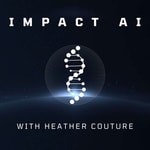
Impact AI – Details, episodes & analysis
Podcast details
Technical and general information from the podcast's RSS feed.
Recent rankings
Latest chart positions across Apple Podcasts and Spotify rankings.
Apple Podcasts
🇫🇷 France - technology
13/07/2025#91🇫🇷 France - technology
06/03/2025#74🇫🇷 France - technology
21/02/2025#70🇫🇷 France - technology
20/02/2025#39🇫🇷 France - technology
19/02/2025#80
Spotify
No recent rankings available
Shared links between episodes and podcasts
Links found in episode descriptions and other podcasts that share them.
See all- https://www.viome.com/
169 shares
- https://pixelscientia.com/newsletter/
127 shares
RSS feed quality and score
Technical evaluation of the podcast's RSS feed quality and structure.
See allScore global : 73%
Publication history
Monthly episode publishing history over the past years.
Foundation Model Series: Transforming Biology with Zelda Mariet from Bioptimus
Episode 117
lundi 17 février 2025 • Duration 21:26
Zelda Mariet, Co-Founder and Principal Research Scientist at Bioptimus, joins me to continue our series of conversations on the vast possibilities and diverse applications of foundation models. Today’s discussion focuses on how foundation models are transforming biology. Zelda shares insights into Bioptimus’ work and why it’s so critical in this field. She breaks down the three core components involved in building these models and explains what sets their histopathology model apart from the many others being published today. They also explore the methodology for properly benchmarking the quality and performance of foundation models, Bioptimus’ strategy for commercializing its technology, and much more. To learn more about Bioptimus, their plans beyond pathology, and the impact they hope to make in the next three to five years, tune in now.
Key Points:
- Who is Zelda Mariet and what led her to create Bioptimus.
- What Bioptimus does and why it’s so important.
- Why their first model announced was for pathology.
- Zelda breaks down three core components that go into building a foundation model.
- How their histopathology foundation model is different from the number of other models published at this point.
- Their methodology behind properly benchmarking how well their foundation model performs.
- Different challenges they’ve encountered on their foundation model journey.
- How they plan to commercialize their technology at Bioptimus.
- Thoughts on whether open source is part of their long-term strategy for the model, and why.
- Developing a product roadmap for a foundation model.
- She shares some information regarding their next step, beyond pathology, at Bioptimus.
- The importance of understanding what kind of structure you want to capture in your data.
- Where she sees the impact of Bioptimus in the next three to five years.
Quotes:
“Working on biological data became a little bit of a fascination of mine because I was so instinctively annoyed at how hard it was to do.” — Zelda Mariet
“Bioptimus is building foundation models for biology. Foundation models are essentially machine learning models that take an extremely long time to train [and] are trained over an incredible amount of data.” — Zelda Mariet
“There are two things that are well-known about foundation models, they’re hungry in terms of data and they’re hungry in terms of compute.” — Zelda Mariet
“On the philosophical side, science is something that progresses as a community, and as much as we have, what I would say is a frankly amazing team at Bioptimus, we don’t have a monopoly on people who understand the problems we’re trying to solve. And having our model be accessible is one way to gain access into the broader community to get insight and to help people who want to use our models, get insight into maybe where we’re not doing as well that we need to improve.” — Zelda Mariet
Links:
Resources for Computer Vision Teams:
LinkedIn – Connect with Heather.
Computer Vision Insights Newsletter – A biweekly newsletter to help bring the latest machine learning and computer vision research to applications in people and planetary health.
Computer Vision Strategy Session – Not sure how to advance your computer vision project? Get unstuck with a clear set of next steps. Schedule a 1 hour strategy session now to advance your project.
Foundation Model Series: Democratizing Time Series Data Analysis with Max Mergenthaler Canseco from Nixtla
Episode 116
lundi 10 février 2025 • Duration 27:11
What if the hidden patterns of time series data could be unlocked to predict the future with remarkable accuracy? In this episode of Impact AI, I sit down with Max Mergenthaler Canseco to discuss democratizing time series data analysis through the development of foundation models. Max is the CEO and co-founder of Nixtla, a company specializing in time series research and deployment, aiming to democratize access to advanced predictive insights across various industries.
In our conversation, we explore the significance of time series data in real-world applications, the evolution of time series forecasting, and the shift away from traditional econometric models to the development of TimeGPT. Learn about the challenges faced in building foundation models for time series and a time series model’s practical applications across industries. Discover the future of time series models, the integration of multimodal data, scaling challenges, and the potential for greater adoption in both small businesses and large enterprises. Max also shares Nixtla’s vision for becoming the go-to solution for time series analysis and offers advice to leaders of AI-powered startups.
Key Points:
- Max's background in philosophy, his transition to machine learning, and his path to Nixtla.
- Why time series data is the “DNA of the world” and its role in businesses and institutions.
- Nixtla's advanced forecasting algorithms, the benefits, and their application to industry.
- Historical overview of time series forecasting and the development of modern approaches.
- Learn about the advantages of foundation models for scalability, speed, and ease of use.
- Uncover the range of datasets used to train Nixtla's foundation models and their sources.
- Similarities and differences between training TimeGPT and large language models (LLMs).
- Hear about the main challenges of building time series foundation models for forecasting.
- How Nixtla ensures the quality of its models and the limitations of conventional benchmarks.
- Explore the gap between benchmark performance and effectiveness in the real world.
- He shares the current and upcoming plans for Nixtla and its TimeGPT foundation model.
- He shares his predictions for the future of time series foundation models.
- Advice for leaders of AI-powered startups and what impact he aims to make with Nixtla.
Quotes:
“Time series are in one aspect, the DNA of the world.” — Max Mergenthaler Canseco
“Time is an essential component to understand a change of course, but also to understand our reality. So, time series is maybe a somewhat technical term for a very familiar aspect of our reality.” — Max Mergenthaler Canseco
“Given that we are all training on massive amounts of data and some of us are not disclosing which datasets we’re using, it’s always a problem for academics to try to benchmark foundation models because there might be leakage.” — Max Mergenthaler Canseco
“That’s an interesting aspect of foundation models in time series, that benchmarking is not as straightforward as one might think.” — Max Mergenthaler Canseco
“I think right now in our field probably benchmarks are not necessarily indicative of how well a model is going to perform in real-world data.” — Max Mergenthaler Canseco
“I think that we’re also going to see some of those intuitions that come from the LLM field translated into the time series field soon.” — Max Mergenthaler Canseco
Links:
Max Mergenthaler Canseco on LinkedIn
Resources for Computer Vision Teams:
LinkedIn – Connect with Heather.
Computer Vision Insights Newsletter – A biweekly newsletter to help bring the latest machine learning and computer vision research to applications in people and planetary health.
Computer Vision Strategy Session – Not sure how to advance your computer vision project? Get unstuck with a clear set of next steps. Schedule a 1 hour strategy session now to advance your project.
Decoding the Immune System for Drug Discovery with Noam Solomon from Immunai
Episode 107
lundi 4 novembre 2024 • Duration 18:02
Today’s guest believes that decoding the immune system is at the heart of improving drug efficacy. He is currently focused on this effort as the CEO and Co-founder of Immunai – a company that is building an AI model of the immune system to facilitate the development of next-generation immunomodulatory therapeutics. Noam Solomon begins our conversation by detailing his professional history and how it led to Immunai before explaining what Immunai does and why this work is vital for healthcare. Then, we discover how understanding the immune system will help to improve how drugs work in our bodies, how the team at Immunai accomplishes its goals, the major challenges of working with complex ML models, and some helpful recommendations for processing the high-dimensional nature of biological data. Noam also explains the collaborative landscape of Immunai, how the evolution of technology made his work possible, Immunai’s plans for the future, and his advice to others on a similar career path.
Key Points:
- Unpacking Noam Solomon’s professional journey that led to his founding of Immunai.
- What Immunai does and why this work is vital for the healthcare industry.
- How understanding the immune system will help to improve drug efficacy.
- Exploring how Noam and his team use AI to accomplish their goals.
- The standardization of data and other challenges of working with complex ML models.
- Techniques for handling the high-dimensional nature of biological data.
- How ML experts collaborate with other domains to inform and build Immunai’s models.
- The technical advancements that have made Noam’s work possible.
- His advice to other leaders of AI-powered startups, and imagining the future of Immunai.
- How to connect with Noam and his work.
Quotes:
“First, let’s talk about the problem, which is today, getting a drug from IND approval to FDA approval—which is the process of doing clinical trials—has less than a 10% chance of success, usually about a 5% chance, takes more than 10 years, and more than $2 billion of open immune therapy.” — Noam Solomon
“Different people respond differently to the same drug, and the reason they respond differently is because their immune system is different.” — Noam Solomon
“You first need to fall in love with the problems. Many ML people—physicists, mathematicians, computer scientists—we love building models; we love solving puzzles. In biology, you need to really fall in love with the question you are trying to answer.” — Noam Solomon
“It’s a great decade for biology.” — Noam Solomon
Links:
Resources for Computer Vision Teams:
LinkedIn – Connect with Heather.
Computer Vision Insights Newsletter – A biweekly newsletter to help bring the latest machine learning and computer vision research to applications in people and planetary health.
Computer Vision Strategy Session – Not sure how to advance your computer vision project? Get unstuck with a clear set of next steps. Schedule a 1 hour strategy session now to advance your project.
Detecting Breast Cancer Earlier with Tobias Rijken from Kheiron Medical
Episode 17
lundi 30 janvier 2023 • Duration 27:55
All women face the risk of breast cancer, but early detection can greatly increase the chances of a positive outcome and reduce the need for aggressive treatment options. In this episode, I talk with Tobias Rijken, CTO and co-founder of Kheiron Medical Technologies, about leveraging AI for detecting breast cancer. We discuss the role of AI in improving medical care, the power of vertical integration and feedback loops, and what makes Kheiron different from other AI startups. Hear about the challenges of acquiring reliable data, whether using generative models is beneficial, details about the products Kheiron has created, and much more!
Key Points:
- Tobias's professional background and why he created Kheiron Medical Technologies.
- Learn about the amazing work Kheiron Medical Technologies does and why it is important.
- Overview of why detecting breast cancer early is so vital and the challenges of screening.
- How AI can help resolve the current challenges in cancer screening.
- He explains the machine learning process and training the model used.
- The complications encountered in working with radiology images.
- Find out why image quality is key to the machine learning process.
- How he is able to account for the variation of technology and methods used.
- Outline of the regulatory process and how it impacts machine learning model development.
- Hear advice Tobias has for other leaders of AI-powered startups.
- Details about how Tobias approaches improving the models over time.
- Tobias tells us what Kheiron Medical Technologies has planned for the future.
Quotes:
“What I liked so much about machine learning is the ability it has to solve real-world problems. And in my opinion, real-world machine learning is very different from academic machine learning.”
“Either the right information isn't available, or it is inaccurate, or there's missing information. We see AI as a tool to help address those information problems.”
“The challenge when you sample uniformly from your whole dataset is that there will be cases you've sampled, where you may not have ground truth.”
“For me, when I started this company, this was not about building a great model that has a great performance on a test dataset. This is about getting AI into the real world.”
Links:
Resources for Computer Vision Teams:
LinkedIn – Connect with Heather.
Computer Vision Insights Newsletter – A biweekly newsletter to help bring the latest machine learning and computer vision research to applications in people and planetary health.
Computer Vision Strategy Session – Not sure how to advance your computer vision project? Get unstuck with a clear set of next steps. Schedule a 1 hour strategy session now to advance your project.
Computer Vision Advisory Services – Monthly advisory services to help you strategically plan your CV/ML capabilities, reduce the trial-and-error of model development, and get to market faster.
Monitoring Fields for Precision Agriculture with Gershom Kutliroff from Taranis
Episode 16
lundi 23 janvier 2023 • Duration 34:39
In this episode, I talk with Gershom Kutliroff, CTO of Taranis, about precision agriculture. Taranis uses computer vision to monitor fields, providing critical insights to growers. Gershom and I talked about how they gather and annotate data, the challenges they encounter in working with aerial imagery, and how they validate their models and accommodate data drift with continuous learning.
Quotes:
“Taranis is using drone technology to capture imagery and then use AI to process that imagery to understand what's happening in grower's field.”
“It becomes increasingly difficult to maintain consistent quality levels if you're working with tens or even hundreds of annotators. But when you have AI models, then you have the ability to control the quality of the insights that you're generating.”
“There's a lot of discussion in the last few years in the AI space about data-centric versus model-centric. Model centric would be the case where in your development you invest a lot in choosing the right architecture that optimizes your performance, gives you the best results for your models, or spending a lot of time with hyper parameters and that type of work. And data-centric is you spend a lot more time making sure that your data set is clean, that you've got that it's balanced, you've got the right amount of classes for the problem that you're trying to solve.”
“We struggle with the problem of long tail distributions. If I take diseases as an example, there are some diseases that can cause a lot of damage to the crops. But they're very rare in terms of how often they actually occur in grower's fields.”
“Because we're running our own operations and so we're flying our own drones, we've also invested in the software that's running on the drones when we're flying. So the images the drone pilot captures in the field are validated in the field. We have algorithms running on the edge to be able to check the quality of those images. And then if the images are not the quality that we expect them to get, the pilot knows while he's still there at the field and he can fly again.”
“For a lot of the models that we use you really need domain experts. You really need trained agronomists who can look at these images.”
“A certain percentage of all of the missions that we've flown are sent for review by our in-house agronomists before we release them to customers. So that's a really critical piece of how we do validation, and that also gives us a high level of confidence internally that the product that we're releasing to our customers stands by the quality that we expect it to.”
“We do suffer from this type of data drift where the data that we're seeing in production is not exactly in the same distribution as the data that we used to train. So the most effective technique that we've seen is to implement some kind of a continuous learning type of framework whereby we are able to take data that we're capturing in production, so when we're actually live and servicing our customers' fields. And then the data that doesn't have a good correspondence with the distribution of the training data that was used for the models, we can then filter that data out. We can extract that data and use it to quickly retrain the models, to adapt the models, and then deploy those models back into production.”
“The company started by offering a product based on manual tagging, which didn't have any AI technology at the beginning, which allows it to offer products and service customers and start building this very rich database that we leverage now.”
Links:
Resources for Computer Vision Teams:
LinkedIn – Connect with Heather.
Computer Vision Insights Newsletter – A biweekly newsletter to help bring the latest machine learning and computer vision research to applications in people and planetary health.
Computer Vision Strategy Session – Not sure how to advance your computer vision project? Get unstuck with a clear set of next steps. Schedule a 1 hour strategy session now to advance your project.
Computer Vision Advisory Services – Monthly advisory services to help you strategically plan your CV/ML capabilities, reduce the trial-and-error of model development, and get to market faster.
Improving Patient Outcomes with Vinod Subramanian from Syapse
Episode 15
lundi 16 janvier 2023 • Duration 35:52
In this episode, I talk with Vinod Subramanian, Chief Data and Product Development Officer at Syapse, about machine learning for healthcare and advancements in cancer treatment. Syapse is a real world evidence company dedicated to improving outcomes for cancer and other serious diseases. Vinod and I talked about the types of healthcare data they work with, the data challenges they encounter, how they validate their models, and how they mitigate bias.
QUOTES:
"Technology is not the answer exemplified of the intent. And the fundamental question, I think, that all of us are confronted by: what is the intent and what in the world that we want to try to help shape?"
"There are infinite possibilities in the terms of patient care with aggregated and harmonized data in healthcare. We all know about the point that data in general is fragmented and decentralized in the industry. Real world data comes from knowledge and knowledge comes from collecting information and of course, information stems from aggregating disparate data."
"Machine learning today, especially in a life science setting, is leveraged as new ways right to garner new biological insights."
"One of the things that we are also doing is not just about adopting and using (ML and NLP), we strongly believe that we want to share our work. And that would not only raise and mainstream the work of everybody doing it, but also it'll help us in adopting and applying in precision medicine through standards."
"Now not all data is needed equal. When we can improve the way data is collected, connected, analyzed, and consumed, we can not only improve the lives of our community, but it also gives us a way to look at the care continuum very differently."
"There's no guarantee when you get into an initiative which uses machine learning and AI, because it cannot be successful. It has to be a learning experience, but it, there's no guarantee that it will be successful. And there needs to be willingness and appetite to experiment, learn, and iterate, and taking a Socratic approach, and accelerate the journey towards success, anchor down the culture."
LINKS:
Syapse
Vinod Subramanian
Resources for Computer Vision Teams:
LinkedIn – Connect with Heather.
Computer Vision Insights Newsletter – A biweekly newsletter to help bring the latest machine learning and computer vision research to applications in people and planetary health.
Computer Vision Strategy Session – Not sure how to advance your computer vision project? Get unstuck with a clear set of next steps. Schedule a 1 hour strategy session now to advance your project.
Computer Vision Advisory Services – Monthly advisory services to help you strategically plan your CV/ML capabilities, reduce the trial-and-error of model development, and get to market faster.
Ecological Restoration with Patrick Leung from Earthshot Labs
Episode 14
lundi 9 janvier 2023 • Duration 28:08
In this episode, I talk with Patrick Leung, Co-founder and CTO of Earthshot Labs, about using machine learning to help predict and restore forests and our ecosystem. Earthshot Labs is building the technology and expert guidance to develop and finance nature-based carbon projects globally. Patrick and I talked about how Earthshot Labs gathers and annotates data, the challenges in working with remote sensing and other forms of data, the importance of collaboration across disciplines, and how machine learning tools can help save our ecosystems.
QUOTES:
"We are able to actually bridge that financing gap and unlock a whole bunch of new projects that can then be in the carbon marketplace, and also bring a host of benefits to both the ecosystem, as well as, the communities that live around the ecosystem."
"Machine learning is really essential because what we're trying to do here is predict the future. We're trying to predict the next 30 years of a forest regrowing in a tropical region."
"We must look at the past. We must look at whatever data we can gather from the past state of the ecosystem and use various machine learning methods to predict the future in order to provide a view on what's gonna happen on this land in the future when we do this project."
"These are actual mathematical simulations that take into account the current conditions of the ecosystem and actually forecast them by using a kind of simulation that incorporates photosynthesis and evapotranspiration and other forms of ecological processes."
"They would look at historical flood maps and essentially combine them with flood forecasting models i order to generate what is a given area going to look like if it gets flooded in the future because of climate change or for other reasons. And I was very enamored with that. I thought that was a very, very clever use of a technology."
"I think what we're doing definitely encompasses biodiverse native ecosystems and just restoring as many of them as we can throughout the most critical parts of the biosphere, that there are in this world. And also helping to switch our societal systems into more of a harmonious, and regenerative relationship with those ecosystems."
LINKS:
Earthshot Labs
Patrick Leung
Resources for Computer Vision Teams:
LinkedIn – Connect with Heather.
Computer Vision Insights Newsletter – A biweekly newsletter to help bring the latest machine learning and computer vision research to applications in people and planetary health.
Computer Vision Strategy Session – Not sure how to advance your computer vision project? Get unstuck with a clear set of next steps. Schedule a 1 hour strategy session now to advance your project.
Computer Vision Advisory Services – Monthly advisory services to help you strategically plan your CV/ML capabilities, reduce the trial-and-error of model development, and get to market faster.
Personalized Physiology Analytics with Matt Pipke from physIQ
Episode 13
lundi 2 janvier 2023 • Duration 33:30
In this episode, I talk with Matt Pipke, Co-founder and Chief Digital Health Officer of physIQ, about personalized medical predictions from physiology data. Matt and I talked about the challenges in working with physiology data, how to validate models and minimize bias, and the importance of collaboration.
Quotes:
“What physIQ does is it harvests data from those continuous data streams from wearable sensors and produces analytical results that are useful for clinical care when taking care of patients who are outside the four walls of the hospital and in scientific endeavors such as clinical trials where it's interesting to know what the efficacy of the drug is on a target disease, whether the health of the patients who might take those drugs is being improved or at least is not degrading any further.”
“What we have to do is build our algorithms and our analytics based on machine learning techniques and, of course, the more recent really successful subgroup of deep neural net algorithms that can sift through this data and can highlight accurately the vital signs of physiology we need to make the assessments available.”
“So part of the issue there, is to figure out how to differentiate the background variation that's normal for people as they move around in their daily lives from the telltale signs that they may be suffering from a derangement of physiology.”
“There's a lot of companies and offerings out there that are in the consumer fitness market. They might be appropriate for healthy populations that are looking to track their activity, the amount of sleep that a healthy person might get, but they're really not the right target populations of interest for the medical system or for clinical trials where you have a population that's suffering from a disease that a drug is targeting.”
“Now I know that a lot of companies out there tend to avoid the regulatory pathway for medical or health or fitness applications, and I don't think that's a good move. . . The FDA experience for us has been at times frustrating of course, as it is for anybody who has to deal with regulations, but at the same time, there is a core of meaningful value add there. Regulatory agencies around the world, FDA included, they have a pretty thankless job. They never get credit for what they do. They only get complained about. But what they're doing is really, really critical to outputting valuable, usable product in the healthcare and medical space.”
“So bias in models really comes back to the representativeness of your data, right? So if you've got data that's not representing the target users, the target populations that you're going to analyze, you can end up with bias. You can end up with bias in surprising ways.”
“If you aren't aware of what might be lurking in your data, you could be overfitting the wrong thing and then find out that your algorithm does not generalize, does not work in other areas.”
“My feeling about this is that it's all about the data. physIQ got started a lot earlier than we probably should have and we've benefited in a strange way in that we've been in the game a lot longer than other players in this space. So we've been collecting data for a long time and we built a robust platform to collect data.”
“There's a lot of resistance to change and, in fact, the layperson might be horrified to learn how the healthcare system actually works. But, stepping back, something definitely has to change in healthcare. We all know that it's not sustainable the way things are now. But we don't have any illusions at physIQ about how a little company like ours can change things by ourselves. It's really about timing. Right. And sometimes you have to look for those windows of opportunity when in large industries with huge amounts of existing business relationships and the way that they work today are ready for change.”
Links:
Resources for Computer Vision Teams:
LinkedIn – Connect with Heather.
Computer Vision Insights Newsletter – A biweekly newsletter to help bring the latest machine learning and computer vision research to applications in people and planetary health.
Computer Vision Strategy Session – Not sure how to advance your computer vision project? Get unstuck with a clear set of next steps. Schedule a 1 hour strategy session now to advance your project.
Computer Vision Advisory Services – Monthly advisory services to help you strategically plan your CV/ML capabilities, reduce the trial-and-error of model development, and get to market faster.
Early Cancer Detection with Emi Gal from Ezra
Episode 12
lundi 19 décembre 2022 • Duration 23:57
In this episode, I talk with Emi Gal, co-founder and CEO of Ezra, about cancer screening with a full body MRI scan. Ezra is on a mission to detect cancer early for everyone by making the process more accurate, faster, and cheaper. Emi and I talked about the challenges in working with MR data, how regulatory processes affect model development, and the importance of validation.
Quotes:
“What we've been able to achieve is to essentially reduce the cost and the time in a scanner of an MRI from about two to three hours for full body to 60 minutes. And we're actually working on a new AI that will roll out next year that will reduce the scan time to 30 minutes.”
“What we do is we acquire the scan fewer times, and then we've built machine learning models that recognize what noise looks like and then just remove that noise. And then we kind of expanded that from not just noise. If you acquire scans with lower resolution, the resulting images are a little bit blurry so we can sharpen them.”
“Our focus on the scanning front is to reduce scan time, which yields these images with increased noise artifacts, and then use machine learning to enhance these images so that a radiologist can then use them for interpretation.”
“I think what having to receive FDA clearance for AI does, is it really forces the company from day one to think about what are all of the things that might influence the performance of said AI, and what can we do to ensure that we maximize the chances of success?”
“We have had an instance when we had to go back to the drawing board and build the model again because we failed internal validation prior to formal validation that we had to submit to the FDA.”
“I think the way you ensure that the technology we develop fits the clinical workflow is actually not starting with the technology, but starting with the end goal in mind and then figuring out what you need to do in order to achieve that.”
“To screen a hundred million people a year, we think, is a huge endeavor and probably going to take a decade or two to achieve. And I'm personally committed to Ezra for the rest of my career. In the next three to five years, I would hope we are making good progress towards that mission, and maybe in five years we're screening at least a million people a year.”
Links:
Resources for Computer Vision Teams:
LinkedIn – Connect with Heather.
Computer Vision Insights Newsletter – A biweekly newsletter to help bring the latest machine learning and computer vision research to applications in people and planetary health.
Computer Vision Strategy Session – Not sure how to advance your computer vision project? Get unstuck with a clear set of next steps. Schedule a 1 hour strategy session now to advance your project.
Computer Vision Advisory Services – Monthly advisory services to help you strategically plan your CV/ML capabilities, reduce the trial-and-error of model development, and get to market faster.
Sorting Recyclables with Amanda Marrs from AMP Robotics
Episode 11
lundi 12 décembre 2022 • Duration 21:15
In this episode, I talk with Amanda Marrs, senior director of product at AMP Robotics about modernizing the world’s recycling infrastructure. Amanda and I talked about how they ensure their models work for a diverse set of objects, measuring the success of their technology, and some tips for building a successful ML team.
Quotes:
“At AMP we have a broad mission of enabling a world without waste.”
“We work backwards on everything that ends up in a landfill to develop the technology we need to keep that from happening.”
“We really have two main areas that we work in. One is technology that we will put in place at a material recovery facility. . . The other half of what we do at AMP is use our own technology for what's called a secondary sortation facility.”
“All of this technology really has three main components. You have to be able to see the objects on the belt, and that's where the machine learning comes in. You have to be able to sort the objects effectively, and there's some ML behind that as well. And then you have to be able to report, see what's happening, and draw conclusions and make decisions and optimize further in the facilities.”
“A majority of the data fits nicely within these primary categories. But, in AI, typically there's this natural long tail, and we have that as well.”
“Diversity is the name of the game in this industry where you have to be able to recognize everything. And so a huge sample set of data really helps us overcome that.”
“The wonderful thing about AI, it doesn't get tired, it doesn't get dizzy. And it can keep its inference at the same rate.”
“What we try to do when we translate this to customers, to non deeply technical folks – they're technical in other ways, but they're not dealing with AI all day – is we really try to translate it to the outcomes.”
“Start your hiring process early so that you're expecting it might take a while before you really, really need that team member joined, onboarded, trained up and enabled to help deliver on projects.”
“I think, for us, recruiting and thinking about what mix of talent we really need on a team, it's looking across all of those different areas and building out a team that really compliments each other's skillsets.”
Links:
Resources for Computer Vision Teams:
LinkedIn – Connect with Heather.
Computer Vision Insights Newsletter – A biweekly newsletter to help bring the latest machine learning and computer vision research to applications in people and planetary health.
Computer Vision Strategy Session – Not sure how to advance your computer vision project? Get unstuck with a clear set of next steps. Schedule a 1 hour strategy session now to advance your project.
Computer Vision Advisory Services – Monthly advisory services to help you strategically plan your CV/ML capabilities, reduce the trial-and-error of model development, and get to market faster.
Related Shows Based on Content Similarities