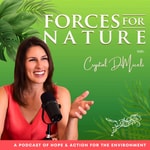
Do you care about environmental issues but feel overwhelmed by all the information out there? Forces for Nature is here to help. We provide a clear, accessible overview of the challenges our planet is facing and, more importantly, focus on solutions. Instead of dwelling on the doom and gloom that fills the news and social media, we answer the question, “What can I do about it?” With Forces for Nature, you’ll find practical steps and inspiring stories that empower you to make a difference so that you, too, can become a force for nature.
Site
RSS
Apple
Data updated on 04/07/2026
Recent rankings
Latest chart positions across Apple Podcasts and Spotify rankings.
Shared links between episodes and podcasts
Links found in episode descriptions and other podcasts that share them.
Federal policy might seem distant from the forests, rivers, and wildlife we care about but, as Bentley Johnson of the Michigan League of Conservation Voters explains, its impact reaches straight into our daily lives.
From an executive order that resulted in higher(!) energy prices to bipartisan efforts that ensure the water coming from your tap is clean, Bentley reveals how political decisions ripple through ecosystems, economies, and communities alike.
He also reminds us that our power doesn’t end at the ballot box. Between elections, we can still shape the laws that protect clean air, renewable energy, and wild spaces- by showing up, speaking out, and holding leaders accountable.
If you’ve ever wondered how what happens in Washington affects us directly, this episode will connect those dots and help you see what you can be doing in between elections that can make a difference.
This is another episode of the Emerging Wildlife Conservation Leaders program Series!
Highlights
The real-world consequences of rolling back clean-energy and conservation laws.
Bipartisan success stories- from PFAS cleanup to Great Lakes restoration- that prove cooperation is still possible.
Why framing issues around health, cost, and community helps bridge divides.
What YOU Can Do
Vote in every election, especially local ones. City and state leaders decide on wildlife corridors, pollution standards, and habitat funding. **CHECK TO SEE IF YOUR AREA IS HOLDING ELECTIONS THIS NOVEMBER 4TH.
Check your representatives’ environmental records. Visit your state’s League of Conservation Voters or lcv.org/scorecard.
Speak up between elections. Attend town halls, share your story, and comment on proposed environmental rule changes.
Join or support local conservation and restoration projects. The federal picture changes, but local action keeps progress alive.
Share success stories. Remind others that clean-energy projects, restored wetlands, and wildlife protections are working. Hope is contagious.
Because Michigan LCV's scorecard is focused on Michigan, you may be interested in the national LCV's congressional scorecard where anyone in the country can look up their Members of Congress.
We also talked about the greenhouse gas emissions reporting rollback. Here is a link to take action on that (it's a national effort but this link is unique for Michigan LCV so that if people use it to make a comment, they can get credit).
Want a free guide to help you become a force for nature? Get it HERE!
If you enjoyed this episode, be sure to subscribe, rate, and review it! This helps to boost its visibility.
Hit me up on Instagram and Facebook and let me know what actions you have been taking. Adopting just one habit can be a game-changer because imagine if a billion people also adopted that!
What difference for the world are you going to make today?
Behind the Lens: How Storytelling Shapes Conservation with Alex Goetz & Justin Grubb, Ep.102
Wildlife filmmakers Justin Grubb and Alex Goetz have traveled from Costa Rica to Alaska capturing stories that connect people and wildlife in powerful ways. As co-founders of Running Wild Media, their work has appeared on National Geographic, PBS, Discovery+, and Disney+, and has been recognized with multiple awards and Emmy nominations.
In this conversation, Justin and Alex share the behind-the-scenes realities of wildlife filmmaking- the challenges, the ethics, and the unexpected humor that happens along the way. From hellbenders in Appalachia to red wolves in North Carolina, they reveal how the most effective conservation stories aren’t about animals alone, they’re about people.
You’ll also hear how they build campaigns that lead to tangible impact, why hopeful storytelling is their most powerful tool, and how each of us can use our own voice to spark change, no matter what our day job is.
Highlights
From prairie dog turf wars to crocodile close calls, what it’s really like in the field.
The ethics of getting the perfect shot while respecting the wildlife.
Why the most powerful wildlife stories focus on the humans connected to the animals.
What YOU Can Do
Justin and Alex shared several simple yet meaningful ways listeners can help support wildlife and conservation storytelling:
Tell your own story. Use your phone, words, art, or photos to share the nature you love. A story told with authenticity and hope can inspire others to care.
Be a hopeful voice. Social media can get dark. Choose to amplify the good instead. Share solutions, success stories, or even small wins happening in your community.
Engage locally. Attend or support environmental or wildlife film festivals. Ask questions, start conversations, and connect with filmmakers and advocates in your area.
How Collaboration Can Make for a Wildlife-Friendlier Future with Kate Gersh, Ep.101
This is another episode of the Emerging Wildlife Conservation Leaders program series!
In a place where moose wander through neighborhoods and grizzlies sometimes cross backyard fences, living alongside wildlife takes creativity, cooperation, and care. The Jackson Hole Wildlife Foundation is proving that when communities come together, including volunteers, landowners, agencies, and visitors alike, they can create lasting solutions that benefit both people and wildlife.
In this episode, Associate Director Kate Gersh shares how this small but mighty organization helps the Greater Yellowstone community coexist with the wild neighbors that make Jackson Hole so special. From pulling down old barbed-wire fences to hand-removing invasive weeds and collecting valuable wildlife data, Kate’s volunteers are showing that conservation success depends on everyone’s participation- not just scientists or professionals.
Kate and I first met through the Emerging Wildlife Conservation Leaders program, where we worked together on a global bat conservation project. It’s been incredible to see how she continues to carry that same collaborative spirit into her work today.
Highlights
How community volunteers have become the lifeblood of wildlife conservation in Jackson Hole.
Why collaboration among ranchers, agencies, nonprofits, and residents leads to solutions that last.
Why conservation needs communicators, fundraisers, and advocates just as much as biologists.
What YOU Can Do
Inspired by Kate’s work? Here are some simple ways to help make your own community more wildlife-friendly:
Volunteer your time with local conservation projects or citizen science programs.
Use bear-resistant trash cans and secure garbage to keep wildlife safe and wild.
Plant native species to support pollinators and local ecosystems.
Protecting Sharks and the People that Depend on Them with Gaby Ochoa, Ep. 100
In 2011, Honduras declared all its waters a shark sanctuary. On paper, it looked like a major conservation win. But for the Indigenous Miskito fishers who had relied on sharks for generations, the law came without consultation- turning long-standing practices into crimes overnight.
My guest, Gabriela “Gaby” Ochoa, is a Honduran marine biologist and founder of Ilili, an organization named after the Miskito word for “shark.” Ilili is working to flip the script on top-down conservation by putting local communities at the center of decision-making. From training fishers in scientific methods, to blending traditional knowledge with modern science, to navigating the complexities of shark sanctuaries, Gaby’s work offers a powerful example of what conservation looks like when it’s truly locally driven.
Highlights
What was the paradox of Honduras’ shark sanctuary and why did top-down conservation backfire here.
How to build trust with fishers and transform them into collaborators and co-researchers.
The emotional challenges of shark conservation and the small wins that keep Gaby going.
What YOU Can Do
Listen first. Conservation that lasts begins by hearing all perspectives, especially those most impacted.
Find citizen science opportunities by you. And, if you are in Honduras, report shark and ray sightings through Ilili’s website.
Remember that conservation isn’t about telling people what to do. It’s about empowering local communities to lead.
This is another episode of the Emerging Wildlife Conservation Leaders program series!
Whether you’re trying to protect a local park, rally donations for your nonprofit, or simply get your friends to recycle, one of the hardest parts of making change is inspiring others to care. How do you move people from awareness to action? That’s the art of fundraising- and it’s about far more than asking for money.
In this episode, David Tucker of the Chesapeake Bay Foundation pulls back the curtain on what he’s learned after years of connecting people’s passions with one of the most ambitious ecosystem restoration efforts in the world. Through stories of the Bay, David shares practical strategies that anyone can use to promote their own cause.
Highlights
Why fundraising is really about relationships, not just money.
How do you get people to feel a connection to a cause?
What is more powerful, storytelling or stats?
What YOU Can Do
Even small, reoccurring gifts are helpful to an organization. Especially if it is unrestricted.
You can hold personal fundraisers, like a dinner, to raise money for a cause you believe in.
If you are a business owner, you can donate a certain percentage of the profit of a particular product to an organization.
Find out if your employer has a donor match program.
This is another episode of the Emerging Wildlife Conservation Leaders program series!
Across Africa, thousands of primates are finding themselves the victims of the illegal wildlife trade, bushmeat hunting, and habitat loss. For many, survival depends on the work of sanctuaries. These safe havens provide food, medical care, and, in some cases, even a path back to the wild.
Today’s guest, Kaitlyn Bock, has spent the past decade with the Pan African Sanctuary Alliance (PASA) helping to support these vital places. PASA is a network of 23 sanctuaries in 13 countries working together to rescue primates, fight trafficking, and engage local communities in conservation.
Kaitlyn’s stories- from orphaned chimps taking their first steps into forested enclosures to the tireless staff who keep sanctuaries running day after day- shine a light on why sanctuaries matter and how they give wildlife a second chance.
Highlights
What makes a sanctuary “good” and how to spot red flags.
Why reintroduction to the wild is both rare and extraordinary.
The hidden role sanctuaries play in enforcing wildlife laws across Africa.
Key Signs of a Good Sanctuary
No direct contact: Visitors should not be feeding, bathing, or taking selfies with the animals.
Educational focus: You leave more informed about the animals’ plight and why the sanctuary exists.
High-welfare enclosures: Spacious, naturalistic habitats that mimic the species’ environment.
Enrichment provided: Animals are given activities and materials (like branches or puzzles) to encourage natural behaviors.
Transparency: Staff openly explain each animal’s story and why they are there.
No intentional breeding: Ethical sanctuaries don’t breed animals in captivity for display or tourism.
Responsible social media: No images of animals in clothes, behaving like pets, or posing with tourists. Captions should educate, not entertain at the animals’ expense.
Through the Eyes of a Wildlife Vet with Dr. Hugo Pereira, Ep. 97
This season of Forces for Nature is extra special- all of the guests are participants in the Emerging Wildlife Conservation Leaders (EWCL) program, a global network of conservationists who are pushing the boundaries of how people and wildlife can thrive together. As EWCL celebrates its 20th anniversary this year, I’m spotlighting some of the inspiring individuals whose work is shaping the future of conservation.
To kick things off, I sat down with Dr. Hugo Pereira, a field veterinarian with the Mozambique Wildlife Alliance. Hugo’s job might sound like it’s all about the animals- from darting elephants, to rescuing orphaned rhinos, and rehabilitating pangolins- but as he makes clear, conservation is just as much about people. In Mozambique, communities and wildlife share the same land, which means Hugo’s work often starts with listening to frustrations, building trust, and co-creating solutions that reduce conflict and create opportunity. And while you may never lift a rhino calf into a helicopter or pull an elephant out of the mud, you probably do encounter your own version of human–wildlife conflict whether it’s deer eating your garden, coyotes prowling your neighborhood, or simply the daily choices of how your community shares space with nature. Hugo’s “people-first” approach shows us that coexistence starts with compassion, creativity, and persistence and the principles he lives by in the savannas of Mozambique are the same ones that can guide us in our own backyards.
Highlights
The adrenaline and precision behind rescuing a rhino calf orphaned by poachers.
After a powerful series of conversations recorded at the EarthX Conference in Dallas, Texas, Forces for Nature host, Crystal DiMiceli, is taking this moment to pause, reflect, and share what she's carrying forward as the season ends.
In this solo episode, she talks about the common themes that emerged across the EarthX series, the value of having all stakeholders in the room—even those we may not always agree with—and why it’s okay to hold complexity in this moment. She also offers some gentle questions to help you stay grounded and engaged as we face both political and environmental challenges alongside a sneak peak as to what she will be up to in the coming months.
EarthX is more than just a conference—it’s a space for unlikely alliances, which leads to real, on-the-ground hope. If you're intrigued to check out the conference for yourself, go to https://earthx.org/
Want a free guide to help you become a force for nature? Get it HERE!
If you enjoyed this episode, be sure to subscribe, rate, and review it! This helps to boost its visibility.
Hit me up on Instagram and Facebook and let me know what actions you have been taking. Adopting just one habit can be a game-changer because imagine if a billion people also adopted that!
What difference for the world are you going to make today?
Bringing Attention to the Overlooked Forest Beneath the Waves with Adam Hussain, Ep.95
Welcome to another episode of the EarthX Conference series!
When you think of ocean conservation, coral reefs likely come to mind. But what if the real unsung hero of the sea is something far less glamorous—and far more vital? Filmmaker Adam Hussain brings us into the underwater world of kelp forests in his upcoming documentary Seaforestation. These underwater ecosystems cover more area than coral reefs, support an astonishing range of marine life, and play a quiet but powerful role in fighting climate change.
Adam shares surprising facts—like how kelp forests could be worth more than the Great Barrier Reef in economic value—and tells stories from the field, including sea lions hopping aboard boats and witnessing the last 5% of Tasmania’s once-vast giant kelp forests. If you've ever dismissed seaweed as just ocean salad, this episode might just change your mind.
Highlights:
Why kelp is critical to coastal ecosystems and climate stability?
What’s threatening these forests—and it’s not just one thing?
How scientists are using “assisted adaptation” to help kelp survive warming oceans?
What YOU Can Do
Most people don’t even know kelp forests exist, let alone how important they are. Just talking about what you learned in this episode can spark awareness and curiosity.
Companies that farm seaweed responsibly (rather than harvesting it from the wild) are helping create demand for sustainable ocean industries. Look for packaging and food products made from farmed seaweed.
Ocean warming is one of the biggest threats to kelp. Cutting back on emissions—from energy use to transportation to food choices—can make a difference at scale.
This is another episode of the Forces for Nature, EarthX Conference series!
What if the way we approach learning could shape not just our own success, but the future of our planet? In this episode, I sit down with James Keyes—former CEO of 7-Eleven and Blockbuster—who believes that education isn’t just about getting a degree; it’s the key to freedom, progress, and solving some of our biggest challenges. But here’s the catch: many of us stop actively learning after school, relying instead on the information that already fits our worldview. That’s where we get stuck.
In this conversation, we explore how fear is weaponized to keep people divided, why knowledge alone isn’t enough to change minds, and how we can shift the way we communicate environmental solutions to be more inviting, less polarizing, and ultimately more effective.
Whether you're an entrepreneur, an activist, or simply someone who wants to engage more critically with the world, this episode will challenge how you think about learning, decision-making, and even the way you advocate for change.
Highlights
Why fear—not lack of information—is at the root of many societal and environmental challenges.
How militant ignorance keeps people from seeing solutions (and how to avoid falling into that trap ourselves).
The three skills you actually need to be a lifelong learner—far beyond the classroom.
What YOU Can Do
Challenge your own biases: Are you truly open to new perspectives, or just reinforcing what you already believe?
Shift your messaging: When advocating for change, focus on shared values and opportunities rather than battles and division.
Reignite your curiosity: Instead of assuming you already know the answer, start asking why more often.
Resources
Support authentic conservation media. Donate to or share films that are fact-based and community-centered. Look for productions that give voice to both people and wildlife.
Stay curious and informed. Fact-check what you share, know your sources, and help counter misinformation about wildlife and conservation issues.
Look closer to home. You don’t need to go to the rainforest to find wonder. Start by noticing and appreciating the wildlife in your own backyard.
Want a free guide to help you become a force for nature? Get it HERE!
If you enjoyed this episode, be sure to subscribe, rate, and review it! This helps to boost its visibility.
Hit me up on Instagram and Facebook and let me know what actions you have been taking. Adopting just one habit can be a game-changer because imagine if a billion people also adopted that!
What difference for the world are you going to make today?
Support local conservation groups- your voice, time, or donation matters.
Advocate for smart land-use policies that protect wildlife movement and habitat.
Talk about coexistence and help spread understanding of how people and wildlife can thrive together.
Emerging Wildlife Conservation Leaders program, that brought Kate and me together, is accepting applications for its next class of young wildlife professionals. Apply here and tell them I sent you!
Want a free guide to help you become a force for nature? Get it HERE!
If you enjoyed this episode, be sure to subscribe, rate, and review it! This helps to boost its visibility.
Hit me up on Instagram and Facebook and let me know what actions you have been taking. Adopting just one habit can be a game-changer because imagine if a billion people also adopted that!
What difference for the world are you going to make today?
Want a free guide to help you become a force for nature? Get it HERE!
If you enjoyed this episode, be sure to subscribe, rate, and review it! This helps to boost its visibility.
Hit me up on Instagram and Facebook and let me know what actions you have been taking. Adopting just one habit can be a game-changer because imagine if a billion people also adopted that!
What difference for the world are you going to make today?
Want a free guide to help you become a force for nature? Get it HERE!
If you enjoyed this episode, be sure to subscribe, rate, and review it! This helps to boost its visibility.
Hit me up on Instagram and Facebook and let me know what actions you have been taking. Adopting just one habit can be a game-changer because imagine if a billion people also adopted that!
What difference for the world are you going to make today?
What YOU Can Do
Donate to sanctuaries. Even small, monthly gifts- especially unrestricted- help to cover food, care, and staff.
Volunteer either on-site or remotely with skills like grant writing or communications.
Speak up on social media when you see red flags in wildlife content.
Only visit sanctuaries that avoid direct contact and focus on education.
Want a free guide to help you become a force for nature? Get it HERE!
If you enjoyed this episode, be sure to subscribe, rate, and review it! This helps to boost its visibility.
Hit me up on Instagram and Facebook and let me know what actions you have been taking. Adopting just one habit can be a game-changer because imagine if a billion people also adopted that!
What difference for the world are you going to make today?
Share conservation stories on social media. Spreading the right information helps raise awareness and attract wider support.
Donate to conservation organizations.
Educate yourself about organizations in your own area: Who they are, why they do what they do, and what would happen if they didn’t exist. This awareness builds empathy and informed support.
Get informed about local wildlife and why they’re present. Understanding why deer, coyotes, or other species show up in neighborhoods helps people move from frustration to tolerance.
Modify your environment to prevent conflict:
Build or adjust fences to keep animals out of gardens or crops.
Use deterrents like flashlights, noises, or scarecrows, depending on the species.
Recognize “tolerance” as an important step: we don’t have to love the wildlife around us, but learning to tolerate them is the bridge toward coexistence.
Want a free guide to help you become a force for nature? Get it HERE!
If you enjoyed this episode, be sure to subscribe, rate, and review it! This helps to boost its visibility.
Hit me up on Instagram and Facebook and let me know what actions you have been taking. Adopting just one habit can be a game-changer because imagine if a billion people also adopted that!
What difference for the world are you going to make today?
Collapse
Want a free guide to help you become a force for nature? Get it HERE!
If you enjoyed this episode, be sure to subscribe, rate, and review it! This helps to boost its visibility.
Hit me up on Instagram and Facebook and let me know what actions you have been taking. Adopting just one habit can be a game-changer because imagine if a billion people also adopted that!
What difference for the world are you going to make today?
Want a free guide to help you become a force for nature? Get it HERE!
If you enjoyed this episode, be sure to subscribe, rate, and review it! This helps to boost its visibility.
Hit me up on Instagram and Facebook and let me know what actions you have been taking. Adopting just one habit can be a game-changer because imagine if a billion people also adopted that!
What difference for the world are you going to make today?
Related Shows Based on Content Similarities
Discover shows related to Forces for Nature, based on actual content similarities. Explore podcasts with similar topics, themes, and formats, backed by real data.