Wellness, Actually with Emily Oster & Perry Wilson, MD – Détails, épisodes et analyse
Détails du podcast
Informations techniques et générales issues du flux RSS du podcast.
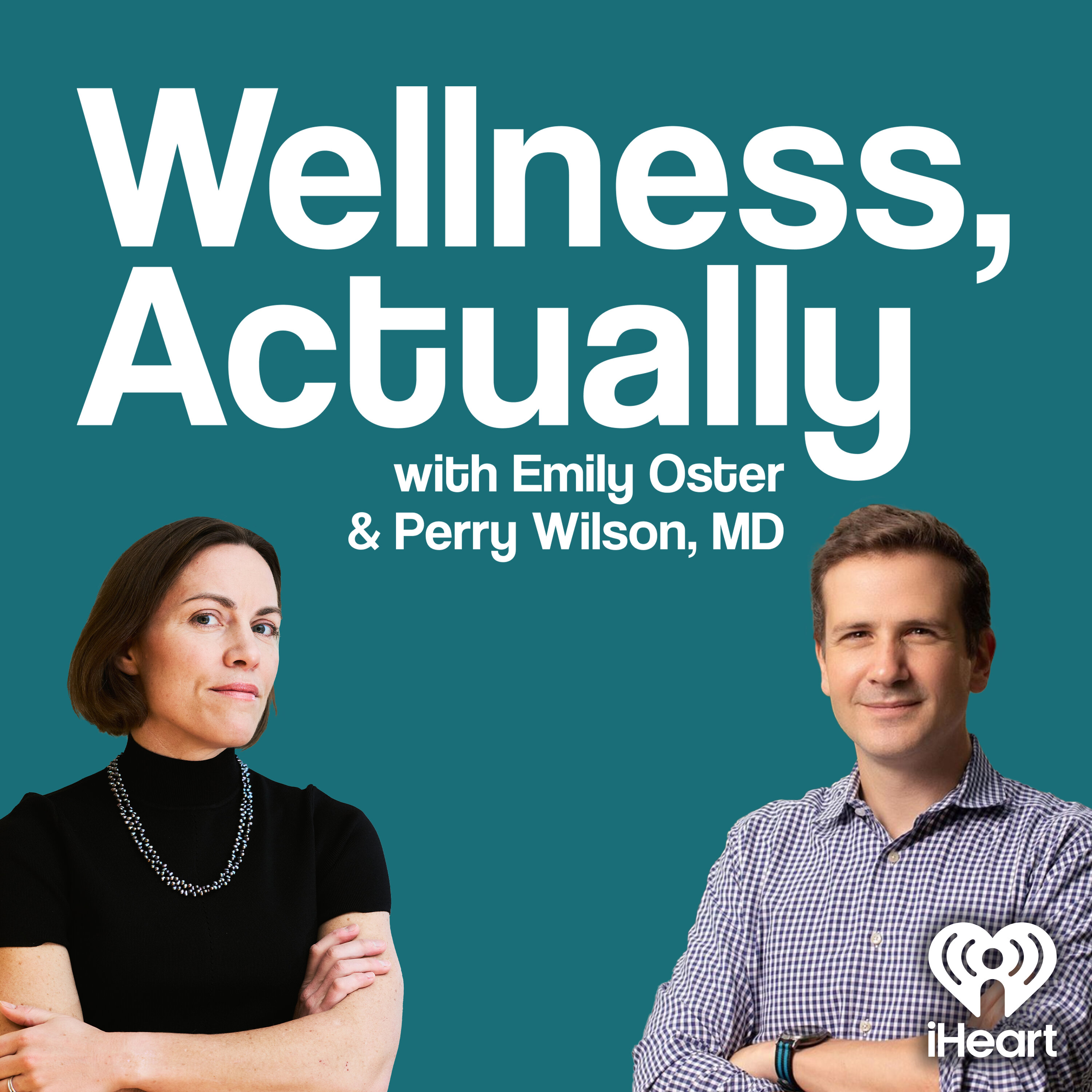
Wellness, Actually with Emily Oster & Perry Wilson, MD
iHeartPodcasts
Fréquence : 1 épisode/15j. Total Éps: 96

A staggering amount of health and wellness news and information is bombarding us everywhere we look – and who’s got time to parse it out, to verify it, and then to actually do the work of improving our health?
We do! We are Emily Oster, best-selling author and data expert, and Perry Wilson, a medical doctor. And unlike the influencers, we actually know how to read a medical paper. This podcast separates fact from fiction, causality from correlation, so that you can stay informed without being overwhelmed. Every episode, we cover the health news of the week, take listener questions, and do a deep dive into a buzzy and misunderstood wellness topic so that you can actually make the best decisions for your own health.
Classements récents
Dernières positions dans les classements Apple Podcasts et Spotify.
Apple Podcasts
Aucun classement récent disponible
Spotify
Aucun classement récent disponible
Liens partagés entre épisodes et podcasts
Liens présents dans les descriptions d'épisodes et autres podcasts les utilisant également.
See all- https://omnystudio.com/listener
1112207 partages
- https://www.thehotline.org/
1188 partages
- https://drinklmnt.com/
420 partages
- https://www.instagram.com/the.vagina.whisperer
103 partages
Qualité et score du flux RSS
Évaluation technique de la qualité et de la structure du flux RSS.
See allScore global : 79%
Historique des publications
Répartition mensuelle des publications d'épisodes au fil des années.
What's the deal with GLP-1s?
Saison 3 · Épisode 5
jeudi 5 mars 2026 • Durée 58:48
This week, Emily and Perry discuss GLP-1s, those blockbuster weight-loss drugs that have taken the world by storm -- and not just what you already know about them. From the origins in Gila monster venom to the surprisingly long history of their use, they explore their effectiveness, side effects, lingering questions about long-term usage, and the weird knock-on effects in both the brain (libido?) and our society (protein water?). These drugs are here to stay, so let's understand them from every angle.
Plus: RFK vs. Dr. Mike, a concerning Surgeon General pick, and unsurprising data around football head injuries.
Submit a question for our weekly mailbag at wellnessactually.fm.
See omnystudio.com/listener for privacy information.
What's the deal with cold plunges and saunas?
Saison 3 · Épisode 4
jeudi 26 février 2026 • Durée 50:11
This week, Emily and Perry plunge, as it were, into the temperature extremes: cold plunges and saunas. Is there any actual value to shocking your body with ice water or sweating out an ocean? Or are we just gluttons for punishment?
Plus: soaring measles rates, Jay Bhattacharya's double federal appointment, and pandemics lurking under the ice.
Submit a question for our weekly mailbag at wellnessactually.fm.
See omnystudio.com/listener for privacy information.
It’s Never Too Late for Pelvic Floor Therapy: Why it’s about more than Kegels
Saison 2 · Épisode 59
jeudi 30 janvier 2025 • Durée 44:16
For many of us, our first exposure to our pelvic floors is through the Kegel exercises we learned about in Cosmo, promising us great sex. The reality of our pelvic floors comes roaring back in pregnancy, when they are are more taxed than they've ever been. The pelvic floor turns out to have a hand in many things, including peeing, pooping, sex, pregnancy, labor, birth, postpartum, and menopause. And like with all muscles, the more we take care of them, they better they can take care of us.
Today on ParentData, we welcome the Vagina Whisperer herself, Dr. Sara Reardon. Sara's new book, Floored: A Woman’s Guide to Pelvic Floor Health at Every Age and Stage, which will be released in June, explores the seasons of life with a pelvic floor, from puberty to menopause. In this conversation, we talk about the optimal ways to pee and poop. We discuss what actually happens when you go to pelvic floor therapy. We discuss Kegels and why they are often good but also not a panacea. More than anything, Sara takes something that we all experience privately, and encourages us to shine a light on it, take the stigma away, and tighten up with confidence.
Subscribe to ParentData.org for free access to new articles every week on data-driven pregnancy and parenting.
Follow Sara Reardon on Instagram
This episode is generously supported by:
See omnystudio.com/listener for privacy information.
Tamron Hall's Late-Night Panic Google
Saison 2 · Épisode 58
jeudi 23 janvier 2025 • Durée 14:37
Award-winning talk show host Tamron Hall dives into dressing your kids properly for the weather and overall preparedness as a parent (and why it's so elusive), and extolls the virtues of the preschool jacket flip (IYKYK).
Subscribe to (the new and improved!) ParentData.org for free access to new articles every week on data-driven pregnancy and parenting.
See omnystudio.com/listener for privacy information.
How to Talk to Your Doctor: Navigating important conversations about your care
Saison 2 · Épisode 57
jeudi 16 janvier 2025 • Durée 51:49
Today on ParentData, we're welcoming back Dr. Nathan Fox, Emily's co-author for The Unexpected- a book about when things go wrong, or at least get complicated, in a pregnancy. Nate is an OB-GYN and a maternal-fetal medicine specialist, and he is one of our favorite returning podcast guests, not just because he’s a great talker but also because it’s really nice to have a doctor who can both provide medical answers to questions that come up around pregnancy, and help you have the best possible experiences with your own doctor.
We’re discuss some big issues that arise during pregnancy and the many prenatal doctor’s visits; about the distinction between self-management and calling your doctor (when do you know if something is normal-bad or bad-bad?), and we’ll talk about just how subjective that line actually is. We also talk about risks and tradeoffs and about the kinds of postpartum issues that are worth addressing while still pregnant (we're looking at you, depression and anxiety).
The Unexpected, and this conversation, are meant to help people be much better prepared for what they may face in their pregnancies and to help better navigate conversations with doctors — both the expected conversations and the unexpected ones.
Subscribe to (the new and improved!) ParentData.org for free access to new articles every week on data-driven pregnancy and parenting.
Subscribe to (the new and improved!) PregnantData newsletter.
This episode is generously supported by:
• Hatch
• LMNT
See omnystudio.com/listener for privacy information.
ParentData Presents: Raising Parents - "Should You Have Kids?"
Saison 2 · Épisode 56
jeudi 9 janvier 2025 • Durée 50:41
Today on ParentData, we're airing an episode from Raising Parents, Emily's limited series podcast in partnership with The Free Press. The episode is the last in the series, but the first question we all need to grapple with before engaging with all the others: should you have kids?
For most of human history, having kids wasn’t much of a choice. Social expectations, lack of birth control, and limited autonomy for women presented a couple of options: Have children, or join a convent. But the 1960s ushered in a big change. With better options for birth control and expanded career opportunities for women, many people for the first time could choose how many children to have, and whether they should have any at all.
Fast-forward to today: More people are choosing not to have children for a wide range of reasons. Having children, of course, is a personal choice. But it’s a choice that has broader implications. Everywhere across the globe—the U.S., Europe, Asia, Africa—fewer children are being born. And strangely enough, having kids has become part of the culture wars. There are pro-natalist public figures like Elon Musk on one side saying everyone needs to have more kids now in order to save humanity. And on the other side, people like climate activist Greta Thunberg say rising sea levels are so catastrophic that having kids in this era is akin to genocide.
But there’s no debate that the fertility rate is plummeting in America and around the world. Presently, American women, on average, have 1.8 kids. In the 1950s, it was 3. The replacement rate in the United States, which is the fertility rate needed for a generation to replace itself without considering immigration, is approximately 2.1 births per woman. Around the world, the fertility rate fell by more than half between 1950 and 2021, as many countries became wealthier and women chose to have fewer children.
For economists like Emily, the speed with which the fertility rate is falling is cause for alarm. Economic growth depends, at least in part, on population growth. Retired people rely on generations of younger workers for support, through contributions to Social Security and taxes. With fertility rates in free fall, the math doesn’t add up.
That’s the big picture. Now back to our own families, and a fundamental question: Should we even have kids in the first place, and what happens if we don’t?
Resources from this episode:
• Bryan Caplan: Selfish Reasons To Have More Kids (Bookshop)
• Gina Rushton The Parenthood Dilemma: Procreation in the Age of Uncertainty (Bookshop)
• Leah Libresco Sargeant
• Helena de Groot
• Ross Douthat
See omnystudio.com/listener for privacy information.
Understanding Panic Headlines: How studies that influence your parenting choices get published
Saison 2 · Épisode 55
jeudi 2 janvier 2025 • Durée 46:43
Here at ParentData, we talk a lot about panic headlines. You know, the headlines that cycle through your feed about coffee and wine and sleep and lead and the causes of autism, many of which contradict the last panic headline, and almost all of them turning out to be not nearly as bad as they seem. But in the moment, they feel so scary and urgent. And if you're a parent just trying to follow the science, do what's best for your kid, sometimes it feels like you're being absolutely and really nonsensically bombarded with the wrong things to do.
Today on ParentData, we've invited Dr. Bapu Jena to help us stay sane. Bapu is an economist and a medical doctor who specializes in natural experiments, which means observing human behavior in naturally existing behavior (as opposed to a randomized trial). This makes him an ideal person to talk about the uses and abuses of data, and how curious nerds conduct research that makes its long and winding way into a headline that almost feels like it's designed to scare the crap out of parents. We talk about the complicated relationship between causality and correlation, the academic and popular incentives to publish these kinds of headlines, and also who decides what research is worth sharing with the world.
This is on the face a conversation about research, but really it's about reassurance - there are a lot of reasons behind publishing a story about lead in Cheerios that have nothing to do with you or how dangerous Cheerios actually are or whether you're a good parent who cares about the health and wellbeing of your kids. You are and you do. Don't throw out your Cheerios, but do explore the journey with us.
Subscribe to ParentData.org for free access to new articles every week on data-driven pregnancy and parenting.
This episode is generously supported by:
See omnystudio.com/listener for privacy information.
Is Gentle Parenting Best? What the evidence says
Saison 2 · Épisode 54
jeudi 26 décembre 2024 • Durée 16:06
If you spend any time in parenting circles, it’s hard to avoid being inundated with “types” of parenting. Parenting labels are not neutral. Some are positive, some negative, but they’re never just descriptive. And lately, the most ink has been spilled over "gentle" parenting (also called permissive or respectful parenting). Gentle parenting, at its core, is an approach to behavior characterized by acknowledging a child’s feelings and not using punishments or rewards.
But does it work? Let's see what the evidence says!
Today on ParentData, Emily reads her recent article on gentle parenting aloud, digging into both the data, and also how hard the data is to evaluate.
Subscribe to ParentData.org for free access to new articles every week on data-driven pregnancy and parenting.
See omnystudio.com/listener for privacy information.
Researching the Importance of Paid Leave: A look into how studies are conducted
Saison 2 · Épisode 53
jeudi 19 décembre 2024 • Durée 43:59
The United States is one of the only countries in the world that doesn’t guarantee paid parental leave. We point out this fact a lot, but what does it really mean when a family doesn't have the ability to take time off when a baby is born?
It means a lot of things. It means moms going back to work while still recovering from childbirth, it means parents struggling to figure out child care for their baby, and it often means babies going to group child care settings, which may be wonderful but do expose them to germs — germs that are more dangerous when babies are small than when they’re bigger. We can talk about these different challenges and why they might matter for kids’ and families’ outcomes, but to figure out how much they matter and in what ways...that’s what research is for.
Today on ParentData, we're joined by Dr. Katherine Ahrens and Dr. Jennifer Hutcheon, who are both epidemiologists and professors. They recently published a paper titled “Paid Family Leave and Prevention of Acute Respiratory Infections in Young Infants," an analysis of paid leave in New York State, and the impacts of that paid leave on hospitalizations for infants, mostly for RSV. The paper's bottom line is that paid family leave keeps babies healthier and keeps them out of the hospital, and now we have the data to prove it and to show that the effects are large in terms of numbers.
But putting together a research paper like this is surprisingly tricky. You need to know what questions you’re asking, and you need to think about how you’re going to determine causality rather than just correlation. So we’re going to take their research from idea to final peer-reviewed paper, and we’re going to talk about everything you always wanted to know about how research is conducted.
Subscribe to ParentData.org for free access to new articles every week on data-driven pregnancy and parenting.
See omnystudio.com/listener for privacy information.
Bess Kalb's Late-Night Panic Google
Saison 2 · Épisode 52
jeudi 12 décembre 2024 • Durée 13:04
Writer and excellent social media follow Bess Kalb ruminates on the best place to move your family to prepare for climate change, giving yourself intentional permission to worry, and the forbidden pleasures of a s'mores Pop Tart.
Subscribe to ParentData.org for free access to new articles every week on data-driven pregnancy and parenting.
See omnystudio.com/listener for privacy information.
Podcasts Similaires Basées sur le Contenu