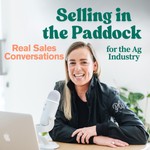
Selling in the Paddock is a podcast about real sales in agriculture. Hosted by Georgia Stormont, The Ag Sales Coach, it cuts through the noise and gets to the point—how to sell better, lead stronger, and get results.
Guests include Paul Roos, AFL premiership coach turned leadership consultant, and Troy Williams, CEO of the National Farmers’ Federation, plus top ag reps, buyers, and business owners.
If you work in ag and want to sell smarter and build better teams, this podcast is for you.
Site
RSS
Apple
Données mises à jour le 23/10/2026
Classements récents
Dernières positions dans les classements Apple Podcasts et Spotify.
Liens partagés entre épisodes et podcasts
Liens présents dans les descriptions d'épisodes et autres podcasts les utilisant également.
Ep 85 - Your Customer Doesn’t Care About Your Product
Épisode 85
lundi 19 octobre 2026 • Durée 37:33
Your customer doesn’t care about your product.
Well… not in the same way you do.
You know the formulation, the genetics, the horsepower, the trial data, the specifications and exactly why your product is better than the competitor’s.
But your customer? They care about what it changes for them.
They care about getting the crop off. Margin. Reliability. Labour. Risk. Profitability. And whether spending another $20K, $50K or $200K is actually going to make a meaningful difference to their business.
In this solo episode of Selling in the Paddock™, I unpack one of the traps I see technically brilliant agricultural salespeople fall into all the time: using product knowledge as a safety blanket.
Because talking about what we know feels safe.
Asking better questions requires curiosity — and sometimes a little courage.
I explore the difference between a feature, benefit and impact, and why you can't truly know the impact of your product until you understand the individual customer sitting in front of you.
We also talk about:
Why technical expertise is incredibly important — but isn't enough on its own
How product knowledge can become a place to hide in a sales conversation
The difference between demonstrating expertise and dumping everything you know
Why knowing where your product doesn't fit can actually build credibility
How to respond to questions about price, trials and competitors while staying curious
Why “our people are different” and “our service is second to none” aren't automatically compelling value propositions
What commercially confident selling looks like when your product genuinely isn't the right fit
And I leave you with one simple shift to make before your next customer meeting.
Instead of asking:
“What do I need to tell them?”
Ask:
“What do I need to understand?”
Because your customer cares about their farm, their business, their people, their risk, their profitability and their problems.
Understand those first, and you'll know which parts of your product actually matter.
Grab a copy of my book, Selling in the Paddock™, where I unpack the skills, mindset and conversations behind selling well in agriculture.
And if you're looking to build greater commercial confidence across your sales team, head to Selling in the Paddock™ online to explore my sales training, workshops and programs for agricultural businesses.
Ep 84 - Selling Change: Why Great Technology Still Needs Great Sales | Michael Whittaker, Tabula
Épisode 84
lundi 12 octobre 2026 • Durée 47:15
Selling new technology into agriculture isn’t just about proving that the product works.
You’re often asking someone to change a process, rethink the way they’ve always done something, invest real money and trust that the change will make their business better.
In this episode of Selling in the Paddock, I’m joined by Michael Whittaker from Tabula, an agricultural technology business celebrating 20 years of selling technology into agriculture.
Michael shares a brilliant perspective on the tension between the speed of technology and the seasonality of agriculture — and why successful adoption often comes from small, incremental changes rather than trying to change everything at once.
We talk about why you need to get your “muddy boots” on if you want to sell into agriculture, and why understanding the practical realities of your customer’s business matters just as much as understanding your own product.
We also unpack ROI — because value isn’t always measured in dollars. Sometimes the biggest return for a customer is time, efficiency, simplicity or removing another job from an already overloaded day.
Michael and I discuss:
• Why selling technology is often really about selling change • The importance of incremental wins when introducing something new • Why understanding the realities of farming matters in agricultural sales • How to communicate value rather than getting stuck talking about features • Why ROI can mean time and efficiency, not just dollars • The power of customer advocates and social proof • Why overselling and overpromising can destroy trust • How seasonality creates a unique sales cycle in agriculture • Why salespeople need to know the limitations of what they sell • Why the human side of selling may become even more important as AI, automation and technology advance
One of my favourite ideas from this conversation is simple:
AI doesn’t do business with AI. Humans do business with humans.
Ep 83 - Stop “Just Checking In”: How to Follow Up Without Sounding Desperate
Épisode 83
lundi 5 octobre 2026 • Durée 27:00
Have you had a chance to look at the quote?
Three days later…
Just checking in.
What would happen if I removed “just checking in” from your sales vocabulary tomorrow?
In this solo episode of Selling in the Paddock™, we’re talking about follow-up — why it matters, why so many of us avoid it, and how to follow up with confidence without sounding desperate, pushy or annoying.
Because silence doesn’t always mean rejection.
Harvest happens. Weather happens. Budgets get delayed. Priorities change. Someone else needs to approve the spend.
But sometimes silence does mean there wasn’t enough value or urgency to progress the opportunity.
And your job in the follow-up isn’t to endlessly chase a yes.
A good follow-up should do one of two things: move the opportunity forward or give you enough information to qualify it out.
In this episode, I unpack:
Why “just checking in” gives your customer very little reason to respond
The psychology behind why salespeople avoid following up
Why fear of rejection leaves opportunities sitting in pipelines for months
How a follow-up problem can actually be a discovery problem
Why a clean no can be incredibly commercially useful
How to bring something valuable into the conversation instead of simply asking about your quote
Why clarity with the customer matters more than trying to maintain “power” over them
How communication preferences are changing across generations
Why you shouldn't follow up with a generation — you should follow up with a person
The simple question you can ask customers to understand how they actually want you to communicate with them
Ep 82 - Are You Busy… or Actually Productive? with Kacee Bohle
Épisode 82
lundi 28 septembre 2026 • Durée 48:36
Agriculture is full of incredibly capable people.
People who know how to work hard, push through and get the job done.
But what happens when “pushing through” becomes the default? When being busy starts to feel like proof that we’re valuable? Or when someone who is technically brilliant gets promoted into leadership without ever being taught how to lead people?
In this episode of Selling in the Paddock, I’m joined by Kacee Bohle, agricultural mindset and leadership coach, speaker, podcast host and founder of AgriMinds in the United States.
Kacee grew up on a fourth-generation corn and soybean farm in Indiana, believing she would one day take over the family operation. When life didn’t follow that plan, she built a career in corporate agriculture, including roles with John Deere and Bayer, while navigating motherhood, identity, burnout and eventually the move into her own coaching business.
And there was SO much crossover in this conversation.
We talk about the mentality agriculture has inherited from generations before us — work hard, keep going, don’t complain and push through — and why some of those beliefs have served us incredibly well… while others might be worth questioning.
The difference between being good at something and actually getting energy from it
Why technically brilliant people don’t automatically make brilliant people leaders
The danger of promoting someone simply because leadership is the “next step”
Building work around the way you actually perform at your best
Why weaknesses don’t always deserve more of our attention
Kacee’s experience using Patrick Lencioni’s Working Genius framework
Why quieter periods in business can make high performers uncomfortable
The mindset shift that changed the way Kacee approached sales
Ep 81 - When the Pipeline Goes Quiet: Don’t Let Scarcity Change How You Sell
Épisode 81
dimanche 20 septembre 2026 • Durée 23:26
What happens to the way you sell when the pipeline goes quiet?
Because it happens to all of us.
The calendar opens up. A few big opportunities are sitting in proposal stage. You’ve followed up. You’ve done what you can. And now… you’re waiting.
That’s when scarcity can start creeping into the sales conversation.
In this solo episode of Selling in the Paddock, I’m sharing something I’m experiencing in my own business right now — and what I’ve noticed about the way a quieter pipeline can subtly change how we sell.
Talking too much on discovery calls. Explaining instead of listening. Following up because we need reassurance rather than because there’s a useful next step. Discounting too quickly. Trying to turn every enquiry into a customer. Or simply filling the day with activity because being busy feels better than waiting.
The problem?
Busy and commercially productive are not the same thing.
In this episode, we unpack:
Why a quiet calendar doesn’t necessarily mean you have an empty pipeline
How scarcity changes your behaviour in a sales conversation
The difference between convincing someone and genuinely understanding whether there’s a fit
Why knowing your pipeline numbers matters
How to stop confusing activity with progress
What commercially useful action actually looks like during quieter periods
Why “yes is usually best, but no is second best”
How your energy enters the sales conversation before your words do
The difference between selling from curiosity and confidence versus needing to be chosen
Why sometimes the best thing you can do for your business is allow some space
I’ll also leave you with three questions:
What does my pipeline actually say — not what does it feel like?
Ep 80 - From Shearing Sheep to Selling AgTech: Gavin Leersen’s BaleTime Story
Épisode 80
dimanche 13 septembre 2026 • Durée 50:02
What happens when a farmer tells you to stop mucking around and build something that will actually help him?
For Gavin Leersen, that conversation eventually became BaleTime.
Gavin is a shearer, electronics tinkerer and the founder of BaleTime — an Australian agtech product designed to help hay producers monitor conditions in the windrow and know when it’s time to bale.
In this episode of Selling in the Paddock, Georgia sits down with Gavin to unpack the wonderfully unconventional story behind BaleTime — from building his first unit for a farmer he was shearing for, to discovering that word of mouth had been doing much of his selling for him.
They explore what happens when you have a genuinely useful product but suddenly realise building it and selling it are two very different skill sets.
Gavin shares what he’s learnt from field days, talking directly with farmers, digital marketing and simply listening to the problems customers are trying to solve. They also discuss why you can’t convince every farmer they have a problem, the importance of understanding what an individual customer actually values, and why sometimes the best sales conversation isn’t really a sales conversation at all.
There’s also a great conversation about perfectionism, innovation and knowing when something is good enough to get into the paddock. As Gavin puts it, if he’d waited until BaleTime was perfect, some of his customers would have missed out on a decade of better sleep.
Plus, Gavin shares where the technology could go next, including flood irrigation monitoring and potential applications well beyond hay.
It’s a very Selling in the Paddock conversation about curiosity, solving real problems, learning from your customers and figuring out how to sell something you genuinely believe can make their lives better.
How Gavin went from shearing sheep to developing agtech
The farmer conversation that sparked BaleTime
Ep 79 - My Sales Numbers Don’t Lie: What My Pipeline Is Teaching Me
Épisode 79
lundi 7 septembre 2026 • Durée 24:27
My Sales Numbers Don’t Lie: What My Pipeline Is Teaching Me
We’re nine months into 2026, so I thought it was time to take you behind the scenes of Selling in the Paddock.
In this solo episode, I’m looking back at what has already been a massive year — the agricultural businesses I’ve worked with, the travel, workshops, conferences, keynotes, launching the Selling in the Paddock book and continuing to grow the business.
But more importantly, I’m opening up my own sales pipeline.
Because I’m not standing on the sidelines teaching sales. I’m in it.
I’m prospecting. I’m following up. I’m writing proposals. I’m getting ghosted. I’m hearing no. I’m winning work. And sometimes, I’m losing it.
Recently, I sat down and properly interrogated my Pipedrive CRM and my sales numbers. I had a gut feeling about where I was strong — particularly once an opportunity reached proposal stage — but I wanted to know whether the data actually backed me up.
It did.
And it also showed me where the bigger opportunities are in my own sales process.
In this episode, I unpack:
What 2026 has looked like behind the scenes at Selling in the Paddock
Why I use Pipedrive to manage my sales pipeline
What I actually track in my CRM — and what I don’t
Why every genuine opportunity needs a next action
Why I don’t assign a dollar value to every lead immediately
The difference between a genuine pipeline and a list of people you hope might buy
Why marking an opportunity as lost can actually help you sell better
What my own conversion numbers revealed about my strengths
Why closing isn’t currently the biggest opportunity in my sales process
How knowing where you’re strong helps you decide where to put your time, energy and resources
One of my biggest takeaways?
Ep 78 - Stop Pushing, Start Pulling: How Great Ag Salespeople Create Demand | Bonita Everts, Netafim Australia
Épisode 78
lundi 31 août 2026 • Durée 38:44
What separates a good agricultural salesperson from a great one?
For Bonita Everts, Grower Business Development Manager at Netafim Australia, it starts with listening.
Originally from South Africa, Bonita has built her career across fertiliser, vegetable seed and now precision irrigation — learning how to sell into agricultural markets where relationships, trust and credibility matter.
In this episode of Selling in the Paddock, Georgia and Bonita unpack the difference between pushing a product and creating genuine pull from the market.
Bonita shares why the best salespeople don't walk onto farm and unload everything they know. They listen first, understand what the grower actually needs, and then offer the right solution.
They also explore the complexity of selling through a dealer or reseller network. How do you create demand with the grower while bringing the dealer along for the journey? Bonita's answer is simple: get alongside them. Jump in the ute. Visit growers together. Educate. Support. Make it easier for everyone to do business.
And then there's the part of sales nobody avoids forever: when things go wrong.
Bonita shares the story of a major fertiliser delivery that didn't arrive when a customer needed it. After a heated phone call — and admitting she didn't handle the initial conversation particularly well — she chose to face the situation head-on, drove to see the customer and worked to make it right.
That customer ultimately became one of her best clients.
Georgia and Bonita discuss why difficult conversations can actually strengthen relationships when we're prepared to show up, take responsibility and work towards a solution rather than putting our head in the sand.
They also dig into persistence, confidence and one of the most valuable questions a salesperson can ask:
“If you're telling me no, I want to understand why.”
Ep 77 - Cooking in the Paddock: Why Great Selling Is Really About People | Oli Le Lievre
Épisode 77
lundi 24 août 2026 • Durée 51:02
What do 500+ conversations with people across Australian agriculture teach you about selling?
Quite a lot, as it turns out.
In this episode of Selling in the Paddock, Georgia sits down with Oli Le Lievre, founder of Humans of Agriculture, to unpack what years of interviewing people across the industry have taught him about curiosity, trust, relationships and what makes people open up.
Oli shares why genuine curiosity is one of the fastest ways to build connection — and why people can tell when you're asking questions because you're truly interested versus simply waiting for your opportunity to sell.
They explore the difference between listening and actually hearing someone, why there are no shortcuts to trust, and how your reputation in agriculture often arrives at the farm gate before you do.
The conversation also gets into an interesting tension Oli is experiencing as Humans of Agriculture grows: how do you remain deeply relationship-focused while being unapologetic about the fact that business ultimately needs a transaction?
And then there's the question that might just require a whole new podcast…
Apparently, according to the next generation, when you're doing something brilliantly, you're “cooking”.
When you're doing something terrible?
You're “selling”. 😂
Which raises a much bigger question: if so many people have a negative reaction to the word selling, particularly in agriculture, do we need to rethink what great selling actually looks like?
This episode is ultimately a conversation about people — understanding them, listening to them, earning their trust and building relationships that last.
Because as Oli puts it, in agriculture there may not really be sales roles at all.
Ep 76 - Why the Best Salespeople in Ag Don’t Talk the Most | Edward O’Dwyer
Épisode 76
lundi 17 août 2026 • Durée 51:32
What separates a good salesperson in agriculture from a great one?
According to Edward O’Dwyer, it might be something surprisingly simple: patience.
In this episode of Selling in the Paddock, I sit down with agribusiness capital markets strategist Edward O’Dwyer for a wide-ranging conversation about agriculture, sales, relationships, investment and the value of knowing when to stop talking and start listening.
Edward’s career has taken him from growing up on a cattle property south of Toowoomba, to jackarooing, horse racing stables, selling LandCruisers, working in major agribusiness real estate and negotiating multi-million-dollar agricultural transactions.
And through all of it, one theme keeps coming back: people.
We talk about why some of the best salespeople Edward has worked with have been calm, patient listeners who are genuinely more interested in their customer than themselves.
We also unpack:
🌱 Why patience can get you everywhere in agricultural sales 👂 Why listening is one of the most underrated sales skills 🤝 What turns a sales rep into a genuine trusted advisor 💰 Why knowing your own value matters when you sell 🚜 How Edward went from the farm to major agricultural property transactions 🐂 Why understanding both sides of a deal matters 📈 How the capital landscape in Australian agriculture is changing 🌏 Where Edward sees opportunities emerging across agriculture, sustainability and investment 💡 Why farmers need to continually adapt, take calculated risks and go back to the drawing board ✈️ Edward’s advice for young people wanting to build a career in agricultural sales
One of my favourite parts of this conversation is Edward’s story about the rural sales rep who essentially managed his farming calendar for him — knowing what he needed, when he needed it and, importantly, understanding where Edward could afford to cut a corner and where he absolutely couldn’t.
Podcasts Similaires Basées sur le Contenu
Découvrez des podcasts liées à Selling in the Paddock. Explorez des podcasts avec des thèmes, sujets, et formats similaires. Ces similarités sont calculées grâce à des données tangibles, pas d'extrapolations !
Technology will continue to change agriculture. But the ability to listen, understand, build trust and have great commercial conversations isn’t becoming less important.
📘 Read the book:Selling in the Paddock: A Proven, People-First Framework for Selling with Confidence in Agriculture — available on Amazon Australia.
🌱 Sales training, workshops and more: Visit Selling in the Paddock™ to learn more about working with me and building greater commercial confidence across your agricultural sales team.
Keep learning with Selling in the Paddock™
Why rejection in sales isn’t actually about you
One of my favourite parts of this conversation comes towards the end when Kacee talks about getting out of her own way in sales.
Instead of seeing herself as a burden or worrying that someone might not want what she was selling, she started looking at it differently:
If you genuinely have a solution to someone’s problem, withholding that solution because you’re scared to sell it doesn’t help them.
YES.
That is exactly why I believe selling is a privilege.
The right customer has a problem you can help solve. Your job isn’t to convince everyone. It’s to understand people, ask the right questions, offer genuine value and be willing to walk away when the fit isn’t there.
This is a cracking conversation about mindset, leadership, strengths, burnout, business and selling — with plenty of laughs and a few rabbit holes along the way.
🎧 Listen now to Selling in the Paddock with Kacee Bohle from AgriMinds.
I reckon “if I’d waited until it was perfect, they would have missed out on 10 years of it making their life better” is also the clip I'd be hunting for from this episode. That's a cracking little founder/innovation moment, especially paired with his story about the farmer's wife thanking him because her husband was finally getting better sleep.
In this episode:Connect with Gavin & BaleTimeConnect with Selling in the Paddock
A pipeline isn’t a list of people you’d like to buy from you. It’s a list of genuine commercial opportunities at different stages.
And when you understand those stages — and your own strengths within them — you can become much more deliberate about where you put your energy.
If this episode gets you thinking about your own sales pipeline, send me a DM. I’d love to know: where are you strongest in your sales process, and where are your opportunities getting stuck?
Because a no isn't necessarily a failure. Sometimes it's feedback. Sometimes it's timing. And sometimes it's simply a delayed yes.
In this episode:
Why great salespeople listen before they sell
The difference between push selling and creating pull
Selling effectively through dealers and resellers
Becoming the “voice of the grower”
Why product knowledge alone doesn't make a great salesperson
What to do when something goes wrong with a customer
Managing expectations and having difficult conversations
Persistence without simply pushing harder
Why you should understand the reason behind a “no”
Bonita's journey from South Africa to Australian agriculture
A brilliant conversation about sales, agriculture, relationships and the willingness to keep learning — because ultimately, great agricultural sales isn't about pushing product.
It's about understanding people.
They might just be relationship management roles.
🎧 If you work in agricultural sales, leadership, recruitment or simply spend your days building relationships across the industry, this one's worth a listen.
That’s not order-taking.
That’s becoming a trusted advisor.
There’s plenty of gold in this one for anyone working in agricultural sales, agribusiness or simply interested in what makes great relationships work.
🎧 Grab a coffee — piccolo if you're joining Edward — and enjoy this episode of Selling in the Paddock.