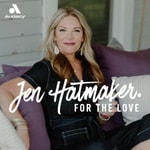
New York Times bestselling author Jen Hatmaker has arrived in the middle years, and she couldn't be happier about it.Jen has navigated the ins and outs of life, from career to parenting, marriage (and divorce), spiritual evolution, and the joys of being a hardcore Gen Xer.With each weekly episode, Jen serves as our "everywoman" guide to all the seasons, past, present, and future, as she walks excitedly and tenaciously into the second half of life.Some weeks, Jen brings her perspective straight to you, just her and the mic, talking through the things we're all navigating. Other weeks, she pulls up a chair for some of the most interesting and accomplished guests around, plus a few of her favorite friends, bringing insight, expertise, and a whole lot of heart to the most relevant topics of our time.While Jen has plenty of wisdom to share (and some pretty hilarious stories, too), she doesn't claim to know it all. From her honest solo reflections to her compelling conversations with guests, she's here to reassure you that you're not alone in this game of life.It's "For the Love" of all that is good, justified, exasperating, exhilarating, real, fun, and so much more.
RSS
Apple
Données mises à jour le 24/10/2026
Classements récents
Dernières positions dans les classements Apple Podcasts et Spotify.
Liens partagés entre épisodes et podcasts
Liens présents dans les descriptions d'épisodes et autres podcasts les utilisant également.
Kim Hill and Paulette Wooten: We Fell in Love and Lost Our Whole World
vendredi 23 octobre 2026 • Durée 01:08:25
Kim Hill had the kind of run most artists only dream of: number one songs on Christian radio, arena stages, and the biggest women’s conferences in the country. Paulette Wooten was a songwriter, musician, and ordained music minister helping build the modern worship movement from the inside. Then they met at a worship school, played a 45-minute set together as near strangers, and a year and a half of friendship on the road quietly turned into love. In a world where that was not allowed, they chose each other anyway.
As part of our Courage to Change: Do It Scared series, Jen sits down with Kim and Paulette, now the Americana duo Wooten Hill, to talk about the long, slow road out of the world that built them. They share the disastrous wedding venue chapter (Billy and the squirrels!), what changed when they stopped hiding from themselves, why they chose not to blow up their lives, and how they’ve kept love at the center even when it wasn’t returned. Plus, the summer they waited on a grandbaby in Nashville and ended up making the truest record of their lives. Their first full-length album, How Did We Get Here, is out now.
Thought-provoking Quotes:
“If I am gay, I’m gonna be gay and have a real relationship. I’m not gonna have some no man’s land.” - Kim Hill
“I feel like someone plugged me into an amp. I feel like I sing better.” - Kim Hill
“This is the truest art I have ever put out.” - Paulette Wooten
“You’re not too late, you’re not broken. You are enough.” - Kim Hill
“I find that kind of faith the most faithful kind of faith.” - Jen Hatmaker
“Your story has made you softer, not harder.” - Jen Hatmaker
Kim and Penn Holderness on Starting Over, Aging Out Loud, and Getting Ahead of Alzheimer's
mercredi 21 octobre 2026 • Durée 59:02
Description:
Twelve years ago, Kim and Penn Holderness made a Christmas card video in their pajamas, it broke the internet, and they both walked away from careers in TV news to make videos full time. With two little kids, two months of savings, and no health insurance. In 2013, when that was not even a job. They have been reinventing ever since, and they are right in the middle of it again.
We recorded this conversation in a very tender week. They had just moved their oldest back to college, and two days earlier, Penn's mother passed away after nine years in skilled nursing with Alzheimer's. They showed up anyway, and I am so grateful they did. We talk about the leap of 2013 and the creators who told them every new baby was worth a million followers, what they owe their kids for putting them on the internet before any of us knew better, why every couple should have a podcast even if you never post it, and why they took their family name off their show to start Laugh Lines, all about aging better together.
Then Penn tells me about the Alzheimer's prevention trial he joined, what he learned about his own genes, the changes he is making now, and how his mom's brain went to a research study at Duke within an hour of her death so it could help someone else. I was not prepared, and I cried. It is one of the most hopeful things I have ever heard about this disease. This is part of our October series, Courage to Change: Do It Scared. Still to come this month: Sarah Stewart Holland and Beth Silvers of Pantsuit Politics.
Thought-provoking Quotes:
There is no such thing as a podcast emergency.
Don't get good at something you don't really want to do.
There's a moment where you can't not do that thing.
Every couple needs a podcast, even if you don't post it.
When you can hear how you talk to your partner, it is so eye opening.
We know what a gift it is to age. I don't want to be 20. I don't want to be 40. I'm really thrilled with the age I am.
You start saying goodbye to someone the minute they go into skilled nursing.
We knew, okay, we're helping. Her brain's going to help.
We all do what we do. No one's right or wrong.
Everybody behind us will do a better version of it. But it's kind of fun being on the front edge with y'all.
Encore: Jenna Kutcher on Taking Your Dreams Off the Shelf and Embracing the “What Ifs”
vendredi 16 octobre 2026 • Durée 48:39
Description:
Jenna Kutcher was a few years into a corporate career at Target when her boss slid a five-year plan across the desk. A promotion, more money, more responsibility, all mapped out by somebody else, and every step of it was something she did not want. She did not know yet what she wanted instead, but she knew exactly what she no longer wanted. So she bought a camera off Craigslist for $300.
We’re in the middle of our Courage to Change: Do It Scared series, and I’m bringing back this conversation from January 2023, when it opened our For the Love of What If series. Jenna walks us through how that camera became a photography business, then the Goal Digger podcast, then the New York Times bestseller How Are You, Really?, and why she built the next thing quietly on the side while the paycheck was still coming in. We talk about what happens when more money doesn’t buy the life you’re longing for, why time became her real currency, and the question she asked me that I could not shake: not how does it look, but how does it feel.
Stay for the end, because something happened after this tape. On the last day of 2025, after 968 episodes, Jenna paused Goal Digger while it was still going strong. She meant every word she said here.
Thought-provoking Quotes:
Her question is yours now. Not how does it look. How does it feel. (Jen Hatmaker)
That is what courage to change actually looks like most of the time. Not a blaze of glory. Not a resignation letter thrown in the air. (Jen Hatmaker)
A woman asking an honest question, hearing an answer she did not love, and then doing something about it anyway. (Jen Hatmaker)
You are not in prison. You made that rule up, and you are allowed to change it. (Jen Hatmaker)
Barbara Kingsolver on Partita, First Love, and Who Gets to Make Art
mercredi 14 octobre 2026 • Durée 01:06:32
Description:
Barbara Kingsolver got the offer on her first novel the same day her first daughter was born. She came home from the hospital to a blinking answering machine, and the book came out the week that same baby learned to walk. Almost forty years later, she has a Pulitzer Prize, the National Book Foundation’s medal for a lifetime of work, and a recovery house for women in Lee County, Virginia, built with her Demon Copperhead royalties. She has been one of my literary heroes and true life mentors for decades, and I still cannot believe I got to talk with her.
We talk about what publishing looked like in 1988 versus now, why a slow-building career was a gift to a young mom, and the stubborn hand condition we both live with that ended her public book signings. She walks us through October on her farm in southern Appalachia, where the tomatoes are canned, the peppers are roasted, and she is the one who gets the call when a lamb gets stuck. And she makes the case that rural people are close to half of this country but almost none of what we see on screen, which is why she writes books that work as mirrors for her neighbors and windows for everybody else.
Then we get into Partita, her new novel. Livia was a piano prodigy from east Tennessee who became a small-town piano teacher instead. In her fifties, the first love who derailed her calls and asks to see her, and she has seven days to decide. Barbara built the whole book like a Bach partita, with movements named for old dances and a listening list in the front. She tells us how a small-town girl fell for classical music on her living room floor, why nobody in America wants to talk about class, why revision is where art lives, and about the practice room scene her pianist friend had been waiting her whole life to read.
Thought-provoking Quotes:
I became a novelist and a mom the same day. (Barbara Kingsolver)
I need my hands to write books. If you let me keep them, I will write you more books. (Barbara Kingsolver)
Rural people are close to half of the population of this country, but we are just about zero percent of what you see on television, in the movies, or in the news. (Barbara Kingsolver)
I want to write these books that are both mirrors for the people who need to see themselves and windows for the people who don’t know. (Barbara Kingsolver)
Stop Guessing About Perimenopause with Dr. Tiffany Lester
vendredi 9 octobre 2026 • Durée 42:50
Description:
This episode is sponsored by Function.
October is Menopause Awareness Month, and every time we talk about midlife bodies on this show, what you write back to me isn’t really about hot flashes. It’s about being dismissed. Walking into an appointment, saying something feels different, and being told it’s normal. Dr. Tiffany Lester, a board certified integrative medicine physician and the Women’s Health Medical Director at Function, has built her career on refusing that answer.
We get into the wellness trend she went all in on and walked away from (and why so much of the research behind it was built around men), the moment her own lab results told her perimenopause had arrived, and what a standard annual physical tends to miss. She explains why markers like ApoB and fasting insulin matter so much in our forties and fifties, whether knowing this much about your body makes you healthier or just more anxious, and where the line sits between owning your health data and needing a doctor across the table. I share what happened when I brought my own results from Function to a new doctor, and we talk about who gets left out of conversations like this one and why health equity is so personal to her.
Thought-provoking Quotes:
As Dr. Stacy Sims likes to say, we’re not little men. We are separate. And that’s okay, it’s not a bad thing. (Dr. Tiffany Lester)
I knew intellectually that this transition was coming. But I still wasn’t ready for it somehow. (Dr. Tiffany Lester)
We have in some ways been conditioned to accept the bare minimum. (Dr. Tiffany Lester)
It’s much harder to dismiss a woman when she’s there with black and white data. (Dr. Tiffany Lester)
We do not have to just grin and bear it. (Jen Hatmaker)
A lot of people don’t even know what they don’t know. But once you see it, you can’t unsee it. (Dr. Tiffany Lester)
It starts with knowing your numbers and not guessing, because you can’t manage what you don’t measure. (Dr. Tiffany Lester)
You Will Not Feel Ready: Jen Hatmaker Solo episode
mercredi 7 octobre 2026 • Durée 57:05
People tell me I’m brave all the time. About the divorce, about the book, about rebuilding my life while everybody watched. And every single time, I feel a low-grade panic, because I know what it actually looked like from the inside: sitting in my parked car for 45 minutes because I could not make myself walk in, typing one sentence and deleting it 15 times, sobbing in the parking lot outside my brand new financial planner’s office. I was not brave. I was scared, and I moved forward anyway.
We’re kicking off our October series, Courage to Change: Do It Scared, and today it’s just me and you. I’m handing you a much smaller word than “ready.” Ready is a feeling, and you can’t schedule a feeling. Willing is a decision, and you can make it on a Tuesday while you unload the dishwasher. We’ll sort fear into two piles: the warning you should heed and the fee you simply have to pay. And I’m going deeper on two stories: the months I waited too long to face what was happening in my marriage, and the years I coddled my fear before publicly changing my theology on LGBTQ inclusion in 2016. That was the best fee I ever paid.
Coming up this month: Barbara Kingsolver, Kim and Penn Holderness, and Sarah Stewart Holland and Beth Silvers of Pantsuit Politics. You’re not going to feel ready. But you can get willing, and willing is available to you in the next ten minutes.
Thought-provoking Quotes:
In my life, ready never came. Not one time in my entire life did readiness already exist before the hard thing.
Ready is something like a feeling, and you can’t schedule a feeling. Willing is a decision. Willing is a choice.
Fear is not measuring whether or not you should. It is measuring whether or not this thing matters.
There is fear that is a warning that should be heeded. And then there is fear that is just a fee. It’s just a cost that you’re going to have to pay.
The first one has a real object, but the second one has an audience.
The fear was a fee. It was not a warning. And I did have to pay it. It’s the best fee I ever paid.
I may not be ready, but I am willing.
You’ve done harder things than this. And you did those things scared too.
Resources Mentioned in This Episode:
Liz Moore: Inside The God of the Woods, From Novel to Netflix
vendredi 2 octobre 2026 • Durée 59:05
This month’s Jen Hatmaker Book Club pick is The God of the Woods, and Liz Moore joins Jen straight off the set of the Netflix series she is co-showrunning in the Adirondacks. Liz talks about the family cabin with no TV and no internet where she read every old book in the house, her early years singing in New York clubs while working weekends at a guitar store, and the practical family that taught her to keep a day job. She explains the difference between a TV writer and a showrunner, why she loves casting local square dancers and first-time actors, and how the cast is deepening the characters she wrote. Plus how she starts a four-year novel knowing only the people, the place, and the first problem, her worries about what AI will do to developing brains, the title her publisher vetoed, the hand-drawn map at the front of the book, and what she is reading right now.
Thought-provoking Quotes:
You have to know people, you have to know place, and you have to know problem.
You just sort of whittle down what feels right emotionally until you get to a place that feels right emotionally, and then that’s the end of the book.
You have to experience frustration in learning and then get past it in order for the brain to grow.
I want the title to have multiple meanings, and for those multiple meanings to become apparent as the reader moves on.
I have too many jobs that I love, which is a huge blessing in life.
This Is What Happens When Women Read with Julianna Glasse
mercredi 30 septembre 2026 • Durée 57:50
Description:
Julianna Glasse was a Christian pop singer playing megachurches and arenas, married to a Major League Baseball player, and in January 2017 she sang at Donald Trump's National Prayer Breakfast weekend after voting the way her husband voted. Two years later she walked away from her faith, her marriage, and nearly everything she had built. Jen and Julianna trace the unraveling: the question she asked while holding her newborn daughter, the friend who handed her Plato's allegory of the cave, the "Christian drinkers" who changed clothes in the car after her concerts, and the day her then husband threw her books on the floor and said the sentence that became her title. They talk about love versus fear as a compass, why storytelling reaches people that shouting never will, and what Julianna would say to evangelical women quietly questioning how they vote. Now an Oxford alum, Julianna leads the This Is What Happens When Women Read foundation, which partners with Oxford's Saïd Business School to fund MBAs for women leaving high-control religions and cultures and has reached more than four million people in nearly 67 countries. Her memoir, This Is What Happens When Women Read, releases October 13.
Thought-provoking Quotes:
“You cannot know that which you do not know, but once you do know, it becomes your responsibility.” – Julianna Glasse
“Does it feel like love or does it feel like fear?” – Julianna Glasse
“This is actually what happens when women read. We notice the systems of oppression that we are in.” – Julianna Glasse
“Bare your teeth at the institution, at the dogma, at the policy. Do not bare your teeth to the human.” – Julianna Glasse
“It's just the teeniest taste of hope and freedom, and that is the most powerful taste you will ever have.” – Jen Hatmaker
Dr. Galit Atlas on the Wounded Child Running Your Love Life
vendredi 25 septembre 2026 • Durée 54:43
Description:
Why do we keep doing the same thing over and over in love? Same argument, same shutdown, same spiral, same reach toward somebody who cannot or will not reach back. We are grown. We have read the books. And still, something inside us takes the wheel and steers us right back into the ditch.
Dr. Galit Atlas says the one driving is probably not you. It is probably the child you used to be.
Galit is a psychoanalyst in New York who has spent more than twenty years in a room with people trying to talk about love. Her last book, Emotional Inheritance, was an international bestseller translated into twenty-nine languages. Her new book, Come Closer, names six wounded children most of us are hauling around inside: the frightened child, the melancholic child, the ashamed child, the invisible child, the guilty child, and the chosen child.
In this conversation, Galit walks us through all six, what each one actually looks like in an adult relationship, and why we keep reaching for the familiar even when the familiar is what hurt us. She unpacks the invisible child who learned to hide too well, the guilty child who is always bracing to be blamed, and the chosen child who cannot separate from the parent she was recruited to take care of. She also opens her own story: her father's childhood in Iran, the losses her family did not have the privilege to name, and what happened when he showed up for her at the hardest moment of her life.
This is not a book about bad parents, and the rummaging is not for its own sake. It is the only way to stop the repeating. The goal is not an apology. The goal is getting the wheel back.
Read it with a pen in hand. And you probably already know exactly who to send this one to.
Thought-provoking Quotes:
“The frightened child is afraid of closeness because they learned that the people they love and the people they depend on can hurt them.” – Dr. Galit Atlas
“The familiar is our home. For better and for worse, even if it's filled with demons, it's our home.” – Dr. Galit Atlas
“We repeat in order to repair.” – Dr. Galit Atlas
“The invisible child masters the art of disappearing.” – Dr. Galit Atlas
Zibby Owens on Losing the Plot, Starting Over, and Building a Life Around Books Description:
mercredi 23 septembre 2026 • Durée 57:57
Description:
Calling all book lovers, calling all readers, calling everyone who has faced down a reinvention in the middle of life. Zibby Owens is one of the book world’s most tireless and warm-hearted connectors: a podcaster who has interviewed more than 2,000 authors, a publisher, a bookstore owner, a self-described accidental activist, and now an author herself. Ten years ago she was a perfectionistic stay-at-home mom of four on the Upper East Side, up at 4:55 a.m. to sign up for parent teacher conferences, with color-coded calendars and no time to read. Then she got divorced, fell in love with her tennis pro, recorded a podcast into her phone from her bed on a whim, and rebuilt the whole thing: new career, new marriage, new name, new voice.
Her memoir in essays, Between Chapters: How I Started Over, Took Some Chances, and Found the Plot, is out now. In this Sacred Work conversation, Jen and Zibby get into what losing the plot actually feels like from the inside, the tiny unglamorous steps that add up to an entirely different life, why she sunsets things that are still making money, and how books became the connection vehicle for a whole community of women. Also: shy kids who grew up into very public careers, and the permission slip Zibby would hand her 39-year-old self.
Thought-provoking Quotes:
"There is a way. You are not stuck. Your life is not over. You can take these small steps to remember who you are. And it is not selfish. It is imperative." - Zibby Owens
"When you cannot remember the last time you belly laughed, that could be a red flag to pay attention to." - Jen Hatmaker
"Save nothing for the swim home." - Jen Hatmaker, quoting her agent Margaret
"Talking about books is really talking about life." - Zibby Owens
"It’s not just, well, I guess this is it because it has to be. This is it because it can be, and it should be." - Jen Hatmaker
Découvrez des podcasts liées à For The Love With Jen Hatmaker Podcast. Explorez des podcasts avec des thèmes, sujets, et formats similaires. Ces similarités sont calculées grâce à des données tangibles, pas d'extrapolations !