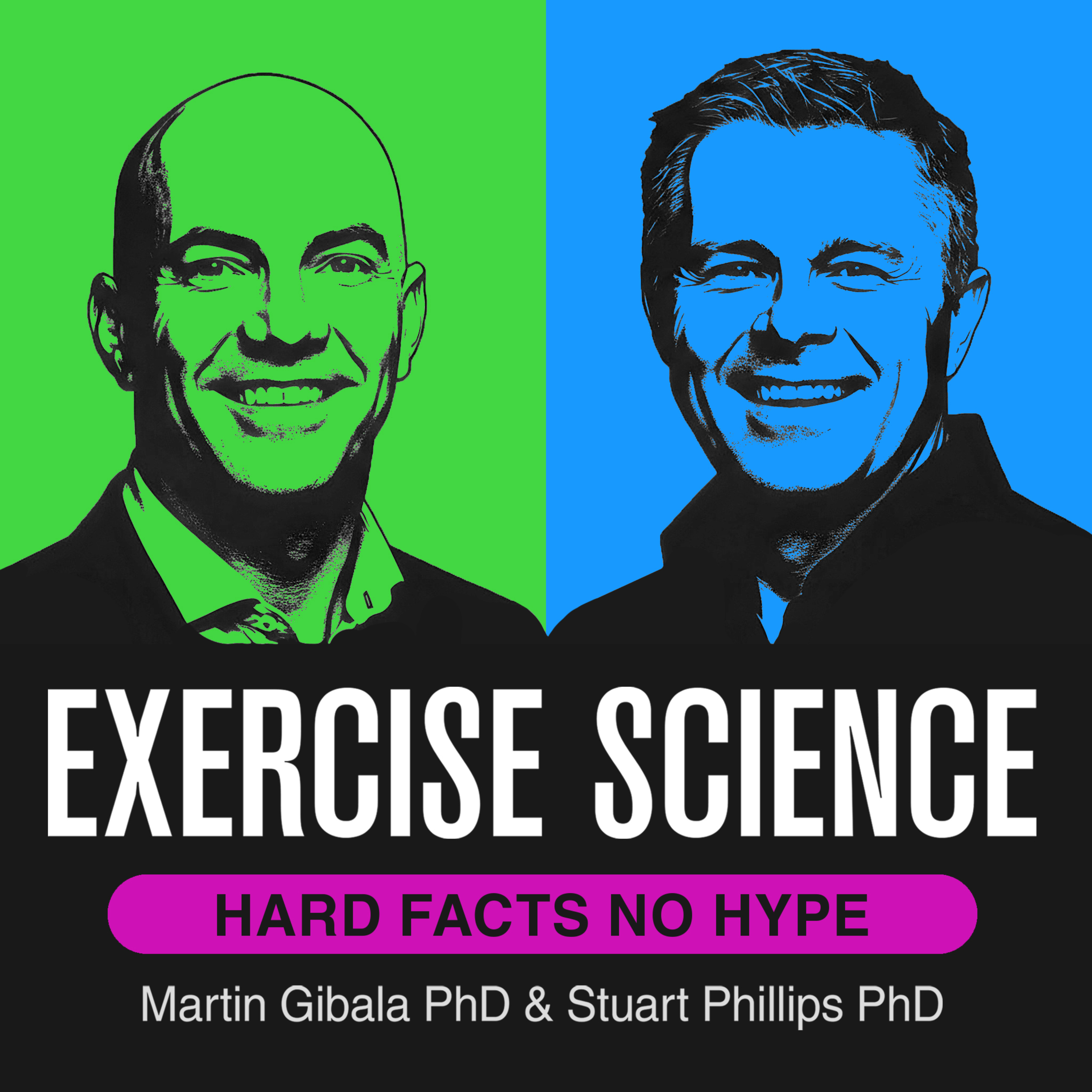
Exercise Science – Détails, épisodes et analyse
Détails du podcast
Informations techniques et générales issues du flux RSS du podcast.

Classements récents
Dernières positions dans les classements Apple Podcasts et Spotify.
Apple Podcasts
Aucun classement récent disponible
Spotify
Aucun classement récent disponible
Liens partagés entre épisodes et podcasts
Liens présents dans les descriptions d'épisodes et autres podcasts les utilisant également.
See all- https://ghostbureau.com/
17 partages

- https://www.instagram.com/mackinprof
31 partages
- https://www.instagram.com/brad_currier
3 partages
Qualité et score du flux RSS
Évaluation technique de la qualité et de la structure du flux RSS.
See allScore global : 38%
Historique des publications
Répartition mensuelle des publications d'épisodes au fil des années.
Much Ado About Zone 2
Saison 1 · Épisode 2
lundi 1 juin 2026 • Durée 30:29
Influencers can’t get enough of Zone 2 low-intensity training. So why did Martin Gibala publish a research paper challenging Zone 2 for the general public? In this episode, Stuart Phillips leads Marty through a critical examination of Zone 2.
Marty suggests that very little scientific research exists to support Zone 2 training intensity for most people—either as an effective stimulus for cardiorespiratory fitness or mitochondrial capacity. In fact, if you do between three and six hours of cardio a week, Marty believes that Zone 2 isn’t hard enough for you to efficiently accrue training benefits. In other words, if you’re an amateur athlete subscribing to the much-vaunted rule that 80% of your cardio should be in Zone 2, you’re not as fit as you otherwise could be.
So what is Zone 2 training? And is Zone 2 causing many people to exercise inefficiently, leaving them less healthy than they otherwise might be? What should people be doing INSTEAD of Zone 2? It’s all here, in the latest episode of Exercise Science!
Have a listener question or an idea for an episode? Email us at realexercisescience@gmail.com
LINKS
Marty and Brendon Gurd’s critical examination of Zone 2: Much Ado About Zone 2: A Narrative Review Assessing the Efficacy of Zone 2 Training for Improving Mitochondrial Capacity and Cardiorespiratory Fitness in the General Population
Marty’s coauthor Brendon Gurd on their Zone 2 paper at the Discover Strength podcast.
Luke Carlson calls the “Much Ado About Zone 2” paper the most important scientific publication of 2025 in this blog post summarizing the paper.
HIIT and Zone 2: Marty on the Discover Strength podcast
Sperlich paper referenced in this episode: Zone 2 Intensity: A Critical Comparison of Individual Variability in Different Submaximal Exercise Intensity Boundaries
Marty was a coauthor on this ACSM/ESSA position statement on exercise intensities
Marty was senior author on this Sports Medicine paper on exercise intensity in high-intensity activity, which features the intensity diagram Marty mentions
Lifehacker’s Beth Skwarecki notes, Nobody Can Agree On What Zone 2 Is
Oura’s heart rate zones
Whoop band’s heart rate zones
Garmin’s heart rate zones
Peter Attia on Zone 2: This Is How You Know If You’re in Zone 2 When Doing Cardio
More Attia: This is What Zone 2 Training Looks Like
Attia saying 80% of cardio should be Zone 2
Origins of Zone 2: Attia and San Milan in the early days of the trend
Find Stu Phillips on most platforms @mackinprof
Find Martin Gibala on Instagram, which he just joined, @gibalamj
Exercise Science is powered by EverMe. Download EverMe for free at your favourite App store.
DISCUSSION POINTS
00:00 Exercise fads
00:34 Intros
02:30 What Zone 2 is
04:21 No uniform definition
06:02 Lactate threshold
08:10 Zone 2 marker variability
09:54 Ventilatory threshold
11:57 Conflation with moderate
12:58 Improving exercise prescriptions
14:40 Health v. performance
16:04 Moderate intensity is better
16:58 80/20 split
18:45 Better alternatives
19:47 Zone 2 origins
20:39 Wearable intensities
22:09 Threshold testing options
23:14 Training for health
24:21 Take-home message
26:05 Vigorous is better
26:44 Listener question
DISCLAIMER
The Exercise Science podcast is for educational and entertainment purposes only and is not a substitute for professional medical advice. Strength training and fitness carry inherent risks. Always consult with a physician or qualified healthcare provider before starting any new exercise program or making changes to your diet. The hosts, producers, sponsors and guests of this podcast disclaim any liability for any injuries or losses connected with the information discussed in this show.
Strength Training for Everybody!
Épisode 1
mardi 26 mai 2026 • Durée 37:45
Our co-host Stuart Phillips was the senior author on the ACSM’s gold-standard strength training position statement, a.k.a. “the most comprehensive evidence-based guidance to date on how resistance training supports muscle strength, muscle size (hypertrophy), power, and physical performance across adulthood.”
In the premiere episode of Exercise Science, co-host Martin Gibala takes Stu through the American College of Sports Medicine update, the first position statement in 17 years.
Parsing the science, together, Stu and Marty break down why strength is the ultimate compound interest investment for your health span. How important is strength training? Why should you consider strength training 2x per week to be just as important as the other main exercise-related health guideline, 150 minutes of moderate-intensity exercise per week?
Plus: How much strength training is enough? What’s the minimum that you should do? What changed during the 17 years between position stands? And how did a 1940s bodybuilding doctor rehabbing soldiers pave the way for modern strength training?Forget the oiled-up pumping-iron musclehead stereotype. In 2026, strength training is officially for EVERYONE. And if you’re going to listen to just one podcast about the new guidelines — make it this episode of Exercise Science!
LINKS
Exercise Science is everywhere @realexercisescience: Substack. YouTube. TikTok. Instagram. Apple Podcasts. Spotify. On X you can find us @realexscience.
Stu is everywhere, too, but mostly on Instagram and X. Follow him on TikTok to make him feel nice!
Marty just started his own Instagram. Give him a follow! He’s also on X!
ACSM Position Stand 2026: The scientific article in Medicine & Science in Sports & Exercise
Here’s the press release about the stand from the ACSM, and a great succinct infographic summarizing the main takeaways
Here are the two previous ACSM position stands on strength: 2009 and 2002
Thomas L. DeLorme and the Medical Acceptance Of Progressive Resistance Exercise - Iron Game History
Thomas L. DeLorme and the Science of Progressive Resistance Exercise - Journal of Strength and Conditioning Research (Abstract)
Among the four students on the position stand, Stu said Brad Currier brought the evidence together, did the lion’s share of the writing and herded the cats
All about Ken Cooper, a seminal expert on aerobic fitness who came to understand the importance of strength training
Honoring the legacy of Steve N. Blair, a giant in the field of exercise epidemiology
Marty and Stu’s MOOC: Hacking Exercise for Health
Exercise Science is produced by Ghost Bureau in Toronto.
DISCUSSION POINTS
00:00 Marty teases Stu
01:20 Episode outline
02:34 What’s a position stand?
03:36 What is the ACSM?
03:52 Building the team
05:00 What’s new in 2026
06:20 Levels of scientific papers
07:10 2026 v. 2009
08:12 Recommendations
09:30 Effort v. failure
10:38 Volume of training
12:30 Home-based options
14:06 Advice for newbies
15:13 Strength explained
18:57 Power explained
19:37 Why now?
22:17 Weight training for women
23:03 Capt. Thomas L. Delorme
25:36 Circus strongmen
26:30 Outdated philosophies
28:01 Barriers to entry
29:33 No pain, no gain is dead
31:45 Safety
33:30 Where to start
35:00 Takeaways
35:50 Listener question
36:50 Outro
DISCLAIMER
The Exercise Science podcast is for educational and entertainment purposes only and is not a substitute for professional medical advice. Strength training and fitness carry inherent risks. Always consult with a physician or qualified healthcare provider before starting any new exercise program or making changes to your diet. The hosts, producers, sponsors and guests of this podcast disclaim any liability for any injuries or losses connected with the information discussed in this show.
The Exercise Science Podcast Coming Spring 2026
vendredi 13 mars 2026 • Durée 02:52
Kinesiology professor Martin Gibala is the worldwide expert on time-efficient cardio. Kinesiology professor Stuart Phillips is the global expert on strength, muscle development and protein. In Exercise Science, these two friends and colleagues translate the world of exercise science for the rest of us — separating the hype from the hard evidence.
Podcasts Similaires Basées sur le Contenu