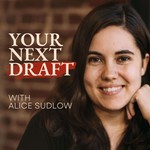
Supporting fiction writers doing the hard work of revising unputdownable novels. The novel editing process is the creative crucible where you discover the story you truly want to tell—and it can present some of the most challenging moments on your writing journey.
Developmental editor and book coach Alice Sudlow will be your companion through the mess and magic of revision. You’ll get inspired by interviews with authors, editors, and coaches sharing their revision processes; gain practical tips from Alice’s editing practice; and hear what real revision truly requires as Alice workshops scenes-in-progress with writers.
It’s all a quest to discover: How do you figure out what your story is truly about? How do you determine what form that story should take? And once you do, how do you shape the hundreds of thousands of words you've written into the story’s most refined and powerful form?
If you’ve written a draft—or three—but are still searching for your story’s untapped potential, this is the podcast for you. Together, let’s dig into the difficult and delightful work of editing your next draft.
Site
RSS
Apple
Data updated on 14/07/2026
Recent rankings
Latest chart positions across Apple Podcasts and Spotify rankings.
Shared links between episodes and podcasts
Links found in episode descriptions and other podcasts that share them.
Discover shows related to Your Next Draft, based on actual content similarities. Explore podcasts with similar topics, themes, and formats, backed by real data.
Where the Turning Point Goes (And How to Know If Yours Is in the Right Place)
Episode 95
Tuesday, October 14, 2025 • Duration 18:11
If you’re second-guessing your pacing, give your turning point this two-part check.
Where the heck is the turning point?
If you’ve ever tried to spot the turning point in a story you love, you’ve probably asked some version of this question.
I always feel like I’m playing that old children’s video game: Where in the world is Carmen Sandiego?
(In my imagination, the turning point is captured in shadowy profile, wearing a red hat with a wide brim.) (this is also called, tell me you’re a 90s baby without telling me you’re a 90s baby.)
Anyway. When you’re analyzing someone else’s story, it feels like a hunt for something you just can’t spot.
When you’re analyzing your own story, it feels like second-guessing your pacing.
Did you put the turning point in the right spot? Is it happening too early? Too late? Will the reader get bored waiting for it to happen? Or have you rushed something critical?
If any of those questions sound familiar, you won’t want to miss this episode.
It’s all about where in the story the turning point is located—and yes, this question is complicated enough to require an entire episode to unpack.
You’ll hear:
2 guiding principles I use for the location of every turning point
Where the turning point is located in a novel, novella, and scene—and why those can be different places
What happens when you move the turning point earlier or later
Whether the turning point and the midpoint are ever the same point
And more!
You know what the turning point is—the moment that makes it clear the protagonist cannot achieve their goal in the way they wanted to.
You know what it does—it forces the protagonist into a crisis choice.
And now, you’ll know where to look for it—and where to put it in your own stories.
"I love Alice and Your Next Draft." If that sounds like you, please consider rating and reviewing my show! This helps me support more writers through the mess—and joy—of the editing process. Click here, scroll to the bottom, tap the stars to rate, and select “Write a Review.” Then be sure to let me know what you loved most about the episode!
Turning Point: How to Find and Write the Moment That Changes Everything
Episode 94
Tuesday, September 30, 2025 • Duration 28:19
It's the hinge your entire story turns on—and one of the hardest story elements to identify and write.
Can I be honest? I struggled with turning points for years.
I knew they were essential. They’re the moment when everything changes. The moment that forces the character to face a crisis choice. The moment that reveals what the story is really, at its heart, about.
And yet . . . I couldn’t see them.
I found so many things that weren’t the turning point. I found inciting incidents, and midpoints, and climaxes.
The turning point, though? It eluded me.
Until I learned a simple framework that finally, finally unlocked them for me.
That framework:
Reveals why the turning point matters so dang much within the story
Ties the turning point perfectly to the inciting incident, climax, and every other element of story
Is objective and straightforward, making it clear to measure (no more guessing at turning points based on gut feeling!)
Is wonderfully simple (it’s kind of incredible how simple it is, considering how tough turning points are to spot)
That framework marked my turning point in the way I edit turning points.
If you have ever struggled to figure out what the heck the turning point is in a story, well, you’re not alone.
I hope this framework gives you a breakthrough. It certainly did for me!
And yet it still falls flat. They mostly align, probably, you’re pretty sure. But somehow, they’re not working together the way they should.
The turning point doesn’t pack the right punch. The crisis doesn’t feel devastating enough, even though all is technically lost. The climax doesn’t feel like a cathartic payoff, but a gentle womp-womp.
All the pieces are there. So what went wrong?
Here’s the thing: in order for the six elements of story to work, you have to understand your character’s goal.
Most writers have a vague sense of what their protagonist generally wants. But that’s not enough.
You need to know specifically the thing that they want—and the thing they don’t want.
So in this episode, I’m putting the goal under the microscope. You’ll learn:
Why it’s not enough to know what your character wants
A super-simple framework for a character’s goal (seriously, it’s ridiculously easy)
How that framework summarizes the meaning of the entire story
And how the goal glues all six elements of story together, driving the entire story from inciting incident to resolution
Without a clearly defined goal, all the structure in the world won’t make your story come alive.
With it, everything else falls neatly into place.
When Should You Work With an Editor? (It's Earlier Than You Think)
Episode 92
Tuesday, September 2, 2025 • Duration 18:40
What if you've already done enough to work with an editor—right now?
You’ve been working on your novel for so long. Not just months—years, maybe even decades.
And yet you have a long way still to go. The day when you have a polished manuscript you’re proud to pitch or publish feels so far away, and you're starting to wonder if you're missing something crucial.
And in the back of your mind, you might be wondering:
When should you work with an editor?
How much more should you do before you start looking? How many drafts should you finish before you reach out? When is your story finally ready for an editor’s feedback?
That’s the question I’m answering in this episode—and the answer might surprise you.
You’ll learn:
The one simple question that tells you it’s time for editorial help
Why "finished" isn't a prerequisite for working with an editor
The landscape of editorial support available at every stage (from idea to publication)
How to find the right type of editor for where you are in your process
The difference between "editor" and "book coach" and what each term suggests
Here's what I've discovered: most writers desperately want editorial support—they just don't know it exists at their stage of the process.
So in this episode, I’ll give you a simple metric to evaluate when you are ready for an editor, and show you what to look for when you are.
How to Use Genre as a Revision Tool (with Savannah Gilbo)
Episode 91
Wednesday, August 20, 2025 • Duration 01:20:08
Here’s what to DO with your genre once you know which one you’re writing.
So you know your story’s genre.
It’s an Action story with a Worldview internal genre. Or it’s a Love story with a Status internal genre. You’re, like, 32% sure of it.
Which is great, because you’ve studied story enough to know genre is important. You’ve heard that it shapes the foundations of your story, that it has conventions and obligatory scenes, reader expectations that you’ll need to deliver on.
Somehow, though, just knowing some words—Action, Worldview, Love, Status—hasn’t magically solved anything. And it’s not a great feeling to have studied story theory so much, and still be stuck on the application.
So what now? Now that you have some language for your story’s genre, what do you do with it? How do you actually use it as a revision tool?
That’s what I’m exploring in this episode with my friend and fellow writing coach Savannah Gilbo. Savannah is my go-to genre expert, and she shares exactly how to make genre work for you in revision.
You’ll hear:
Why naming your genre earlier than you think can save you from endless rewrites
The 3 genre mistakes that secretly stall drafts (and how to avoid them)
How to turn genre from a rigid list of “must-haves” into a flexible writing tool
How to blend multiple genres like a pro (and without getting lost)
And more!
Identifying your genre is a great first step. In this episode, Savannah will show you what to actually do with it once you know which one you’re writing.
Genre isn’t what you think it is. Here’s how to use it better.
Genre. Let me guess:
It’s the bane of your existence. A convoluted soup of arbitrary descriptors that almost but not quite mean the same thing. Sci fi or fantasy? Paranormal or supernatural? Upmarket or book club? Do words even have meaning?
Or, it’s a restrictive box with tropes and conventions you feel like you need to cross off a checklist, until your story is more “paint by numbers” formulaic than an original creation unique to your imagination.
Or, it’s a necessary evil in your query letter. Your task is to say the right genre words to the right agent to appeal to their interests and make them want to request your manuscript. Get it right, you get a book deal. Get it wrong, you fail.
Genre can be all those things, for sure.
But what if, first and foremost, it were a tool that works for you?
In this episode, I’m throwing out the way we usually talk about genre. And I’m replacing it with an approach to genre that’s actually useful for crafting great stories.
Not just useful, actually. Essential.
You’ll learn:
What “genre” actually means
Why the genre labels on the shelves at Barnes and Noble won’t help you craft a great story
The 12 fundamental genres that apply to every great story
2 questions to begin identifying your story’s genre
This approach to genre won’t constrain your creativity within someone else’s box. Rather, it will reveal the story you truly want to tell.
How Great First Lines Make Readers Pay Attention (with Abigail K. Perry)
Episode 89
Tuesday, July 22, 2025 • Duration 48:31
It is a truth universally acknowledged that a fiction writer in possession of a brilliant story must craft a captivating opening line.
No pressure, right?
Your opening line is your story’s first impression. Agents, editors, and even readers decide fast whether they want to keep reading or drop the book altogether. And yes, they can make that judgment in as little as the very first sentence.
So your opening line is doing some heavy, heavy lifting.
But what, exactly, do great first lines do?
What sets an unputdownable first sentence apart from a forgettable dud? How do they capture readers—and agents—in a matter of seconds?
I turned to Abigail K. Perry, editor, book coach, and expert in opening chapters, to find out.
You’ll hear:
What agents are looking for in the first line of a manuscript (and what makes them stop reading)
What makes captivating first lines actually work
How to find the hooks of your story—what only your story can deliver
How to lighten the pressure to get the first line right
And more!
If you’ve ever worried over the beginning of your book—if you’ve ever written and discarded a dozen different versions of your first sentence, and you’re still stressed that that first line won’t land—well, I think you’re going to love what Abigail has to share.
Check out a few of Abigail’s “First Chapter Deep Dive” episodes on Lit Match:
Where Progressive Complications Go WRONG (and How to Fix Them)
Episode 88
Tuesday, July 8, 2025 • Duration 31:04
Are your readers bored? Disappointed? Confused? Here's what that tells you about your story's middle.
You’re stuck in the messy middle. Languishing in the doldrums of your story. The inciting incident is long past, the climax is so far ahead you can’t see it over the horizon, and you’re drifting, lost at sea.
What is actually supposed to happen here?
Where did your plot momentum go?
Why do your pages feel full of stuff, and yet nothing ever happens?
The answers to all those questions lie in your progressive complications. Specifically, something’s going wrong in your progressive complications.
In this episode, I’m digging even deeper into the progressive complications.
I’m sharing the seven most common traps I see, the impact they have on your story and your readers, and of course, how to fix them so you can make your story unputdownable from beginning to end.
You’ll learn:
How to diagnose the problem in your story’s middle based on how your reader feels
How to spot “fluff” that isn’t moving your story forward
How coincidences work in stories—and what happens when they don’t work
What happens when a story has no progressive complications at all
And more!
And don’t miss the free cheat sheet that goes with this episode! Print it and keep it handy as you’re editing.
Here’s the thing: the middle of a story isn’t an inscrutable secret. This episode is your guide to spot the most common traps and free your story from them.
Links mentioned in the episode:
Get the Progressive Complication Revision Cheat Sheet: alicesudlow.com/88
Work with me:
Make Sense of Your Messy Middle With the Most Underrated Story Element
Episode 87
Tuesday, June 24, 2025 • Duration 29:16
You don’t need more filler. You need better progressive complications.
Your inciting incident hooks your readers and promises them a story they’ll love.
And then comes the middle.
The messy middle. The quiet doldrums of your story, where plot momentum goes to die.
Where your characters wander, your conflict blurs, and you start to wonder if any of it is working.
So what do you do? Add some “stuff that happens” and hope it holds your readers’ interest? Toss in a random subplot? Describe your character’s breakfast in extreme detail?
Nope. This is the space of the progressive complications.
And in this episode, I’m showing you exactly how to revise them.
Because the middle of your story isn’t filler or unnecessary fluff. It’s 60% of the story, and it has an essential job to do.
What progressive complications really are (and what they’re not)
How they build momentum and escalate conflict
The 8 qualities I’m looking for when I edit progressive complications
How to know if your scenes are working—or just taking up space
And more!
And to make it even easier, I’ve created a cheat sheet to help you revise your progressive complications. Print it out, keep it handy, and use it every time you edit a scene.
If you’ve ever gotten stuck in the middle of your manuscript wondering how to move forward—this episode is for you.
Let’s take your messy middle and make it unputdownable.
How Great First Chapters Make Readers Care (with Abigail K. Perry)
Episode 86
Tuesday, June 10, 2025 • Duration 01:14:22
Your first chapter has a monumental task: to make potential readers care about your book right away and hook them to keep reading.
Every sentence is a chance to earn your reader’s attention—or lose their fragile, baby-fresh interest before your story even begins.
And that’s assuming that your book makes it to the bookstore shelves. If you’re traditionally publishing, the first chapter’s burdened with even more responsibility. It’s your first impression with agents and editors, who will judge whether to consider the full manuscript based on the first five or ten pages alone.
The stakes are high.
So high, in fact, that it’s easy to get stuck—revising and refining your first chapter over and over while the rest of the manuscript gathers dust.
So I asked Abigail K. Perry, a fellow editor and book coach, to come help us break out of that trap.
“If we don't care about a character, we don't care about what happens to them. . . . Pull us into character and let us understand and get to know them so that when threats are posed against them, we care about what happens.”
—Abigail K. Perry
You’ll hear:
What great first chapters must accomplish
Why mystery is a good thing in first chapters (and info dumps are not)
How to make your readers care about your characters in a matter of pages, paragraphs, or even sentences
And more
If you’ve ever found yourself stuck in a first chapter revision loop, this one’s for you.
Check out Abigail’s “First Chapter Deep Dive” episodes on the books we discussed:
"I love Alice and Your Next Draft." If that sounds like you, please consider rating and reviewing my show! This helps me support more writers through the mess—and joy—of the editing process. Click here, scroll to the bottom, tap the stars to rate, and select “Write a Review.” Then be sure to let me know what you loved most about the episode!
"I love Alice and Your Next Draft." If that sounds like you, please consider rating and reviewing my show! This helps me support more writers through the mess—and joy—of the editing process. Click here, scroll to the bottom, tap the stars to rate, and select “Write a Review.” Then be sure to let me know what you loved most about the episode!
"I love Alice and Your Next Draft." If that sounds like you, please consider rating and reviewing my show! This helps me support more writers through the mess—and joy—of the editing process. Click here, scroll to the bottom, tap the stars to rate, and select “Write a Review.” Then be sure to let me know what you loved most about the episode!
"I love Alice and Your Next Draft." If that sounds like you, please consider rating and reviewing my show! This helps me support more writers through the mess—and joy—of the editing process. Click here, scroll to the bottom, tap the stars to rate, and select “Write a Review.” Then be sure to let me know what you loved most about the episode!
"I love Alice and Your Next Draft." If that sounds like you, please consider rating and reviewing my show! This helps me support more writers through the mess—and joy—of the editing process. Click here, scroll to the bottom, tap the stars to rate, and select “Write a Review.” Then be sure to let me know what you loved most about the episode!
"I love Alice and Your Next Draft." If that sounds like you, please consider rating and reviewing my show! This helps me support more writers through the mess—and joy—of the editing process. Click here, scroll to the bottom, tap the stars to rate, and select “Write a Review.” Then be sure to let me know what you loved most about the episode!
"I love Alice and Your Next Draft." If that sounds like you, please consider rating and reviewing my show! This helps me support more writers through the mess—and joy—of the editing process. Click here, scroll to the bottom, tap the stars to rate, and select “Write a Review.” Then be sure to let me know what you loved most about the episode!
"I love Alice and Your Next Draft." If that sounds like you, please consider rating and reviewing my show! This helps me support more writers through the mess—and joy—of the editing process. Click here, scroll to the bottom, tap the stars to rate, and select “Write a Review.” Then be sure to let me know what you loved most about the episode!
"I love Alice and Your Next Draft." If that sounds like you, please consider rating and reviewing my show! This helps me support more writers through the mess—and joy—of the editing process. Click here, scroll to the bottom, tap the stars to rate, and select “Write a Review.” Then be sure to let me know what you loved most about the episode!