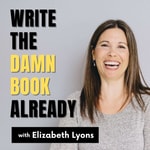
Want to write, publish, and market your book, but feel overwhelmed by where to start?
Write the Damn Book Already breaks down the writing process, self-publishing, and traditional publishing so you can move from idea to finished book with clarity and confidence.
Hosted by Elizabeth Lyons—author, book writing coach, book editor, and self-publishing expert—this show untangles the often-confusing world of writing and publishing. From first draft to finished manuscript, indie publishing to traditional publishing, Amazon strategy to long-term book visibility, you’ll get practical guidance and honest conversations about what it really takes to get a book into the world.
Through solo episodes and interviews with both traditionally published and indie authors—across fiction and nonfiction—Elizabeth brings a well-rounded, no-hype perspective to the publishing industry. Whether you’re working on memoir, nonfiction, or a novel, you’ll walk away with clearer next steps and fewer mental roadblocks.
Site
RSS
Apple
Data updated on 28/09/2026
Recent rankings
Latest chart positions across Apple Podcasts and Spotify rankings.
Shared links between episodes and podcasts
Links found in episode descriptions and other podcasts that share them.
She's back! Cassie Miller joined me last spring to talk about her debut, Meet Me Under the Lights, and now she's here with book two, Meet Me on Mistletoe Lane, out October 6, 2026 from Penguin Teen. I somehow have three copies, one of which is the finished edition with glitter on the cover. Cassie, the actual author, has not yet seen the glitter. I felt terrible about this for almost a full minute.
This time we talked marketing, because I've been in a lot of marketing conversations lately and the same misconceptions keep coming up. Namely, that traditional publishers do nothing to market your book (which is sometimes somewhat true), and that marketing and selling are the same thing.
Cassie was generous enough to walk us through what her experience has actually looked like, one book in and with a second about to launch.
We got into:
Cassie's definition of marketing versus publicity, and why she thinks one has a face and the other happens behind the scenes
The marketing campaign printed right on the back of her ARC, and what it means in practice
Why she's never been afraid to ask her publicist questions, and why she thanks her publishing team in nearly every email
How she coordinated with her publicist to personally send ARCs to the bookstagrammers who championed her first book
How a fellow author confessed that her gorgeous social media presence came courtesy of a publicist she hired herself
Why a fall farmer's market book became a Christmas book during contract negotiations, and why Cassie said yes immediately
Whether launching in a crowded holiday season makes you a needle in a haystack
Cassie describes herself as an introvert who can extrovert, and then describes unboxing her ARCs to the Sugar Plum Fairy while her son filmed and shook his head. She makes a really good case that authors, especially those writing for kids and teens, need to be willing to be a little silly.
We also debated the appeal of "It's a Wonderful Life." I will not be taking questions at this time regarding my position.
🧭 BACK COVER BLUEPRINT
Get back cover templates for nonfiction, memoir, and fiction; real-world examples; a polishing checklist; and a guide for turning it into an optimized online description that attracts the right readers.
WANT TO SELL MORE BOOKS (WITHOUT THE SELF-PROMO CRINGE)?
The Author Visibility Bundle gives you 200+ done-for-you email templates, social media graphics, and other book promo tools designed to help authors build buzz and drive sales, without feeling pushy.
Write the Damn Book Already is a weekly podcast featuring interviews with authors as well as updates and insights on writing craft and the publishing industry.
After writing 6 nonfiction books, I'm working on my first novel, which everyone who listens to this show is painfully aware of by now. So when Kim Purcell reached out about her new book, Write a Novel in 100 Days, the timing felt less like coincidence and more like the universe smacking me on the head.
Kim is the author of Trafficked and This Is Not a Love Letter; she has an MFA; she's been teaching novel writing to kids, teens, and adults for about as long as I've been in this business; and her new guide comes out September 22 from Penguin Random House with a foreword by Donald Maass. It also took her longer to write than three of her novels, which made me feel enormously better about my own life.
We covered a lot:
Why the 100 days aren't consecutive, and what to do when life detonates in the middle of your draft
The 15-minutes-a-day approach, and what counts as writing when you can't actually write
"Method writing," and why becoming your character is where the scenes that make readers cry actually come from
Why rewriting a scene from scratch is roughly ten times faster than fussing with the one you have
The handful of plot points even devoted pantsers need to know before they start, and why the muddy middle is almost always a missing midpoint
Kim's theory on asking for critical feedback before your first draft is finished
Near the end, Kim gives some advice I'm putting into my own toolbox: Let go of it being good and entertain yourself instead.
🧭 BACK COVER BLUEPRINT
Get back cover templates for nonfiction, memoir, and fiction; real-world examples; a polishing checklist; and a guide for turning it into an optimized online description that attracts the right readers.
Katie Clapham didn't set out to build an author platform. (Anyone else tired of that word?) She had a week where she had nothing ready to publish, she was working her usual shift at the bookshop she runs with her mom, and she opened a draft and started writing down the day as it happened. She called it Receipt from the Bookshop, numbered it one on the off chance she'd do it again, and sent it to a couple hundred subscribers at the end of her shift.
Roughly 250 people read it. Nearly 12,000 read it every week now, and it's been turned into a book. Receipts from the Bookshop comes out in the US on September 8, 2026 from William Morrow, after publishing in the UK in June 2026.
Keep in mind, when the publishing offer came in, her subscriber number was sitting in the low 2,000s. The numbers arrived after the deal, not before.
In this episode, Katie and I get into what actually went into the pitch, since this was her first time writing a nonfiction proposal after years of children's and YA books. Sample pages, a short introduction, and about two months of work getting the voice right.
We also talk about paid subscribers do to your Sunday-night brain. Why she keeps her best work free and prices her subscription as low as the platform allows. Why she has no website at all (and her publisher has never asked her to have one). And her honest fear going into launch, which was less about the marketing and more that this was the part where she'd find out the book isn't as good as she hopes it is.
If you've been circling Substack wondering whether it's the magic platform, or you're mid-manuscript and quietly convinced you need a bigger following before anyone will take you seriously, this episode is a great listen!
In this episode:
Why Katie joined Substack in November 2022 and what she was actually looking for when she did
How she splits free and paid posts so the pressure doesn't run her life
What a nonfiction book proposal looks like when you don't have a finished book
Ep 183: Developmental Editing, Beta Readers, and Knowing When Your Book Is Actually Ready (with Allison Buehner)
I have been quietly fangirling over Allison Buehner's editing tips on Instagram for months. I have so many of them saved that at this point she deserves her own folder. So I finally asked her to come on the show, and then discovered we had already sort of met years ago, when she emailed me to suggest I talk to another editor she admired. No pitch. Nothing in her it for herself. In twenty years of doing this, nobody had ever done that, and I've thought highly of her ever since.
Allison runs Golden Editorial out of Colorado and works mostly with indie and self-publishing authors. She started out in nonfiction and memoir before following her heart into fantasy, contemporary fiction, and, lately, a truly impressive amount of cowboy romance.
We got into the things first-time authors usually find out the expensive way:
Why "I'll just hire a proofreader" is the priciest shortcut in self-publishing, and what has to happen before your manuscript ever reaches an editor
The real difference between an alpha reader, a critique partner, and a beta reader, plus why handing the book to your best friend is a terrible plan
What a developmental edit actually looks like, and why it can feel like you paid a lot of money for a document that says "go do more work"
What good editors will and won't do, because fixing it for you crosses into co-authoring
Breaking craft rules on purpose versus breaking them because you never learned them, and roughly how many you can get away with in one book
The want-versus-need conflict Allison has been recommending to nearly every fiction author lately, and why it makes characters feel like people instead of plot delivery devices
How to know you're genuinely ready to hand your manuscript to a professional
🧭 BACK COVER BLUEPRINT
Get back cover templates for nonfiction, memoir, and fiction; real-world examples; a polishing checklist; and a guide for turning it into an optimized online description that attracts the right readers.
Laurie Notaro has hit the New York Times bestseller list more times than she can pin down. She's also written so many books she can't tell you the number without checking. And she drives a 2008 Mini Cooper, lives in a 1,500 square foot house, and has earned out on exactly one of those books. If you've ever wondered what a long career in publishing actually looks like from the inside, start here.
We talk about I've Got a New Complaint, her new essay collection out September 8 from Little A, which is so hysterical I'll be giving it to everyone for the holidays.
Laurie walks through her essay writing process, including the structural trick she wishes she'd figured out thirty years earlier.
She's also as blunt as you'd expect about the parts nobody prints on a book jacket. Her first book, The Idiot Girls' Action-Adventure Club, was self-published after seven years of rejections, then picked up by Random House. Her career came apart twice. She was dropped by her agent over email while she was on tour. She spent three years living on credit cards. And she was told repeatedly that nobody wants to read about middle-aged women, which is a fascinating position to take on the largest book-buying demographic in the country.
We also get into why she left the Big Five for an Amazon imprint, plus her genuine affection for one-star reviews and why they may be the best free marketing a first-time author will ever receive.
If you're writing a book and trying to figure out whether traditional publishing or self-publishing is the right road, this is a candid look at both from someone who has done all of it, more than once.
🧭 BACK COVER BLUEPRINT
Get back cover templates for nonfiction, memoir, and fiction; real-world examples; a polishing checklist; and a guide for turning it into an optimized online description that attracts the right readers.
Joyce Maynard has been publishing books for fifty-three years. In Wonderland is her fourteenth novel, and it came out eight days before we recorded this. She still does not outline. She sits down knowing exactly who her characters are, what they want, what they're afraid of, what they can't stop thinking about, and then she lets them take her somewhere she didn't plan on going.
We talked about the year she rented a little house on the shores of Lake Atitlán, and then bought a piece of land, which now serves as a retreat center where she's hosted well over a thousand women for memoir workshops. The question she gets there, every single time, from women only: How do I tell an honest story about my life without hurting the people in it?
Other things we covered:
Why she doesn't consider writing to be therapy, and what she thinks needs to happen before your story is ready for the page
The difference between resilience and reinvention (she has a great analogy involving an inflatable clown)
Going back to Yale at sixty-five, and the D- on a French exam that led to a diagnosis at an age when nobody in her generation got one
Her approach to writing as making a movie that plays inside the reader's head, and why she refuses to over-explain
Write what you know, and also the case for writing what you don't know
🧭 BACK COVER BLUEPRINT
Get back cover templates for nonfiction, memoir, and fiction; real-world examples; a polishing checklist; and a guide for turning it into an optimized online description that attracts the right readers.
Eli McCann never planned to write a novel. He wrote one chapter kind of, maybe, to prove to himself he couldn't. But when he handed it to his husband, who both laughed and cried reading it, his curiosity and determination grew.
That chapter became Stitched, his debut novel about competitive quilting, unlikely friendships, and found family. The story of how it got published is required listening for any first-time author who's ever been told to change their book to make it more marketable.
We talk about the year Eli spent building a storytelling following before he had a book to sell, the agent who warned him publishing has a bias problem against older women (and how unfortunately correct she turned out to be), why he refused to rewrite his book into something it wasn't just to land a deal, and what it was actually like to narrate his own audiobook, complete with dialogue-heavy scenes from multiple distinct voices.
🧭 BACK COVER BLUEPRINT
Get back cover templates for nonfiction, memoir, and fiction; real-world examples; a polishing checklist; and a guide for turning it into an optimized online description that attracts the right readers.
WANT TO SELL MORE BOOKS (WITHOUT THE SELF-PROMO CRINGE)?
The Author Visibility Bundle gives you 200+ done-for-you email templates, social media graphics, and other book promo tools designed to help authors build buzz and drive sales, without feeling pushy.
Ep 179: Meg Mitchell Moore on Messy First Drafts and Why Nobody Has Publishing Figured Out
Ten books in, Meg Mitchell Moore still doesn't know what her plot is going to be when she starts writing.
Meg Mitchell Moore has published ten novels. And she still starts most of them with no idea what's going to happen. No outline, no plot, sometimes not even a reason her characters are in the room together. She figures it out as she goes, often with her agent's or editor's help.
If that sounds like it shouldn't work, that's kind of the point of this conversation. It does work. It's worked ten times! And I love how honest Meg is about the fact that her first drafts are a mess and revisions are where it all comes together.
We also get into the parts of book publishing that show up in very few highlight reels. Meg talks about learning, book by book, how much of a "big author moment" (the 10-city tour, the massive publisher push) is actually the author funding it themselves. She talks about the fear of writing a book with no contract attached to it, and how that fear doesn't necessarily go away with experience.
We talk about the business-versus-art tension every working writer eventually has to make peace with, and why the current pace of the industry has authors feeling more frantic than they perhaps did fifteen years ago, even as the community itself has gotten more supportive.
🧭 BACK COVER BLUEPRINT
Get back cover templates for nonfiction, memoir, and fiction; real-world examples; a polishing checklist; and a guide for turning it into an optimized online description that attracts the right readers.
This episode quickly got personal because I'm elbow-deep in my first novel after six nonfiction books, and Angela Brown writes the kind of fiction that makes one feel quite seen.
Angela is the author of Olivia Strauss Is Running Out of Time, Some Other Time, and her newest, Ways to Find Yourself. And I will fully admit I read the prologue the night before we recorded and had a moment. Not a cute moment. A "why am I like this" moment. So we start there, obviously.
But this conversation goes way past my feelings about her book (though we do talk about her characters, her sneaky habit of naming them after real people in her life, and the "what if" questions that kick off each of her novels). We get into the actual mess of writing fiction: how she doesn't always know where a story is headed when she starts it, the time an entire book arrived in the shower (why does all our best thinking happen there?) and she wouldn't leave her desk for two hours because she was afraid it would vanish, and the moment (mid-draft) when she realized the book wasn't broken—she was just writing from the wrong point of view.
We also talk about her MFA (Was it worth it?), the myth that there's one right way to write a book, and how she's getting much better at saying one simple word: no.
Oh, and stick around for the end. You'll walk away saying "no ploblem" for the rest of your week. You're welcome.
🧭 BACK COVER BLUEPRINT
Get back cover templates for nonfiction, memoir, and fiction; real-world examples; a polishing checklist; and a guide for turning it into an optimized online description that attracts the right readers.
TV writer, screenwriter, and author Eric Garcia has published six books (so far). He sold three of them to Hollywood and somehow still managed to write his latest novel entirely by accident. He set out to write a short story. Then it got longer. Then it was a novella. Then it was 80,000 words and he had to admit he'd written a whole book, mostly at night, while still juggling film and TV work.
We also talk about what's changed in publishing since his Random House days (Hint: mid-list used to mean stable; now everyone's terrified of it), why chasing trends is a losing game when a book takes years to reach shelves, and why there are no rules for how long a chapter should be, except the one that matters: Don't make me want to stop reading.
We also bond hard over the Oxford comma as well as the correct use of "less" and "fewer." I nearly combust with joy over our shared grammar rage.
🧭 BACK COVER BLUEPRINT
Get back cover templates for nonfiction, memoir, and fiction; real-world examples; a polishing checklist; and a guide for turning it into an optimized online description that attracts the right readers.
WANT TO SELL MORE BOOKS (WITHOUT THE SELF-PROMO CRINGE)?
The Author Visibility Bundle gives you 200+ done-for-you email templates, social media graphics, and other book promo tools designed to help authors build buzz and drive sales, without feeling pushy.
WONDERING EXACTLY HOW TO SELF-PUBLISH SO YOU CAN STOP GUESSING?
Grab the action plan and finally feel confident you’re doing this the right way.
WANT TO SELL MORE BOOKS (WITHOUT THE SELF-PROMO CRINGE)?
The Author Visibility Bundle gives you 200+ done-for-you email templates, social media graphics, and other book promo tools designed to help authors build buzz and drive sales, without feeling pushy.
Write the Damn Book Already is a weekly podcast featuring interviews with authors as well as updates and insights on writing craft and the publishing industry.
Why she disabled Substack's new AI detection scan (very on-trend topic, no?)
How she defines success for this book
🧭 BACK COVER BLUEPRINT
Get back cover templates for nonfiction, memoir, and fiction; real-world examples; a polishing checklist; and a guide for turning it into an optimized online description that attracts the right readers.
WANT TO SELL MORE BOOKS (WITHOUT THE SELF-PROMO CRINGE)?
The Author Visibility Bundle gives you 200+ done-for-you email templates, social media graphics, and other book promo tools designed to help authors build buzz and drive sales, without feeling pushy.
Write the Damn Book Already is a weekly podcast featuring interviews with authors as well as updates and insights on writing craft and the publishing industry.
WANT TO SELL MORE BOOKS (WITHOUT THE SELF-PROMO CRINGE)?
The Author Visibility Bundle gives you 200+ done-for-you email templates, social media graphics, and other book promo tools designed to help authors build buzz and drive sales, without feeling pushy.
Write the Damn Book Already is a weekly podcast featuring interviews with authors as well as updates and insights on writing craft and the publishing industry.
WANT TO SELL MORE BOOKS (WITHOUT THE SELF-PROMO CRINGE)?
The Author Visibility Bundle gives you 200+ done-for-you email templates, social media graphics, and other book promo tools designed to help authors build buzz and drive sales, without feeling pushy.
Write the Damn Book Already is a weekly podcast featuring interviews with authors as well as updates and insights on writing craft and the publishing industry.
WANT TO SELL MORE BOOKS (WITHOUT THE SELF-PROMO CRINGE)?
The Author Visibility Bundle gives you 200+ done-for-you email templates, social media graphics, and other book promo tools designed to help authors build buzz and drive sales, without feeling pushy.
Write the Damn Book Already is a weekly podcast featuring interviews with authors as well as updates and insights on writing craft and the publishing industry.
Write the Damn Book Already is a weekly podcast featuring interviews with authors as well as updates and insights on writing craft and the publishing industry.
WANT TO SELL MORE BOOKS (WITHOUT THE SELF-PROMO CRINGE)?
The Author Visibility Bundle gives you 200+ done-for-you email templates, social media graphics, and other book promo tools designed to help authors build buzz and drive sales, without feeling pushy.
Write the Damn Book Already is a weekly podcast featuring interviews with authors as well as updates and insights on writing craft and the publishing industry.
WANT TO SELL MORE BOOKS (WITHOUT THE SELF-PROMO CRINGE)?
The Author Visibility Bundle gives you 200+ done-for-you email templates, social media graphics, and other book promo tools designed to help authors build buzz and drive sales, without feeling pushy.
Write the Damn Book Already is a weekly podcast featuring interviews with authors as well as updates and insights on writing craft and the publishing industry.
Write the Damn Book Already is a weekly podcast featuring interviews with authors as well as updates and insights on writing craft and the publishing industry.
Discover shows related to Write the Damn Book Already, based on actual content similarities. Explore podcasts with similar topics, themes, and formats, backed by real data.