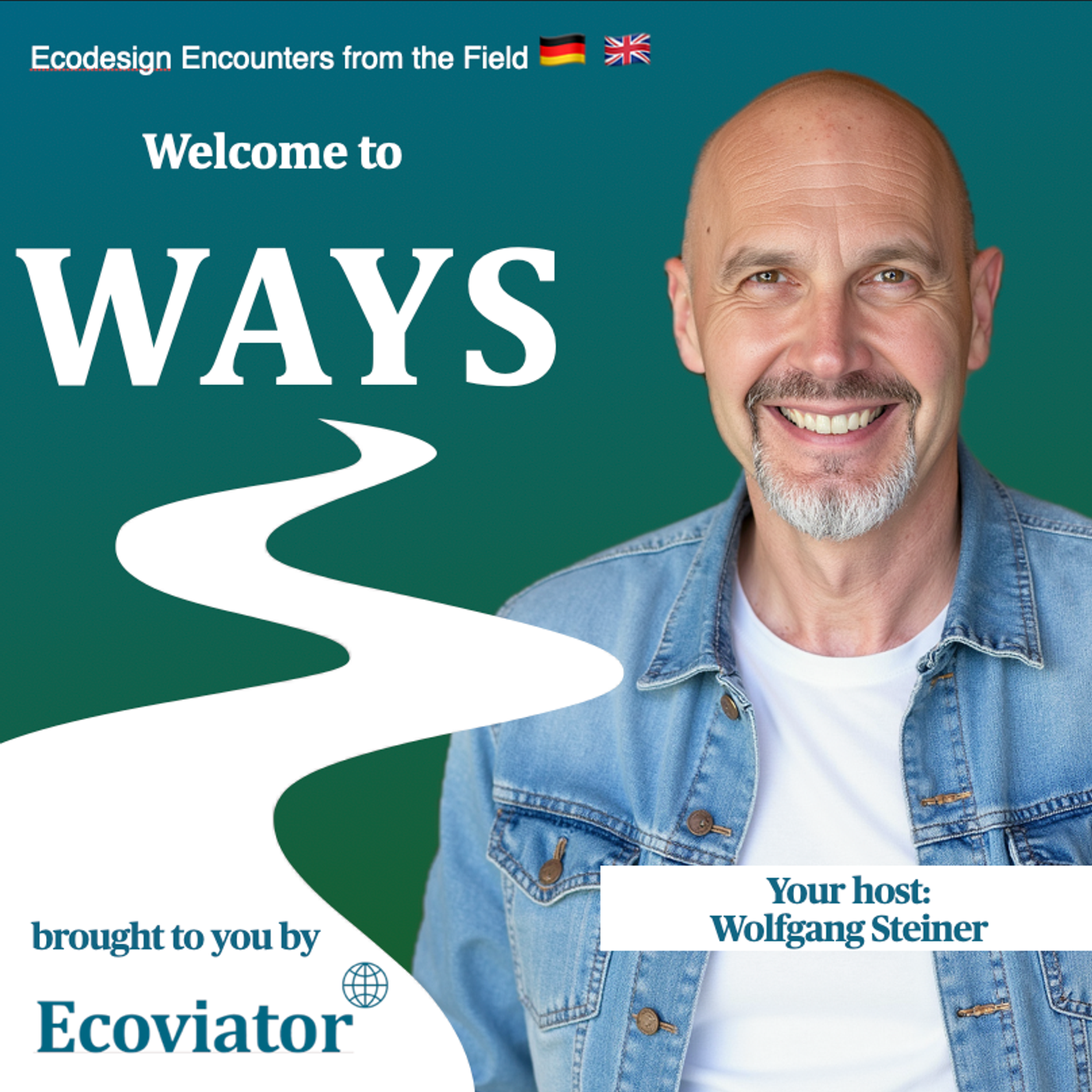
Let's turn Great Sustainable Product Ideas into Business Reality - Vanya Boneva (Essity)
Season 1 · Episode 8
Thursday, July 30, 2026 • Duration 36:05
About WAYS
WAYS explores real-world experiences at the intersection of ecodesign, circular economy, product sustainability, digital transformation and regulatory readiness (including ESPR, the Digital Product Passport and product data governance).
Who this episode is for
Relevant for product designers, product managers, sustainability professionals, marketing and communication teams, innovation leaders, manufacturers, and anyone interested in bringing sustainable product innovation successfully to market.
About the guest: Vanya Boneva
Vanya Boneva is Sustainability Lead (Central & East Europe) and Regional Marketing Manager HHT at Essity (essity.com). Combining sustainability with commercial marketing, she works at the interface where sustainable product innovation becomes customer value. Her work on Essity’s award-winning Coreless technology demonstrates how sustainability, product development and marketing can come together to create innovations that benefit consumers, retailers, businesses and the environment alike.
About the host: Wolfgang Steiner
Wolfgang Steiner has spent many years working at the intersection of product innovation and design, digital & data, and sustainability. He is the Founder of Ecoviator, helping companies navigate the Twin Transformation towards sustainable product businesses through digitalisation—including preparation for the Digital Product Passport.
In this episode, Wolfgang speaks with Vanya Boneva about what it really takes to transform a sustainable idea into a successful product innovation. Using the story behind Essity’s award-winning Coreless technology, they explore why sustainability alone is rarely enough. Instead, lasting innovation emerges when sustainability, marketing, product development and commercial teams work towards a common goal. A conversation about stakeholder alignment, credible sustainability communication, customer value—and why some of the most impactful innovations begin by questioning assumptions we’ve taken for granted for decades.
Soundbites
• “Marketing and sustainability should not work in parallel—they should design together.”
• “The best innovations don’t always add something new. Sometimes they remove what we’ve always assumed was necessary.”
• “Sustainable innovation succeeds when customer value, business value and environmental value reinforce one another.”
WAYS_Intro and Outro to Vanya Boneva_final script.pdf
Chapters
00:00 Introduction and Vanya’s journey
04:15 Sustainability meets marketing
10:30 The story behind Coreless
20:05 Designing products retailers embrace
29:40 Communicating sustainability credibly
37:10 Aligning stakeholders across the organisation
45:25 Why less can become more
52:10 Looking ahead: the future of sustainable product innovation
SDG 17 Ultra: Together is the Only Way - Oliver Mergens (VAUDE)
Season 1 · Episode 7
Thursday, July 16, 2026 • Duration 58:17
Über WAYS:
WAYS beleuchtet echte Erfahrungen an der Schnittstelle von Eco-Design, Circular Economy, Produktnachhaltigkeit, digitaler Transformation und Regulatory Readiness (u. a. ESPR, Digital Product Passport, Daten-Governance).
Für wen diese Episode gedacht ist:
Relevant für Produktdesigner:innen, Produktmanager:innen, Sustainability Teams, Kommunikationsverantwortliche, Hersteller sowie alle, die Nachhaltigkeit glaubwürdig und wirksam in Produkte und Unternehmen integrieren möchten.
Über den Gast: Oliver Mergens
Mit über 20 Jahren bei VAUDE engagiert sich Oliver aktuell als Berater der VAUDE Academy für nachhaltiges Wirtschaften (vaude.com) mit langjähriger Erfahrung in Nachhaltigkeit und der Begleitung von Unternehmen auf ihrem Weg zu mehr Verantwortung und Kreislauffähigkeit.
Über den Host: Wolfgang Steiner
Engagiert sich seit vielen Jahren in den Schnittstellen von Produktinnovation und -design, Digital & Data und Nachhaltigkeit. Er ist Gründer und Inhaber von Ecoviator und unterstützt Unternehmen bei der Twin Transformation - zu nachhaltigem Produkt-Business mit Hilfe der Digitalisierung, inklusive der Vorbereitung auf den Digitalen Produktpass
In dieser Episode sprechen wir mit Oliver Mergens darüber, wie Nachhaltigkeit vom Purpose zur gelebten Unternehmenskultur wird. Am Beispiel von VAUDE sprechen wir über Pionierarbeit im Eco-Design, den Umgang mit EMPCO, die Chancen des Digitalen Produktpasses sowie darüber, warum Transparenz wichtiger ist als perfekte Nachhaltigkeitsversprechen. Ein Gespräch über Glaubwürdigkeit, Suffizienz, Partnerschaften – und weshalb Circular Economy nur gemeinsam gelingen kann.
The Human Side of Circular Economy – Mihaela Stefanescu (UNFCCC)
Season 1 · Episode 6
Wednesday, June 3, 2026 • Duration 46:38
WAYS – Ecodesign Encounters from the Field
Episode #6 – The Human Side of Circular Economy – Mihaela Stefanescu (UNFCCC)
About WAYS
WAYS explores real-world experiences at the intersection of ecodesign, circular economy, product sustainability and the systems that help make sustainable transformation possible.
Who This Episode Is For
Relevant for sustainability professionals, policy makers, product teams, circular economy practitioners and anyone interested in the connection between climate action and product design.
In this episode, Wolfgang speaks with Mihaela Stefanescu about the relationship between circular economy, climate policy and product design.
Mihaela shares insights from her work on circular economy policy and as a nominated expert on the United Nations Framework Convention on Climate Change (UNFCCC) roster of experts supporting technical reviews under the Paris Agreement.
From Scrap-Yard-Vibes to Industrial-Grade Recycling – Christian Aschenbrenner (PA)
Season 1 · Episode 5
Wednesday, May 20, 2026 • Duration 31:33
Über WAYS:
WAYS beleuchtet echte Erfahrungen an der Schnittstelle von Eco-Design, Circular Economy, Produktnachhaltigkeit, digitaler Transformation und Regulatory Readiness (u. a. ESPR, Digital Product Passport, Daten-Governance).
Für wen diese Episode gedacht ist:
Relevant für Produktdesigner:innen, Produktmanager:innen, Sustainability Teams, Hersteller sowie Akteure aus Recycling, Refurbishment, und Repair.
Über den Gast: Christian Aschenbrenner
Gründer & Geschäftsführer, PA GmbH (we-are-pa.com) – „Circular Architects“ mit Fokus auf profitablere Recyclinglösungen, insbesondere WEEE (E-Waste) und große Hausgeräte.
In dieser Episode spreche ich mit Christian Aschenbrenner über Kreislaufwirtschaft dort, wo sie oft am wenigsten glamourös – aber am wirkungsvollsten – ist: im Recyclingprozess selbst. Christian beschreibt, warum echte Zirkularität nicht mit „mehr Recycling“ beginnt, sondern mit besserer Trennung, saubereren Fraktionen und Materialqualitäten, die am Markt wirklich bestehen können.
Key Topics:
• Zero Waste WEEE: Anspruch, Nutzen, Grenzen
• Industrialisierung im Recycling: Qualität, Standards, Prozessfähigkeit
Better Materials for Better Products – Efrat Friedland (Materialscout)
Season 1 · Episode 4
Tuesday, May 5, 2026 • Duration 39:57
WAYS – Ecodesign Encounters from the Field
Episode #4 – Efrat Friedland (Materialscout)
About WAYS
WAYS explores real-world experiences at the intersection of eco-design, product sustainability, digital transformation and regulatory readiness (ESPR, Digital Product Passport, data governance and the twin transformation).
Who This Episode Is For
Relevant for product designers, product managers, sustainability teams and organisations working on better material choices, circularity and eco-design readiness.
In this episode, Wolfgang speaks with Efrat Friedland, material expert and founder of Materialscout, about the role of materials in sustainable product design.
Efrat shares her journey from industrial design into material expertise – shaped by the realisation that the world does not simply need more products, but better decisions on what products are made of.
The conversation explores how material choices influence environmental impact, product perception, storytelling and collaboration across design, engineering, procurement and marketing. Through a real-world case with BSH / Bosch Siemens Hausgeräte, Efrat shows how teams can align around better material decisions – and how easily sustainability claims such as “recyclable” can be misunderstood.
A key insight: material selection alone does not define sustainability. Materials may represent only one part of a product’s footprint, but they remain a powerful lever when combined with lifecycle thinking, supply chain strategy and portfolio-level decisions.
Looking ahead, Efrat calls for reduced material complexity, fewer unnecessary product variants, closed material loops and a shift in mindset: brands should start seeing materials as their own long-term assets.
Key TopicsAction ItemsSoundbitesChapters
Eco-Design Without Perfect Data – Beth Hadley (WBCSD / PACT)
Season 1 · Episode 3
Thursday, March 19, 2026 • Duration 41:13
WAYS – Ecodesign Encounters from the Field
Episode #3 – Beth Hadley (WBCSD / PACT)
Über WAYS
WAYS beleuchtet reale Erfahrungen an der Schnittstelle von Eco-Design, Produktnachhaltigkeit, digitaler Transformation und regulatorischer Vorbereitung (ESPR, Digitaler Produktpass, Daten-Governance, Twin Transformation).
Für wen ist diese Episode relevant
• Produktmanager:innen in der nachhaltigen Produktentwicklung
• Nachhaltigkeits- und ESG-Verantwortliche
• IT- und Datenteams im Kontext von Produkttransparenz
• Unternehmen in Vorbereitung auf ESPR & DPP
Zum Gast
Beth Hadley
World Business Council for Sustainable Development (WBCSD) – PACT
Hintergrund in Data Science & Software Product Management
In diesem Walk-and-Talk entlang der Isar spricht Beth Hadley über ihren Weg von Data Science in die Nachhaltigkeit und ihre Arbeit an CO₂-Transparenz in globalen Lieferketten.
Im Zentrum stehen die praktischen Herausforderungen von Scope-3-Daten, die Rolle von Standards und der oft zitierte „Standards-Zoo“. Beth bringt eine klare, pragmatische Perspektive ein: Nachhaltigkeitssysteme und Datenreife entwickeln sich iterativ – nicht perfekt von Anfang an.
Why sustainable product design often fails not because of technology – but because the product data simply isn’t there.
About WAYS
WAYS explores real-world experiences at the intersection of eco-design, product sustainability, digital transformation and regulatory readiness (ESPR, Digital Product Passport, data governance and the twin transformation).
Who This Episode Is For
Relevant for:
• product managers working on sustainable product development
• sustainability and ESG leaders in manufacturing
• engineers integrating lifecycle thinking into product design
• teams preparing for ESPR or the Digital Product Passport
Climate change is happening. Regulations are tightening. Product transparency is no longer optional.
In this short teaser episode, Wolfgang Steiner – Founder of Ecoviator – shares why WAYS exists and what listeners can expect. The podcast explores real-world experiences at the intersection of eco-design, product sustainability, digital transformation, and regulatory readiness (ESPR, Digital Product Passport, data governance).
WAYS is not about theory. It is about practice.
Conversations with practitioners who are already walking the path – navigating complexity, building new capabilities, and turning sustainability into structured ways of working.
If you work in product development, sustainability, innovation, or data – this podcast is for you.
Licensed under Creative Commons CC0 (public domain)
Welcome to WAYS - Intro to Ecodesign Encounters
Episode 4
Monday, March 2, 2026 • Duration 04:01
About WAYS – Ecodesign Encounters from the Field
The podcast explores real-world experiences and insights at the intersection of eco design, product sustainability, digital transformation and regulatory readiness (ESPR, Digital Product Passport, data governance, Twin Transformation).
In this teaser episode, Wolfgang Steiner provides an overview of the themes explored in the WAYS podcast. He discusses the challenges and opportunities in eco design and reflects on how organisations can integrate environmental considerations into their processes. Wolfgang shares personal experiences and insights gained from conversations with experts and practitioners in the field.
• The importance of eco design and product transparency
• Challenges and opportunities in product development
• Personal experiences and insights from Wolfgang Steiner
Key Frameworks
• Digital Product Passports
• Transparency in product development
Action PointsSoundbitesChaptersMusic Credits
Teaser-Video | Willkommen zu WAYS
Episode 1
Sunday, February 22, 2026 • Duration 01:02
Teaser-Video | Willkommen bei WAYS
Warum dieser Podcast. Warum jetzt.
Der Klimawandel ist Realität. Regulatorische Anforderungen nehmen zu. Produkttransparenz wird zum neuen Standard.
In dieser kurzen Teaser-Episode erläutert Wolfgang Steiner – Gründer von Ecoviator – warum WAYS ins Leben gerufen wurde und was dich in diesem Podcast erwartet. Im Mittelpunkt stehen reale Erfahrungen an der Schnittstelle von Eco-Design, Produktnachhaltigkeit, digitaler Transformation und regulatorischer Vorbereitung (ESPR, Digitaler Produktpass, Daten-Governance).
WAYS ist kein Theorieformat.
Es geht um Praxis – um Menschen, die bereits unterwegs sind und neue Wege entwickeln, um Nachhaltigkeit systematisch im Unternehmen zu verankern.
Für alle, die in Produktentwicklung, Nachhaltigkeit, Innovation oder Daten arbeiten – und wissen wollen, wie man sinnvoll beginnt.
Licensed under Creative Commons CC0 (public domain)
Related Shows Based on Content Similarities
Discover shows related to WAYS - Ecodesign Encounters, based on actual content similarities. Explore podcasts with similar topics, themes, and formats, backed by real data.
Together they explore why circularity is essential for achieving climate goals, why waste is often the result of design decisions made long before a product reaches consumers, and why repairability, transparency and material choices play a crucial role in creating more sustainable systems.
The conversation also highlights a theme often overlooked in technical discussions: circular economy is not only a challenge of technology and regulation, but also one of governance, education, trust and human behaviour.
Topics Discussed
• Circular economy and climate action
• The role of the UNFCCC and Paris Agreement
• Why waste is often a design problem
• Repairability and product longevity
• Material choices and product sustainability
• Transparency and Digital Product Passports
• Building trust across countries and value chains
• The human side of circular economy
Presented by Ecoviator
Your Journey Companion for the Twin Transformation of Products
• Materials as emotional and strategic product drivers • BSH case: recycled materials in consumer electronics • Recyclable vs. recycled – terminology matters • Limits of material impact in lifecycle assessments • Barriers to adopting new materials • Positive Plastics as a learning tool for designers • Closing material loops and reducing portfolio complexity
• Reduce unnecessary material complexity • Align design, procurement, engineering and marketing early • Think beyond one product: look at the whole portfolio • Prioritise lower material use, not only material substitution • Explore take-back and closed-loop material systems
• “We don’t need more products – we need better material decisions.” • “Recyclable does not mean recycled.” • “Brands should think of materials as their own assets.”
00:00 Introduction 05:31 From designer to material expert 11:35 BSH material case 17:04 Recyclability claims 20:05 Materials and LCA 22:58 Introducing better materials 28:20 Positive Plastics 31:43 Future material standards 35:50 Making eco-design the norm
Content Type: Interview
Primary Goal: Education
Music Credits: “Lullaby | Hip-Hop Instrumental” by kontraamusic Source: Freesound.org Licensed under Creative Commons CC0
Zentrale Hürden sind fehlende Anreize, mangelnde Zusammenarbeit zwischen Abteilungen und unzureichende Datenqualität. Ihr Ansatz: „Minimum Viable Truth“ – Fokus auf die wichtigsten Impact-Kategorien, statt alles gleichzeitig messen zu wollen.
Die Episode zeigt, wie Unternehmen trotz unvollständiger Daten handlungsfähig werden – und warum Entscheidungen wichtiger sind als Perfektion.
Zum Abschluss gibt Beth einen Ausblick auf die nächsten fünf Jahre: klarere Standards, integrierte Softwarelösungen und der wachsende Einfluss von KI auf Datenqualität und Entscheidungsfindung.
• Nachhaltigkeit operativ umsetzen – über Abteilungen hinweg
• Mit unvollständigen Daten sinnvoll arbeiten
• Product-Management-Denken auf Nachhaltigkeit übertragen
In this conversation with Jahanzeb Tariq, we explore how eco-design becomes operational inside a global manufacturing organisation.
JT works at the intersection of engineering, sustainability and business innovation, helping product teams integrate sustainability KPIs into real product decisions.
The discussion touches on the practical challenges of introducing lifecycle thinking into complex industrial products. From manually weighing components during early lifecycle assessments to coordinating sustainability, engineering and product teams, the episode illustrates the organisational and data realities behind eco-design.
We also discuss product data maturity, system thinking in energy technologies and the growing role of the Digital Product Passport.
Why Listen
Practical insights on:
• translating sustainability goals into product development decisions
• using embodied carbon as a design KPI
• overcoming data challenges in lifecycle assessments
• coordinating cross-functional teams for eco-design
• why the future of sustainable product innovation lies in system thinking
Keywords
Eco-Design, Lifecycle Assessment, Product Sustainability, Sustainability Data, Digital Product Passport, ESPR, Product Development