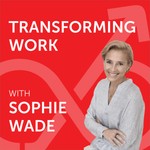
Sophie addresses current business conditions and explores ways to navigate the disruption. She shares informative insights and interviewing leading innovators who are providing or benefiting from transformative solutions that will allow companies to emerge with sustainable models, mindsets, and business practices.
Find out how to transition to more effective, productive, and supportive new ways of working—across locations, generations, and platforms—as we harness these challenging circumstances to drive significant, multidimensional changes in all our working lives.
Site
RSS
Recent rankings
Latest chart positions across Apple Podcasts and Spotify rankings.
Shared links between episodes and podcasts
Links found in episode descriptions and other podcasts that share them.
Cali Williams Yost, CEO and Founder of Flex+Strategy Group, has pioneered workplace flexibility since 1995. Cali shares her journey from banking to becoming a flexibility strategist. She explains why flexible work is essential for business growth and attracting and retaining top talent. Cali explains the pitfalls of hybrid and flexible model policy-only approaches and the need for full operational system-wide integration. She urges leaders to rethink outdated work constructs and outlines practical steps for embedding flexibility into organizational culture for sustainable success.
TAKEAWAYS
Chapter 1: Origins of a Flexibility Strategist
[01:19] Cali studies English and Economics appealing to her two contrasting interests.
[02:08] Cali's first job at a bank gives her training and allows her to go to New York City!
[02:43] Client relationships are key to success, but rigid systems cause Cali's colleagues to quit.
[03:35] Cali sees flexible work as logical and proposes it, unsuccessfully to bank leadership.
[04:30] A bank client CEO explains he offers flexible working to retain his employees long-term.
[05:14] Urged by his business-driven reasoning, Cali leaves to become a flexibility strategist.
[05:47] Cali gets an MBA to have credibility with business leaders about workplace innovation.
[06:10] Cali joins Families and Work Institute, developing strategies to operationalize flexibility.
[07:35] Workplace flexibility becomes an employee benefit part of policy, not operationalised.
[08:45] Making policies operational, Cali develops 'work-life fit' and publishes her first book.
Chapter 2: Workplace Flexibility Before & During COVID
[10:13] Top down approaches are not effective so Cali dives deep into change management.
[11:15] Cali starts her own firm to take an operational, integrated approach to flexible working.
[12:26] Pre-2020, most companies had flexible work policies but they weren't operationalised.
[13:50] Widespread flexibility was organic and inconsistent with more men working remotely.
[13:55] When COVID hit, companies with operationalised flexibility policies adapted easily.
[14:19] Executives must reassess foundational work constructs and beliefs to adapt effectively.
[17:00] The work challenges presented by leaders and younger employees "clash of contexts".
[18:55] The upcoming demographic cliff makes flexible work necessary to attract and retain talent.
Chapter 3: Leading in the Modern Work Era
[19:26] Finding those ready to lead the change, challenge their context and hold space.
[19:48] Three change phases—assess, align, activate—are critical for embedding flexibility.
[20:10] Leadership alignment is essential; one resistant leader can derail an entire initiative.
[22:45] Employers investing in defining new working parameters unlock many benefits.
[23:59] Leaders need to be aware of what is and isn't working with employees.
[25:31] Critical willingness to hold space for change being messy and looking at work differently.
[27:11] Mandating in-office days without data and strategic input erodes employee confidence.
[27:52] Executives co-creating with employees to achieve aligned operational flexibility.
[29:55] Trust increases when employees participate in experimenting and defining the process.
Chapter 4: Intentional Future of Work Transformation
[32:11] Senior leaders must be intentional about work transformation.
[32:50] The sustainability of 5-day/week RTO policies especially for talent attraction/retention.
[34:07] The significant, essential hurdle of stepping back and rethinking the old work model.
[35:12] Younger employees successfully create an intern integration program when empowered.
[37:45] Talent shortages by 2032 make flexible models essential to business continuity.
[38:33] AI will supplement, not replace, human workers—talent attraction remains vital.
[39:42] Rigid workspace metrics must evolve to support dynamic, flexible workforce needs.
[42:16] Organizational transformation requires change management and relationships with systems thinking.
IMMEDIATE ACTION TIP: Leaders need to assess their talent reality from now through 2030 – aligning the expectations of their workforce and the needs of the business.
Pre-pandemic "Flexibility was happening organically. It was happening inconsistently, and it was not optimized."
"The consistent recognition is - I need to do this differently. So what does that look like?"
"You have to be willing to hold the space because change is messy."
"This [flexibility] isn't a policy. This is a way of operating."
"We're getting ready to hit a historic labour cliff demographic cliff. There aren't gonna be people. The workers who are left? They are going to dictate how they're gonna work. So you should be working right now on being employer of choice."
156: Andrew Mawson - Increasing Productivity: Key Factors, Brain Capacity, and Mental Load
Episode 156
Friday, November 7, 2025 • Duration 42:24
Andrew Mawson, Founder and Managing Director of Advanced Workplace Associates, explores how organizations can enhance performance, especially by helping employees better manage their brain capacity. Andrew shares six evidence-based factors most impacting knowledge worker productivity. He discusses the neuroscience-researched factors affecting brain function and performance. Andrew offers actionable leadership guidance to reduce mental load, enhance employee well-being and resilience, and achieve sustainable results.
TAKEAWAYS
Chapter 1: Andrew's Early Career
[01:18] Andrew studies applied statistics finding it useful, later describing reality through numbers.
[01:59] Working in tech and defence, Andrew then joins Fujitsu and leads a program on intelligent buildings.
[02:47] Intelligent building initiatives aim to increase computing adoption and data integration.
[04:54] Advanced Workplace Associates is founded to bring a business- and people-focused lens to workplace strategy.
Chapter 2: Six Key Factors of Knowledge Worker Productivity
[07:31] Analysis of past research identifies top factors impacting knowledge worker productivity.
[09:28] Factor 1: Social cohesion emerges as the top factor boosting collaboration and innovation.
147: Mark Dixon - Making Offices Work for Today's Distributed Workforce
Episode 147
Thursday, May 22, 2025 • Duration 38:05
Mark Dixon, Founder and CEO of IWG, which he started in 1989 as Regus, discusses workplace evolution and flexible work trends. He shares insights from building IWG's 18-brand network serving 8 million users across 120+ countries. A serial entrepreneur, Mark shares how evolving workforce needs and digital tools shape location-agnostic office strategies. He emphasizes structuring real estate portfolios to empower employees and align with their work, and critiques outdated RTO policies. Mark discusses reshaping onboarding and productivity practices across roles and generations. He debunks in-office apprenticeships in today's tech-facilitated world.
TAKEAWAYS
[01:36] Mark Dixon find school too slow and leaves to start getting involved in business.
[02:39] After his first—sandwich—venture, Mark travels the world to gain more experience.
[02:59] Mark builds a successful hotdog business, then co-living apartments in Belgium.
[03:45] Exploring entrepreneurial opportunities in Europe lays the foundation for IWG.
[05:37] Mark's struggles securing office space in reveals a market need for flexible workspaces.
[06:07] On a hunch, the first center opens in 1989, based on simplicity, speed, and outsourcing needs.
[07:21] Companies want flexibility, speed, and capital-light solutions—not real estate complications.
[09:32] IWG's first clients are mostly large enterprises, while half now are SMEs and entrepreneurs.
[10:31] All clients' reasons are the same: efficiency off the balance sheet with flexibility and speed.
57: Dr. Grin Lord — Empathy and AI: Algorithms that Help Us Listen and Learn
Episode 57
Friday, November 11, 2022 • Duration 42:20
Dr. Grin Lord is the founder and CEO of mpathic.ai, an AI-powered service bringing empathy to enterprises. Trained as a clinical psychologist, Grin describes critical discoveries while a research scientist and gaining expertise in conversational design. She shares insights about how AI and machine learning can augment human connection, improve therapy bots, and train leaders, managers, and employees to be more empathic.
KEY TAKEAWAYS
[03:12] Dr. Grin Lord's scientific background and early focus on empathy.
[04:15] The extraordinary benefits of listening and withholding judgments.
[07:28] The national rollout and financial impact of empathetic listening.
[08:12] Grin finds the 3-day training workshops are not successful for forming habits.
[09:43] Grin transitions to coaching modality to change behaviors.
[11:21] Specific intense training rules for providers optimize empathy, engagement, and trust.
[12:53] Unnatural learned techniques have undeniable power!
[13:41] Self-awareness is needed to adhere to the rules and be most effective.
[14:30] With phone-based coaching, Grin starts using machines to support the process of learning empathy.
[15:17] Research and ratings evaluate provider effectiveness and how computers were trained to do it.
56. Colin Field - Transforming Financial Services with a Human-Centric Approach
Episode 56
Friday, October 28, 2022 • Duration 49:50
KEY TAKEAWAYS
[02:50] Colin started his career in accounting and then retail banking.
[03:50] Colin discovers he enjoys seeing people win and developing their careers.
[04:35] When banks were fighting for survival, the focus was internal not on customers.
[05:54] Colin wanted to understand the business end to end and the role he and others played.
[06:54] Transitioning from a large to a small organization was a shock for Colin—a risk for both sides.
[07:34] The culture at Saffron was warm from Day One.
[08:41] Colin rose rapidly to CEO, despite having no plan to achieve the role at this time.
[09:52] Colin leads transformation of the organization's culture and ethos from having top down centralized control.
[11:02] The "how" of work changes, especially opening up communications.
[12:13] To affect a culture change, being candid is key, bringing people into the process and encouraging them to ask questions.
[13:34] Cultural transformation starts with trust and being relentlessly honest and open.
[15:30] Emphasizing career development meant showing people growing and winning.
55: Lou Diamond — How to Connect and Communicate - Be Curious, Be Fearless, Be Super!
Episode 55
Friday, October 21, 2022 • Duration 50:01
Lou Diamond, growth consultant and CEO of Thrive, is the host of popular podcast Thrive Loud, a keynote speaker and author. Lou's new book "Speak Easy" is a playbook to help people connect and communicate, especially addressing the most difficult and awkward conversations. Lou shares insights gathered working in retail, consulting, banking, and as an entrepreneur, learning how "soft" skills are the "super" skills of communicating effectively and improving outcomes.
KEY TAKEAWAYS
[02:44] Lou comes in feeling more than spectacular, sharing how beekeeping and jewelry selling were a part of his academic path to studying economics at Cornell!
[03:35] Economics was originally taught in the Agricultural School at Cornell, so Lou also learned bee-keeping.
[04:17] Lou learned much from his entrepreneurial father working in the family's stores from age 13.
[05:13] How does communicating in a very small space differ from communicating in larger spaces?
[06:15] How to transcend the transaction in a competitive environment.
[07:28] Lou minors in communications in business—a key aspect of who he is.
[08:15] Consulting is the first stop to explore different industries and roles.
[10:32] Lou gets the opportunity to transition to communications and marketing in financial services.
[13:44] In the 2008 market crash, the spotlight was on Lou covering government sponsored agencies.
54: Haddy Davies - Thinking Outside the (Office) Box Innovating for the New Era of Work
Episode 54
Friday, October 14, 2022 • Duration 37:26
Haddy Davies is the Global Procurement Leader and Black Employee Network Chair at Johnson Matthey, a British specialties chemicals and sustainable technologies company. Haddy shares how lockdown in March 2020 forced her to do her job very differently. She recognizes the business's heavy reliance on machines as well as the critical importance of understanding and engaging employees. Post-pandemic, her company is rethinking and testing new options—approaches, processes, and work arrangements—while Haddy uses First Principles to evaluate responsible sourcing.
KEY TAKEAWAYS
[03:00] Haddy shares why she choose a career in engineering.
[05:11] Transitioning to the UK from The Gambia was not so easy.
[06:54] Haddy does a gap year at Bible college to understand more about religion for many family-related reasons.
[09:40] The link between science and theology for Haddy is the appetite for knowledge.
[11:48] Haddy and her husband have multi-faceted connections.
[12:04] Choosing between studying engineering or continuing to study theology.
[13:03] An industrial placement year, starts Haddy's career at DuPont in sustainable packaging which led to fuel cells using clean fuel.
{14:14] Haddy enjoys working on her company's efforts to decarbonize the world and get to net zero.
53: Trond Undheim — Flexibility for Fixed-Site Jobs Pt II: A Top Down & Bottom Up Approach
Episode 53
Friday, September 30, 2022 • Duration 52:37
Trond Undheim, futurist, speaker, entrepreneur, venture partner, and the author of a new book, Augmented Lean in this second episode gets to the practical details of how flexibility can be achieved in manufacturing plants after a 50 year innovation hiatus. Trond draws on his industrial tech background, understanding of manufacturers' realities, and recognition of frontline workers' expertise to develop flexible, augmented environments. He recommends balancing inputs from both employees on the shop floor and management to "hack and govern" new solutions. Trond acknowledges these are long term paradigm shifts.
KEY TAKEAWAYS
[02:57] Trond explains the deskless reality for factory workers results from forgetting to innovate for 50 years.
[05:00] Adding multiple screens gives employees the data they need and freedom to walk around.
[05:36] How no code technology now allows data to be widely available and accessible.
[06:26] Up to date information augments workers' intelligence and real-time operational decisions.
[07:03] The first killer application is digital work instructions.
[07:52] Tech advances enable empathetic learning as feedback is immediate and uncontentious.
[09:44] Augmented lean approaches technology integration in a smarter way—top down and bottom up.
[10:54] Governance is an essential aspect of modern organizations.
Trond Undheim, futurist, speaker, entrepreneur, venture partner, and author of a new book "Augmented Lean". Trond draws on his technology-focused background across public, academic, and private sectors to discuss the need and solutions for workplace flexibility for frontline manufacturing workers. Acknowledging the paradigm shift to employ a human-centric approach, integrating employees' inputs, Trond highlights sophisticated new software which improve frontline experiences and overall results. These solutions optimize processes and augment workers rather than emphasize machine automation.
KEY TAKEAWAYS
[03:19] Trond's path starts in a random manner when he notices a poster!
[04:55] How Trond canceled Christmas to write his Ph.D. proposal in two weeks.
[06:02] Norway's phone company is exploring the nomadic workplace in 1998.
[07:44] Trond does fieldwork in Silicon Valley that is selling "placelessness".
[09:18] Trond becomes sought after for technology policy decision-making, government thinktanks, energy policy, and eventually economics at the E.U..
[12:19] Standardization: Trond explains how fascinating and essential it is—eg the Apple charger.
[14:54] How interoperability and openness have been important new developments.
[16:19] Trond equates learning standards and standardization like foreign languages.
51. Jen Fox — Our Learning Journeys: To Attract, Hire, Empower, Develop, and Retain Talent
Episode 51
Friday, September 9, 2022 • Duration 48:50
Jen Fox, Director of People Experience and Culture at Justworks, discovered her passion for training and developing people early on. She shares learnings from her experiences at Nordstrom and Starbucks as well as working independently as a coach. Jen continues her journey at Justworks supporting new individualized career pathways, navigating new work arrangements, and empowering employees to help figure it out.
KEY TAKEAWAYS
[03:04] Jen starts out as an entrepreneur.
[04:12] The business reaches an inflection point and they have to make a decision.
[04:40] Jen joins Nordstrom and gets moved in Learning & Development.
[07:35] At Starbucks for five years, Jen benefits from many different experiences.
[08:57] Leadership's commitment to the employee makes a difference—including transparency and openness.
[10:20] Jen hones her HR skills at Getty Images.
[11:30] Early understanding and observations about company culture.
[13:01] An impactful learning moment when having to lay people off after an acquisition.
[14:22] Jen's lasting takeaway is the human-centric core.
[10:35] Despite not wanting to go, Jen moved to New York City to pursue her career.
[15:20] After having three kids, Jen transitions organically to freelancing, consulting, and coaching.
RESOURCES QUOTES
[10:43] Factor 2: perceived supervisory support with leaders tailoring their approach for each person.
[11:41] Factor 3: Information sharing enables a culture of openness, countering knowledge-hoarding.
[11:59] Factor 4: vision clarity helps employees connect their work to the team and corporate purpose.
[12:45] Factor 5: external communication makes teams challenge their ideas and be open to others' views.
[13:29] Factor 6: Trust underpins all factors, fostering belief that leaders and colleagues do the right thing.
[15:10] Leaders must create a level of certainty to reduce employee anxiety despite external turmoil.
[16:21] Social cohesion usefully creates a buffer during uncertain times, enhancing resilience.
Chapter 3: Research into Brain Performance
[17:16] Humans are individual brains – research identifies 14 key factors to optimise performance.
[18:42] Sleep (7.5 hours) is key for brain performance, with quality and preparation critical enablers.
[19:50] Hydration, exercise, and a good diet—with breakfast—are also essential for cognitive health.
[21:39] Leaders must recognize that lifestyle habits affect their team's productivity and wellbeing.
[23:00] AWA is running a cohort trial to educate leaders on brain health and track performance.
[23:57] After baselining, coaching how to integrate new habits and track performance.
Chapter 4: Cognitive Capacity & Managing Load
[24:56] Recognising finite brain capacity, environments can be designed to reduce mental loads.
[25:55] Everyone can better manage their well-being and outcomes using workspace that increases capacity.
[28:10] A story of making tea illustrates how cognitive load varies by individual and context.
[29:37] Brains are managing humans' entire systems unconsciously, consuming much energy.
[30:20] Personal stressors, such as family and finances, compound work demands and brain strain.
[31:24] Leaders need to monitor workload and not exceed employees' brains' capacity limits.
[32:34] When excessive load get to a point that it blocks capacity for planning and logic.
[33:26] Managers and employees can manage load together to restore cognitive function quickly.
[34:13] Organizations are communities of connected brains aiming to optimise knowledge flow.
[35:05] All six factors are linked and applied together can improve productivity and wellbeing.
Chapter 5: How Leaders can Improve Performance
[36:26] Leaders need to better understand how the brain works to enable high-performing teams.
[37:07] Most managers lack vital training; the six factors offer a useful playbook for leaders.
[38:17] How many managers believe social cohesion is their responsibility?
[38:58] Competitive pressures between teams create division and undermine collaboration.
[39:54] Leaders must promote and model trust and social cohesion to cultivate environments that enable success.
"The name of the game is to get everybody as socially cohesive as possible to allow fluidity of movement, of knowledge and, and collision of knowledge."
"[External communication is] the idea that you should expose your knowledge and your brain to other things…. going to other places and have other people challenge your understanding so that your understandings remain fresh."
"Humans have got a finite capacity and how that capacity is loaded and eaten into is also another important part of the jigsaw."
"Organizations really are communities of connected brains…I think the first thing the leaders need to do is understand more about the brain."
"Brains are the unit of production going forward in the world of knowledge work."
"We are all actually different…We should be trying to create an environment and giving people knowledge about the status of different spaces and things in the places in the building so they can go and choose."
"The duty of a leader is to try to create a level of certainty, create a vision, and create a direction of travel that is almost independent of the turmoil that's going on."
[11:19] IWG's 18 brands offer diverse options from flexible warehouse space to a private members' club.
[13:07] A hospitality mindset is key—providing functioning workspaces with good internet and support.
[14:05] Technological advances enable management at distance, where employees have support.
[15:32] Workers increasingly self-optimize office usage: hourly, daily, or long-term team project space.
[16:50] Good management skills, not location, drives productivity and effective team outcomes.
[18:49] More projects and fractionalized work are driving demand for short-term collaboration spaces.
[20:58] IWG supports distributed workers and teams globally with platform-like flexible access.
[21:23] Businesses shift to convenient offices near where people live to reduce commute strain.
[23:30] RTO mandates are based on leaders responding to questions with data support.
[24:00] 80% of Fortune 500 companies are becoming more distributed, often providing offices nearer to where people live.
[25:22] Virtual onboarding and apprenticeships are effective supported intentionally with technology.
[28:45] Workspace purchasing shifts from real estate to procurement, finance, and HR departments.
[29:30] Many companies want offices which are convenient for the people they want to hire.
[30:00] Organizations are focused on their balance sheet and being capital light and flexible.
[31:54] IWG spends significant resources studying work design for customers and IWG employees.
[32:48] Design investments encompass tech needs and usage and evolving user expectations.
[33:52] IMMEDIATE ACTION TIP: To optimize work and location for outcomes, structure your portfolio, not your policy, and give people the best support for the jobs they are doing.
"Business people in general understood the value of capital light - focus capital on core business, not on peripheral activities. The value of service. The value of immediacy. I can just take it--the value of flexibility."
"Companies are understanding that they're in the job of supporting people to be more productive. That's the job. They're very focused on their balance sheet. They're very focused on capital light. They're very focused on flexibility."
"In a modern tech-facilitated world, you structure your portfolio, not your policy. It's not a question of RTO or not—it's about enabling the best support for the people for the job they're doing."
"80% of Fortune 500 use us, and the majority of them are moving to a more distributed workplace."
"We used to deal with just property directors. Now we are talking to procurement, human resources. and to finance people."
"Companies are understanding that they're in the job of supporting people to be more productive."
[16:40] Grin explains synchronizing—people naturally adjusting their language style to others'.
[17:39] How synchronizing is a form of empathy.
[18:44] Grin is curious about other ways we can measure empathy.
[19:49] Dr. Lord's realization: we need to get outside of the clinical space.
[20:00] Grin wants to use her learnings outside clinical and academic fields and moves into the startup space.
[21:48] When the pandemic starts, Grin is working on a therapy chatbot that uses artificial intelligence.
[22:56] People start preferring to talk to the chat bot as it "gets" them.
[23:56] During the crisis, Grin starts her own company while looking after her kids and both parents at home.
[25:36] Starting with a game Empathy Rocks, Grin teaches coaches and therapists how to listen with empathy.
[27:03] The next step was applying empathy in different business and work situations.
[27:24] The powerful effect of empathy—or lack of empathy—when handling insurance claims.
[30:00] How empathic suggestions help managers give feedback.
[31:56] The next feature will direct users responses over time to relevant skills training.
[33:54] The goal is to give objective, timely feedback at scale, not to replace human interaction.
[35:48] Grin explains how mpathic is currently being integrated in HR platforms to improve communications.
[38:05] IMMEDIATE ACTION TIP: If you want to be more empathetic, start with seeing if you can repeat back what you heard when you're listening, before you ask a question or provide advice.
[39:02] Grin recommends starting to apply a couple of simple skills in your daily life.
"We found that the folks that got the empathy intervention had major drops in their drinking and those effects held for three years and led to a 46% reduction in readmissions."
"Some of the key ingredients of listening interventions have to with approaching people with non-judgment, curiosity, and accurate listening."
"Even if the person knows that you're using those techniques — it's undeniably powerful — they still work!"
"We even had users report that they would rather talk to the bot than a human because of how consistently non-judgmental it was."
"A large percentage of customers will leave after a bad interaction."
"The core starting place for improving your empathy over time is seeing if you can get accurate understanding before you jump in providing advice or assuming."
[17:18] Culture needs to be aligned internally and externally, including customers too.
[18:02] To develop the business, people's roles needed to change.
[19:05] Achieving the improvements employees had committed to build trust and gained commitment for the next, growth phase.
[20:32] When the pandemic struck, Saffron was able to adjust rapidly as employees were used to change and communicating effectively.
[21:54] The pre-crisis transformation laid a strong foundation for two of the company's strongest trading years—during and since the pandemic.
[23:33] Saffron was able to respond flexibly to customers' different situations.
[24:37] The human-centered approach recognizes and responds to changing customer needs.
[26:42] Coming out the pandemic, Colin senses a seismic shift in how the employee value proposition [EVP] needs to considered.
[27:22] Colin is certainly not asking employees to return to the office five days a week
[28:23] Saffron takes a 'principles approach'—the most important principle is that a society comes first, the service of customers comes first.
[29:00] Colin observes that people know how to work best, they don't need the rules and expectations that other companies are talking about.
[30:11] During times of heightened ambiguity, ongoing conversations and iterations are important.
[31:08] A 'management manager' people training program facilitating new ways of working.
[32:12] Colin believes you need to understand where the people you work with are coming from.
[32:43] Saffron's top executive team, who are spread out across the UK, are intentional when interacting online and in person.
[34:29] How to encourage transparent dialogue and assimilate new habits.
[37:46] People are adjusting how they're living their lives no longer bound by geography—it's a work in progress.
[38:57] Customers' and employees' expectations are needing to adapt.
[40:56] Colin has an open and less conventional approach for attracting good talent.
[42:35] Colin helps employees grow in their roles and even out of the organization.
[44:17] Colin shares the story of a bus driver looking for a career change at Saffron.
[45:15] IMMEDIATE ACTION TIP: To make whatever transformation your organization needs, start with the culture…then leadership, people, and processes….and stay the course — it will take at least twice as long as you think it will.
"I found the thing that made my heart sing! And the thing that made me smile was seeing people win, seeing people around you win, colleagues developing their careers and actually seeing and getting proud about something you were doing as a business."
"Trust is the hardest thing to build in terms of culture."
"Overnight we went from a business that was head office in two central buildings and eight branches, to all of a sudden we're in no buildings, and we're in studies, spare bedrooms, dining room tables."
"Why would we want to start saying to people "you need to come back into the office again." It's crazy! We've just proved over two years that we don't need to do that. That makes no sense."
"I fell the secret is to swim with the tide here as a business, you go with it as much as you possibly can do and that's the way to unlock the benefits."
"Our customers set, a lot of them are 50+, and a number of them are 80 plus. And people would say to me "Colin, digital channels: you're wasting your time in that group. People will not want to use digital channels." And now that's been completely debunked."
[16:00] Despite being very busy, Lou wanted to share his experiences and insights more broadly.
[17:40] After a side hustle for a tech consultancy in Vegas, the entrepreneur's urging resulted in Lou writing "Master the Art of Connecting".
[20:15] It's not about what you need to say, how you need to be. There are five ways starting with "Be curious".
[22:50] Lou became a certified coach knowing coaching skills would help him become a better communicator and leader.
[24:27] The importance of sharpening question-asking muscles.
[26:22] Be fearless. Move through courage, owning and committing to what you say.
[28:27] We all have to get comfortable with being uncomfortable.
[30:50] How can we understand each other when our contexts are so different?
[32:00] To make a connection with someone, you have to let go a little bit which is the hardest thing for people to do.
[32:43] The three steps of moving through fear into courage.
[33:52] Being more fearless, we are more likeable, more connectable.
[35:06] Lou does a V.O.I.C.E. check-in to prepare before communicating: Visualize; Opportunity; Identity; Charisma and Energy level.
[37:20] "Soft" skills are actually "super" skills to Lou.
[39:08] The pandemic highlighted the importance of connections and conversations.
[39:59] The benefit of conversations at work to uncover and deal with problems—such as "why are people leaving?".
[41:07] Lou shares a creative/risky exercise an executive tested to bring more empathy into work.
[43:02] "Speak Easy" us a guidebook and gift which explains how to prepare for different conversations using communication "cocktails"!
[46:26] IMMEDIATE ACTION TIP: Lift the energy and be super--unleash your superpower. If you don't know yet what your superpower is, ask yourself and others to help you figure it out and then incorporate that when describing who you are when you meet people.
"It's not what you need to say, it's how you need to be."
"If you're not telling and talking and you're focused on asking and listening, by definition you're curious."
"By embracing curiosity, we are putting ourselves in a position to be open to the idea that we can grow, connect, and establish that relationship."
"You have to move through your fears into courage in every conversation."
"We're afraid to engage and connect, we're not embracing being fearless and being vulnerable in the way that we can actually be as a human being. We need to do that."
"Be brief, be bright, be gone!"
[16:02] The power of problem solving during emergencies.
[17:46] Typical mitigating response from engineers did not anticipate pandemic.
[18:26] Crisis conditions shift investment to achieve more flexibility as resources are freed up to find viable solutions.
[19:36] Cybersecurity issues with remote working require some extra caution with linking up the plant.
[21:07] Innovation to augment machines to reduce onsite human accidents and errors.
[22:18] Haddy's company is rethinking the design for the workplace to be "fit for purpose".
[22:54] Flexibility allows tailoring to employee preferences and project needs.
[24:20] Streamlining operations is a continuing challenge, and we need to let go and let the machines do their work!
[25:31] Empathetic management is needed so workers don't feel disenfranchised or unfairly treated.
[26:54] Haddy is upskilling to explore new roles and is currently working on responsible sourcing.
[28:10] Using a First Principles approach is helpful to reimagine and assess new possibilities.
[30:00] IMMEDIATE ACTION TIP: You need a courageous people plan—one that is for the people with inputs from the people—which incorporates a flexible in the approach.
[31:28] The importance of understanding and engaging workers—transparency ensuring no disparities and career rich opportunities to support retention.
[33:42] Haddy's family is doing well!
[34:27] How the pandemic enabled Haddy and her husband to reimagine their family life.
"Most of the great theologians were great thinkers; they were exploring the disjointedness of life, they always grappled with living in the now while understanding what had come before, and science is the same."
"Things may seem impossible: 'You can't possibly work from home if you're an on-site person!' We have not been forced to define the problems and bring solutions to the fore as a collective."
"We are rethinking the design of the workplace to make sure that it is fit for purpose."
"We need to train the machines to be on their own!"
"If anybody says to me 'this is how we've been doing it!' I will walk!"
"You have a workforce that is showing up for you. This means that they have considered all of the other options they could have gone to and they are staying. Never take that for granted."
"Let the people plan the people plan!"
[11:42] The problems arising with top down only technology integration.
[12:57] The benefit of bottom up analysis of bottlenecks and operating needs.
[13:51] The advantage of workers' general understanding of operations and cross-training.
[14:38] In manufacturing, employees have to be learning on the job, on site.
[15:27] How can we expect an innovative workplace if the tools do not augment workers?
[16:32] Greenfields permit shortcuts so workers can add digital apps to legacy systems.
[17:44] What to do with legacy machines.
[18:39] Taking a First Principles approach to production based on value creation.
[19:10] Augmented lean is about context and flexibility.
[20:32] "Hack and Govern" – hacking is bottom up and governing is top down.
[23:58] Apps-based productivity in this digital revolution needs a certain amount of flexibility.
[24:56] Empowering and inspiring frontline workers to show their experience and improve ROI.
[26:15] How to get new workers interested in manufacturing jobs in the US.
[28:08] What is factory work like now? What do factories look and sound like?
[32:43] What does Trond think about Musk's edict "return or resign"?
[34:25] Backlash or not, managers have a losing proposition trying to get everyone back to the office.
[35:44] This decade, Trond does not see factory work being done 100% on site.
[37:12] With significant advanced technologies, the shop floor has more pull than office environments.
[38:52] New fluid interfaces that interact with workers—the factory floor wasn't ready at first.
[42:01] With cyber-physical systems, 'prototype to product' is not easy and can take time.
[43:42] The vision of "lean" in Trond's new book.
[44:54] Did we take a wrong fork in the road away from cyber-physical systems in the 1970s?
[46:22] IMMEDIATE ACTION TIP: Rinse and repeat! Use quick iterations to experiment your way through to positive change. Hack and Govern: the juxtaposition of bottom-up and top down approaches for a more balanced outcome.
"If the tools that we are providing to the workforce don't augment them, don't make them feel meaningful, don't give them dignity, and don't give them knowledge, how can we expect to have an innovative workplace?"
"You have to govern technology … but on the other hand, the internet revolution is all about hacking, it is about bottom-up initiative, about enabling your smartest nerds — who nowadays can be someone who didn't study computer science."
"There are so many exciting factories right now … they have robots, they have digital interfaces, factories don't look like you might imagine they do!"
"Tesla is today's Ford — it is not a virtual organization of software programmers — Tesla produces something physical, they have factory floors, in fact, they have some of the world's biggest factories that they just opened in Texas."
"Software is easy, cyber-physical systems are hard."
"Think in sprints, allow hacks, don't forget to govern."
"There is no management of workers that doesn't include letting them experiment and try out new things, and there is no responsible management approach that lets everyone do their own thing."
[19:22] Trond's work at MIT on no-code language and the impact it can have on the workplace.
[20:42] Advanced efforts to transform the factory floor with productivity tools for frontline workers.
[22:08] The tech user interface is finally simple enough to get out of the way.
[22:49] Was the emphasis on automation was the wrong path to take—being technology deterministic?
[23:00] When it comes to manufacturing, why has the focus historically been on automation and efficiency?
[24:49] The question is NOT "Are the robots going to take over?" That has been a distraction.
[26:10] How can we think about the "how" of work differently to get on the right track? Trond offers a fundamental to ask question first.
[27:20] The role of business schools in producing leaders who think they know best!
[28:20] Changing the paradigm from a quest for lifelong specialization in one domain to multiple specializations over time with general systems knowledge.
[31:40] How a human-centric manufacturing approach gathers and benefits from front-line workers' and middle managers' years of expertise.
[34:17] Why "cobots" are an important reframing of machines as "robots" are defined as "dangerous".
[36:52] Bridging the digital/physical divide through augmentation to transform frontline workers toward knowledge work—Trond explains why this is a good thing.
[40:45] How greater advances now can be made augmenting how frontline workers work rather than automating machines.
[42:30] The potential for renewed glory in manufacturing by augmenting the entire workforce. Tune in for Part 2 – the practical "how" to make it happen.
"It sounds extremely dry, but standardization is super interesting. It's the driver of the economy: it builds markets."
"Markets are built: they are very purposely constructed architectures of rules, regulations, and standards."
"Multiple specialities consecutively throughout your career has to be the target."
"In a true human centric vision of manufacturing, the humans are always at the center---the whole idea is manufacturing has always been about innovation."
"The overall perspective that 'management knows best' is detrimental to a true understanding of human work."
"To make progress, the smart thing is to augment your workforce more than you automate your machines."
[17:42] Jen deliberately doubles down on her strengths.
[18:20] Why Jen wanted to go in-house at Justworks.
[20:20] The important focus on supporting small business.
[22:05] Jen delights about employees craving development resources.
[23:36] Driving the Wellness Program, Jen plans out through 2025.
[25:10] Being proactive, not just reactionary.
[25:58] Becoming more data driven and integrating DEIB.
[27:38] How Justworks pivoted in March 2020 as they were providing important support for their client companies.
[28:49] The core value is camaraderie.
[29:15] The tension about how best to build interpersonal relationships with new work arrangements.
[31:36] Being intentional about learning how to optimize remote working.
[32:31] Empowering teams to figure it out, working their way along their own journeys.
[34:59] How Jen tactically acts and reacts to support employees' well-being.
[36:32] The four pillars of Justworks' Well-being Program.
[37:03] Creating meeting boundaries.
[37:24] Financial well-being is a key focus.
[38:18] Now Jen purposefully shows her commute on her calendar.
[39:13] The importance of managers in creating a positive and productive team environment.
[40:17] Partnerships for resources help develop managers.
[41:18] New interest in role playing and learn new skills.
[42:51] New efforts to understand individual talent and create personalized career paths.
[43:48] Jen needs a pause button and intentionally to block time for herself.
[45:54] IMMEDIATE ACTION TIP: Remember your why. In the hardest times, it's a pause to remember why you are doing this work. It's different for everybody. Get in touch with your why.
"It's a privilege being at a company where our employees are at the center of it all."
"If you take care of the people and yes, there's a lot of process and logistics and paperwork. But if at the end of the day, these are just people. How can we help and support them?"
"What I realized more so for myself was that doubling down on my strengths gave me more fuel, more energy. The more I did it, the more confident I became. And then the more people wanted to hire me."
"We were able to pivot and get our stuff together essentially so quickly because we had to. Because we, our customers, all those little companies were now looking to us to help them keep the lights on."
Related Shows Based on Content Similarities
Discover shows related to Transforming Work with Sophie Wade, based on actual content similarities. Explore podcasts with similar topics, themes, and formats, backed by real data.