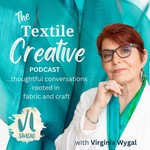
The Textile Creative explores creativity as a vital, sustaining practice — one rooted in skill, material engagement, and thoughtful attention.
Hosted by Virginia Wygal, designer, former Director of Product Development in the garment industry, and longtime educator, the podcast offers grounded, intelligent conversations about what it means to live a creative life with ambition without surrendering to hustle culture or empty productivity narratives.
Drawing on decades of experience with textiles, construction, and design — from couture wedding gowns to historical costume — each episode stays anchored in the physical realities of making: the weight of fabric, the logic of pattern, the quiet discipline of skilled hands at work.
Restoration here is not retreat or disengagement. It is renewal through meaningful, embodied creative work. The podcast emphasizes discernment, mastery as a form of freedom, and creative expression as essential to mental and emotional well-being.
Episodes are designed to leave listeners feeling clearer, more capable, and more confident in their own creative direction - not pushed forward - but grounded in what they already know how to do, and what they are ready to grow into next.
Site
RSS
Apple
Data updated on 04/10/2026
Recent rankings
Latest chart positions across Apple Podcasts and Spotify rankings.
Shared links between episodes and podcasts
Links found in episode descriptions and other podcasts that share them.
"The Textile Creative" with Virginia Wygal, a podcast by Virginia Leigh Studio - Stats, Episodes and Rankings - My Podcast Data
RSS feed quality
To improve
Score global : 53%
Related Shows Based on Content Similarities
Discover shows related to "The Textile Creative" with Virginia Wygal, based on actual content similarities. Explore podcasts with similar topics, themes, and formats, backed by real data.
Quick poll. Are you an Ostrich? Maybe a Peacock? Possibly a Chaser? None of that makes sense yet - but it will. And at least one of those is going to sound uncomfortably familiar before the series is done.
This episode kicks off a four-part pricing series. Not the math - the math isn't actually the problem. Most makers can do the calculation correctly. The problem is what happens between the ears after the calculation is done. That something - the thing that overrides the number the math produced and puts a completely different one on the tag - falls into four very specific patterns. Each one has its own logic, its own emotional root, and its own specific fix that doesn't require becoming a different person.
This episode covers what pricing actually is for a maker - and why it's fundamentally different from pricing a commodity. A commodity has a market rate. You look it up and charge it. When a maker puts a price on their own work they're making a public statement about what they believe their skill, time, and expertise are worth. That's not just about the object. That's a declaration. That's the exposure. And the skill of separating that number from the self-assessment - which the garment industry made very clear had real professional stakes - is what most pricing advice never touches.
The four patterns are introduced: Avoidance, Fear, No Anchor, and Identity. The series goes deep into each one over the next four episodes. The Income Math free PDF - which connects pricing directly to the portfolio career framework - is linked in the show notes and at www.virginialeighstudio.com/incomemath.
94: Building Your Portfolio Career from the Center Out
Thursday, September 24, 2026 • Duration 17:18
Building Your Portfolio From the Center Out
Last week introduced the portfolio career and the four income types. This week we talk about what it actually looks like to build one that holds together rather than pulling you in six different directions.
Before anything else this episode makes one distinction clear: a portfolio career is not a collection of random income sources. It's a connected system built around one core identity and one deep skill set. The difference between a portfolio that energizes you and holding down three different jobs that exhaust you is almost entirely about whether the streams are related or random. A portfolio career is your whole working life - not a day job plus a side hustle plus a hobby that occasionally makes money. A complete practice. Built from the center out.
The episode opens with the central question: what is the thread that runs through everything you do? Not what you make - the underlying skill, knowledge, and creative identity that makes you capable of doing what you do. It addresses makers who already have a clear thread and those who don't yet - what the thread could and should be, what to look at if the current income mix includes streams that pull away from the core rather than drawing from it, and why building from the center out produces compounding results that a random collection of income sources never can.
From there it walks through what belongs in the well for a serious fiber and fabric maker, how to map the edges of your own expertise, and how to think about which streams belong at which level in the portfolio. It closes with a tease for next week: you can map the four types and identify the thread, but you can't accurately place a stream in the portfolio until you know what it's actually earning versus what it could earn. That's the pricing conversation - and that's exactly where episode 95 goes.
Last week's episode did the demolition work - took a hard look at the math behind making a living from handmade sales alone and the numbers were not great. This week is the follow-through. Last week was the why it doesn't work. This week is what does.
The episode picks up on a phrase used at the end of episode 92 - the portfolio career. Not a side hustle, not a backup plan, not a consolation prize for people who couldn't make it on handmade sales alone. A deliberate intentional way of building income that the most successful working makers have been doing all along whether they called it that or not.
Starting with Bonnie Christine - surface pattern designer, educator, and creative entrepreneur - whose story illustrates the concept clearly: even selling out consistently, the ceiling on handmade sales alone was around $40,000 a year with no income the moment she stopped producing. So she pivoted to licensing, then education, then more. Today her portfolio includes licensing, education, a community, and a print magazine - all drawing from one core skill. Kristin Omdahl in the knit and crochet world built the same kind of portfolio through pattern licensing, teaching, publishing, and YouTube. Different craft, same principle.
From there the episode walks through four income types - Foundation, Steady, Bright Spot, and Fill-In - using a weaving artist as a running example, and then maps them against a real working portfolio. It ends with four questions for the listener to sit with about their own practice, and a free ten-minute PDF called The Income Math that helps map what's already there.
Something is causing a lot of unnecessary pain in the handmade and creative world right now. The feeling that you're failing. That everyone else has figured out something you haven't. That if you just found the right platform, the right product, the right hack - that one tablespoon of secret sauce - you'd finally be making a real living from your handmade work.
This episode is about where that feeling actually comes from. And it includes some math that changes everything.
Starting with a direct admission - a full living from handmade sales alone isn't happening here either, and it isn't happening for most working makers, not consistently, not long term. The episode then names the specific story being sold out there, why it's doing real damage beyond the financial cost, and what it actually costs a maker before they ever get to the numbers - in confidence, in satisfaction, in the relationship with work they once loved.
From there it goes into the math using a real product at a real price point: what it would actually take in production time, what the revenue number looks like before expenses come out, and why the math of making a full living from handmade sales alone is genuinely, structurally, mathematically impossible for most people at most price points. It ends by naming what actually works - a portfolio career - and what's coming in the next episode to help you build one.
02:17 - I Don't Make a Full Living From Handmade Sales Either
03:38 - The Story Being Sold and Why It's Doing Real Damage
91: What to Ask Before Signing the Check
Thursday, September 3, 2026 • Duration 29:14
What to Ask Before Signing the Check
Most makers approach show selection one of two ways. They say yes to everything that sounds interesting and figure it out later. Or they talk themselves out of it entirely because the whole thing feels like too much. This episode is for all of you - and for the makers who are actively building a show roster right now and making real decisions about what stays in and what comes out.
Before the framework, two things get addressed directly. First - shows are not for everyone and this episode is not here to argue otherwise. But the seven-question framework covered here is transferable to any placement decision: a gallery, a pop-up, a collaborative event, an online marketplace. Anywhere you're putting your work in front of buyers the questions apply. Second - there is a meaningful difference between a genuine reason not to do a show and an excuse dressed up as one. The episode names a few common ones.
The framework itself covers seven questions worth asking before committing to any show. We talk about everything from the venue, to the marketing and what total commitment actually costs - including the cost of not doing it. A free downloadable worksheet with all seven questions is available at www.virginialeighstudio.com/showframework.
00:00 - The Question Underneath Every Show Decision
02:17 - Shows Are Not for Everyone - But the Framework Is Transferable
03:14 - Excuses vs Genuine Reasons: Knowing the Difference
05:33 - Reframe: A Show Is Not Just a Sales Event - The Gift Story
90: The Cost of Comfortable
Thursday, August 27, 2026 • Duration 17:57
The Cost of Comfortable
Three weeks of episodes named what making does for your brain, the difference between doing and pursuing, and what's actually causing the exhaustion most makers feel right now. This episode is where it all settles. Because there's a question underneath all of it: what happens to the maker who hears all of that and still doesn't change anything? Not because they can’t, mind you! Because staying comfortable is easier. And it's a choice that doesn't feel like a choice until you see what it costs you.
Complacency is not a personality type. It's not a condition some people have and others don't. It's a posture - adopted through repeated small decisions not to reach for something harder. The drift that results doesn't warn you ahead of time. It accumulates below the threshold of notice, one small reasonable decision at a time, until you look back and realize how much ground you've lost without knowing it.
This episode covers the three specific costs of staying comfortable over time: the skill cost, which is the most concrete and the easiest to deny while it's happening; the satisfaction cost, which is subtler and costs more over the long run because it's harder to trace back to a cause; and the identity cost, which is the quietest and the most significant because at some point comfortable stops being what you choose and starts being who you are. It also covers the good news - all three costs are entirely reversible - and ends with one specific practical ask: one decision today, slightly harder than the comfortable one. That's the whole prescription.
00:00 - The Choice That Doesn't Feel Like a Choice
02:08 - Complacency Is a Posture Not a Personality Type
89: The Cause Is Chosen
Thursday, August 20, 2026 • Duration 28:40
The Cause Is Chosen
The exhaustion is real. That part isn't being argued with. What is being argued with is the diagnosis - because most people are exhausted for a reason they haven't fully looked at yet. And you can't push through this particular kind of exhaustion. It doesn't respond to willpower. It doesn't respond to the kind of rest most people reach for either. But there is something you can do about it.
This episode starts by naming a distinction that changes everything: there are two completely different kinds of tired. The first comes from meaningful effort and responds to rest. The second comes from meaningless consumption - hours of scrolling, passive absorption of algorithmically served content - and does not respond to rest at all. Reaching for more scrolling to recover from scrolling exhaustion is like treating a hangover with more alcohol.
From there the episode goes directly into what social media platforms actually are - not neutral entertainment spaces but engineered environments built specifically to capture attention and hold it using negative emotional responses, because your anxiety and envy and outrage drive more engagement than contentment does. It covers the historical context - the Spanish Flu, the Great Depression, World War Two, the 1800s - and makes the case that what is genuinely new is not the difficulty of life but the 24/7 engineered emotional overwhelm of this information environment. It addresses the muscle analogy, the addictive design of the solution the platforms offer, and five specific concrete things to do differently starting today. And it ends with Newton's First Law applied honestly: you are going to have to be the outside force that gets yourself back into motion.
00:00 - The Exhaustion Is Real - The Diagnosis Isn't
88: Wanting Is Not A Plan
Thursday, August 13, 2026 • Duration 22:04
Wanting Is Not A Plan
Last week covered what making does for your brain - the dopamine, the serotonin, the flow states, the cognitive reserve. All of it real and documented. This week is the follow-up question nobody stops to ask. Because knowing what making can do for you and actually getting those benefits are two completely different things. All that research only delivers under one specific condition. And that condition depends entirely on you.
There are two ways to show up in the studio. From the outside they look identical - same materials, same tools, same techniques. The internal experience is completely different. And what each one produces over time differs in ways that are hard to see while you're in it. This episode sheds light on this, asks you to look honestly at which one your actual decisions reveal you're doing, and addresses the gap most makers never close - the one between wanting to get better and actually deciding to pursue it.
Drawing on Gay Hendricks - "if you argue for your limitations you get to keep them" - and Anders Ericsson's deliberate practice research, and grounded in a personal account of what the pursuing orientation looks like from the inside and what it cost to claim it fully, this episode ends with a practical inventory: what are you actually pursuing right now, and for the things you say you want but aren't pursuing - are you genuinely deciding they're not worth the effort, or are you arguing for your limitations while keeping the identity of someone who wants them?
02:13 - Making for Its Own Sake vs Making to Get Better - Both Valid
87: Your Brain on Making
Thursday, August 6, 2026 • Duration 18:42
Your Brain on Making
When you feel anxious or overwhelmed or just flat - what do you reach for? Most people reach for something easy. The phone. The remote. Something mindless. And most people find it doesn't really help. They put the phone down twenty minutes later feeling roughly the same. Sometimes worse.
There's a documented reason for that. And the solution the research points toward is the exact opposite of what most wellness content recommends.
This episode goes deep into the neuroscience of what making things with your hands actually does for your brain and body - starting with neuroscientist Kelly Lambert's research on effort-based rewards, the specific neurochemical signal the brain evolved to receive from physical effort that produces a visible result, and why engineering that activity out of modern daily life has contributed to the rise in depression and anxiety. It also covers Csikszentmihalyi's flow research from a new angle - why the challenge has to match or push against your current capacity for flow to happen, and why comfortable repetition and genuine pursuit produce completely different neurological outcomes. And it ends with behavioral activation - the documented finding that action precedes motivation, not the other way around - and what that means for every maker who has ever said "I don't feel like it."
04:29 - What Fiber and Textile Making Does to Your Brain Specifically
05:20 - Lambert's Research on Mood, Behavior and the Blah Nobody Can Explain
06:27 - Fine Motor Skills and Cognitive Reserve Over Time
86: The $500 Education
Thursday, July 30, 2026 • Duration 27:22
The $500 Education
This is not a success story. It's something more useful than that.
Whether you're thinking about doing your first show, trying to decide if shows are worth it, recovering from one that went sideways, or too scared of the horror stories to consider it at all - this episode is for you. It's a full honest debrief of a recent museum show that produced almost nothing in sales and cost roughly $500 when everything was factored in. And it's also the story of what that $500 actually bought - because it wasn't nothing, not even close.
This episode covers the full financial breakdown, a specific venue autopsy that had nothing to do with the quality of the work (July in Dallas, no museum marketing, social media posts reaching 15-20 people per post for a local event), and a detailed account of everything that worked so well it's being kept permanently - from the framing decision finally resolved, to a linear display layout, to a look book system, to a booth positioning change that transformed the energy of every conversation. It also covers exactly what's changing going forward: telling the story of the work everywhere, making the process visible, contact collection, online presence strategy for the art specifically, pricing without anxiety, and show selection going forward.
The Fabric and Fiber Studio application window is open. Details at virginialeighstudio.com/thestudio.