The Outthinking Investor with Daleep Singh – Details, episodes & analysis
Podcast details
Technical and general information from the podcast's RSS feed.
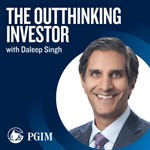
The Outthinking Investor with Daleep Singh
PGIM
Frequency: 1 episode/32d. Total Eps: 54

Recent rankings
Latest chart positions across Apple Podcasts and Spotify rankings.
Apple Podcasts
No recent rankings available
Spotify
No recent rankings available
Shared links between episodes and podcasts
Links found in episode descriptions and other podcasts that share them.
See allRSS feed quality and score
Technical evaluation of the podcast's RSS feed quality and structure.
See allScore global : 63%
Publication history
Monthly episode publishing history over the past years.
The Old Normal: Macro Shocks Amid War, AI, and Economic Rivalries
Season 6 · Episode 4
mardi 7 avril 2026 • Duration 23:23
Marc Sumerlin, Managing Partner at Evenflow Macro and former Deputy Director of the White House National Economic Council under President George W. Bush, joins Daleep Singh for a conversation about economic transformation on this episode of PGIM's The Outthinking Investor.
Daleep and Marc talk about macro shocks stemming from the Iran war, how U.S. budget deficits will influence policy rates and the economy, and the relationship between monetary and fiscal authorities in a new age of economic competition.
The discussion also covers:
- The impact of tariffs and AI on the labor market
- Monetary policy challenges when navigating an energy shock
- The future of the U.S.-China trade relationship
Second Order Effects – From Iran to China: A Live Conversation with Dr. Kurt Campbell
Season 6 · Episode 3
mardi 24 mars 2026 • Duration 40:28
Daleep welcomed Kurt for an in-depth look at the U.S.-China relationship and the Iran war's implications for Asia-Pacific. Speaking in front of a live audience, they also discussed how geopolitical shifts are reshaping economies, strategic leverage lurking in critical supply chains, and the outlook for Japan.
The Rise of Geoeconomics: Power Dynamics Shaping Global Markets
Season 5 · Episode 7
mardi 8 juillet 2025 • Duration 26:36
The House of Medici, which ruled over Florence for much of the Renaissance period, established a political dynasty with influence built on successful ventures in commerce and banking. The Medicis predated the concept of geoeconomic power, or governments' ability to wield economic might to achieve geopolitical and economic goals. Today, soft power might be giving way to intensifying competition between great powers. Government leaders are increasingly focused on solidifying economic security through trade leverage, tariffs, sanctions and other measures. As a result, potential new investment risks and opportunities are emerging.
This episode of The Outthinking Investor discusses how investors can measure their portfolio's exposure to geoeconomic shifts, which economies and sectors could benefit amid a realignment in supply chains, whether the US dollar can maintain its global dominance, and investment strategies that could potentially mitigate risk and capitalize on new opportunities.
Our guests are:
- Matteo Maggiori, finance professor at the Stanford Graduate School of Business
- Joseph Nye, political scientist and former Dean of Harvard University's Kennedy School of Government
- Mehill Marku, Lead Geopolitical Analyst at PGIM
Do you have any comments, suggestions, or topics you would like us to cover? Email us at thought.leadership@pgim.com, or fill out our survey at PGIM.com/podcast/outthinking-investor.
To hear more from PGIM, tune into Speaking of Alternatives, available on Spotify, Apple, Amazon Music, and other podcast platforms. Explore our entire collection of podcasts at PGIM.com.
Balancing Growth, Costs, and Geopolitics in Airlines
Season 5 · Episode 6
mardi 10 juin 2025 • Duration 22:46
Airlines represent one of the most challenging and complex industries in today's economy. With thousands of flights moving people and cargo around the world every day, airlines manage a "complicated logistical dance," as Oscar Munoz, United Airlines' former Chairman and CEO, tells us in this episode of The Outthinking Investor. The airline industry has adapted and evolved through technological innovation, consolidation, regulatory changes, and an increasingly competitive transportation sector—providing universal lessons for businesses and investors.
Amid a turbulent outlook, this episode explores how airlines are addressing a host of business challenges, from the threat of aircraft tariffs to volatile fuel costs and customer demand. Topics include business strategies that drive revenues and boost profits, the future of business and leisure travel, navigating antiquated air traffic control systems, the outlook for low-cost carriers, and reflections on United Airlines' turnaround.
Our guests are:
- Oscar Munoz, former United Airlines Chairman and CEO
- Jack Fitzsimmons, credit analyst on PGIM Fixed Income's US Leveraged Finance Credit Research team
- Sean Goodier, credit analyst on PGIM Fixed Income's European Investment Grade Credit Research team
Do you have any comments, suggestions, or topics you would like us to cover? Email us at thought.leadership@pgim.com, or fill out our survey at PGIM.com/podcast/outthinking-investor.
To hear more from PGIM, tune into Speaking of Alternatives, available on Spotify, Apple, Amazon Music, and other podcast platforms. Explore our entire collection of podcasts at PGIM.com.
Tariffs, Sanctions & Chokepoints: Investing in an Age of Economic Warfare
Season 5 · Episode 5
mardi 13 mai 2025 • Duration 27:23
Critical shipping routes around the world, from the Panama Canal to the Bosphorus Strait, hold strategic importance for global trade. As a result, these chokepoints are often caught in the crosshairs of geopolitical competition. But in a new age of economic warfare, invisible chokepoints are also emerging. The dominance of the US dollar, economic sanctions, and tariffs on imported goods can all be leveraged to achieve political goals. Meanwhile, nations are laying out plans to increase defense spending—potentially altering the outlook for productivity, industrial activity, and economic growth.
With economic warfare becoming a lasting feature of the investment environment, new winners and losers based on country, region, sector and asset class could emerge. This episode of The Outthinking Investor explores how economic warfare, national security concerns, and friend-shoring in global trade are creating new implications for investors to consider.
Our guests are:
- Edward Fishman, senior research scholar at Columbia University's Center on Global Energy Policy and author of the new book, "Chokepoints: American Power in the Age of Economic Warfare"
- Katharine Neiss, PGIM Fixed Income's Deputy Head of Global Economics and Chief European Economist
- Jeff Rathke, President of the American-German Institute at Johns Hopkins University and former American diplomat
Do you have any comments, suggestions, or topics you would like us to cover? Email us at thought.leadership@pgim.com, or fill out our survey at PGIM.com/podcast/outthinking-investor.
To hear more from PGIM, tune into Speaking of Alternatives, available on Spotify, Apple, Amazon Music, and other podcast platforms. Explore our entire collection of podcasts at PGIM.com.
Trading Up: How Active ETFs Revolutionized Investing
Season 5 · Episode 4
mardi 8 avril 2025 • Duration 25:33
Exploring the continued evolution of the ETF landscape, fueled by rapid growth in active ETFs and an expanding universe of investment choices.
ETFs, or exchange-traded funds, were born out of a need for greater market liquidity following the 1987 stock market crash known as Black Monday. US regulators determined that institutions needed the ability to trade stocks more efficiently and cost-effectively during trading days. In 1993, the first ETF in the US emerged: SPY. With one trade, investors could buy or sell a basket of stocks that tracked companies in the S&P 500.
ETFs have since revolutionized investing. A combination of liquidity, diversification, tax efficiency and ease of access has helped ETFs attract trillions of dollars in capital. A 2019 regulatory update in the US, which made it easier to launch new ETFs, paved the way for further expansion, fueled by active strategies that are driving the next phase of growth. Offering access to actively managed strategies across stocks, bonds and alternatives, active ETFs surpassed $1 trillion in global assets under management for the first time in 2024.
Our guests are Matt Collins, CFA, Head of ETFs at PGIM Investments; Eric Balchunas, senior ETF analyst at Bloomberg Intelligence and author of "The Institutional ETF Toolbox"; and Dave Nadig, independent financial futurist and former CEO of ETF.com.
Learn more about PGIM ETFs at PGIM.com/investments/exchange-traded-funds-etfs.
Do you have any comments, suggestions, or topics you would like us to cover? Email us at thought.leadership@pgim.com, or fill out our survey at PGIM.com/podcast/outthinking-investor.
To hear more from PGIM, tune into Speaking of Alternatives, available on Spotify, Apple, Amazon Music, and other podcast platforms. Explore our entire collection of podcasts at PGIM.com.
Raising the Stakes: Investing and the Art of Risk Taking
Season 5 · Episode 3
mardi 11 mars 2025 • Duration 22:47
With a standard deck of cards, there are around 2.5 million potential hands at the start of each game of poker. The key to success is in the decision process—determining how to play a hand, and how much to bet, despite not knowing which cards are in another player's hand. Like in poker, every investment decision includes at least some degree of uncertainty. What lessons can poker teach investors about sizing their bets, managing risk, and making better decisions for their portfolio? This episode is not intended to promote gambling or equate investing to gambling.
This episode of The Outthinking Investor delivers insights on the benefits of probabilistic thinking, the best methods for analyzing portfolio decisions, and how investors could develop a sound decision-making process for targeting returns - even when facing uncertainty and market volatility.
Our guests are Annie Duke, a decision scientist, former world-class professional poker player, and the author of books including "Thinking in Bets" and "Quit"; Tina Lindstrom, Head of Oil Derivatives Trading for North America at Marex; and Adam Papallo, Head of Implementation Research at PGIM Quantitative Solutions.
Do you have any comments, suggestions, or topics you would like us to cover? Email us at thought.leadership@pgim.com, or fill out our survey at PGIM.com/podcast/outthinking-investor.
The New Arms Race: Supply Chains, Data, and National Security
Season 5 · Episode 2
mercredi 12 février 2025 • Duration 25:43
The world's superpowers are engaging in a different type of arms race beyond the battlefield. With technology advancing at a speedy pace, a global competition for all the ingredients necessary to support artificial intelligence—from data centers and semiconductors to the AI models themselves—is heating up. Not only do these ingredients form the building blocks of today's economy, but building a secure and reliable flow of data is also considered a key national security objective. The UK designated data centers as critical national infrastructure in 2024, underlining how governments are now prioritizing energy supply, cybersecurity, and efforts to guard the digital world from adversaries. This race for technological supremacy, coupled with growing private-sector demand related to AI and cloud computing, is propelling new investment opportunities.
This episode of The Outthinking Investor covers the opportunities, challenges, and security considerations at play amid rapid innovation in AI and a global battle for technological supremacy. Topics include the intersection of AI, chips and national security; governments' pursuit of secure and reliable supply chains; and real estate opportunities created by rapid growth in hyperscale data centers.
Our guests are Chris Miller, a professor at the Fletcher School at Tufts University and author of the book "Chip War: The Fight for the World's Most Critical Technology"; William Reinsch, senior adviser with the Economics Program and Scholl Chair in International Business at the Center for Strategic and International Studies; and Morgan Laughlin, Global Head of Data Center Investments at PGIM Real Estate.
Do you have any comments, suggestions, or topics you would like us to cover? Email us at thought.leadership@pgim.com, or fill out our survey at PGIM.com/podcast/outthinking-investor.
To hear more from PGIM, tune into Speaking of Alternatives, available on Spotify, Apple, Amazon Music, and other podcast platforms. Explore our entire collection of podcasts at PGIM.com.
Against the Grain: Challenging Conventional Wisdom for Better Outcomes
Season 5 · Episode 1
lundi 6 janvier 2025 • Duration 23:45
Edward Lorenz, a meteorologist and mathematician, formulated a theory called the butterfly effect—based on a hypothetical scenario in which a butterfly, simply by flapping its wings, affects a tornado weeks later. The butterfly effect illustrates how small actions in complex systems can lead to big changes, underscoring the challenges in making forecasts. This is particularly relevant for investors. A complex global economy often takes unexpected turns, and macro disruptions and uncertainty present challenges for those navigating financial markets. But with this knowledge, investors could make better decisions by challenging conventional wisdom and taking a long-term view.
The Season 5 premiere of The Outthinking Investor explores how investors can steer through economic volatility and pursue sound portfolio construction for the long run. Philipp Carlsson-Szlezak, Boston Consulting Group's Global Chief Economist, and Robert Tipp, PGIM Fixed Income's Chief Investment Strategist, discuss the forces that may drive change in the economy, potential risks to the outlook, how market fears can distract from real long-term consequences, emerging opportunities in fixed-income markets, and structural changes resulting from a higher level of expected interest rates.
Do you have any comments, suggestions, or topics you would like us to cover? Email us at thought.leadership@pgim.com., or fill out our survey at PGIM.com/podcast/outthinking-investor.
To hear more from PGIM, tune into Speaking of Alternatives, available on Spotify, Apple, Amazon Music, and other podcast platforms. Explore our entire collection of podcasts at PGIM.com.
Balancing Act: Economic Policy and National Security in a Fragmenting World
Season 4 · Episode 11
mardi 12 novembre 2024 • Duration 25:31
Italy surprised much of the world when it became the first—and only—member of the G7 to join China's Belt and Road program in 2019. Just four years later, Italy withdrew from the initiative. The about-face served as a microcosm of the geopolitical landscape's evolution. Policymakers have long viewed the economy through a geopolitical lens. But the overlap between the economy and national security has grown, increasingly becoming the focus of today's geopolitical fractures amid global competition over trade, technology and defense.
This episode of The Outthinking Investor explores the ways in which nations are balancing economic and security priorities, and how investors can leverage geopolitical analysis to make informed portfolio decisions in a changing world. Our guests are Mark Esper, former US Secretary of Defense and author of "A Sacred Oath: Memoirs of a Secretary of Defense During Extraordinary Times"; Nobel Prize-winning economist Michael Spence, senior fellow at the Hoover Institution, former Dean of the Stanford School of Business and co-author of "Permacrisis: A Plan to Fix a Fractured World"; and Magdalena Polan, PGIM Fixed Income's Head of Emerging Markets Macroeconomic Research. Topics include the three main forces affecting the global economy, how national defense is influencing economic policy, the geopolitical factors impacting trade flows and emerging markets, and whether the peace dividend is evaporating.
To learn more about the macroeconomic and investment implications of geopolitical risks, explore PGIM's 2024 Global Risk Report, Resilient Investing Amid Geopolitical Uncertainty, at PGIM.com.
Do you have any comments, suggestions, or topics you would like us to cover? Email us at thought.leadership@pgim.com.