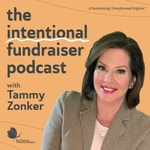
Welcome to The Intentional Fundraiser Podcast. I'm your host, Tammy Zonker, and I'm thrilled you're here.
I've spent nearly three decades specializing in major gifts. I’ve seen how major gifts often form the backbone of an organization’s financial stability, and yet, I know many of us find this area particularly challenging. Time and again, I’ve been approached by fundraisers and nonprofit leaders eager to establish or supercharge their major gift programs. It’s become crystal clear that there’s a growing hunger for training and expertise in this area.
I’ve had the incredible privilege of working with nonprofits from all around the world helping organizations collectively raise nearly one billion dollars. During this time, I’ve developed strategies and tools that have consistently helped organizations transition their mid-level donors into major donors through meaningful engagement. It’s a process that, when done consistently, can truly catapult an organization’s major gift fundraising to the next level.
Whether you’re a seasoned major gift officer looking to refine your approach, a development director aiming to build a powerhouse program, an executive director looking to scale your organization’s capacity for transformational giving, or a board member seeking to understand the transformative potential of major gifts, The Intentional Fundraiser podcast is your source for growth and excellence in major gift fundraising.
So, buckle up! We're about to embark on a journey to take your major gift program to the next level – and beyond. Let's get intentional about major gift fundraising!
Keep transforming,
Tammy Zonker
Major Gift Expert & Keynote Speaker
Fundraising Transformed
#ScaleRaiseDo
Site
RSS
Apple
Data updated on 14/10/2026
Recent rankings
Latest chart positions across Apple Podcasts and Spotify rankings.
Shared links between episodes and podcasts
Links found in episode descriptions and other podcasts that share them.
A 6:45 a.m. call from London. A donor wanted to give $1.5 million to the children's hospital that saved her little brother.
Her gift officer was thrilled. Thirty seconds later, she was terrified.
Because the donor was a US citizen living in London. Her husband was British. The money was in pounds. Their business had accounts in two countries.
Who gets the tax benefit? Which account does the money come from? What if the exchange rate moves?
Here's what I love. She didn't pretend to have the answers. She said, "I want to get this right for you. Can I ask a few questions, then bring in our finance team and your advisors?"
Two months later, the gift was structured in a way that worked for everyone. Every payment arrived on time.
That's what this week's episode of The Intentional Fundraiser Podcast is all about: "Thinking Global: Cross-Border Major Gifts."
I talk about:
Why global giving is showing up at organizations of every size
The core questions to ask early, and the pitfalls to avoid
How to build the right support team so you're never figuring it out alone
Listen at or wherever you get your podcasts, and share it with a colleague or board member who should hear it too.
Review my show:Please review my show. After you click the link, scroll to the bottom, first tap to rate with five stars, and then tap “Write a Review.” Then, let me know what you liked most about this particular episode or how you find my podcast helpful, valuable, insightful, or inspiring in some way.
I spent it chasing a stock transfer with no name on it.
My plan had been "we'll get serious after the gala."
The gala ended in mid-November. You can guess how that year went.
Here's what I learned the hard way. December isn't where year-end is won. It's where you find out how well you planned in October.
And year-end 2026 raises the stakes. New tax rules. Donors who "bunched" their giving into last year. Complex gifts that need more lead time than ever.
On this week's episode of The Intentional Fundraiser Podcast, "Stacking the Deck for Year-End Major Gifts," I walk through:
What's changed for donors this year, and the one question to ask about it
The Year-End Countdown, five checkpoints planned backward from December 31
A one-page dashboard and a 15-minute Monday huddle that keep your whole team focused
Give it a listen this week, then share it with a colleague who's heading into Q4 with a long list and a short runway.
The donor had watched his business take a hit, watched the news every night, and frozen. He wasn't saying no to her $250,000 proposal. He was saying he didn't know how to say yes to anything right now.
Here's what she finally did.
She sent a note that had nothing to do with the gift. She just asked how he was thinking about the year ahead.
He called at 8:15 the next morning and talked for forty minutes. About his company. His kids. How unsure everything felt.
She didn't re-pitch. She asked one question near the end: what would make a commitment feel manageable for you right now?
Five years instead of three, he said. And a conversation each January.
He signed for $300,000.
The gift got bigger because the risk got smaller.
In this week's episode of The Intentional Fundraiser, I'm walking you through the emotional layer of giving in 2026, the four conversational moves I use with anxious donors, and five gift structures that help people feel safe saying yes to something big.
Here's my question for you. When a donor hesitates, is your first instinct to shrink the number or to shrink the risk?
Listen to the episode, then share it with someone on your team who has an anxious donor conversation coming up this week.
Almost thirty years ago, I had a donor meeting with a man who genuinely intimidated me. My development director stopped by my desk and asked what I planned to ask him.
I recited my agenda. She listened, then said, "That's fine. But what do you really want to know about him?"
I said I wanted to know why he kept giving to us when he clearly didn't need us.
She said, "Ask him that."
He talked for twenty minutes about his mother, a scholarship, and a debt he'd been paying back for forty years. He made our largest gift that year.
Four minutes at my desk. No budget. No program. No conference.
That's the whole thing I want us to understand about developing the next generation of major gift fundraisers. We keep trying to hire our way out of what is really a coaching problem.
If someone on your team told a story like that about you ten years from now, what would they say you did?
This week on The Intentional Fundraiser Podcast, I walk through what's different about the fundraisers coming up now, the four competencies they need, five coaching moves that cost nothing, and what it quietly costs your donors when you skip all of it.
Give it a listen, then share it with a manager who's carrying a team and wondering why hiring hasn't fixed it.
When Clicks Meet Conversations: Digital and Major Gifts
Episode 156
Tuesday, August 25, 2026 • Duration 21:00
The lobby test.
Your website is the lobby of your building.
It never closes the gift. But it absolutely sets the tone for everything that happens around it.
In this week's episode of The Intentional Fundraiser, I tell the story of a six-figure donor who tried to give on her phone in December, gave up three screens in, and mailed a check instead.
The gift still came. The dashboard still looked healthy.
And a loyal donor quietly filed away one piece of information about the organization she loves: this is harder than it should be.
We talk about why digital shapes what your largest donors believe about you, even the ones you have lunch with.
The four elements that matter most to a donor giving at the top of your file.
And the digital behavior signals sitting in your data right now that point toward your next major gift conversation.
Then I give you a twenty-minute audit you can run before your next staff meeting.
Here's my question for you: if a financial advisor researched your organization tomorrow, what one sentence would they report back to your donor?
Give it a listen, and share it with the person on your team who owns your website. This one is better as a conversation than a solo listen.
A campaign chair asked that in a planning meeting for a $14 million campaign, and the room went completely quiet.
She wasn't being negative. She'd run a manufacturing business for thirty years, and she said, "I've never run a three-year plan that came in exactly where the model said it would."
So we built an answer. Three of them, honestly. Conservative, moderate, and optimistic, all built around one internal working goal.
Eighteen months later, the $4 million lead gift came in at $1.8 million.
In most campaigns, that's an emergency board meeting. In this one, it was a Tuesday, because everyone already knew what to do.
They finished at $11.4 million, and the board called it a success.
In this episode, I walk through what a working goal really is, the three scenarios you build around it, how to write triggers you can see coming, and the five sentences that keep a board steady when the number moves.
Give it a listen, then share it with someone on your team who's been waiting for a better moment to launch.
At the opening of a gorgeous new wall, one of their most generous donors leaned in and said, "I didn't give so my name could be up there. I gave for the kids. I wish the wall told me about them."
That one sentence is the whole episode.
On this week's Intentional Fundraiser Podcast, Recognition That Feels Right Today, I dig into what donors are signaling about recognition now, fresh mission-centered practices you can borrow, and how to handle sensitive naming questions without walking into a landmine.
Recognition, done right, isn't a plaque. It's a window into the change a donor made possible.
Is your recognition making donors feel important, or connected?
Give it a listen, then share it with someone wrestling with their own donor wall.
Review my show:Please review my show. After you click the link, scroll to the bottom, first tap to rate with five stars, and then tap “Write a Review.” Then, let me know what you liked most about this particular episode or how you find my podcast helpful, valuable, insightful, or inspiring in some way.
Review my show:Please review my show. After you click the link, scroll to the bottom, first tap to rate with five stars, and then tap “Write a Review.” Then, let me know what you liked most about this particular episode or how you find my podcast helpful, valuable, insightful, or inspiring in some way.
Review my show:Please review my show. After you click the link, scroll to the bottom, first tap to rate with five stars, and then tap “Write a Review.” Then, let me know what you liked most about this particular episode or how you find my podcast helpful, valuable, insightful, or inspiring in some way.
Review my show:Please review my show. After you click the link, scroll to the bottom, first tap to rate with five stars, and then tap “Write a Review.” Then, let me know what you liked most about this particular episode or how you find my podcast helpful, valuable, insightful, or inspiring in some way.
Review my show:Please review my show. After you click the link, scroll to the bottom, first tap to rate with five stars, and then tap “Write a Review.” Then, let me know what you liked most about this particular episode or how you find my podcast helpful, valuable, insightful, or inspiring in some way.
Review my show:Please review my show. After you click the link, scroll to the bottom, first tap to rate with five stars, and then tap “Write a Review.” Then, let me know what you liked most about this particular episode or how you find my podcast helpful, valuable, insightful, or inspiring in some way.
Review my show:Please review my show. After you click the link, scroll to the bottom, first tap to rate with five stars, and then tap “Write a Review.” Then, let me know what you liked most about this particular episode or how you find my podcast helpful, valuable, insightful, or inspiring in some way.
Review my show:Please review my show. After you click the link, scroll to the bottom, first tap to rate with five stars, and then tap “Write a Review.” Then, let me know what you liked most about this particular episode or how you find my podcast helpful, valuable, insightful, or inspiring in some way.
Review my show:Please review my show. After you click the link, scroll to the bottom, first tap to rate with five stars, and then tap “Write a Review.” Then, let me know what you liked most about this particular episode or how you find my podcast helpful, valuable, insightful, or inspiring in some way.
Discover shows related to The Intentional Fundraiser Podcast, based on actual content similarities. Explore podcasts with similar topics, themes, and formats, backed by real data.