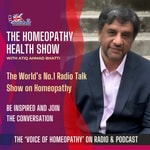
The Homeopathy Health Show is the ’Voice of Homeopathy on Radio & Podcast’, bringing together guests from the world of Homeopathy to share their perspectives, anecdotes, insights, experiences and valuable contributions to field.
Whether they are Homeopaths, educators, lecturers, authors, researchers or students, a diverse range of ’Homeopathic Voices’ is featured.
Support Homeopathy on Radio & Podcast by subscribing!
The Homeopathy Health Show is the world’s No.1 Radio Talk Show on all things Homeopathy.
Site
RSS
Apple
Data updated on 06/11/2026
Recent rankings
Latest chart positions across Apple Podcasts and Spotify rankings.
Shared links between episodes and podcasts
Links found in episode descriptions and other podcasts that share them.
Discover shows related to The Homeopathy Health Show with Atiq & Naila, based on actual content similarities. Explore podcasts with similar topics, themes, and formats, backed by real data.
Bonus Episode: The Architecture of Healing: Energy, Remedies & the Living Patient | Colin Griffith
Friday, November 6, 2026 • Duration 01:19:32
🎙️ THE HOMEOPATHY HEALTH SHOW
Episode Title
The Architecture of Healing: Energy, Remedies & the Living Patient | Colin Griffith
Episode Summary
What does it really mean to understand the architecture of healing?
In this special bonus episode, we welcome contemporary homeopath, teacher and author Colin Griffith for an introduction to his upcoming masterclass, The Architecture of Healing.
Drawing on decades of clinical experience, Colin shares how his understanding of homeopathy has evolved beyond simply applying textbook knowledge. He describes the importance of learning from living patients, recognising the individual expression of remedies and bringing together knowledge, intuition and clinical experience.
Using the analogy of a tapestry, Colin explores how different threads contribute to the healing process. He introduces the idea of energy as a dynamic and moving structure, and considers how remedies may have their own distinctive patterns of movement and expression.
The conversation also provides a preview of the four themes at the heart of his masterclass: the midline and reciprocal tension membrane, the thymus gland and remedial action, the nodes of the Moon, and the concept of disempowerment.
Along the way, Colin reflects on new remedies, contemporary provings, ancestral experiences and the importance of allowing homeopathy to evolve through clinical observation and individual understanding.
An inspiring introduction to a fascinating exploration of homeopathy, its philosophy and the many dimensions that may contribute to the experience of healing.
In This Episode We Explore
The Architecture of Healing
Colin's journey from textbook learning to developing his own clinical understanding.
The tapestry analogy and the different threads that contribute to the healing process.
Why knowledge must be combined with intuition and experience.
Learning from the living experience of patients rather than relying exclusively on books.
The importance of recognising the individual expression of remedies.
Energy, Movement and Homeopathy
Colin's perspective on energy as the foundation of the architecture of healing.
How energy may move in different directions and patterns.
The individual characteristics and movement of remedies.
The relationship between structure, energy and the living patient.
Why homeopathy must remain open to discovery and development.
The Midline and Reciprocal Tension Membrane
An introduction to the midline and reciprocal tension membrane (RTM).
Their relationship within Colin's wider understanding of the body's structure.
The connection with the fascia and the energetic perspective discussed during the session.
The proposed relationship between these structures, memory and emotional experience.
A preview of the first masterclass session.
The Thymus Gland and Remedial Action
Colin's interest in the thymus gland and its potential significance within his approach.
The use of thymus gland in combination remedies.
The idea of creating remedies to open new possibilities within a case.
His exploration of protection remedies and the concept of spiritual prophylaxis.
How remedies may be considered in preparation for challenging experiences.
The Nodes of the Moon and the Journey Through Time
Colin's exploration of the nodes of the Moon.
The relationship he draws between time, energy and the patient's journey.
The significance of the past, present and what remains unresolved.
Remedies associated with lunar themes, including Silica and Moonstone.
A preview of the third masterclass session.
Disempowerment and Reclaiming Empowerment
Why Colin considers disempowerment an undervalued concept in homeopathy.
How people may experience disempowerment through relationships, education and life experiences.
The relationship between practitioners and patients.
Recognising the importance of observation and allowing patients to experience their own responses.
How practitioners can develop confidence in their clinical decisions.
New Remedies, Provings and the Evolution of Homeopathy
Colin's experience with newer remedies and contemporary provings.
Exploring remedies such as Bog Oak, Citrine and Raw Kundalini.
His reflections on Rainwater, Blackbird Song and other less familiar remedies.
Why materia medica should remain fluid rather than becoming fixed.
The responsibility of each generation to contribute to the ongoing development of homeopathy.
About Our Guest
Colin Griffith
Colin Griffith is a contemporary homeopath, teacher and thinker whose work explores modern interpretations of classical homeopathy.
He is the author of The New Materia Medica, Volumes 1, 2 and 3, and has taught internationally through seminars and courses designed to deepen practitioners' understanding of the inner experience of patients and the individual expression of remedies.
His approach brings together classical homeopathic philosophy, clinical experience, intuition and an interest in newer remedies and provings.
Colin's work encourages practitioners to remain curious, explore beyond conventional materia medica and develop their own understanding through the experience of working with patients.
Connect With Our Guest
Online:
Instagram:
Facebook:
Key Questions Explored
What does Colin mean by the architecture of healing?
How did his own clinical experience change his approach to homeopathy?
Why is it important to move beyond textbook knowledge?
How can practitioners understand remedies through energy and movement?
What is the reciprocal tension membrane, and how does Colin describe its significance?
What role does the thymus gland play in his approach?
How can the nodes of the Moon offer another perspective on a patient's journey?
Why is disempowerment an important concept for both patients and practitioners?
How do new remedies and provings contribute to the evolution of homeopathy?
How can practitioners develop greater confidence in their own clinical observations?
EP200: The Voice of Homeopathy, 200 Conversations, 200 Stories | Atiq & Naila
Episode 200
Wednesday, November 4, 2026 • Duration 48:27
🎙️ THE HOMEOPATHY HEALTH SHOW
The Voice of Homeopathy, 200 Conversations, 200 Stories | Atiq & Naila
Episode Summary
In this very special 200th episode of The Homeopathy Health Show, Atiq & Naila take a moment to look back on an extraordinary journey of conversations, discoveries, inspiration and connection.
From the early days of wondering how to fill a 57-minute radio programme to hosting conversations with some of the most recognised and inspiring names in homeopathy, the show has grown into a platform connecting practitioners, teachers, researchers, students and homeopathy enthusiasts from around the world.
But as Naila reflects, perhaps the most incredible thing isn't actually the number 200. It's the people they have met along the way.
In this personal and often humorous episode, Atiq & Naila share behind-the-scenes stories, the unexpected moments, technical mishaps, memorable conversations and the experiences that have shaped them as presenters and homeopaths.
They explore what they have learned from 200 conversations, how different professional backgrounds enrich homeopathic practice, and why homeopathy offers so many opportunities for continued learning and development.
A particularly fascinating discussion considers the balance between expanding our knowledge and remaining grounded in the foundations of classical homeopathy. Atiq reflects on the importance of staying flexible while returning to the roots of the discipline, while Naila shares her perspective on nutrition, clinical experience and the importance of supporting families through education.
The episode also celebrates the people who have trusted them with their stories, the guests who have shared their knowledge, the UK Health Radio Network and, most importantly, the listeners who have made the journey worthwhile.
This is more than a celebration of 200 episodes. It is a celebration of the people, ideas, experiences and shared passion that continue to give homeopathy a voice.
Bonus Episode: German New Medicine: An Introduction to Conflict, Biology & the Body | Dr Asher Shaikh
Wednesday, November 4, 2026 • Duration 01:55:14
🎙️ THE HOMEOPATHY HEALTH SHOW
German New Medicine: An Introduction to Conflict, Biology & the Body | Dr Asher Shaikh
Episode Summary
What is German New Medicine, and how does it interpret the relationship between emotional experiences, biological processes and the body?
In this introductory episode, we explore the background and fundamental concepts of German New Medicine (GNM) with Dr Asher Shaikh.
Associated with the work of Ryke Geerd Hamer, German New Medicine proposes that certain illnesses are connected to what it describes as biological conflicts. Its framework explores the relationship between a perceived conflict, the brain and changes in particular organs or tissues.
We introduce the central ideas behind this approach, including the concept of biological conflict, the proposed phases of a conflict and the way GNM interprets the body's responses.
We also consider how this perspective differs from conventional medical understanding and why it has attracted interest, discussion and controversy.
This episode is intended as an introduction to the theory and its terminology, offering listeners an opportunity to become familiar with the framework and consider the questions it raises.
In This Episode We Explore
What Is German New Medicine?
The origins and background of German New Medicine.
The work of Ryke Geerd Hamer.
The central ideas and terminology associated with GNM.
The distinction between this framework and conventional medical models.
The Concept of Biological Conflict
What GNM means by a biological conflict.
How the theory describes the relationship between an emotional experience and a biological response.
The proposed significance of unexpected or highly stressful experiences.
Bonus Episode: Human Chemistry: Understanding the Obstacles to Cure | Ton Jansen & Roger Savage
Tuesday, November 3, 2026 • Duration 01:22:52
🎙️ THE HOMEOPATHY HEALTH SHOW
Human Chemistry: Understanding the Obstacles to Cure | Ton Jansen & Roger Savage
Episode Summary
In this second bonus episode, we introduce the International Foundation Masterclass in Human Chemistry, featuring Ton Jansen and Roger Savage.
Human Chemistry presents an approach to homeopathy that looks beyond symptom-matching to explore the obstacles that may prevent patients from achieving lasting results.
A central question lies at the heart of this approach: why do patients sometimes relapse, even after initially responding well to a remedy?
The Human Chemistry method considers how different layers of a patient's history, environment and lifestyle may influence their health and response to treatment. These include previous medication use, such as steroids, antibiotics and hormonal contraception, alongside nutritional and lifestyle factors, long-term stress and emotional trauma.
The approach places particular emphasis on constructing detailed case timelines, identifying potential obstacles and working with multiple layers simultaneously.
In this episode, we introduce the principles behind Human Chemistry and explore how this framework aims to extend the possibilities of homeopathic practice while remaining rooted in its traditional foundations.
In This Episode We Explore
Why Human Chemistry?
Looking beyond symptom-matching in homeopathy.
Understanding why improvements may not always be sustained.
Exploring the question of why relapses occur.
Recognising the limitations that practitioners may encounter in cases where remedies initially help but results do not last.
Uncovering the Hidden Obstacles
The potential influence of previous medication, including steroids, antibiotics and hormonal contraception.
Bonus Episode: The Acid Remedies: Loss, Depletion & the Experience of Suffering | Dr Massimo Mangialavori
Monday, November 2, 2026 • Duration 45:11
🎙️ THE HOMEOPATHY HEALTH SHOW
The Acid Remedies: Loss, Depletion & the Experience of Suffering | Dr Massimo Mangialavori
Episode Summary
In this episode, we welcome back internationally respected medical doctor and homeopath Dr Massimo Mangialavori for an in-depth conversation exploring the acid remedy group in homeopathy.
Moving beyond the chemical properties of acids, Massimo shares his perspective on the deeper patterns that may connect these remedies, including depletion, loss of substance, weakness, grief, guilt and the experience of suffering.
He explores how the metaphor of corrosion can offer a way of understanding the experience of these remedies, and why the feeling that something has been lost permanently may be an important theme.
A particularly thought-provoking part of the discussion focuses on the sense of responsibility and inadequacy that Massimo observes in some patients: the feeling that they should have been able to make things better, even when faced with circumstances beyond their control.
We also consider how these experiences may be expressed through physical symptoms, emotional patterns, memory and relationships.
This is a fascinating discussion that invites homeopaths to look beyond familiar remedy associations and explore the individual experience of suffering in greater depth.
In This Episode We Explore
Understanding the Acid Remedy Group
What are we really referring to when we speak about acid remedies?
Looking beyond the chemical substance and considering the experience of contact with acids.
The distinction between strong acids and milder acids.
Inorganic and organic acids, and Massimo’s approach to studying substances in depth.
Why the use of certain acid remedies may have become less common in contemporary practice.
Depletion, Corrosion and Loss of Substance
EP199: Family Empowerment, Homeopathy & The Journey from Scepticism | Lisa Strbc
Episode 199
Wednesday, October 28, 2026 • Duration 48:07
THE HOMEOPATHY HEALTH SHOW
Family Empowerment, Homeopathy & The Journey from Scepticism | Lisa Strbac
Episode Summary
In this episode of The Homeopathy Health Show, Atiq & Naila welcome Lisa Strbac, homeopath, international bestselling author and integrative nutrition health coach, to explore the personal journey that led her from scepticism to homeopathy.
Lisa’s journey began in 2015, when she was searching for answers for her young daughter. Her experience encouraged her to investigate homeopathy more deeply, pursue professional training and develop a passion for helping other families learn.
We explore the inspiration behind her books, The Homeopath in Your Hand and The Trailblazer’s Insight into Homeopathy, and her mission to make homeopathic concepts more accessible through practical resources, educational courses and community building.
Lisa shares her thoughts on empowering parents through education, communicating complex ideas in straightforward language, and creating opportunities for people to connect and learn. We also discuss social media, the Atrium community and the importance of reaching people who are new to homeopathy.
This is a warm conversation about curiosity, personal discovery, teaching and sharing knowledge.
In This Episode We Explore
From Scepticism to Homeopathy
Lisa’s personal journey as a mother searching for answers.
The experience that prompted her to investigate homeopathy.
How her curiosity developed into professional training.
The importance of remaining open to learning and discovery.
Empowering Families
Lisa’s mission to make homeopathy more accessible.
Why education and clear communication matter.
Her passion for teaching parents and families.
EP198: Dream Provings, Archetypes & The Collective Unconscious | Jane Tara Cicchetti | Part 2
Episode 198
Wednesday, October 28, 2026 • Duration 51:29
THE HOMEOPATHY HEALTH SHOW
PART 2
Dream Provings, Archetypes & The Collective Unconscious | Jane Tara Cicchetti
Episode Summary
In Part 2 of this two-part special, Atiq & Naila continue their extraordinary conversation with Jane Tara Cicchetti, going deeper into dream analysis, homeopathic provings, archetypal imagery and the collective unconscious.
Jane shares fascinating examples from her work analysing dreams within homeopathic provings, including Pele's Hair - crystallised lava from Hawaii - and Monotropa uniflora, also known as Ghost Pipe or Indian Pipe.
In one proving, Jane worked through an extraordinary 232 dreams, looking for coherent patterns and imagery that could illuminate the nature of the substance.
The conversation explores how dreams may reveal recurring symbolic themes within a proving, how mythology and alchemical imagery can provide additional layers of understanding, and why Jane believes dream analysis can sit alongside - rather than replace - the traditional symptoms of a proving.
In This Episode We Explore
Dream Provings - Jane explains how dreams can contribute another dimension to homeopathic provings and why coherent imagery may emerge across different provers.
Pele's Hair - The Lava Proving - Jane reveals the extraordinary proving involving crystallised lava from a sacred Hawaiian volcano and describes how themes of fire, transformation and myth emerged from the dreams.
Atalanta & Alchemical Imagery - We explore how imagery within the dreams connected Jane to the ancient myth of Atalanta and historical alchemical symbolism.
Dream Analysis in Provings - Jane explains why the meaning of a dream to the individual prover is not necessarily the central question in a proving. Instead, the focus becomes what the collective dream material may reveal about the substance itself.
Monotropa Uniflora - Ghost Pipe - Jane describes her work with Misha Norland on the proving of Monotropa uniflora, also known as Ghost Pipe or Indian Pipe.
EP197: Homeopathy, Jungian Psychology & the Language of Dreams | Jane Tara Cicchetti | Part 1
Episode 197
Thursday, October 15, 2026 • Duration 51:19
THE HOMEOPATHY HEALTH SHOW
PART 1
Homeopathy, Jungian Psychology & The Language of Dreams | Jane Tara Cicchetti
Episode Summary
In Part 1 of this fascinating two-part special, Atiq & Naila welcome Jane Tara Cicchetti, a classical homeopath, teacher, author and researcher whose work brings together homeopathy, Jungian psychology, dream analysis and archetypal symbolism.
Jane has practised classical homeopathy for more than 35 years and has developed a distinctive approach to understanding the symbolic dimensions of the homeopathic case. Her work grew from a lifelong interest in Jungian psychology and an intensive period of personal training analysis, which helped her explore the relationship between the conscious and unconscious aspects of the psyche.
Together, we explore dreams as symptoms, the unprejudiced observer, projection, the shadow, archetypes, the collective unconscious and the question of what a dream may reveal about the person behind the symptoms.
Jane describes dream work as something akin to exploring the “anatomy of the psyche”, while emphasising that the meaning of a dream ultimately belongs to the dreamer rather than the practitioner.
In This Episode We Explore
Jane's Journey into Jungian Psychology & Homeopathy - How Jane's early interest in Jungian psychology eventually became integrated into her homeopathic practice.
The Unprejudiced Observer - Jane explores one of Hahnemann's central ideas and why practitioners need to be aware of their own unconscious material and projections.
The Shadow & Projection - How the practitioner's own psychological material can potentially interfere with the ability to truly perceive the patient.
Dreams as Part of the Homeopathic Case - We explore why dreams can provide another dimension of information alongside physical and mental symptoms.
The Anatomy of the Psyche - Jane describes dream work as comparable to studying anatomy and physiology, but applied to the inner psychological world.
EP196: Classical Homeopathy, NHS Practice & the Art of Case-Taking | Andrew Ward
Episode 196
Thursday, October 8, 2026 • Duration 46:17
Classical Homeopathy, NHS Practice & the Art of Case-Taking | Andrew Ward
Episode Summary
In this inspiring episode of The Homeopathy Health Show, Atiq & Naila welcome Andrew Ward, one of the UK's long-standing classical homeopaths, teachers and ambassadors for homeopathy.
Andrew shares the remarkable story of his journey into homeopathy, beginning with his own experience of severe acne and an encounter with a homeopath that changed the direction of his life. From qualifying at the College of Homeopathy, his career led him into an extraordinary 14-year period working as a homeopath within primary care alongside GPs.
The conversation then turns to Andrew's long association with Professor George Vithoulkas, his experience studying in Greece, the art of case-taking, recognising the patient's own language, and how deep Materia Medica knowledge can transform the way a homeopath listens and prescribes.
In This Episode We Explore
Andrew's Journey into Homeopathy - Andrew shares the personal experience that first introduced him to homeopathy and eventually inspired him to train professionally after seeing the effect of treatment on his own health.
From the College of Homeopathy to Clinical Practice -Andrew reflects on his early training and the challenges of learning homeopathy when different teachers offered different approaches.
Homeopathy Within NHS Primary Care - One of the most fascinating chapters of Andrew's career was his work within an NHS primary-care setting, where he established referral protocols with GPs and practised alongside conventional healthcare professionals for approximately 14 years.
The Golden Years of Homeopathy in Primary Care - Andrew recalls a period when demand for homeopathy was extremely high, with patients queuing for appointments and homeopathy being incorporated into GP practices.
Studying with George Vithoulkas - Andrew describes attending a major seminar at Regent's College and subsequently travelling to Greece to study with George Vithoulkas, an experience that profoundly influenced his understanding of classical homeopathy.
EP195: Homeopathy, Sarcodes, French Potencies & Clinical Practice | Jerry Van den Bosch | Part 2
Episode 195
Sunday, October 4, 2026 • Duration 01:03:17
Organotherapy, Sarcodes & Drainage in Homeopathy | Jerry Van den Bosch | Part 1
Episode Summary
In this two-part episode of The Homeopathy Health Show, Atiq & Naila speak with homeopath, author and teacher Jerry Van den Bosch about organotherapy, sarcodes, drainage, French homeopathy and French potencies. Jerry explains how these approaches can be integrated into homeopathic clinical practice alongside constitutional prescribing, with discussion around complex chronic cases, acute prescribing, lithotherapy and the Organotherapy Circle.
With more than 25 years in clinical practice and over 15 years teaching, Jerry shares his journey into homeopathy, beginning with a transformative experience involving psoriasis before discovering French homeopathy, organotherapy, sarcodes and drainage.
The conversation explores how organotherapy can be used alongside constitutional prescribing, the specific potency approaches associated with French organotherapy, and the role of drainage in preparing what Jerry describes as the body's emunctories before deeper prescribing.
Jerry also discusses his experience working with complex chronic cases, acute prescribing, musculoskeletal complaints, support during conventional cancer treatment, and the fascinating world of lithotherapy.
In This Two-Part Episode We Explore
Jerry's Journey into Homeopathy - From studying hypnotherapy in 1993 and witnessing a dramatic change in a case of psoriasis, to beginning his formal homeopathic education in Belgium and later continuing his studies in the Netherlands.
Discovering French Homeopathy - Jerry describes discovering French remedies and potencies and his subsequent exploration of French homeopathic literature and practice.
What Is Organotherapy? - Understanding the concept of supporting organs through specific energetic preparations and how organotherapy can sit alongside constitutional prescribing.
Sarcodes & Organ Support - Exploring remedies associated with organs and tissues, including the different ways Jerry describes their use in clinical practice.
200 conversations. 200 weeks. Countless moments of inspiration. And the conversation continues.
In This Episode We Explore
Celebrating 200 Episodes
The journey from the first episode to reaching this incredible milestone.
How the original idea of giving homeopathy a voice developed into an international radio and podcast platform.
The evolution of the show and how the conversations have changed over time.
Why 200 episodes represent not just recordings, but 200 weeks of commitment and connection.
The importance of the listeners and the wider homeopathic community.
Behind the Microphones
The early challenges of presenting a radio show.
Listening back to your own voice and getting comfortable behind the microphone.
The funny moments, recording mistakes and technical mishaps.
The challenges of internet connections, missing recordings and editing.
Atiq's tendency to go off on a tangent — and Naila's famous WhatsApp reminder to stop!
The importance of making guests feel relaxed and comfortable enough to share their stories.
The People Behind the Conversations
Why the most memorable part of the journey is the people they have met.
The personal stories and experiences that guests have trusted them to share.
How one conversation can inspire another homeopath, student or someone considering entering the profession.
The importance of giving practitioners a platform where their voices can be heard.
The sense of community that develops when homeopaths hear the experiences of others around the world.
What 200 Conversations Have Taught Us
How much there is still to discover within homeopathy.
The different professional backgrounds people bring into the profession.
How experiences in engineering, medicine, nursing, nutrition, IT and other fields can influence a practitioner's approach.
Why every homeopath develops their own individual perspective and style.
How conversations can open doors to new subjects, ideas and clinical approaches.
Homeopathy: An Art, a Science and a Journey of Discovery
Atiq's analogy of homeopathy as an art, with each practitioner creating their own portrait.
The importance of having strong foundations while continuing to explore.
The relationship between classical homeopathy and newer approaches.
Exploring different methods without losing sight of the fundamental principles.
Why practitioners should remain open, flexible and willing to learn.
Are We Becoming Better Homeopaths Through More Information?
Whether having more information always makes us better practitioners.
The value of expanding our understanding of different approaches.
Recognising when a particular method or perspective may be relevant to a case.
Avoiding unnecessary complexity and confusion.
Why Atiq believes we should remain grounded in classical homeopathic foundations while continuing to develop.
The Importance of Nutrition and Foundations
Naila's perspective on the relationship between nutrition and homeopathic practice.
How nutritional knowledge can help practitioners recognise wider patterns.
The role of dietary foundations and tissue salts in Naila's approach.
Why supporting the individual involves looking beyond the presenting complaint.
The importance of adapting our understanding to the needs and circumstances of each patient.
Educating the Next Generation
Naila's passion for educating parents and families.
The importance of supporting children and recognising recurring health concerns.
Why education and reassurance matter to both parents and practitioners.
The role of experienced homeopaths and teachers in supporting newer practitioners.
Encouraging continued learning and clinical development.
Thank You for Being Part of the Journey
A special acknowledgement of Johan Ilgenfritz and the UK Health Radio Network.
Gratitude to every guest who has contributed to the show.
Thanking listeners who have followed the journey, whether for one episode or all 200.
Inviting listeners to suggest future guests, topics and conversations.
Looking ahead to the next 200 episodes.
About Your Hosts
Atiq Ahmad Bhatti
Atiq Ahmad Bhatti is a homeopath, broadcaster, writer and producer, and co-host of The Homeopathy Health Show. He is also co-founder of Homeopathy in Practice, an educational platform supporting homeopaths through professional development, teaching and clinical learning.
With a background spanning broadcasting, business and technology, Atiq brings a broad perspective to conversations about homeopathy, its development and its place in the modern world.
His passion is giving homeopathy a voice, connecting practitioners internationally and creating opportunities for meaningful conversations that inspire learning and collaboration.
Naila Cheema
Naila Cheema is a homeopath, nutritionist and Biochemic Tissue Salts Practitioner. She is co-founder of Homeopathy in Practice and co-host of The Homeopathy Health Show.
Naila brings her clinical experience, nutritional knowledge and deep interest in the human experience to the conversations. Her passion lies in exploring what inspires practitioners, understanding different approaches to homeopathy and encouraging education for both homeopaths and families.
Together, Atiq & Naila bring complementary perspectives to the show, creating conversations that are informative, engaging, personal and rooted in their shared passion for homeopathy.
How individual experiences are interpreted within the GNM framework.
The Brain, Organs and Biological Responses
The proposed relationship between the brain and particular organs or tissues.
How GNM interprets the body's responses to conflict.
The concept of biological programmes within the theory.
The importance GNM places on understanding the individual experience.
The Proposed Phases of Conflict
The theory's distinction between an active-conflict phase and a resolution phase.
How GNM describes changes during these proposed phases.
The terminology used to explain different biological responses.
Why understanding the framework's language is important when studying GNM.
Exploring GNM in Practice
Why some practitioners are interested in exploring the relationship between emotional experiences and physical symptoms.
Questions that arise when considering GNM alongside other therapeutic approaches.
The importance of critical thinking and appropriate medical assessment.
What listeners may wish to explore further after this introduction.
About Our Guest
Dr Asher Shaikh
Dr Asher Shaikh joins us to introduce the subject of German New Medicine and explore its underlying concepts and terminology.
This episode provides an opportunity to become familiar with the GNM framework and consider the questions it raises about the relationship between emotional experiences, biology and the body.
Further biographical details and professional credentials can be added when supplied.
Key Questions Explored
What is German New Medicine, and where did it originate?
Who was Ryke Geerd Hamer?
What does GNM mean by a biological conflict?
How does the theory connect the brain, organs and emotional experiences?
What are the proposed phases of a biological conflict?
How does GNM differ from conventional medical understanding?
Why has this approach attracted interest among practitioners?
What should someone understand before exploring GNM further?
Nutritional and lifestyle factors.
Long-term stress and emotional trauma.
How a patient's history may provide important information when investigating obstacles to progress.The
Human Chemistry Method
Identifying potential obstacles within a patient's history.
Understanding and addressing multiple layers simultaneously.
Integrating detoxification concepts with homeopathic prescribing.
Considering both recent and historical influences.
Supporting the body's innate healing capacity, as described within the Human Chemistry approach.The
Importance of Case Timelines
Constructing precise and detailed case timelines.
Recognising patterns that may be associated with relapse.
Understanding the sequence of events in a patient's health history.
Identifying potential obstacles that may otherwise be overlooked.
Recognising the importance of history, environment and vitality.
Exploring a broader framework for understanding health and disease.
About Our Guests
Ton Jansen & Roger Savage
Ton Jansen and Roger Savage are associated with the International Foundation Masterclass in Human Chemistry, which introduces practitioners to the Human Chemistry method.
The masterclass explores an approach to homeopathy that focuses on identifying potential obstacles to cure, understanding the influence of a patient's history and applying layered strategies within clinical practice.
Individual biographies and professional credentials were not included in the supplied material, so these have been left out rather than assumed.
Why do patients sometimes relapse after initially responding well to homeopathic remedies?
What potential obstacles may influence a patient's progress?
How can previous medication and lifestyle history be considered within a case?
Why are detailed case timelines important?
What does it mean to work on multiple layers simultaneously?
How does Human Chemistry integrate detoxification concepts with homeopathy?
How can practitioners recognise patterns that may otherwise remain hidden?
How does the Human Chemistry approach seek to extend the possibilities of homeopathic practice?
The difference between burning and the deeper sensation of corrosion.
Massimo’s description of a cold, invading and pervasive burning sensation.
Weakness, poor stamina and difficulties with nourishment.
Loss of weight, fluids, blood, bone and other forms of physical substance.
How the theme of depletion may appear before more obvious physical symptoms develop.
Grief, Bereavement and Irreversible Loss
The connection Massimo explores between acid remedies and experiences of loss.
Why some losses can feel impossible to overcome.
The metaphor of permanent injury and the lasting mark left by an experience.
Cultural expressions of mourning and the symbolism of losing a part of oneself.
How different remedy groups may respond to experiences of bereavement in different ways.
Guilt, Inadequacy and Over-Responsibility
The feeling that one is responsible for the suffering or dysfunction within the family.
Why some patients may express compassion and guilt rather than anger.
The tendency to excuse, minimise or protect those who have caused suffering.
The feeling: “If this situation has not improved, perhaps it is because of me.”
How these patterns may help differentiate acid remedies from other remedy groups.
Nourishment, Early Experiences and Relationships
Massimo’s observations about early family experiences and emotional nourishment.
The significance of a child's response to the emotional expressions of a parent.
How a sense of inadequacy may develop through early relational experiences.
The tendency to repeat familiar relationship patterns in adult life.
The wider meaning of nourishment beyond food, including what we receive from our environment and relationships.
Memory and the Loss of Identity
Memory as an essential part of who we are and how we have developed.
The experience of losing access to memories.
How Massimo relates memory loss to the broader theme of losing substance.
The importance of looking at the whole individual rather than relying on a limited group of familiar symptoms.
About Our Guest
Dr Massimo Mangialavori is a medical doctor and homeopath based in Modena, Italy. Having qualified in medicine in 1984, he has dedicated decades to clinical practice, research, teaching and the ongoing development of homeopathic understanding.
He is internationally respected for his contributions to materia medica, case-taking and remedy analysis. He is perhaps best known for his method of complexity, an approach that considers the intricate relationships between physical symptoms, emotional experiences, behaviour, personal history and the wider context of an individual's life.
His work draws on traditional materia medica alongside natural history, anthropology, psychology, culture, mythology and human experience.
We are delighted to welcome Massimo back to The Homeopathy Health Show.
What are we really referring to when we speak about acid remedies beyond their chemical properties?
How can the metaphor of corrosion help us understand the acid remedy group?
What connects depletion and loss of substance with the experience of suffering?
Why might grief and bereavement be important themes when studying acid remedies?
How does a sense of guilt and over-responsibility manifest in these patients?
How can we differentiate this experience from other remedy groups associated with difficult family backgrounds?
What role do early experiences of nourishment and emotional connection play?
Why might memory and the loss of memory be significant in understanding these remedies?
Helping newcomers explore homeopathy without unnecessary complexity.
The Homeopath in Your Hand
The inspiration behind Lisa’s practical book.
Bringing remedy pictures to life.
Making homeopathic information accessible to families and younger readers.
Encouraging readers to explore remedies beyond simple lists of uses.
The Trailblazer’s Insight into Homeopathy
Lisa’s reasons for creating a resource for deeper exploration.
Constitutional prescribing, miasms, nosodes and sarcodes.
The book’s collection of 88 remedies.
Resources for students, practitioners and curious readers.
Teaching, Nutrition and Community
Lisa’s interests in homeopathy and integrative nutritional health.
Her experience of teaching courses and workshops.
Why she created the Atrium community.
The value of learning together and building connections beyond social media.
Communicating Homeopathy
Making unfamiliar concepts easier to understand.
Sharing knowledge without overwhelming newcomers.
The opportunities and limitations of social media.
Lisa’s perspective on the future of homeopathy education.
Advice for Beginners
Lisa’s encouragement to people nervous about taking the first step.
Why curiosity can open the door to new learning.
The importance of sharing knowledge and experience.
About Our Guest
Lisa Strbc is a homeopath, international bestselling author and integrative nutrition health coach whose work focuses on making homeopathy accessible to families.
Her journey began in 2015, when she was searching for answers for her young daughter. Initially sceptical of homeopathy, Lisa became interested in understanding it more deeply following her family’s experience. She went on to pursue professional training and develop a passion for writing, teaching and education.
Lisa is the author of The Homeopath in Your Hand and The Trailblazer’s Insight into Homeopathy, alongside other published work. Her books aim to make homeopathic information more accessible, from practical introductory resources to material exploring concepts in greater depth.
Alongside her writing, Lisa teaches educational courses and has developed the Atrium community, bringing together people interested in learning about homeopathy.
Through her work, Lisa aims to encourage curiosity, share knowledge and help more families explore homeopathy.
How did Lisa’s journey from scepticism to homeopathy begin?
How did her experience as a mother influence her professional direction?
Why does she believe homeopathy education should be accessible to families?
What inspired The Homeopath in Your Hand?
Why was it important to bring remedy pictures to life?
What does The Trailblazer’s Insight into Homeopathy offer readers?
How can books support different stages of learning?
What has Lisa learned from teaching courses and workshops?
How can practitioners explain homeopathy more clearly?
What role can social media play in education?
Why did Lisa create the Atrium community?
What advice does Lisa offer to nervous beginners?
232 Dreams - Jane explains how she analysed 232 dreams from the Monotropa proving, identifying recurring themes and patterns within the material.
The Black Dog & The Heart - Jane shares a striking proving dream involving a black dog and the heart, which led her to recognise imagery connected with an ancient alchemical woodcut.
Dreams & The Collective Unconscious - Jane explores how dream work can connect the individual unconscious with the collective unconscious and why she considers this particularly relevant to homeopathic provings.
Dreams & Everyday Life - Jane discusses the increasingly blurred boundary between the dream world and waking life and the role of psychological projection in both.
The Purpose of Dreams - Naila asks whether dreams have a therapeutic purpose, including what happens when we dream before we can consciously communicate. Jane discusses dreams as a way of connecting with unconscious aspects of ourselves.
Connecting with Our Own Dreams - Jane encourages homeopaths who want to work with dreams to become familiar with their own dream world first.
Dream Journaling & Dream Awareness - We explore the importance of remembering, recording and reflecting upon dreams.
A Deeper Connection with Nature - The conversation returns to the relationship between homeopathy, nature, the psyche and the possibility of regaining a deeper sense of connection.
Hope & Healing - Jane leaves us with a beautiful message about the possibility of dreams helping people reconnect with wholeness and hope.
About Our Guest - Jane Tara Cicchetti
Jane Tara Cicchetti has spent more than 35 years practising classical homeopathy, while also teaching and mentoring generations of homeopaths.
Her work sits at a fascinating intersection of homeopathy, Jungian psychology, dream analysis, mythology and archetypal symbolism.
Through her research into dream provings, Jane has developed ways of analysing the symbolic material arising from provings to explore whether the psyche may reveal something coherent about the substance being proved.
Her work with Pele's Hair and Monotropa uniflora provides particularly fascinating examples of this approach.
Can recurring dream imagery reveal something about a substance?
What can mythology tell us about a remedy?
What is the relationship between archetypes and provings?
How does the collective unconscious relate to homeopathy?
What can Pele's Hair teach us?
What is Monotropa uniflora / Ghost Pipe?
Why did one proving produce 232 dreams?
What does the black dog and heart imagery represent?
Can dreams contribute to healing?
Why should homeopaths study their own dreams?
The Dreamer's Interpretation - Why Jane believes the most important question is not what the practitioner thinks a dream means, but what the dream means to the person who experienced it.
The Conscious & Unconscious Mind - How dreams may create a bridge between conscious awareness and the unconscious.
The Collective Unconscious - Jane introduces Jung's concept of a collective unconscious and explores its relevance to dreams and homeopathic provings.
Dreams, Mythology & Archetypes - We begin exploring the symbolic language of the psyche and how mythology can illuminate recurring patterns.
Homeopathy & the Psyche - Jane explains why integrating dream work does not necessarily mean turning homeopathy into psychology, but can instead provide another way of understanding the homeopathic case.
Dreams & Healing - We discuss whether dreams have a therapeutic function and what happens when conscious and unconscious aspects of ourselves become more connected.
About Our Guest - Jane Tara Cicchetti
Jane Tara Cicchetti is a classical homeopath, teacher, author and researcher with more than 35 years of experience in homeopathy.
Her distinctive contribution lies in bringing together classical homeopathy and Jungian psychology, particularly through the study of dreams, archetypes, mythology and the symbolic dimensions of homeopathic provings.
Jane's work encourages practitioners to look beyond the literal presentation of a case and consider the deeper symbolic and psychological patterns that may emerge through dreams.
How can Jungian psychology complement classical homeopathy?
What does it mean to be an unprejudiced observer?
How can practitioners recognise their own projections?
What is the shadow?
What is the collective unconscious?
Should the practitioner interpret a patient's dream?
What does the dreamer's own interpretation tell us?
Can dreams be considered symptoms?
How can mythology and archetypes deepen our understanding of a case?
The Art of Case-Taking - We explore the importance of listening carefully, recognising significant phrases and understanding the patient's own language rather than simply following a predetermined questioning process.
When the Patient Speaks the Language of the Remedy - Andrew shares a striking clinical example where recognising a patient's exact language helped him identify the remedy picture and create an immediate sense of recognition for the patient.
Materia Medica & Asking the Right Questions - Andrew explains how strong Materia Medica knowledge allows the practitioner to differentiate remedies during the consultation and use the right questions to uncover the case.
Learning from George Vithoulkas - Andrew reflects on observing Vithoulkas work with patients and the extraordinary level of concentration and attention he brought to each case.
How Do We Teach Clinical Skill? A major theme is Andrew's desire to make the process of learning classical homeopathy more focused, practical and accessible to students.
The Problem of Information Overload - Andrew discusses the sheer volume of new techniques, provings and methodologies available to modern students and argues for the importance of establishing a reliable foundation before adding more tools.
Grounding in Theory & Materia Medica - Andrew's message to new graduates is simple: build a strong foundation in homeopathic theory and Materia Medica before becoming overwhelmed by competing systems and techniques.
The Changing Face of Chronic Disease - Andrew reflects on almost four decades of practice and describes seeing increasingly complex, chronic and progressive cases, often involving multiple medications.
Supervision & Continued Learning - Andrew explains why supervision remains valuable even for experienced practitioners and discusses his own online supervision work and advanced teaching programme.
Rapid Fire with Andrew Ward - We finish with a fun rapid-fire round covering favourite remedies, repertory versus Materia Medica, mental symptoms and physical generals, acute versus chronic work, the most important quality in a homeopath and the lessons patients teach us.
The Future of Homeopathy - Andrew's final message is optimistic: he believes the future of homeopathy is good, and that helping people and watching them blossom in their health and lives is what keeps the profession alive.
About Our Guest - Andrew Ward
Andrew Ward is a UK classical homeopath, teacher and long-standing ambassador for homeopathy, with more than three decades dedicated to clinical practice, education and the advancement of classical homeopathy.
After qualifying from the College of Homeopathy in London, Andrew developed a distinguished clinical career and, in 1995, became a resident homeopath within an NHS primary healthcare team. The service provided an unusual opportunity for homeopathy to work alongside conventional general practice, with patients referred to Andrew through established practice protocols.
Andrew subsequently spent more than 25 years studying closely with Professor George Vithoulkas, including extensive study in Greece. He later introduced Vithoulkas' e-learning programme to the UK and continues to teach advanced classical homeopathy, supervise teaching clinics and lecture internationally.
He is also involved in practitioner supervision and advanced education, with a particular interest in helping students develop strong foundations in classical homeopathic theory, Materia Medica and clinical case-taking.
The 4CH, 7CH & 9CH Approach - Jerry explains the French potency model he uses to describe stimulation, regulation and inhibition of physiological function.
Drainage & the Emunctories - Why Jerry places importance on opening the body's routes of elimination before attempting deeper constitutional prescribing, and his discussion of aggravations when drainage is not considered.
Working Alongside Constitutional Prescribing - The discussion considers how organotherapy and sarcodes can be incorporated without replacing the constitutional approach.
Complex Chronic Cases - Jerry explains why he does not expect one remedy to address everything in complex cases and describes beginning by supporting the body's elimination processes.
Sarcodes in Acute & Chronic Cases - Part Two explores how Jerry approaches sarcodes in both acute and chronic situations, while emphasising that practitioners still need to study and understand them properly.
Supporting Patients During Conventional Treatment - Jerry discusses his experience of using organotherapy and drainage as supportive approaches for patients undergoing chemotherapy, while making a clear distinction between supporting the patient and claiming to treat or cure cancer.
Lithotherapy - A fascinating introduction to the French approach of lithotherapy and Jerry's explanation of its proposed role in making minerals more available to the body.
The Organotherapy Circle - Jerry explains the international learning community he founded, bringing practitioners together through case discussions, mentorship and continuing education.
The Importance of an Open Mind - The conversation ends with Jerry identifying humility and an open mind as important qualities for practitioners, reflecting the broader theme of continuing to explore and learn.
About Our Guest - Jerry Van den Bosch
Jerry Van den Bosch is a Belgian-born homeopath based in the Netherlands with more than 25 years of clinical experience and over 15 years of teaching experience. He has taught practitioners and healthcare professionals across Europe and lectured for professional organisations and educational institutes, including CHE in the UK.
He is the author of The Hidden Gems of Homeopathic Medicine, a practical guide exploring sarcodes, organotherapy, drainage remedies and French potencies. He is also the founder of the Organotherapy Circle, an international learning community dedicated to advanced prescribing, case discussions, mentorship and continuing education.