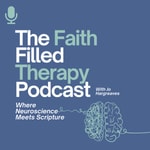
The Faith Filled Therapy podcast sits at the intersection of Scripture, neuroscience, and therapeutic insight, exploring how we actually experience change, not just talk about it.
Each episode gently unpacks what it means to renew your mind in a real, lived way, looking at thought patterns, the nervous system, and the inner world we carry, all through a lens that holds neuroscience with curiosity, while ultimately submitting it to the truth of Scripture.
This isn’t about quick fixes or surface-level faith. It’s about understanding why you feel the way you feel, learning how your mind and body work, and discovering how transformation happens-spirit, soul and synapses.
If you’ve ever loved God but still felt stuck in your thoughts, overwhelmed in your emotions, or unsure how faith connects to your mental health, you’re not alone.
This podcast will help you make sense of your inner world, and take small, meaningful steps towards wholeness.
Site
RSS
Apple
Data updated on 07/11/2026
Recent rankings
Latest chart positions across Apple Podcasts and Spotify rankings.
Shared links between episodes and podcasts
Links found in episode descriptions and other podcasts that share them.
Who You’re Becoming: The Path to Lasting Change with Chuck DeGroat
Season 2 · Episode 7
Friday, November 6, 2026 • Duration 44:26
Why can we understand ourselves and still struggle to change? What does it take to grow in Christlike character? And how do we hold compassion and accountability together when someone has caused harm?
In this episode of the Faith Filled Therapy Podcast, Jo Hargreaves is joined by licensed therapist, professor and author Chuck DeGroat for a conversation about narcissism, trauma and the slow work of lasting transformation.
Chuck shares how his experience as a pastor and therapist has shaped his work with people who have caused harm and those who have been harmed. Together, he and Jo explore how compassion can sit alongside accountability, why our reactions make sense within our stories, and how we can find our way back to a more grounded state.
They also discuss Chuck’s book, Who You’re Becoming: The Slow and Courageous Work of Cultivating Character in a Narcissistic Age. Drawing on Scripture, neuroscience and therapeutic practice, they consider why knowing more does not automatically mean changing, and how genuine growth involves our bodies, relationships and life with God.
This conversation offers an invitation to move beyond quick fixes, make room for honest reflection and approach the work of change with patience and hope.
Key Takeaways
Compassion and accountability belong together. Understanding someone’s trauma does not erase the harm they have caused. Chuck explains why abuse needs to be acknowledged honestly, rather than treated simply as a communication problem.
A reactive state is not your whole story. Feeling the urge to fight, withdraw or escape does not have to become a fixed story about who you are. Jo and Chuck explore how noticing these states and practising grounding can help us respond from a more settled place.
Spiritual growth involves the body too. The Psalms give us pictures of faith expressed through our bodies, emotions and actions. Jo and Chuck discuss an approach to wholeness that takes our physical experience seriously alongside our spiritual life.
Lasting character change takes time. More information, therapeutic language or a short period away does not necessarily mean deep transformation has happened. Chuck describes the patient work of unlearning protective patterns and engaging honestly within safe relationships.
Strength can include tenderness. Chuck explores how a longing for strength can become entangled with control and self-protection. Growth can involve learning to express strength through vulnerability, tenderness and connection.
Safety comes first when harm is present. Chuck encourages people who have been harmed to take their pain and their physical and emotional safety seriously. Hope that another person might change should not require someone to minimise their own needs or experience.
About Chuck DeGroat
Chuck DeGroat is a licensed therapist, a professor at Western Theological Seminary in Holland, Michigan, and founder of the Soul Care Collaborative. He previously served as a pastor in Orlando and San Francisco, where he founded two church-based counselling centres.
He is the author of seven books, including When Narcissism Comes to Church, Healing What’s Within and Who You’re Becoming. His work includes supporting people navigating trauma, spiritual abuse and challenges in pastoral and leadership life.
For free resources, reflections, and regular encouragement, come join me over on Substack. You’ll also find the option to subscribe to The Faith-Filled Collective; a monthly space for women who are pursuing wholeness and holiness.
You can also find my e-books and webinar links here
Love and hope
Jo
A Faith-Filled Insight Into Emotional Endurance with Leslie M. Bosserman
Season 2 · Episode 6
Friday, October 9, 2026 • Duration 45:24
What helps us keep going when life feels overwhelming? How can we grow our resilience while honouring our need for rest? And what does emotional endurance look like in a life rooted in faith?
In this episode of the Faith Filled Therapy Podcast, Jo Hargreaves is joined by Leslie M. Bosserman, executive leadership coach, TEDx speaker and author of Emotional Endurance, for a thoughtful conversation about hope, resilience and finding room to meet the demands of everyday life.
Drawing on her coaching work, Christian faith and experience as a mum of three, Leslie introduces her framework of six principles and eighteen practical skills. Together, Jo and Leslie explore how we can move forward when we feel stuck, recognise patterns of self-sabotage and notice the growth that has already taken place.
Their conversation also considers the relationship between stress and performance, the importance of margin, and why managing our emotional, physical, mental and spiritual energy matters alongside managing our time. With honesty and humour, they bring these ideas into the ordinary realities of parenting, work, tiredness and doing hard things.
The episode closes with Leslie praying for listeners who feel stuck, hopeless or overwhelmed. Join Jo and Leslie for an encouraging invitation to start where you are, recognise your needs and take a small, purposeful step forward.
Key Takeaways
Emotional endurance is a capacity we can develop. Leslie describes a framework of six principles and eighteen practical skills that bring together neuroscience, positive psychology and biblical truth. Resilience forms one part of this wider picture of growing our capacity to navigate life.
Noticing what already works can help us move forward. Leslie’s coaching approach begins with understanding someone’s values, purpose and existing strengths. Looking for evidence of growth can help reveal a possible next step when everything feels stuck.
Hope involves goals, agency and possible pathways. Leslie explores the importance of knowing where we want to go, believing we can take action and identifying ways forward. Her discussion of perspective offers a way to examine a situation with greater curiosity.
A Faith-Filled Insight Into Adlerian Therapy: “Belonging Without Proving Your Worth” with Judy Potts
Season 2 · Episode 5
Wednesday, September 23, 2026 • Duration 41:12
Why do we still feel not good enough, even when we know God loves us? Could perfectionism, people pleasing and constant striving be connected to how we learned to belong? What might change if we no longer felt we had to prove our worth?
In this episode of the Faith Filled Therapy Podcast, Jo Hargreaves is joined by Judy Potts, an Adlerian therapist known as The Social Therapist, to explore our longing to feel equal, secure and good enough.
Judy shares how tying her worth to achievement led to overworking, burnout and depression, and how her own experience of therapy helped her begin to see herself differently. She introduces the Adlerian concept of private logic: the conclusions we draw early in life about ourselves, other people and what we must do to belong.
Together, Jo and Judy explore how Christian faith and psychology can work alongside one another when knowing we are loved does not yet translate into feeling secure. They discuss self-compassion, the hidden cost of striving, and the difference between freely using our strengths and feeling compelled to prove ourselves through them.
From becoming more curious about others to recognising what is ours to carry in relationships, this conversation offers a warm invitation to understand your patterns with compassion and explore a more secure way of belonging.
Key Takeaways
Our early conclusions can shape how we seek belonging. Judy explains how private logic develops through the meaning we give our experiences. Beliefs that we must achieve, please others or stand out can continue to influence our adult relationships and choices.
Understanding your patterns creates room for compassion. Jo and Judy invite us to recognise why our protective strategies once made sense. Understanding where they came from can help us approach change with encouragement instead of self-criticism.
Knowing you are loved and feeling secure can be different experiences. The conversation explores the gap between understanding God’s unconditional love and feeling that truth deeply. Judy describes how therapy can help us examine old beliefs and practise new ways of responding alongside our faith.
It’s Time to Heal: “Rewiring the Mind and Living From Love” with Dr Derwin L. Gray
Season 2 · Episode 4
Monday, September 7, 2026 • Duration 39:39
Can we really heal from the things that have shaped us? What does it mean to renew your mind after trauma? And how can we learn to live from love rather than spending our lives trying to earn it?
In this episode of the Faith-Filled Therapy Podcast, Jo Hargreaves is joined by pastor, author and former NFL player Dr Derwin L. Gray for a powerful conversation about trauma, healing, identity and the transforming love of Jesus.
Derwin shares openly about growing up surrounded by addiction, abuse and violence, his journey from professional football to faith, and the healing that followed. He and Jo explore how biblical truth can reshape our thoughts, nervous system and lived experience, helping us face pain while replacing the lies we have believed with truth.
Drawing from his new book, It’s Time To Heal: Four God-Given Steps To Restore What Life Has Shattered, Derwin introduces his HEAL framework: being honest about what happened, expecting pain along the way, accepting the past without letting it define you, and ultimately learning to live from love, not for love.
Blending Scripture, neuroscience, grace and real-life stories, this episode offers a practical, Christ-centred invitation to face what has hurt us and move towards healing.
Key Takeaways
You cannot heal from what you will not reveal. Derwin talks about the importance of becoming honest about what has happened to us, and sometimes what we have done, rather than hiding or minimising our pain. Healing begins with bringing our real story into the light.
Your past can shape you without defining your future. Trauma is real and its effects matter, but Derwin challenges the idea that our past gets to “take the ink pen and write our future.” What happened to us is part of our story, but it does not have to become our identity.
Renewing your mind is a repeated practice, not a one-time moment. Jo and Derwin explore neuroplasticity, taking thoughts captive and learning to recognise the difference between thoughts that speak against us and the truth of who we are in Christ.
Neuroscience, Epigenetics & Spiritual Growth with Dr Chuck Coker
Season 2 · Episode 3
Wednesday, August 26, 2026 • Duration 34:28
How does faith shape the brain? Can neuroscience help us understand spiritual growth? And what does epigenetics have to do with transformation?
In this episode of the Faith-Filled Therapy Podcast, Jo Hargreaves is joined by author, speaker and leadership expert Dr Chuck Coker to explore the fascinating intersection of neuroscience, psychology and biblical wisdom.
Together, they discuss emotional intelligence, spiritual formation, Gen Z’s search for authenticity, the science of worship, and how God’s design for spirit, soul and body points us towards wholeness. Chuck also shares insights from his book, A God-Shaped Mind: The Neuroscientific Path to Spiritual Maturity, which explores spiritual development through both Scripture and brain science.
Key Takeaways
Faith and neuroscience don’t have to be competing conversations. Jo and Chuck explore how our understanding of the brain can offer another lens through which to consider spiritual growth and transformation.
We are designed as whole people. The conversation considers the interconnectedness of spirit, soul, brain and body, and what that means for living a full and flourishing life.
Spiritual maturity is an ongoing process. Chuck explores stages of spiritual development and how growth can shape the way we think, relate to others and invest in the next generation. His book develops this journey from “spiritual infant” through to “spiritual parent.”
Emotional intelligence and spiritual formation are deeply connected. Chuck and Jo discuss emotional intelligence alongside the Fruit of the Spirit and the role relationships play in our development.
Neuroplasticity and epigenetics open up fascinating questions about transformation. Chuck explains his understanding of how our experiences and spiritual formation interact with biological processes.
Gen Z is looking for authenticity, not perfection. Chuck reflects on a generation seeking truth and reality, and on a God whose love is based on relationship rather than performance.
Community and discipleship matter. Transformation isn't simply about acquiring information. Chuck emphasises intimacy, accountability and meaningful relationships as important parts of spiritual maturity.
Exploring the Mind-Body Connection with Dr. Lee Warren
Season 2 · Episode 2
Sunday, May 3, 2026 • Duration 50:56
Exploring the Mind-Body Connection with Dr. Lee Warren
Join us in this insightful episode as Dr. Lee Warren, a renowned neurosurgeon, shares his unique perspective on neuroscience, faith, and mental well-being. Discover how understanding the brain can deepen our spiritual walk and improve mental health.In this episode:
The role of neuroplasticity and how deliberate mental practices can reshape our brains
Practical strategies for self-regulation based on Scripture and neuroscience
The fascinating interface of mind, brain, and spiritual life
How suffering can refine us and give purpose, supported by biblical perspective
The impact of hope on neurochemistry and resilience
Exploring the concept of the mind’s location and its connection to eternity
The significance of wonder and awe in mental health and spiritual life
Key Takeaways:
Dr. Warren’s blend of neuroscience and faith points to the importance of managing thoughts through intentionality and the biblical practice of taking every thought captive.
The “self-brain surgery” metaphor emphasises deliberate mental strategies to address emotional and spiritual health.
The reticular activating system filters our perceptions; belief modifies the signals we focus on, shaping our reality.
Moments of wonder and awe, especially in the right brain hemisphere, are vital for mental health and spiritual connection.
Hope activates motivational neurochemicals, empowering us to undertake meaningful change, even in suffering.
The biblical concept of “renewing the mind” aligns with neuroplasticity principles—changing thought patterns through deliberate action.
The distinction between mind and brain underscores that thoughts are not exclusively generated by physical brain activity, offering hope and freedom.
Suffering, when reframed, can lead to character development and hope, as supported by both Scripture and science.
God Given Ways To Regulate Part 1
Season 2 · Episode 1
Tuesday, March 31, 2026 • Duration 23:05
Hello to you.
After a short break, the podcast returns with an honest and gently reflective episode about waking up feeling overwhelmed, anxious, and physically on edge. From that real-life moment, this conversation explores what it means to regulate your nervous system in a way that is both deeply therapeutic and rooted in faith.
Blending neuroscience with scripture, you’ll be guided through simple, grace-filled practices like breath prayer, gratitude, singing, and getting outside, reminding you that your body isn’t a barrier to God, but part of how you were designed to heal, connect, and feel safe.
If you’ve ever felt stuck in your head, weighed down by anxiety, or simply exhausted, this episode offers a gentle reminder: you make sense, and there is a way through.
For free resources, reflections, and regular encouragement, come join me over on Substack. You’ll also find the option to subscribe to The Faith-Filled Collective; a monthly space for women who are pursuing wholeness and holiness.
You can also find my e-books and webinar links here
Love and hope
Jo
An Intro To Your Left And Right Hemisphere With Dr Perianne Brownback
Season 1 · Episode 13
Saturday, December 27, 2025 • Duration 49:05
In this episode, Jo Hargreaves, faith-filled therapist and writer, is joined by Dr Perrianne Brownback for a thoughtful conversation about the left and right hemispheres of the brain, moving beyond pop-psychology myths into something far richer and more meaningful.
Together, they explore how simplistic ideas about being “left-brained” or “right-brained” have been largely debunked, while also uncovering the profound truth that how our brain processes the world really does matter. Drawing on the work of psychiatrist and philosopher Ian McGilchrist, this conversation looks at the distinct roles of each hemisphere, and why the left hemisphere was never designed to operate independently, but to be guided and interpreted through the right.
This episode invites listeners to reconsider how they think, perceive, and make meaning, not just cognitively, but relationally and spiritually. It’s a grounding, curiosity-stirring conversation that connects neuroscience, lived experience, and faith, offering a deeper understanding of how we attend to the world, to God, and to ourselves.
You can follow Perianne's work here and purchase her book here
For free resources, reflections, and regular encouragement, come join me over on Substack. You’ll also find the option to subscribe to The Faith-Filled Collective; a monthly space for women who are pursuing wholeness and holiness.
You can also find my e-books and webinar links here
In this episode of the Faith Filled Therapy podcast, Jo Hargreaves discusses the significance of biblical meditation and its impact on mental health and spiritual growth. She shares her personal journey with God's word, emphasizing the importance of taking scripture at face value and the therapeutic benefits of meditation. Jo explores the neuroscience behind meditation, explaining how it can rewire the brain and promote peace. She encourages listeners to integrate biblical meditation into their daily lives, highlighting its transformative power.
For free resources, reflections, and regular encouragement, come join me over on Substack. You’ll also find the option to subscribe to The Faith-Filled Collective; a monthly space for women who are pursuing wholeness and holiness.
You can also find my e-books and webinar links here
Love and hope
Jo
Understanding Intrusive Thoughts Through Scripture and Science
summary In this episode of Faith Filled Therapy, Jo Hargreaves explores the complex nature of intrusive thoughts, their intersection with neuroscience and scripture, and how to manage them compassionately. She discusses the role of stress, hormonal changes, and the importance of grounding techniques and scripture in finding peace. Jo emphasizes that intrusive thoughts are not a reflection of one's character but rather a natural response of the brain, and she encourages listeners to approach these thoughts with compassion and understanding.
takeaways
Intrusive thoughts can be distressing and often arise unexpectedly.
Understanding the neuroscience behind intrusive thoughts can foster self-compassion.
Stress and hormonal changes can increase the frequency of intrusive thoughts.
Mindfulness and interrupting negative thought patterns are crucial for mental freedom.
Grounding techniques, such as deep breathing and scripture meditation, can help manage intrusive thoughts.
God's compassion is present in our struggles with intrusive thoughts.
Scripture can serve as a lifeline for grounding and reassurance.
The brain's response to perceived threats can be misinterpreted as real danger.
It's important to not attach meaning to intrusive thoughts to prevent them from gaining power.
You are not broken; there is grace for your mind and nervous system.
Chapters
00:00 Introduction to Intrusive Thoughts
02:56 Understanding Intrusive Thoughts
05:19 The Neuroscience Behind Intrusive Thoughts
07:38 The Role of the Amygdala and Prefrontal Cortex
Stress calls for awareness and discernment. Leslie discusses how stress can support motivation and performance, and how it can become overwhelming beyond a certain point. Together, she and Jo consider doing hard things alongside healthy boundaries and intentional rest.
Margin gives us room to meet the moment. The conversation explores the relationship between life’s demands and the resources we have available to meet them. Sleep, nourishment, rest and caring for our bodies all feature in their discussion of remaining present when life is demanding.
Time management works alongside energy management. Having time available does not automatically mean we have the energy to use it. Leslie considers emotional, physical, mental and spiritual energy, and encourages starting with small, manageable periods of practice.
Small steps count as progress. Leslie encourages recognising what has already changed and using that experience to support the next step. Through stories from coaching, parenting and working with children, she explores patience, encouragement and the possibilities opened by adding “yet” to what feels difficult.
About Leslie M. Bosserman
Leslie M. Bosserman, M.Ed., CPCC, is the founder of Lead With Intention®, where she coaches and trains teams on the science of emotional endurance. She is a TEDx speaker, executive leadership coach, creative entrepreneur and author of Emotional Endurance.
Based in Northern California, Leslie runs The Makers Place™, an innovative coworking space with onsite childcare. She is also a mum of three, bringing her experience of family life into her work and writing.
If you’d like to watch the video version of the podcast, you can watch it on YouTube here: https://youtu.be/FzHLkGNNURY
For free resources, reflections, and regular encouragement, come join me over on Substack. You’ll also find the option to subscribe to The Faith-Filled Collective; a monthly space for women who are pursuing wholeness and holiness.
You can also find my e-books and webinar links here
Love and hope
Jo
Your strengths do not have to become conditions of worth. Hard work, generosity and a desire to do things well can be valuable gifts. Judy encourages us to notice when freely choosing to use those gifts becomes feeling that we must use them at any cost to be acceptable.
Counting the cost can help us recognise unhelpful patterns. Jo and Judy reflect on how overcommitting and perfectionism affect both us and the people we love. Asking what a pattern costs, and who pays that cost, can help us make more intentional choices.
Belonging can grow through curiosity and contribution. Judy introduces social interest, an Adlerian concept concerned with connection, cooperation and care for others. They explore how shifting attention from how we are being perceived towards genuine interest in another person can create space for connection.
Caring for someone does not mean carrying every reaction. Judy introduces the separation of tasks as a way of considering our own responsibilities and those of other people. She and Jo reflect honestly on the discomfort that can remain after setting a boundary, even when we believe it was needed.
About Judy Potts
Judy Potts is an Adlerian therapist known online as The Social Therapist. Her work explores feelings of inferiority, belonging and the development of a more secure sense of self.
A church leader and mother of two, Judy brings Christian faith, her own experience of therapy and her work with clients into the conversation. She also creates psychoeducational resources, including her online course, Overcoming Inferiority.
If you’d like to watch the video version of the podcast, you can watch it on YouTube here: https://youtu.be/vxtLrgBLJqY
For free resources, reflections, and regular encouragement, come join me over on Substack. You’ll also find the option to subscribe to The Faith-Filled Collective; a monthly space for women who are pursuing wholeness and holiness.
You can also find my e-books and webinar links here
Love and hope
Jo
Healing is not toxic positivity. Renewing the mind doesn't mean pretending painful experiences did not happen. It means facing what is true while also allowing the truth of Scripture to reshape our beliefs, thoughts and behaviours.
We can learn to live from love rather than for love. Derwin describes the security that comes from knowing we are already loved by God, including at our worst. Instead of performing for acceptance, we can begin to live from a place of belovedness.
Our brains can learn new patterns. Derwin shares how practices he first learned as a professional football player eventually helped him understand neuroplasticity and the process of replacing deeply rooted beliefs with biblical truth.
Healing can change more than one generation. Derwin shares his hope that people will interrupt patterns of hurt, toxicity and trauma so that what is passed to future generations is health and blessing instead.
Jesus is at the centre of wholeness. Jo and Derwin discuss healing as something that encompasses spirit, soul and body. Therapy, neuroscience and spiritual disciplines can all have a place, while the conversation continually points back to relationship and union with Christ.
About Dr Derwin L. Gray
Dr Derwin L. Gray is the co-founding and Lead Pastor of Transformation Church, just outside Charlotte, North Carolina. He is the recipient of the John M. Perkins Justice Award, an award given to a visionary leader whose life and work exemplify the principles of biblical justice.
Derwin is also an award-winning author whose books include How to Heal Our Racial Divide: What the Bible Says, and What the First Century Christians Knew about Racial Reconciliation, Lit Up With Love: Becoming Good-News People To A Gospel-Starved World, and his new release, It’s Time To Heal: Four God-Given Steps To Restore What Life Has Shattered.
If you’d like to watch the video version of the podcast, you can watch it on YouTube here:YouTube Link
For free resources, reflections, and regular encouragement, come join me over on Substack. You’ll also find the option to subscribe to The Faith-Filled Collective; a monthly space for women who are pursuing wholeness and holiness.
You can also find my e-books and webinar links here
Love and hope
Jo
About Dr Chuck Coker
Dr Charles “Chuck” Coker, PhD, DMin, SPHR, is the founder and CEO of LifeThrive Performance Systems and has more than 35 years of experience across leadership, teaching and ministry. His work brings together neuroscience, psychology and biblical wisdom to help people grow emotionally, spiritually and personally.
He is also the founder of Yesha Ministries and author of A God-Shaped Mind: The Neuroscientific Path to Spiritual Maturity, which explores how brain science and biblical truth intersect in the journey towards spiritual maturity.
Book: A God-Shaped Mind: The Neuroscientific Path to Spiritual Maturity
Chuck’s book is available now in Amazon, Barnes & Noble, Books-A-Million, Walmart and Target as places where listeners can find it.
If you’d like to watch the video version of the podcast, you can watch it on YouTube here:YouTube Link
Special resource for Faith-Filled Therapy listeners:
Purchase a copy of Dr Chuck Coker’s A God-Shaped Mind and send a screenshot of your proof of purchase to cwcoker@lifethrive.com to receive a complimentary 16-week Bible study designed to accompany the book.
For free resources, reflections, and regular encouragement, come join me over on Substack. You’ll also find the option to subscribe to The Faith-Filled Collective; a monthly space for women who are pursuing wholeness and holiness.
You can also find my e-books and webinar links here
For free resources, reflections, and regular encouragement, come join me over on Substack. You’ll also find the option to subscribe to The Faith-Filled Collective; a monthly space for women who are pursuing wholeness and holiness.
You can also find my e-books and webinar links here
Love and hope
Jo
Read more
Collapse
10:08 Compassion and Reassurance in Managing Thoughts
13:07 Grounding Techniques and Scripture
15:43 The Spiritual Aspect of Intrusive Thoughts
18:03 Finding Peace and Compassion in Faith
21:12 flow-211881.mp3
For free resources, reflections, and regular encouragement, come join me over on Substack. You’ll also find the option to subscribe to The Faith-Filled Collective; a monthly space for women who are pursuing wholeness and holiness.
You can also find my e-books and webinar links here
Love and hope
Jo
Related Shows Based on Content Similarities
Discover shows related to The Faith Filled Therapy Podcast, based on actual content similarities. Explore podcasts with similar topics, themes, and formats, backed by real data.