The Art of Space Engineering – Details, episodes & analysis

Podcast details

Technical and general information from the podcast's RSS feed.
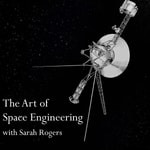
Podcast The Art of Space Engineering

The Art of Space Engineering

Sarah Rogers

Technology
Education

Frequency: 1 episode/52d. Total Eps: 30

Hosting podcast RSS.com
The Art of Space Engineering is a podcast which aims to explore the details behind how spacecraft and various payloads come together before launch, and the lessons learned along the way. Episodes feature discussions between faculty, students, and industry professionals on topics including instruments, CubeSats, and various engineering disciplines, to provide a well-rounded overview of what it takes to prepare space systems for missions both in and beyond Earth's orbit. Hosted by Sarah Rogers Cover art design by Amy Liu Feel free to connect with me! Email: artofspaceeng@gmail.com LinkedIn: https://www.linkedin.com/in/sarah-s-rogers Hosted on rss.com: https://rss.com/podcasts/theartofspaceeng/
Site
RSS
Apple

Recent rankings

Latest chart positions across Apple Podcasts and Spotify rankings.

Apple Podcasts

  • 🇫🇷 France - technology

    23/07/2025
    #96

Spotify

    No recent rankings available


RSS feed quality and score

Technical evaluation of the podcast's RSS feed quality and structure.

See all
RSS feed quality
To improve

Score global : 58%


Publication history

Monthly episode publishing history over the past years.

Episodes published by month in

Latest published episodes

Recent episodes with titles, durations, and descriptions.

See all

#30 - Tilebox: End to End Data Processing for Space Missions (Laura Costa Ortega & Laura Todd) 

Season 1 · Episode 30

mardi 4 mars 2025Duration 58:28

Episode Overview

This episode features a discussion with Laura Costa Ortega, the co-founder of Tilebox, and Laura Todd, Vice President of Space Exploration Future Programmes at Airbus Defense and Space and mentor at the Creative Destruction Lab.

We discuss the challenges of processing data products collected by space missions and new methodologies being developed to improve efficiency of the end to end processing chain. In addition, we discuss the business side of emerging space companies which provides a nice blend of technical interchange with strategy and vision. I hope you enjoy this format!

Timestamps

0:00 - Episode intro

3:54 - Background: Laura Costa Ortega & challenges in space data processing

13:08 - Background: Laura Todd

18:20 - Developing the Tilebox narrative, startup mentality, strategy, and product development

31:12 - Tilebox + Colossus integration, end to end processing

41:44 - Challenges of on orbit processing vs ground processing

46:41 - Future methodologies for data processing

51:50 - What do you love most about your job

57:34 - Episode outro

Links

#29 - Operating Satellite Constellations at Planet Labs with Deanna Farago

Season 1 · Episode 29

dimanche 10 mars 2024Duration 55:28

Episode Summary 

This week’s episode features a conversation with Deanna Farago on how Planet Labs manages efficient commissioning and nominal operations for its constellation of over 200 satellites. Planet Labs was founded in 2010 with a goal to collect high resolution imagery of the entire earth every day. Today, Planet’s dataset includes, on average, 1700 images of every place on Earth. This has provided researchers, business, and governments with significant insight into our Earth.  

In this episode we dive into how Planet Labs balances commissioning new satellites while continuing to operate existing ones, the tools and automated features enable their constellation to run seamlessly, what aspects of constellation management are not as well known as they should be, and finally what we can learn from reflecting on a decade of operations. 

Deanna Farago is the Director of Mission Operations at Planet. Her team is responsible for commissioning and operating the largest Earth-observation constellation of satellites in the world. With an expertise in operations-at-scale, Deanna has written papers and presented at conferences such as Small Satellite, Grace Hopper, and the SpaceOps Conference. Prior to coming to Planet in 2014, Deanna worked as a Simulation Engineer at NASA Ames Research Center performing human-in-the-loop experiments in the Vertical Motion Simulator (VMS). She also worked as the Mission Assurance Manager on the ASTRA project at NASA Jet Propulsion Laboratory which helped to advance Mars surface instruments using a high-altitude balloon test environment. 

Timestamps

0:00 - Episode intro

2:39 - Deanna's background 

14:00 - Pelican 1 Tech Demo status

19:20 - Commissioning process for Dove fleets

25:28 - Queueing satellite commissioning

28:32 - Megahealth app - contacting satellites post deployment 

32:48 - Aside on TLEs and operational experience

39:44 - Looking back on growth over the years

45:50 - Things to consider about operating constellations

50:28 - Episode Outro & other applications 

Links 

#20 - Calling Major Tom: Cloud Based Mission Control, with Tyler Browder

Episode 20

mercredi 8 septembre 2021Duration 01:08:58

This episode features a conversation with Tyler Browder, who is the CEO and co-founder of Kubos, whose application, Major Tom, provides a cloud-based solution to operating spacecraft from orbit. Utilizing cloud-based platforms helps reduce development and maintenance resources, as well as allows spacecraft to be operated from anywhere. This discussion dives into how Kubos has been designed to help manage the operations phase and explores what it’s like to bring a startup company to life.

For more information on Kubos, please visit their website: https://www.kubos.com/

#19 - Unveiling Planetary Mysteries, with Dr. Hugh Kieffer

Episode 19

dimanche 25 juillet 2021Duration 01:23:54

Dr. Hugh Kieffer is a renowned geophysicist who studies planetary bodies across the solar system through a combination of numerical modeling and remote sensing. He is the creator of KRC, a planetary thermal model of Mars, which has become the gold standard for predicting temperatures on Mars and other planetary bodies (planets, moons, comets. etc.). He also served as the Project Investigator (PI) of the Infrared Thermal Mapper (IRTM) instrument, which flew on the Viking orbiter in the 1970s.

In this conversation, we discuss his remarkable career path in geophysics, why/how KRC and IRTM were created to support Viking, as well as what it was like to develop KRC during the 1970s, when computers had only 4 MB of memory. Co-hosted by Adi Khuller.

#18 - Developing the Mission Operations Phase with Ernest Cisneros

Episode 18

jeudi 25 mars 2021Duration 01:28:26

Preparing for the operations phase of a mission is a lot more challenging than it sounds. What information will help me understand the state of the entire spacecraft? What risks might we need to mitigate? What do we need to train people to operate this spacecraft so they can detect anomalies and help resolve them? And how do we organize all of this for a system with a lot of moving parts?

This episode features a conversation with Ernest Cisneros on mission operations and how we prepare ahead of time to make this as smooth as possible. Ernest has a background in Systems Engineering and System & Network Administration, and he has supported operations for several instruments at ASU. A few of which include the Lunar Reconnaissance Orbiter cameras (LROC), Mastcam on the Curiosity Rover, Mastcam-Z on the Perseverance Rover, and the hyperspectral cameras on the Psyche Spacecraft, which is slated to launch in 2022 to journey to a metal asteroid named Psyche, where scientists hope to learn more about the origin of planetary cores.

#17 - Terahertz Electronics for Astrophysics Research (Part 2) with Justin Mathewson & Jonathan Hoh

Episode 17

dimanche 28 février 2021Duration 01:09:33

THz research! The great basement flood! Betashell! This episode continues the discussion with Justin and Jon on the work done by ASU’s THz lab, and highlights lessons learned, testing LNAs, the great basement flood of 2019, and other words of wisdom for students.

Justin and Jon are both part of the THz Lab at Arizona State University, and have contributed to a variety of projects that will benefit our understanding of the universe. Their work is centered on the THz electronics which aid in processing the signals on both balloon borne and ground based space telescopes such as GUSTO, the Terahertz Intensity Mapper (TIM), Simon’s Observatory, and the Large Millimeter Telescope developed by Toltec, all of which are aimed at studying the formation and evolution of stars and other properties of our galaxy in various ways.

#16 - Terahertz (THz) Electronics for Astrophysics Research (Part 1) with Justin Mathewson & Jonathan Hoh

Episode 16

dimanche 28 février 2021Duration 01:23:02

Scientists can gain a great deal of insight into how our universe began and its current state by measuring signals in the THz spectrum, which includes frequencies on the order of 1011 - 1013 Hz. The THz spectrum gives us information on the composition of interstellar gasses, the detection of water on other planetary bodies, and other dynamic processes in planetary atmospheres, such as radiation balance, changes in our ozone, and volcanic activity within our solar system.

The science you can do with these higher frequencies is pretty powerful, but making this possible requires highly precise instrumentation that can collect data as accurately as possible so that we can learn as much as possible with the information we gather. Today’s episode will cover low noise amplifiers. As a telescope looks into the cosmic background, amplifiers boost the incoming signal to make it clear and distinguishable from noise.

In today’s episode, I chat with Justin Mathewson and Jonathan Hoh about their work in ASU’s THz Lab, the scientific studies that result from it, and the antics that ensue along the way. Their work is centered on the THz electronics which aid in processing the signals on both balloon borne and ground based space telescopes such as GUSTO, the Terahertz Intensity Mapper (TIM), Simon’s Observatory, and the Large Millimeter Telescope developed by Toltec, all of which are aimed at studying the formation and evolution of stars and other properties of our galaxy in various ways.

#15 - Differences Between CubeSats & Large Spacecraft with Prof. Chuck Boehmer

Episode 15

samedi 20 février 2021Duration 01:27:10

CubeSats (small spacecraft ranging from the size of a tissue box to the size of a shoebox) have become widely popular within the universities across the globe as more teams utilize this platform to conduct scientific research, demonstrate new technology, and educate the next generation of engineers. However, student-led CubeSat projects can be very different from industry-level projects, both in technical and programmatic terms. In today’s episode, I sat down with Prof. Chuck Boehmer to chat about these differences a bit more in detail based on his experience in the industry, and my experience on the Phoenix CubeSat at ASU.

#14 - SpaceX Dragon Avionics with Kate Hendrix

Episode 14

vendredi 29 janvier 2021Duration 01:31:09

Episode 14 features an interview with Kate Hendrix, who’s career has taken her to SpaceX, Astranis (geostationary satellites), and Luminar Technologies (LiDAR technology). Today’s episode discusses the electrical power avionics systems on the Dragon Spacecraft and what goes into developing them. In addition to avionics, we dive into a bit of SpaceX’s early history, lessons learned over the years, and how working with a spacecraft like Dragon differs from geostationary satellites (in terms of radiation, EMI, etc).

Dragon made history in spaceflight last summer as the first spacecraft developed by a private company to take astronauts to the international space station. In doing so, astronauts returned to the ISS from US soil for the first time since the end of the space shuttle program. Disclaimer: All information in this episode is considered public knowledge and therefore does not reveal any “hidden secrets” behind SpaceX’s design.

#13 - Phoenix Team Structure & What I’d do Differently - PhxSat Q&A Sessions (with the Polytechnic University of Milan, Pt. 2)

Episode 13

vendredi 22 janvier 2021Duration 38:18

This episode continues a Q&A conversation with Lyle Campbell and Andrea Sportillo from the Polytechnic University of Milan in Italy, in which we discuss what went into getting the Phoenix CubeSat up and running at ASU. In particular, this episode will cover how we structured the team and general meetings, as well as a few things I would do differently if I were to start a student-led CubeSat project all over again.


Related Shows Based on Content Similarities

Discover shows related to The Art of Space Engineering , based on actual content similarities. Explore podcasts with similar topics, themes, and formats, backed by real data.
Podcast Savvy Painter Podcast with Antrese Wood
Podcast Side Hustle Pro
Podcast The BetterLife Podcast
Podcast Retirement Answer Man
Podcast The Model Health Show
Podcast NextLevelChess
Podcast Capitalism.com with Ryan Daniel Moran
Podcast Achieve Your Goals with Hal Elrod
Podcast Mindfulness Mode
Podcast A Pleasant Solution: Embracing an Organized Life
© My Podcast Data