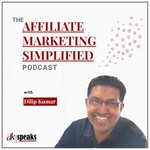
If you thought Affiliate Marketing is a fly-by business after seeing all of those make money quick videos, then think again. The Affiliate Marketing Simplified Podcast is an attempt to change that perception and show you how affiliate marketing can be a long term and sustainable business model. Here I share simple affiliate marketing tips and advices to help you build a long term affiliate marketing based business.
Site
RSS
Apple
Data updated on 14/07/2026
Recent rankings
Latest chart positions across Apple Podcasts and Spotify rankings.
Shared links between episodes and podcasts
Links found in episode descriptions and other podcasts that share them.
The Affiliate Marketing Simplified Podcast, a podcast by Dilip Kumar - Stats, Episodes and Rankings - My Podcast Data
RSS feed quality
To improve
Score global : 32%
Related Shows Based on Content Similarities
Discover shows related to The Affiliate Marketing Simplified Podcast, based on actual content similarities. Explore podcasts with similar topics, themes, and formats, backed by real data.
The Step-by-Step Process to Setup a List Building System for Your Blog
Tuesday, February 12, 2019 • Duration 19:31
Pinterest29
Facebook 0
Twitter 0
LinkedIn
WhatsApp
29Shares
When should you start off with your list building?
And what goes into putting together a fool proof list building plan in place?
Now that we know how to create a lead magnet (we discussed this in the last post), let us look at the step-by-step process to start capturing email addresses on our blog.
If you would like to skip this post and go to the Show Notes and Resources, you can do so by clicking here.
One proven fact is that email is by far the most effective medium to reach your fans today. In fact it is even more effective than social media.
But the biggest challenge is on how to build your list fast. I am sure you don’t want to take years to build a list of 1000 subscribers.
So in this post we will look at a few strategies on how to build a list fast and also how to get the most out of your list even if it is small.
Before we do that, let me re-iterate the principle that I follow. This is something I learnt from Andre Chaperon.
Your profitability doesn’t depend upon the size of the list. Instead it depends upon how engaged your list is.
So even if your list is small, you could very well be making a lot more money than people who have a huge list.
If you are thinking as to why we are talking about list building even before we have put out our first piece of content, then you might want to write this on a piece of paper and paste it somewhere that you can always see it – “The Money is in the List”.
That’s right. If you are ever going to make decent income; income that can substitute your 9-5 job, then it is going to be from your list.
It is personal experience that is speaking here. I will keep that rambling and the story for some time later. But at this point, keep in mind that your list is the most important thing for you.
So, if your list is going to be the most important thing for you, then shouldn’t that be the first thing you should think about?
Absolutely!
Let us assume you have installed your blog and you post your first article. You then share it on social media sites and a few visitors come over to your site. Imagine if you don’t have a lead magnet on your blog.
What happens then?
Those visitors will read your article and then leave. Isn’t that a loss, even if it was just one visitor?
You lost a prospective subscriber.
It is hence that I suggest that you put together your lead magnet or, optin bribe as we call it, the first.
On that note let us get straight into the strategies.
Step-by-Step Process to Setup a List Building System
This is a simple 6 step process and is the pre-requisite to start capturing email addresses
First things first. There are 3 important things that you need to keep in mind even before we start.
Make the process Simple – Everybody is short of time today and we do not want to put in too much of efforts to achieve som...
How to Create a Lead Magnet for Your Blog to Build Your Subscriber List
Wednesday, January 30, 2019 • Duration 19:42
Pinterest18
Facebook 0
Twitter 0
LinkedIn
WhatsApp
18Shares
In the last post we discussed about creating a reader profile for your blog. A reader profile primarily identifies your readers so that you can write for them.
At the same time, the reader profile also gives you another very critical information which is one of the pre-requisite to creating a lead magnet.
In this post we will discuss about how to create a lead magnet for your blog.
If you would like to skip this post and go to the Show Notes and Resources, you can do so by clicking the below links.
* Show Notes* Resources
Before we dive into that specific critical information that the reader profile provides, which can help us in creating our lead magnets, let us first understand what a lead magnet is.
This is what Digital Marketer says about a “Lead Magnet” –
Lead Magnet — noun — an irresistible bribe offering a specific chunk of value to a prospect in exchange for their contact information.
In simple terms, a lead magnet refers to a specific thing, tangible or, intangible that you are offering anybody who enters their contact information (email address, to be specific) on your website or, blog.
If you have browsed through the internet, I am sure you would have come across some or, the other type of a lead magnet. Because pretty much every website out there welcomes you with a pop-up asking you to enter your email address.
And in return, they will offer you something like an ebook, a discount coupon, a trial access etc.
Since the topic of our discussion is our blog, the lead magnets that we will be talking about in this post will be very specific to our blog and the niche that we are covering.
Also it will be about something that your audience is seeking more information about.
And this is the critical information that your reader profile will give you and which I was talking about a little while back..
Now another thing that we need to keep in mind is that something like a discount coupon will not and in fact, will never work as a lead magnet on a blog.
Why?
Because your blog is not about selling something.
And the people coming over to your blog is not there to buy something.
They are there on your blog for information.
That makes the obvious point on what is it that they would be enticed with and for which they would be ready to give away their email address – that is “information”.
Let us look at what are the best lead magnets to offer your blog readers.
The Best Lead Magnets for a Blog
Blogging is all about providing information. Hence it is obvious that people coming over to your blog is coming for information.
Now imagine, if they read about some specific topic that they were struggling with, on your blog and are satisfied with what they saw, would it make sense to offer them a report with additional information about the same topic?
Will they be ready to enter their email address in order to download that information?
Absolutely.
Does HTTPS Help in Search Engine Rankings of Your Blog and Where to buy the right SSL Certificate?
Thursday, January 24, 2019 • Duration 12:00
Pinterest20
Facebook 0
Twitter 0
LinkedIn
WhatsApp
20Shares
Have you ever seen a “Not Secured” notification in front of a website URL on the address bar?
What was your first thought when you saw that?
If you are anything like me, you would have asked yourselves if you really want to click through to the website. Isn’t it?
Now imagine if it was your website.
A little while back, Google came out with an update that emphasized the need to provide a clean and secure experience to users. That was the first notification to websites to start looking at options to enhance the security of their website.
Then in 2014, they announced HTTPS as a ranking signal.
And then began the race. Who doesn’t want their Search engine rankings and that too on Google, to stay intact?
There started the frenzy to get SSL Certificates for their websites and marketers quickly went onto get their websites HTTPS compliant.
But was it really necessary?
Does HTTPS help in Search Engine Rankings?
One of the common questions that most bloggers have is “does SSL Certificates help in search engine rankings?”.
Neil patel did a study and gathered some data that indeed proved that installing an SSL certificate could help you in your search engine results, albeit in a minor way.
His study was done a little while back.
And since that time there has been a few more significant changes. Browsers like Chrome and Firefox started shaming websites that were not HTTPS, by showing a “Not Secure” tag in the address bar.
In this time, the impact that HTTPS has on search engine rankings have also increased.
Some studies have indeed shown
So what is this HTTPS thing all about?
What is HTTPS?
HTTPS stands for Hypertext Transfer Protocol Secure and its main benefit is that it provides a secure connection to users on those pages where they share personal data.
And in order for this to happen, you need to install an SSL certificate (Secure Socket Layer certificate). Its a protocol that HTTPS uses.
In layman’s terms, it means that HTTPS encrpts the secured information that is exchanged between a web server and a browser, thereby keeping such information safe.
This means that you website will be considered as a trustworthy one by people using it.
Once you have installed an SSL certificate, browsers like Firefox and Chrome will show a security padlock in green, which basically proves that your website is trustworthy and secure.
But what are the benefits of an SSL Certificate?
Benefits of installing an SSL Certificate
If you are an internet marketer or, Blogger, I am sure your business depends on your trustworthiness. If your subscribers,
How to create a Reader Profile for your blog in 3 Simple Steps?
Wednesday, January 16, 2019 • Duration 16:22
Pinterest40
Facebook 0
Twitter 0
LinkedIn
WhatsApp
40Shares
Note – This is a continuation to the last post where we discussed about Buyer Personas.
Just go out there and publish a post every week..
Isn’t that the advice you generally get, when you are just starting to blog?
It isn’t a wrong advice but can you just go out there and publish a post without knowing who your audience is?
In fact, this is a mistake a lot of us do, I am no different.
When I started off blogging, that is just what I did.
But over a period of time, I realized that I was missing the connect with my audience.
Why?
Because I wasn’t really writing for my audience.
In fact, I didn’t know my audience and so I was writing for some general audience. This wasn’t really something my audience was expecting.
So, I lost that confidence and connect with my audience over a period of time. And I could see this in the decreasing email open rates and decreasing readership for the blog.
After having spent a few weeks and after I put together a reader profile, my posts were extremely targeted and gradually the response rate started going up.
But, the big question here is, how do I know who my audience is, when I am just starting off?
It’s an absolutely valid question.
And I am sure, that a lot of you guys starting off out there would have this question..
So, in this episode, I am going to tell you about 3 simple steps in which you can create a reader profile for your blog.
How to Create a Reader Profile in 3 Easy Steps
We will keep the entire process of creating a reader profile absolutely simple. That’s a promise. But keep in mind that “Simple things are at times the most difficult and the easiest to ignore”.
So, you’ll need to promise that you will implement every single one of these steps.
So, Let’s start out.
Research your competitors
Your competitors are your biggest source of information and what you can learn from them is extremely valuable.
We tend to often ignore them, just because they are our competitors.
That’s one mindset that you need to change. Some of the best things (I mean in terms of returns) I have implemented, are things I learnt from my competitors.
So, what exactly do I mean when I say “competitors”?
Competitors are the blogs that are operating in the same niche as yours and are targeting the same audience as yours.
At this point, there could be 2 obvious questions
* What if I don’t have any competitors? – Then you are in the wrong niche. If there is no competitor, then it esentially means that the niche is not something you would want to get in because it is very likely that there isn’t an audience in the niche.* How do I know if they are my competitors? – Just browse through their blog and check if the content they are publishing is something you too are planning to publish. That would mean that they are your competitors.
Now that both of these obvious questions have been answered, let us look at the not so obvious question.
How to Create a Buyer Persona, its Importance and the Points to Keep in Mind
Wednesday, January 9, 2019 • Duration 18:59
Pinterest19
Facebook 0
Twitter 0
LinkedIn
WhatsApp
19Shares
Struggling with how to create a buyer persona for your blog or, website? Then you might want to read on for some simple tips to create one.
But before that, let me ask you a few questions.
Are you marketing to the right people?
Do you know your audience well and are you pitching your content to the right person?
In my last post I had spoken about some of the experiments that I did in the last 18 months or, so.
One of them involved this product that I and one of my friends had created. We were actually bitten by the product creation bug. So we set out to create this product. When the product was ready, we were so excited with the result that we jumped straight into selling it hoping that we were going to make millions out of it.
We had confidence in the product. We knew it was of great quality and that it was an information that was sought by a lot of people.
We launched the product and waited for the dollars to come in..
But that did not happen.
The wait continued but the results did not change. We got a few sales here and there. But it certainly wasn’t enough..
After spending a lot of time and wasting a lot of money in promotions, we finally decided that it was enough and so called the entire thing off.
But why did this product launch flop?
We got the answer when we looked into our promotions and the audience type that we were promoting the product to.
The one line answer was that we didn’t target the right audience.
There is this course from Andre Chaperon – Auto Responder Madness. If you haven’t gone through it, I would recommend you to do it at the earliest because it is one course you shouldn’t miss.
In one of the chapters in this course he talks about customer avatars. If you wish to know more about it, you can visit frankvsmatt.com
Customer avatar is another name for Buyer Persona.
What is Buyer Persona?
The definition of “Buyer Persona” goes like this.
A buyer persona is a fictional character that represents a segment of your customers that you are planning to target with your product and services.
Though we refer to it as Buyer Persona or Customer Avatar, it need not necessarily mean only buyers or, customer. It can represent anything from the audience you intend to reach with your content (if you are a blogger), the market that you plan to target with your products and services, the type of customers that you wish to market to, etc.
Andre is an advocate of relationship marketing. His style of marketing is different. He builds relationships with his prospects and the relationship is so strong that his audience trusts his recommendations and buys whatever he recommends.
That is how he promotes his products. And because of the style of promotion that he uses, his conversion rates are extremely high.
Auto Responder Madness and
The DKSpeaks Podcast is Back – What to Expect?
Monday, December 31, 2018 • Duration 11:10
Pinterest0
Facebook 0
Twitter 0
LinkedIn
WhatsApp
0Shares
“I am Back!”T-850 (Terminator – Rise of the Machines)
Remember that famous dialogue from “Terminator 3 – Rise of the Machines”?
It’s that one dialogue that has become synonymous with Arnold Schwarzenegger, now. In fact nobody does it better than he does. And when he says it, you can see the joy and conviction in that statement.
It is clear that he means business and no nonsense business. And that he is back to beat the heck out of all his enemies.
I am no Arnold Schwarzenegger. And I do not have any enemies that I want to beat the “heck out of”.
But, I mean business and no-nonsense business. So “I am Back“.
Buy Why a Comeback, You Ask?
If you have been a regular reader of my blog here, then you would have realized the reduced frequency of posts on the blog for almost the last complete year.
And when I am talking about readership, it is important that I also mention the fact that I lost quite a lot of readers in the past year or, so just because of the irregular publishing pattern.
Sad, Isn’t it?
My podcast had also gone into hibernation since almost the last year and a half. And that too was a deliberate decision albeit at the wrong time.
Just when the listens had gone up, I withdrew and today I find that the listens are almost negligible.
But why did I do all this?
You know, one of the best things about internet marketing is that when you strike gold, you just go on and things fall into place one after the other. But at the same time, if you fail then there is a high possibility that things take a downward spiral, unless you know how to control it.
While the fear of such failures can deter you from trying new things, the experience and the learnings that you get from such failures are immense and can help you for your future.
There were quite a few experiments that I tried in the last 18 months or, so which included launching a new course, attempting selling on Amazon, book writing, public speaking etc.
Some of these were utter failures like trying to sell on Amazon, some were partial success like the product launch and some others were a success like public speaking.
There are yet others that are work-in-progress like my book writing venture.
Failure or, success, there was something that I learnt from each of the experiments. And since these weren’t small experiments, these learnings will play a considerable part in my future endeavor.
Remember the tagline that Pat Flynn used on his blog, smartpassiveincome.com
I am Your Crash Test Dummy. Let’s See What Works!Pat Flynn
Every experiment in Internet Marketing is a “Crash Test”. And if somebody hasn’t done it already, then you need to do it on your own.
What I learnt from my experiments are pure gold that I will retain for my future experiments. And I am sure it will make me a better marketer.
What You can Expect from the DKSpeaks Podcast in its new Avatar?
When I started the DKSpeaks podcast, I was already listening to a lot of podcasts. In fact, there were a few that I was regularly following and really enjoyed l...
DKSP EP:52 – 9 Simple and Easy Tips to Fix the Slow Page Load Times of Your WordPress Blogs
Sunday, April 9, 2017 • Duration 16:57
Pinterest4
Facebook 0
Twitter 0
LinkedIn
WhatsApp
4Shares
How does page load times affect your websites?
The other day I was searching for a specific recipe that I had bookmarked some time back. I was on my mobile phone and I had to quickly access the recipe blog.
I clicked on the link and waited for the page to open. The wait went on for a few seconds and the page was still loading. Out of desperation, I closed the site and quickly switched to my laptop.
I went to my bookmarks and clicked on the link again. The site started loading. After some preliminary stuff had loaded the site was still loading. I waited because I was not able to do anything. My browser was stuck, the page wouldn’t scroll, nothing would click and nothing would move.
Guess what would have been my reaction – Frustration.
And out of frustration I closed the site and searched for other places where I could get hold of that recipe. I even deleted the bookmark because keeping that there was of no use.
Now, this is a situation where I knew about the blog and I was willing to give it a few minutes. Imagine if you are browsing to find something and you stumble upon such a site.
You are seeing the site for the first time.
What will be your reaction?
This is not an uncommon scenario. There are thousands of blogs and websites out there which take ages to load. Wise men say that a user will wait only for about 10 seconds before browsing off.
And if your site takes more than 10 seconds to load, the result is obvious – a lost reader.
So, what do you do about it?
Let us look at 9 Simple ways to speed up your blog’s page load times.
How to Speed up Your Page Load Times
Improving your page load time, is not as difficult as it sounds. There are a few simple tweaks that you can do which can speed up your blog load times considerably.
So you need to first assess your site load speed, which you can do by going to tools.pingdom.com to understand the amount of tweaking you will do.
Check out the below image to see a snapshot for my blog.
Now that you have assessed your site load speed, let us look at some simple tips to improve your site load speeds.
Selecting a Reliable Hosting Provider
Start with your hosting provider and your hosting plan. If you are using a shared host and they run a lot of websites on the same server, then there is no way your site is going to load fast.
Cheap hosting providers often do this and that is one of the primary reasons for a poor loading website.
Ensure that you are hosting your blog with a reliable hosting provider. Bluehost, Hostgator and iPage are some of the best hosting providers as per our experience.
DKSP EP:51 – Why Clickbait Headlines like Buzzfeed Might Prove Disastrous for your blog
Sunday, March 26, 2017 • Duration 11:46
Pinterest137
Facebook 0
Twitter 0
LinkedIn
WhatsApp
137Shares
Are You spending a lot of time writing Clickbait Headlines like Buzzfeed?
Then you might just be doing the worst thing you could ever do for your blog..
A Clickable headline is what every blogger wants to write because his ultimate objective is to get readers to click on that link and come over to his blog to read his blog post.
There are 2 noteworthy points in the above statement. First, readers clicking on the link because of your headline. Second, they come over to your blog and read your post.
Does a Clickbait headline satisfy both these points?
It will not, because it is meant to take care of only the first part. The second part is to be taken care of by your content. You need to ensure that your content ties really well into the headline that the reader clicked on.
And it is here that the problem lies.
I remember how the headlines formula changed after sites like Buzzfeed and Viralnova emerged on the blogging horizon. All of a sudden it was all about traffic from social media and, Buzzfeed like posts were all over your social media feeds, especially Facebook feeds.
The inquisitiveness that the headline created made people click on those and a multi-million dollar business named Buzzfeed was born.
But this trend did a lot of harm than good to blogging and content marketing in general.
There are so many instances where you would have clicked over a headline to be taken to a post that sucked from the beginning till the end.
Why You Shouldn’t Focus too much on Clickbait Headlines
Something that a site like Buzzfeed destroyed was genuine content generation and the use of genuine headlines – headlines that conveyed the essence of a post.
While a lot of bloggers adopt this style of writing headlines, this might just not be the right thing to do.
Let us see why it is not the right thing to do and why writing Clickbait headlines could prove disastrous for your blog.
The Unnecessary Hype
The Buzzfeed like headlines generate inquisitiveness by creating an unnecessary hype.
I still remember one of those headlines that I saw in my Facebook news feed, that read – “8 Horrible places in the World that You would never want to visit – the 6th is the most Frightening”.
While the headline in itself was interesting, the last few words generated an inquisitiveness to find out what that 6th place was and hence I clicked over to go to the post.
And what did I find..
Absolutely nothing different from the rest of the 7 places that were quoted there. All of them were equally frightening and the 6th one was no different from the rest. Though the post was interesting, I felt I was cheated by the headline.
In spite of an experience like this, I still clicked on many more such headlines that I saw in my Facebook newsfeed and most of them turned out to be just the same – an unnecessary hype.
Something that you need to keep in mind is that such headlines generate a lot of hype and it is almost always, very difficult to live upto that hype that you have created which eventually means you are going to upset your readers, if your content doesn’t live up to the expectations generated by the hyped headline.
Clickbait Headlines are a Fading Trend
DKSP EP:50 – Instagram Hashtags Best Practices for Better Engagement on Instagram
Sunday, March 19, 2017 • Duration 10:29
Pinterest80
Facebook 0
Twitter 0
LinkedIn
WhatsApp
80Shares
If you are struggling with low engagement in your Instagram posts then these Instagram Hashtags Best Practices can help you improve the engagement.
One of the lifelines of Instagram is Hashtags. That is the pivot around which content marketing on Instagram works.
Hashtags for Instagram is what Keywords are for SEO. Just as keywords get your content found on search engines, Hashtags get your content found on Instagram.
The fact that, not a lot of marketers are using hashtags on Instagram proves that the awareness of the importance of hashtags amongst marketers who are wanting their piece of the Instagram pie, is very low.
On surveying some of these marketers and asking them as to why they are not using hashtags, their response was something common – that they were not aware of researching and finding the best hashtags for their content and that they did not feel that the commonly used hashtags were doing any good.
You should be able to understand the importance of hashtag from a simple example; the use of a hashtag “#followforfollow” or, its variants can get you a lot of followers on Instagram. It means that people are using hashtags to search for content on Instagram.
Researching and finding the best keywords for your content requires a planned approach and it is the same for Hashtags as well.
And in this episode of the dkspeaks podcast, we will be discussing about Instagram hashtags best practices.
Instagram Hashtags Best Practices
First things first.
If you want to make the most of using Hashtags, it is important that you maintain a list of hashtags for your content, that you will be using in each of your posts on Instagram.
So it is important to be prepared. And preparation primarily means researching hashtags, identifying the best ones that can help your content be found and keeping this handy in a notepad so that you can just copy and paste it into your Instagram posts.
Researching and finding Hashtags is not as difficult as it is for Keywords. A simple 4 step method can help you do it and these 4 are more or, less the only ways of finding hashtags as of now.
How to find the Best Instagram Hashtags
Let us look at these 4 steps to finding hashtags for Instagram.
Branding Hashtags
Firstly decide on a branding hashtag that you would like to use. Branding hashtags help create a brand around your business and also helps your business stand out from the crowd. Let us check out some example of how big brands are using branding hashtags.
Nike uses their branding hashtags #justdoit in almost all their posts. You can see this while browsing their posts on Instagram.
Kitkat is another brand that uses a branding hashtag very nicely. They use a branding hashtag #HaveaBreak in all their posts.
Branding hashtags are very powerful in establishing yourself as a brand and in starting a campaign around your brand. For marketers who are starting out, a branding hashtag might not be of a lot of relevance right away. But in due course when you build a following on Instagram, you will realize the importance of a branding hashtag.
A branding hashtag necessarily need not be a single hashtag. It can be multiple hashtags as well. Spend time to brainstorm and decide on what your branding hashtag will be.
A Friendly Google Search
The next method is as simple as heading over to google and doing a quick search to find relevant hashtags.
Here are some of the results when I searched for “best hashtags in blogging”. You will see hundreds of resources including blog posts which will hand over a list of the best hashtags in the blogging niche.
You could use this search term in any niche and get a list of readymade hashtags.
DKSP EP:49 – 11 Common Instagram Mistakes and How to Avoid them in a few Simple Steps
Saturday, March 11, 2017 • Duration 16:55
Pinterest70
Facebook 0
Twitter 0
LinkedIn
WhatsApp
70Shares
Instagram marketing is huge and the fact that a lot of big brands are making a lot of money from Instagram, stamps its authority and makes it all the more important for internet marketers to check out the social media platform.
Considering that Instagram is a simple platform where you are to share images and that too using your mobile phone, it should be a cake walk for an average marketer.
But then, why is it that a lot of marketers are failing in their Instagram Marketing strategy?
It is because of some very common Instagram mistakes that most internet marketers make.
And in this episode of the DKSpeaks Podcast we will be discussing these common Instagram mistakes and how to avoid them so that you get better results out of your strategy.
11 Common Instagram mistakes to avoid
If you have been an Instagrammer and you are not getting the kind of results that you were expecting, then you would surely making one or, more of these mistakes that we are going to talk about.
In fact, I have noticed a lot of marketers making these mistakes. And the fact that these are some of the basics makes it a crime to make these mistakes.
So let us discuss each of these and understand how to ensure that we are avoiding these Instagram mistakes.
Here is what we will be discussing in this episode –
* The most common Instagram mistakes that people make
* An Instagram mistake that is almost always the reason for driving low traffic to your websites
* 2 tips to make your Instagram content even more effective
* A simple tip for a better profile description
Resources mentioned in this episode
We did not discuss a lot of tools and resources in this episode. But if you are keen on knowing about some of the best tools for Instagram marketing, then you might want to listen to the following episode –
* Instagram Marketing tools
We have a few other interesting episode on Instagram marketing which you might want to listen to –
* how to make money with Instagram
* how to build your followers on Instagram
* how to market on Instagram
Thank You for Joining in
I would like to thank you all for joining in today for this episode on Instagram mistakes.
I hope you enjoyed this episode and also learnt some tips on how not to make the same Instagram mistakes that a lot of the other marketers are making.
In order to stay updated with the latest episode you might want to subscribe to the podcast.
You can subscribe to the podcast using any of the below links:
Click here to Subscribe via iTunes
Click here to Subscribe via RSS (non-iTunes Feed)
Click here to Subscribe via Stitcher
Pinterest70
Facebook 0
Twitter 0
LinkedIn
WhatsApp
70Shares