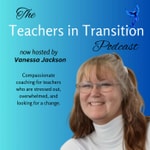
Burned out in the classroom? You’re not alone—and you’re not stuck.
Teachers in Transition: Career Change and Real Talk for Burned-Out Teachers is the podcast for educators who’ve given everything to their students—and now need to give something back to themselves.
Hosted by Vanessa Jackson, a former teacher who transitioned into the staffing and hiring industry, this show blends honest conversations, practical strategy, and deep emotional support. Vanessa knows exactly how burned-out educators can reposition themselves and stand out to recruiters because she’s been on both sides of the hiring table.
Each episode offers real talk and real tools to help you explore what’s next—whether that’s a new job, a new identity, or a new sense of peace.
💼 Career advice for teachers leaving education 💡 Practical job search tips, resume help, and mindset shifts 🧠 Real talk about burnout, grief, and rebuilding
You’ve given enough. It’s time to build a life that gives back.
Teachers have been told to “do more with less” for decades. But eventually, less produces less—and teachers have quietly been making up the difference with their own money, time, creativity, and stress.
In this episode of Teachers in Transition, Vanessa continues the Four Horsemen of Education miniseries with the Second Horseman: Resources. She examines how teacher generosity became an unofficial funding stream for education, why a single pencil is not really just a single pencil, and how teachers became institutional shock absorbers for poorly prioritized spending.
Then, in the Career Transition and Job Search segment, Vanessa turns to ghost jobs: postings for positions employers may not be actively trying to fill. Every application consumes finite resources—including time, attention, energy, and hope. Understanding the dysfunction behind ghost jobs can help transitioning teachers build rejection resilience and stop interpreting every unanswered application as a verdict on their value.
IN THIS EPISODE:
• Why “doing more with less” is no longer sustainable • How teachers personally subsidize classroom operations • The difference between teacher generosity and institutional responsibility • Why school spending is often a prioritization problem • What ghost jobs are and why employers post them • How ghost jobs consume applicants’ unpaid labor • Why networking can reveal information a job posting cannot • How to protect your confidence and build rejection resilience
If your job search is consuming your time, energy, and hope without producing results, you may not need to work harder. You may need a stronger strategy and help separating what you can improve from the dysfunction you cannot control.
The crowdfunding campaign for Invisible Excellence: The Hidden Value of Teachers Beyond Teaching is nearing its halfway point. The book only goes to press if it receives enough support to cross the finish line. Find the campaign link at:
Share this episode with a teacher who needs to hear that the system’s lack of resources - and the hiring market’s dysfunction - are not evidence that something is wrong with them.
Teacher burnout isn't a failure of resilience. What happens when teacher workload simply exceeds the time, energy, and capacity available to do the job?
This week on Teachers in Transition, Vanessa kicks off a new four-part series on the Four Horsemen of Education with the first Horseman: Capacity, also known as Realistic Expectations. We look at how decades of "it'll only take five minutes" have steadily expanded teacher workload—and why continually asking teachers to do more with less eventually means getting less with less.
We also get practical about reclaiming some of that capacity. In the Teacher Hack, learn how to create a simple response bank for the emails, explanations, policies, and other messages you find yourself writing repeatedly. The rule is simple: if you're typing it for the second time, put it in the bank. Using reusable chunks, headings in Google Docs or Word, voice-to-text, and AI for basic cleanup can save both time and mental energy.
Then, in our Career Transition and Job Search segment, we're talking networking and informational interviews. Networking doesn't have to mean awkwardly asking strangers for jobs. Instead, borrow a lesson from Ted Lasso: Be curious. A 10–15 minute conversation with someone doing work you're interested in can help you explore careers beyond teaching, learn how people entered their fields, identify skills or certifications you may need, and grow your professional network before you ever submit an application.
Also in this episode
Why teacher capacity is about the total workload, not whether each individual request seems reasonable
How EdTech can save administrative time while quietly consuming teacher time
Why "just five minutes" becomes a serious problem when nothing ever comes off the plate
How to build a mix-and-match response bank without creating another giant project for yourself
Questions to ask during an informational interview
Why teachers already have many of the relationship-building skills needed for effective networking
AI, Authentic Applications and the Human Advantage
AI is everywhere, but should we embrace it, fear it, or approach it with a healthy dose of skepticism?
In this episode of Teachers in Transition, Vanessa talks with bestselling author, former educator, and AI expert Jeremy Schifeling about the strange contradictions surrounding artificial intelligence. AI can help teachers recognize their transferable skills, translate their experience into corporate language, and strengthen their job-search materials, but when it becomes an easy button, the results can quickly turn into generic, fabricated word salad.
Vanessa and Jeremy explore the difference between work that is generated by AI and work that is developed with AI. They also discuss the emerging AI arms race between job seekers, recruiters, and employers, and why the best way to stand out may be to lean harder into the qualities AI cannot replicate: personality, curiosity, empathy, relationships, and real-world problem solving.
In This Episode
Why AI works best as a thought partner rather than a replacement for human thinking
How teachers can use AI to identify and translate their transferable skills
Why generic AI-generated resumes and cover letters can hurt a candidate
How to write for both applicant tracking systems and the humans behind them
Why understanding the hiring manager’s actual problem matters more than simply matching keywords
How teachers can use a master resume to make tailoring applications easier
Why relationships and networking remain essential in an AI-driven job market
How AI may affect entry-level jobs and the future talent pipeline
Why teachers’ relationship-building and emotional-intelligence skills may become even more valuable
How to ask AI to critique your resume instead of writing it for you
A simple, low-pressure way for AI beginners to start experimenting
Jeremy’s Teacher Hack for surviving those final ten minutes before the bell
Your Classroom Is Beautiful. Please Get Off the Desk.
Back-to-school classroom setup videos are full of creativity, care, and an astonishing amount of teachers’ personal money. But what happens if you are injured while decorating before your contract begins—or if the things you purchased are damaged, destroyed, or carried off during summer cleanup?
In this episode of Teachers in Transition, Vanessa examines some risks hidden behind those beautiful classroom transformations. She discusses workers’ compensation, a viral video showing a teacher’s belongings covered in mold, and the important difference between documenting a workplace problem and publishing it online.
Teacher Hack: Create a Classroom Purchase File
Learn how to:
• Save and organize classroom receipts • Document furniture, electronics, books, and other personal property • Keep records outside district-controlled systems • Photograph valuable items without exposing student information • Understand the difference between a tax deduction and a tax credit
For eligible educators, the federal educator-expense deduction rises to $350 for expenses paid during tax year 2026. Tax laws and individual circumstances vary, so verify the current rules and consult a qualified tax professional.
Career Transition and Job Search
Every public post contributes to your personal brand. Vanessa explains how to audit your digital footprint, preserve important workplace evidence, remove content that no longer represents you, and intentionally build the professional identity you want employers to find.
Ask yourself:
• Is this accurate? • Is this an impression I am willing to own? • Would I be comfortable explaining it during an interview?
Coming Next Week: Join the Movement: Invisible Excellence is available for pre-sell
This week on Teachers in Transition, I share a deeply personal story about a medical event that forced me to confront a difficult truth: sometimes our greatest strengths - resilience, endurance, and the ability to adapt - can become our greatest blind spots. It’s so personal that even the show notes are in first person!
Using the GenX childhood metaphor of quicksand, I explore how teachers gradually normalize exhaustion, chronic stress, and declining health until they no longer recognize what's happening. I also share the frightening experience of a vasovagal syncope episode after a "perfect storm" of circumstances and the lessons it taught me about paying attention before our bodies demand it.
In this episode you'll discover:
• Why "Teacher Tired" isn't always just teacher tired. • How resilience can accidentally hide a growing problem. • Why the best career decisions aren't made from survival mode. • A practical Teacher Hack to help you recognize when you're slowly sinking. • How a Battle Buddy can help you notice what you've adapted to. • Why asking better questions can be more important than finding one perfect answer.
If you've been wondering whether you're burned out, exhausted, or simply running on empty, this episode is for you.
In this episode, Vanessa explores what happens when companies eliminate entry-level positions while still expecting experienced employees to magically appear. As AI continues taking over more beginner-level work, who will develop the next generation of experts?
You'll discover why teachers may be uniquely positioned to solve a workforce problem that employers don't even realize they have yet, and how to position your experience as the solution.
In this episode:
Why the traditional career ladder is disappearing
How AI may unintentionally widen the experience gap
Why teachers are experts at developing people—not just delivering content
A new way to think about résumé bullet points: Task → Problem Solved
How to connect your classroom experience to the business problems employers are trying to solve
This week's Teacher Hack: a simple Google Doc that keeps all of your beginning-of-year ideas, shopping lists, and PD notes in one searchable place
Vanessa's recommendation: Ride or Die on Amazon Prime
Ready to start your own transition? Schedule a complimentary Discovery Session at https://TeachersinTransition.com/calendar.
Resources: 🎙 Happier in Hollywood Podcast The conversation that inspired this episode came from Happier in Hollywood, Episode 478, hosted by television writers and producers Liz Craft and Sarah Fain.
📺 Ride or Die (Amazon Prime Video) Vanessa's recommendation this week is Ride or Die, starring Octavia Spencer and Hannah Waddingham—a smart, funny series about friendship, competence, and the often invisible excellence of women in their fifties.
🍎 Teachers in Transition Ready to explore what's next after the classroom? Learn more, schedule a complimentary Discovery Session, and find additional resources at TeachersInTransition.com.
That’s a Feature, Not a Bug: The Hidden Value of Adaptability
What looks like “fine” may actually be a carefully engineered workaround.
In this episode, Vanessa explores the hidden value of adaptability through a misbehaving knee, a broken keyboard, and one spectacularly orange 1974 Lincoln Continental.
Teachers are experts at adapting. They anticipate problems, build missing systems, create backup plans, translate confusing information, and keep people moving—even when the systems around them are not working. When those adaptations succeed, however, they can conceal both the original problem and the cost of compensating for it.
You’ll hear:
• Why functioning is not the same as being fine • How teacher workarounds can hide institutional problems • The Adaptation Audit: Rebuild, Revise, or Refuse • How adaptability translates into marketable career skills • Two paths to explore: finding a job or creating one • Why teacher adaptability may also be entrepreneurship
Before rebuilding an old workaround for the new school year, ask what it was doing—and what it was doing to you.
Vanessa also shares some big news: she is writing a book!
The working title is Invisible Excellence: The Hidden Value of Teachers Beyond the Classroom, with publication planned for spring 2027. The book will explore how teachers’ leadership, communication, strategic thinking, training, relationship-building, adaptability, and problem-solving abilities become hidden - and how educators can make that value visible beyond the classroom.
Vanessa is looking to speak with former educators who have transitioned into new careers and teachers who are beginning to wonder what else might be possible.
If that describes you- or someone you know - reach out using the contact information below.
Links and resources:
What Teachers Can Learn About Leadership and Career Change from The Beastmaster
What does a 1982 fantasy movie filled with ferrets, bat-people, blue fire, and questionable leather wardrobe choices have to do with leaving teaching?
Quite a lot, actually.
In this episode of Teachers in Transition, Vanessa uses The Beastmaster as a surprisingly useful map for teacher career transition.
Dar begins the movie believing he is on a revenge mission. His home is gone. His identity has been shattered. The people in power have caused real harm, and he has every reason to be angry.
That emotional starting point may feel familiar to teachers preparing to leave the classroom.
The hero’s greatest strength is the very thing others see as strange. That same pattern shows up for teachers, who often minimize skills like communication, adaptability, leadership, relationship-building, and crisis management because they were treated as “just part of the job.”
This episode explores:
• Why your “weird” strengths may be your most valuable transferable skills • How networking is really built through trust and reputation • Why leaving teaching can feel like losing part of your identity • The difference between escaping a harmful system and building a better future • Why you are not starting over. You are learning to name what you already know how to do
Your transition does not have to stay focused on what education took from you.
It can become a rescue mission for your health, confidence, voice, family, and future.
Have you ever felt like teaching has become one long marathon...where everyone expects you to sprint?
In this episode of Teachers in Transition, Vanessa shares an unexpected lesson from a 3,000-mile solo road trip. She planned to write, record podcasts, and make progress on her business. Instead, she spent most of the trip managing recovery, sleep, hydration, and a very opinionated knee.
That experience led to a realization that many educators desperately need to hear:
You can't always be at your best. Otherwise, it wouldn't be your best—it would be your normal.
This episode explores why experienced teachers are sometimes unfairly labeled "bitter” and why learning to adapt is more sustainable than simply enduring.
Whether you're planning to remain in education or considering a career transition, this episode offers practical strategies for protecting your energy, building career capacity, and preparing for your future one step at a time.
In This Episode
Why sprinting is a terrible strategy for a marathon
The hidden cost of expecting teachers to operate at 110% every day
Why experienced teachers aren't "bitter"—they've become efficient
How schools unintentionally prevent veteran teachers from benefiting from experience
The difference between activity and impact
Why experience is supposed to pay dividends
The importance of recovery as part of professional excellence
The Teacher Hack: Budget Bumper Time
Career Transition Strategy: Build capacity before you need it
Why you shouldn't "buy new running shoes on marathon day"
Practical ways to prepare for a career transition without overwhelming yourself
How strategic upskilling can help you prepare for your next career before you need it
What if one of the best career lessons for teachers came from a 1993 comedy?
In this Moviesode, we're looking at Dave, starring Kevin Kline—not as a political movie, but as a modern fairy tale about leadership, service, and remembering that every job is temporary.
As Dave unexpectedly steps into one of the most powerful roles in the world, he doesn't rely on political experience. He succeeds because he listens, notices people, asks good questions, and surrounds himself with people whose expertise complements his own.
Sound familiar?
Those are many of the same invisible skills teachers use every single day.
In this episode, we'll explore:
Why Dave is really a fairy tale about leadership
The difference between noticing people and simply looking at them
Why teachers are "professional noticers"
What Murray the accountant teaches us about asking simple questions
How labels can hide our true abilities
Why your greatest professional strengths may already exist—you just haven't seen them in a new environment yet
The connection to my upcoming book, Invisible Excellence: The Hidden Value of Teachers Beyond Teaching
Why every job—including teaching—is ultimately a temporary assignment
Whether you're actively considering a career transition or simply thinking differently about your current role, this conversation is a reminder that your value is much bigger than your job title.
📘 Follow for Updates on: Invisible Excellence: The Hidden Value of Teachers Beyond Teaching
The one rule to remember when someone gives you 15 minutes of their time
Help Publish a book that can help all teachers recognize their excellence!
Invisible Excellence: The Hidden Value of Teachers Beyond Teachingis about bringing the extraordinary skills, expertise, and value of teachers into the light—and helping teachers recognize what they bring to the table.
The Visibility Project is currently crowdfunding publication of Invisible Excellence, with several ways to participate beginning at $50. The campaign closes September 18 at midnight Eastern.
Whether you're wondering if it's time to leave teaching, exploring careers beyond teaching, translating your teacher skills, building a resume, networking, job searching, or preparing for interviews, Teachers in Transition has resources designed to meet you where you are in the process.
Vanessa is also accepting a limited number of new coaching clients for fall. If you'd like to talk about where you are in your career transition and whether working together would be a good fit, schedule a conversation here:
· AI is especially good at translation, pattern recognition, brainstorming, and review. Give it your real experiences, accomplishments, feedback, and stories, and it can help you see connections you may have missed.
· AI should not replace your voice, your curiosity, or your relationships. Use it to support your thinking, but keep yourself in the process.
· And remember: Your teaching experience has prepared you to solve real problems, communicate with different audiences, manage competing priorities, and build relationships quickly. Those abilities are valuable far beyond the classroom.
Vanessa’s upcoming book, Invisible Excellence: The Hidden Value of Teachers Beyond Teaching, is currently in its presale and crowdfunding phase. The goal is to bring this book into the hands of teachers everywhere and help them recognize how much value they carry beyond the classroom.
If you enjoy this scrappy little indie podcast, please consider:
sharing this episode (or any of them!) with a teacher friend
leaving a 5-star rating and review on Apple Podcasts or Spotify
supporting the show financially starting at just $3/month Support Teachers in Transition. It helps with production costs to keep this show on the air. Bottom of Form
The transcript to this podcast is found on the episode’s homepage at Buzzsprout
🎵 Rush – "Sweet Miracle" If you've ever wondered why Rush lyrics occasionally sneak into my vocabulary, this song has quietly lived in my head for years and it applies beautifully to this episode.
Please don't let my story discourage you from donating blood.
My experience was unusual because a whole bunch of factors lined up at exactly the wrong time. That's really the point of this episode.
If you're healthy and eligible, donating blood is still one of the simplest and most meaningful ways to help another human being. Find your local blood bank and consider making an appointment.
• See the spectacular orange Lincoln: • Contact Vanessa about the book: Vanessa@TeachersinTransition.com (You can contact Vanessa about anything related to Teachers in Transition also at that email.
Support the Podcast!
If you enjoy this scrappy little indie podcast, please consider helping me keep this resource going so that it can help other teachers. You can:
Please follow the podcast, leave a rating and review on Apple Podcasts, and share it with a teacher who needs the reminder that sustainable excellence isn't about sprinting every day.
Sometimes the bravest thing we can do isn't push harder.
Sometimes it's learning to pace ourselves wisely.
Support the Podcast!
If you enjoy this scrappy little indie podcast, please consider:
Discover shows related to Teachers in Transition: Career Change and Real Talk for Burned-Out Teachers, based on actual content similarities. Explore podcasts with similar topics, themes, and formats, backed by real data.