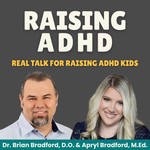
Raising a child with ADHD can feel overwhelming—meltdowns, school struggles, medication decisions, and the constant fear you’re doing it wrong. Raising ADHD is the podcast for parents and teachers who want clarity, strategies, and real-life support.
Hosted by Apryl Bradford, M.Ed. (former teacher and ADHD mom) and Dr. Brian Bradford, D.O. (Child & Adolescent Psychiatrist), this show cuts through the myths and misinformation about Attention-Deficit/Hyperactivity Disorder. Together, Apryl and Dr. Bradford bring both lived experience and clinical expertise to help you:
Understand what ADHD really is (and isn’t)
Navigate school challenges and partner with teachers
Make sense of medication options without the jargon
Support your child’s strengths while tackling everyday struggles
Feel less alone and more empowered on this journey
Each week, you’ll hear practical tips, the latest insights from the field, and conversations that validate what you’re living through. Whether you’re dealing with emotional outbursts, executive function challenges, or the stigma that still surrounds ADHD, you’ll find real talk and real help here.
If you’ve ever asked yourself, “Am I doing this right?”—this podcast is your answer.
Disclaimer: This podcast is for educational and informational purposes only. It is not medical or psychiatric advice and should not replace professional consultation with a qualified healthcare provider. Always seek the advice of your physician or other licensed professional with any questions you may have regarding your child’s health or behavior.
Site
RSS
Apple
Recent rankings
Latest chart positions across Apple Podcasts and Spotify rankings.
Shared links between episodes and podcasts
Links found in episode descriptions and other podcasts that share them.
Discover shows related to Raising ADHD: Real Talk For Parents & Educators , based on actual content similarities. Explore podcasts with similar topics, themes, and formats, backed by real data.
ADHD executive function is why your checklist isn't working. Learn how to become your child's GPS and scaffold the skills that actually get things done at home.
You made the checklist. You laminated it. You hung it on the fridge. Your child used it for two days. Now you're frustrated because they won't even look at it, and you're wondering if anything will ever work.
Here's the problem: the checklist was never the issue. Your child's ADHD executive function was. And nobody taught you how to scaffold a tool into a skill.
ADHD executive function is the brain's GPS. It's what gets your child from "time to get ready" to actually being ready. Your child has the car, the engine, and the ability to drive. What's missing is the navigation. And handing someone a map when their GPS is broken doesn't fix anything. It just gives them one more thing to forget.
In this episode, Apryl shows you exactly what ADHD executive function looks like in real life (including a hilarious melatonin-and-ant-trap story), walks through her actual morning routine step by step, and teaches you the scaffolding system that builds your child's internal GPS over time.
You'll learn:
What ADHD executive function actually is and why it's the real reason things aren't getting done
The GPS analogy: Why your child knows WHERE they want to go but can't navigate HOW
Why checklists add one more task to a brain already struggling with working memory
How to become your child's GPS until their ADHD executive function catches up
A real-life ADHD morning routine from start to finish (including the 40-minute breakfast that actually helps)
The 3 layers of scaffolding: From full support to independence
How to scaffold a checklist IF you want to use one (so it actually works)
Why consistency builds ADHD executive function faster than any tool
What to do when ADHD executive function skills slip back
After this episode, you'll stop blaming the checklist and start building the scaffolding that makes ADHD executive function actually grow.
Not sure how to talk to your child about ADHD? Get age-specific scripts, do's and don'ts, and the mom perspective on making the conversation feel natural, not heavy. _____________________________________________________________
Have you been putting off the ADHD conversation with your child? Maybe you're not sure what to say. Maybe you're afraid you'll say the wrong thing. Maybe you're worried it'll feel too heavy or make them feel like something is wrong with them.
This episode is going to take that weight off your shoulders.
Apryl shares her real-life mom perspective on how she talks to her daughter about ADHD, from tiny everyday car conversations to the bigger moments. She breaks it down by age group with actual scripts you can use, and shares the do's and don'ts that keep the conversation empowering instead of intimidating.
You'll learn:
How to use everyday moments to talk about ADHD naturally (not as a sit-down "talk")
The race car brain and Model T brakes analogy that kids actually understand
Age-specific scripts for preschool/early elementary (4-8), tweens (9-12), and teens (13+)
How to frame ADHD as different, not broken
Why books like My Brain is a Race Car and ADHD Rapped Up are so helpful
How to build self-advocacy so your child can communicate what they need
The do's and don'ts of language and tone (what to say and what to never say)
How talking openly about ADHD reduced meltdowns in Apryl's home
Why your teen should be in the driver's seat of their own treatment plan
After this episode, you'll stop dreading the conversation and start having it. And your child will be better for it.
KEY TAKEAWAYS
The core philosophy: Be open. Make it normal. Use everyday moments. The more you talk about ADHD, the more regular it becomes. And the more your child understands their brain, the more they can advocate for themselves.
ADHD Without Medication: What Actually Works (According to the Highest-Quality Research)
Overwhelmed by conflicting ADHD advice? Discover what actually works (and doesn't) for managing ADHD without medication, backed by top-tier research.
______________________________________
If you've ever found yourself Googling "ADHD help without medication" at midnight, wondering if anything actually works, or if you're just failing your kid, this episode is for you.
Here's the truth most people won't tell you: the research is clear about what helps and what's just wishful thinking. But that clarity? It's actually freeing.
Today, Apryl and Dr. Brian break down what the highest-quality research, from the Lancet, NIMH, Cochrane, and the American Academy of Pediatrics, actually says about non-medication strategies. No TikTok trends. No miracle supplements. Just honest, evidence-based guidance you can actually use.
In this episode, you'll learn:
The single most effective non-medication intervention (and why it focuses on YOU, not your child)
How 20 minutes of exercise creates a 60-minute window of improved focus
The surprising research on sleep interventions and lasting symptom reduction
Which supplements have real evidence (and which are wasting your money)
A 3-tier action plan you can start this week
Why the "multimodal approach" outperforms any single strategy
Free tools to track progress like a scientist
Walk away with a research-backed plan, and permission to stop chasing every new "cure" that pops up on your feed.
ADHD mornings don't have to be chaos. Learn how to identify your household's biggest battle zone and make one environmental shift that changes everything.
_______________________________________
Someone's crying. You're already running late. The shoes are right there but somehow invisible—and suddenly you're not just tired, you're angry. Before you've even had your coffee, you're yelling. Sound familiar?
Here's the thing: the problem isn't your child. It's not that they're not trying hard enough, and it's not that you're failing as a parent. The problem is that we keep asking kids with developing executive function to do things their brains aren't ready for—especially before medication kicks in.
In this episode, Apryl breaks down exactly how she transformed their chaotic ADHD mornings into something actually... calm. No 5 AM wake-up overhauls. No Pinterest-perfect systems. Just one strategic shift that changed everything.
What you'll learn:
How to identify your household's biggest "battle zone" (and why you only fix ONE at a time)
The reframe that changes everything: scaffolding isn't creating dependence
Apryl's exact morning setup that eliminated the "go upstairs" problem
Why removing decisions beats adding reminders every time
The Alexa alarm system that took nagging completely off her plate
You'll walk away knowing exactly where to start—and finally believing calm mornings are possible for your family too.
RESOURCES MENTIONED
Free Workshop: "When You Love Your Child But Don't Like Who You're Becoming"
Your phone buzzes: another behavior report. Learn why punishment fails ADHD kids and get scripts to build a real school-home team.
____________________________________
It's 2:47 PM. Your phone buzzes. You already know what it is before you look. Behavior update. Today was difficult. Please discuss consequences at home. Your stomach drops—because this isn't information. It's a verdict.
Here's what no one tells you: There are three people drowning in that moment. Your child, who's overwhelmed and has no words for it. The teacher, who's exhausted and out of tools. And you, already hanging on by a thread, now expected to be the enforcer.
This episode is for that moment. Not the Pinterest version of ADHD support—the real one. Apryl breaks down why traditional classroom discipline fails ADHD brains and what actually works, backed by research and her decade of classroom experience.
You'll learn:
Why taking away recess is one of the worst things you can do for an ADHD kid
The one phrase that changes everything: "Praise the positive opposite"
3 research-aligned moves teachers can use in the moment of meltdown
A word-for-word email script to send your child's teacher (without sounding like you're blaming)
How to ask for a two-goal plan that both school and home can actually sustain
The simple template that replaces behavior crime reports with trust-building communication
Why ADHD kids change through in-the-moment support—not 8 PM lectures
After listening, you'll finally have language for what you've been feeling and a concrete plan to share with your child's school.
The Email Script for Parents
Ask for:
Please don't remove recess for behavior—movement helps them regulate
Can we pick two school goals only? (Example: raise hand during math, start work within 2 minutes)
Why Your ADHD Child Thinks "I'm the Problem" (And How Repair Changes Their Identity)
ADHD kids hear "I'm the problem" on repeat. Learn why repairing after yelling rewrites that story—and what to do when your child won't engage.
________________________________________
There's a sentence ADHD kids learn really early. They don't usually say it out loud, but they're living it internally: I'm the problem.
Not "that was hard." Not "that didn't go well." But something is wrong with me.
Here's what the research says: it's not the conflict that damages your relationship—it's the unrepaired conflict. And for kids with ADHD, who've already received thousands more corrections than their peers by elementary school, those unrepaired moments stack into an identity.
In part two of our repair series, we're going deeper into why repair matters so much for the ADHD brain—especially when rejection sensitivity makes yelling feel like proof they're unlovable.
In this episode, you'll learn:
The critical difference between shame and guilt (and why it matters for ADHD)
Why your child refuses to accept your apology (it's protection, not defiance)
How to repair when your kid shuts down or says "I don't care"
The nonverbal repairs that count just as much as words
Language shifts that protect your child's identity
Signs that your repair actually worked
Walk away knowing that every repair—even the ones your child doesn't respond to—becomes data they'll use to trust you again.
KEY TAKEAWAYS
The Shame vs. Guilt Distinction
Why Kids Refuse Repair (3 Reasons)
How to Repair When They Won't Engage
Nonverbal Repairs That Count
The Identity-Protecting Language Shift
Why This Matters for ADHD
Stop Sitting in Mom Guilt: How to Repair with Your ADHD Child After You Lose It
Yelled at your ADHD child and feel awful? Learn the 5-step repair system that protects your child's self-esteem and actually strengthens your relationship.
_______________________
The explosion is over. The house is quiet. Your kid has disappeared into their room, and you're standing there with a pit in your stomach, replaying the look on their face and asking yourself the question no parenting book prepared you for: Am I ruining my kid?
Here's what you were never taught: the yelling isn't what damages the relationship. It's what happens—or doesn't happen—afterward.
In this episode, Apryl and Dr. Brian Bradford break down the neuroscience behind why your child can't "learn their lesson" during a blowup (spoiler: their thinking brain is literally offline), and walk you through the exact 5-step repair process that protects your child from developing a shame-based identity.
Because ADHD kids already hear thousands more corrections than their peers by elementary school. They don't need perfection from you. They need repair.
You'll learn:
Why secure attachment is built through rupture AND repair—not by never messing up
The brain science behind why consequences don't work when your child is dysregulated
The 5-part repair system you can use tonight (with exact scripts)
How to apologize without giving in on your boundaries
The "do-over" technique for catching yourself before it escalates
Why this one shift can change your child's internal story from "I'm bad" to "I'm learning"
If you've been carrying guilt about losing your temper, this episode will feel like someone finally handed you the missing manual.
RESOURCES MENTIONED
Free course: "3-Second Calm Reset" at
When ADHD Anger Turns Destructive: Why Punishment Makes It Worse (And What Actually Works)
Destructive anger in ADHD kids is one of the most misunderstood, shame-loaded experiences parents face. The advice most families are given — harsher consequences, bigger punishments, “making it stop” — often makes these episodes happen more often, not less.
In this episode, Apryl and Dr. Brian walk through what’s actually happening in the ADHD brain during these moments — and the system that helps families stop the cycle without becoming permissive or powerless.
Thoughts parents have that this episode answers
“If I don’t punish this hard, am I raising a future adult who can’t control themselves?”
“Why does my kid destroy things over something so small?”
“Nothing works — consequences, lectures, taking things away.”
“Am I being too soft… or am I missing something?”
You’re not weak for asking those questions. You’re responding to a nervous system problem with tools that were never designed for ADHD brains.
What This Episode Walks You Through
1. Why logic disappears during ADHD anger explosions
What’s happening in the amygdala vs. the prefrontal cortex
Why reasoning, lecturing, and threats cannot work in the moment
The difference between knowing better and being able to do better
2. The system that reduces destructive behavior over time
How to interrupt explosions before they happen
Why antecedents matter more than consequences
The “positive opposite” strategy that teaches replacement behaviors
3. Consequences that teach — without escalating the fire
Why harsh punishment increases aggression and dysregulation
[Part 5 of 5] The ADHD Holiday Survival System: The 3-Phase Plan That Stops Meltdowns, Sensory Overload & Dopamine Crashes
This is the holiday episode every ADHD parent needs. After five weeks of dismantling holiday myths, decoding meltdowns, and rebuilding your confidence piece-by-piece…we’re finally here.
In this episode of Raising ADHD, Apryl (former teacher + ADHD mom) and Dr. Brian Bradford (child & adolescent psychiatrist) reveal the complete, step-by-step ADHD Holiday Survival System — the exact 3-phase plan that helps your child stay regulated, reduces sensory overload, prevents RSD spirals, and finally lets your family enjoy the holidays again.
If you’ve ever thought:
“Why do the holidays always end in tears?”
“Why does my ADHD child fall apart at family gatherings?”
“Why is the week after Christmas the hardest week of the year?”
“Why does my kid get overstimulated so fast — and how do I help?”
…this episode is your roadmap back to calm, connection, and actual joy.
🎄 What You’ll Learn (and Why It Works for ADHD Brains)
PHASE 1 — The Setup (Outsourcing Executive Function Before the Holidays Even Start)
✔ The Visual Preview Strategy that solves ADHD time blindness ✔ The No-Surprises Gift Rule that prevents meltdowns and RSD ✔ The Body-Doubling Wrapping Method that eliminates last-minute stress ✔ Why neurodivergent families need predictability, not “magic” ✔ How ADHD adults benefit from these same tools too
PHASE 2 — The Event (Regulating Sensory + Social Load in Real Time)
✔ How to create a Sensory Safe Zone before you even walk in the door ✔ What belongs in your ADHD Regulation Kit ✔ The Two-Car Rule that stops the “I’m trapped here” panic spiral ✔ Social Scripts to avoid overexplaining, awkwardness, or unsolicited advice ✔ The Dopamine Menu that stabilizes mood + behavior without restricting joy
[Part 4 of 5] The Small Holiday Tweaks That Create Big ADHD Wins (Parents Can’t Believe the Difference)
There’s a moment every ADHD parent remembers. Not the big, Instagram-perfect one — the small, quiet one.
It’s the moment you realize: “Wait… this actually worked.”
The morning didn’t explode. The meltdown didn’t happen. Your kid didn’t spiral at the holiday party. For a few seconds, your home felt calm — and you almost didn’t believe it.
This episode of Raising ADHD is about that moment. The wins. The proof that small changes create big transformations, especially during the holidays.
Welcome to Episode 4 of our Holiday Series — the episode where everything finally clicks.
✨ What This Episode Covers (and Why It Matters)
After learning the ADHD Holiday Paradox (Ep 1), the 10-Minute Reset (Ep 2), and the myths sabotaging your season (Ep 3)… today we show you how the wins start showing up — in mornings, sensory overwhelm, boundaries, and emotional regulation.
These are the changes you’ll begin to see when your child’s brain finally gets:
Let’s break down the four biggest wins ADHD families experience during the holidays.
🎁 WIN #1 — Morning Peace (The Everyday Anchor That Changes Everything)
Mornings are the pressure cooker of ADHD households — fast, frantic, and full of cortisol spikes. But one small daily anchor (“the first thing we always do”) can completely change the tone of the day.
You’ll learn:
Age-by-age approach:
Ages 4-8 (Preschool/Early Elementary): Keep it simple. Use the race car brain with Model T brakes analogy. Normalize "crashes." Frame differences as just different, not bad. Introduce the idea of tools that help the brain (glasses analogy). Use books. Reassure them it's not their fault, they're not alone, and you love them no matter what.
Ages 9-12 (Tweens): Add brain science (prefrontal cortex, executive function as the air traffic control system). Talk about strengths: creativity, hyperfocus, humor, risk-taking. Introduce self-advocacy. Let them have a voice in treatment decisions. Use books like ADHD Rapped Up by Mr. G. Pull up YouTube videos of the brain. Show them successful people with ADHD.
Ages 13+ (Teens): Full transparency. Use the term "executive function skills" because it carries into adulthood. Discuss co-occurring issues (anxiety, depression). Put them in the driver's seat of their treatment plan. Co-create strategies together. Address stigma directly. Show them how successful adults manage ADHD.
Do's and Don'ts:
Do: Start early. Pick a calm moment. Keep it positive and realistic. Use their own language. Revisit often in small, casual ways.
Don't: Say "you ARE ADHD" (say "you HAVE ADHD"). Make it shameful or secret. Focus only on deficits. Use ADHD as a blanket excuse for everything. Present it as a life sentence.
Phrases to keep handy: "Your brain works differently, and different isn't bad. It just means we need different tools." / "ADHD explains why some things are hard. It doesn't define you." / "Lots of kids and adults have ADHD. You're not alone." / "Our job as your parents is to help you figure out how your brain works best."
Ready to Build a Calmer Home? Start Here:
🧩 Take the Free Executive Function Quiz — Compare your skills with your child's and find out where the gaps are
By late elementary school, kids with ADHD have received thousands more negative corrections than their peers. These aren't neutral—they stack into an identity of "I am the problem." Consistent repair doesn't erase consequences; it changes the story from "I am bad" to "that was hard."
How small, boring, predictable consequences actually stick
4. How this changes for teenagers
Why dignity, privacy, and agency matter more as kids get older
How to collaborate instead of control
What repair sounds like after the storm — without shaming
5. What teachers can do to prevent public blowups
Simple classroom strategies that protect regulation and self-esteem
How to intervene quietly before the explosion
Why predictability lowers threat for ADHD students
Why this approach works when others fail
Most parenting advice treats explosive anger as a behavior problem. This episode treats it as a nervous system overload — and responds with strategies that work with ADHD brains instead of against them.
This isn’t permissive parenting. It isn’t “being soft.” It’s strategic, research-aligned, and focused on building skills your child will carry into adulthood.
Want to go deeper?
Share this episode with a partner, teacher, or caregiver who needs the full picture
Subscribe so you don’t miss the next episode on repairing after blowups
Leave a review — it helps other ADHD families find support that actually helps
You’re not failing. You’re learning a different way to lead — because you have a different kid.
These strategies don’t just help your child stay regulated — they help YOU stay regulated, which makes the whole day smoother.
PHASE 3 — The Landing (Preventing the Dopamine Crash After the Holidays)
✔ Why the post-holiday crash is biological, not behavioral ✔ The Buffer Day Rule that protects your family’s nervous system ✔ Why every ADHD family needs a Bridge Event 2–3 weeks after Christmas ✔ How to rebuild joy through connection, not perfection ✔ “Good Enough Traditions” that reduce overwhelm and increase bonding
This phase alone will change your January.
🌟 Why This Episode Matters
The holidays were built for neurotypical brains — not ADHD ones. If you’ve ever felt like you were failing…you weren’t.
The system was failing you.
But with the right structure, sensory strategies, and dopamine-aware planning, your holidays can go from barely surviving to:
peaceful mornings
fewer meltdowns
more connection
actual joy
…for both you and your ADHD kiddo.
🔗 FREE Holiday Survival PDF (Your Step-By-Step Plan)
Grab the full holiday system as a printable PDF: 👉 raisingadhd.org/holiday
🎙️ Have a Question You Want Us to Answer on the Show?
Submit it here and we may feature it in an upcoming episode: 👉 raisingadhd.org/question
❤️ If This Episode Helped You…
The best gift you can give us this season is:
leaving a review
tapping subscribe
sharing this with another parent or teacher who needs it
Your support helps more families find the ADHD clarity they’ve been searching for.
How predictable anchors wake up the “CEO of the brain”