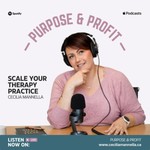
Host Cecilia Mannella is on a mission to help therapists scale their therapy practice - she scaled from solo therapist to 7-figure group practice. This show is for therapists ready to ditch the "hustle harder" mentality and scale without sacrificing values or sanity. Learn sustainable growth strategies that don't require 60-hour weeks or caffeine IVs. Whether you're hitting $100K or scaling beyond, get real tactics for building a profitable practice that serves your life. Scale without sacrifice.
Site
RSS
Apple
Data updated on 14/07/2026
Recent rankings
Latest chart positions across Apple Podcasts and Spotify rankings.
Shared links between episodes and podcasts
Links found in episode descriptions and other podcasts that share them.
25 | Live Coaching: From OT to RCC With Lisa Brooks — Building Permission to Self-Promote
Episode 25
Tuesday, February 24, 2026 • Duration 52:27
When you've got unfinished PESI courses piling up and a background in OT, how do you actually translate all that knowledge into shameless self-promotion? Lisa Kessier-Brock is a registered clinical counsellor who blends her occupational therapy roots with psychotherapy to support parents navigating the messy, never-ending journey of parenthood. Cecilia coaches her through the permission piece, tech overwhelm, and building sustainable marketing systems that don't require dancing on social media.
What You'll Learn:
Why permission to self-promote is the first hurdle most therapists face (and how to get over it)
The tech intimidation factor for women and how to move through it with practical tools
How to maximize your existing tech stack instead of complicating things with more platforms
The strategic difference between workshops that convert and workshops that just drain your energy
Why time blocking isn't a time management issue — it's a self-boundary issue
How to create automated email sequences that nurture workshop attendees without Jane App
The real reason content takes three hours instead of 45 minutes (and it's not the content)
Why your ADHD brain needs built-in creative time blocks, not rigid productivity systems
Key Topics Discussed:
Lisa's journey from OT to RCC and why the mental health piece was always the passion
The COVID-era "everyone has a wait list" myth that set up unrealistic expectations
Permission to share knowledge and why life experience is as valuable as seven courses from PESI
Shameless self-promotion as a Full Practice Formula breakthrough
Tech intimidation as a gendered issue and how to overcome it
Workshop strategy: free vs. paid, in-person vs. virtual, and what actually converts
Building email automation with MailerLite forms and Google Meet (no Jane App needed)
Time blocking as a self-boundary practice, not a productivity hack
The brain's relationship to time allocation and why tasks expand to fill the space you give them
Integrating ADHD needs into your business systems instead of fighting them
Mentioned in This Episode:
Lisa Kessier-Brock, M.Ed., RCC - Registered Clinical Counsellor, Vancouver, BC
Nurtured Foundations Therapy & Consulting - Lisa's practice supporting parents
Full Practice Formula - Cecilia's program for therapists building sustainable practices
PESI - Professional education platform with endless...
24 | From Care Aide to Grief Specialist: Building a Practice That Honours the Messy, Non-Linear
Episode 24
Tuesday, February 3, 2026 • Duration 39:33
What happens when everything you learned in graduate school about grief contradicts what you experienced in real life? Eliezer Moreno, grief and loss therapist in Vancouver, shares the powerful story of losing his friend Ryan shortly after learning "all the right things" about supporting people in grief—only to find himself confused, lonely, and unable to cry at the memorial. This conversation explores how his grandmother's nursing legacy, hospice volunteering, and personal loss shaped a practice that rejects pathologizing grief and instead walks alongside people in their messy, non-linear healing.
What You'll Learn:
+ Why the hospice model of "companioning" differs radically from clinical training's pathologizing approach
+ How losing a friend shortly after grief training revealed the gap between theory and lived experience
+ The physical manifestations of grief that aren't talked about enough
+ Why disenfranchised grief keeps people stuck and how to validate every type of loss
+ The power of saying "I don't know what to say" instead of trying to fix or solve
+ How to build a grief therapy practice that honours mess over models
+ Why YouTube and email marketing are essential for grief therapists in 2025
+ The one-to-many service model that extends your impact beyond the therapy room
Key Topics Discussed:
+ Eliezer's journey: grandmother's nursing legacy in the Philippines → care aide work → collecting stories from clients
+ The shift from practical care to therapeutic presence (noticing photos on walls, asking about people's lives)
+ Social work training: learning modalities and clinical interventions focused on pathology
23 | The Social Worker's Dilemma: Making Money Without Betraying Your Values
Episode 23
Tuesday, January 27, 2026 • Duration 41:54
Social workers are trained to fight capitalism and poverty—so what happens when you decide to open a private practice and charge for your services? April Griffin, MSW and group practice owner, gets brutally honest about the identity crisis, money shame, and values conflict that social workers face in the private sector. This conversation tackles the elephant in the room that nobody in social work education wants to discuss.
What You'll Learn:
+ Why social workers struggle more than other therapists with the transition to private practice
+ The values conflict: anti-capitalist training meets the reality of needing income to survive
+ How social work education fails to prepare practitioners for private practice (or even acknowledge it exists)
+ Why private practice social workers aren't winning "Social Worker of the Year" awards
+ The scarcity mentality that prevents social workers from investing in their practice growth
+ How April built a 400-member Facebook group for BC social workers in private practice
+ What it takes to reconcile social work values with running a profitable business
+ Why "I just wanted to help people for free" is an unsustainable business model
Key Topics Discussed:
April's journey: Ukraine volunteer work at 18, Downtown Eastside, addiction/trauma/domestic violence work
+ Transition from Fraser Health (Maxine Wright Centre) to private practice during COVID
+ Starting in 2020: offering in-person therapy when everyone else was virtual only
+ The slow-and-steady build: hourly rental → sublet → own space → group practice (3 associates)
+ Social work's "client first" values that leave no room for practitioner sustainability
22 | Live Coaching: When Your Two Niches Feel Like They Don't Belong Together
Episode 22
Tuesday, January 20, 2026 • Duration 41:50
What do you do when you have two completely different niches that you're equally passionate about? KelliWheatley is a first-year therapist in North Vancouver who loves working with both chronic pain/mind-bodyconnection AND walk-and-talk nature therapy. On the surface, they seem unrelated—but Cecilia coaches herthrough discovering the powerful connection that makes both niches work under one cohesive brand umbrella.
What You'll Learn:
+ Why two different niches can work together when YOU are the umbrella
+ How to position yourself as the brand instead of fragmenting into separate identities
+ The biggest mistake therapists make when entering private practice (expecting to be fully bookedimmediately)
+ Why niche clarity is burnout prevention and creates practice longevity
+ How to write blog content at a conversational level (the 13-year-old test)
+ The mindset shift from "content creator" to "service provider" (one-to-many education)
+ Why marketing as a therapist feels gross (and how to reframe it as getting in front of people you cansupport)
+ How to connect two seemingly different specialties through the common thread
+ The "COVID bubble" myth: why the "everyone has a wait list" messaging set up new therapists fordisappointment
+ First-year reality check: the expectation vs. reality of building a private practice
+ Niche confusion: chronic pain/mind-body work AND walk-and-talk nature therapy—how do theyconnect?
+ The umbrella concept: YOU are the brand that holds everything together
21 | Beyond Resolutions: The CEO Pause You Actually Need (New Year Reflection)
Episode 21
Tuesday, January 6, 2026 • Duration 34:45
New Year's resolutions feel empty because they skip the most important part: honest reflection. This isn't another "new year, new you" message—it's the anti-resolution episode you need. Before you set any goals for2026, you need to pause and look honestly at where you've been and who you're becoming as a practice leader.
What You'll Learn:
+ Why reflection matters more than resolution-setting for sustainable practice growth
+ The exact journaling questions Cecilia uses every quarter to assess her practice
+ How to evaluate your year through the lens of lessons learned, not just wins and losses
+ What made 2025 successful in Cecilia's practice (ecosystem building, strategic hiring, marketing experiments)
+ The habits you need to start and stop to become the leader your 2026 vision requires
+ How to identify what needs to be released before you can move forward
+ Why personal growth is the prerequisite for business growth (not the other way around)
Key Topics Discussed:
+ The CEO pause: taking off your clinician hat to reflect as a business leader
+ 2025 wins: building an ecosystem practice with diverse specialties, promoting from within, experimenting with AI optimization
+ 2025 challenges: bad hires, letting go quickly, investment experiments that didn't pay off
Lessons learned:
+ Experimentation mindset, stabilization after growth, team culture importance
+ Releasing unfinished conversations and letting go of what no longer serves
20 | Why Great Leaders Still Drown in Chaos (4P — Process Pillar)
Episode 20
Tuesday, December 9, 2025 • Duration 37:06
You've got your purpose clear, your profit strategy solid, and your team aligned with your values. So why are you still spending 17+ hours a week drowning in administrative chaos? Here's the truth nobody tells you: You can have the best vision, strongest profit margins, and most authentic leadership—but if your operations don't have clear systems, they're going to burn you out. This final episode in the 4 Pillars series tackles the unsexy but essential foundation that makes everything else possible: processes.
What You'll Learn:
Why 50-80% of your non-clinical time goes to operational issues that could be systematised
The hidden cost of hiring without a structured process (and how it's draining your time and money)
How to stop being the bottleneck in every single decision your team needs to make
The six priority systems every therapy practice needs—and the exact order to implement them
Why documentation isn't bureaucracy—it's the key to scaling without losing your mind
How to build team communication structures that actually work instead of fragmenting across platforms
The firing and off-boarding process you need before you need it (because it never gets easier)
Key Topics Discussed:
Operational chaos symptoms: hiring without systems, financial mystery, communication fragmentation, performance management avoidance, documentation resistance, and crisis-mode firing
The real cost of not having processes: reactive hiring, constant re-explaining, self-doubt, financial uncertainty, wasted time, team frustration, legal vulnerability, and burnout
Six priority systems in implementation order: hiring and onboarding, financial tracking and reporting, performance management and feedback, team communication and decision authority, regular check-ins, and firing/off-boarding protocols
Hiring system essentials: clear job descriptions, structured interview processes, comprehensive onboarding plans, and 30-60-90 day check-ins
Financial clarity requirements: monthly profit and loss reviews, quarterly projections, clear bookkeeping systems, and knowing your numbers at all times
Performance management framework: regular check-ins, real-time feedback culture, documented conversations, and early issue identification
19 | Why You Can't Scale Without Letting Go (4P — People Pillar)
Episode 19
Tuesday, December 2, 2025 • Duration 37:51
You've built a thriving practice, you're at capacity, and you know the next step is hiring—but here's what nobody tells you: being an excellent therapist doesn't automatically make you a great leader. Most therapy practice owners struggle to scale not because they can't, but because we were never taught how to shift from clinician to leader. And the fear of becoming the kind of manager you never wanted to be? That's keeping you stuck in solo practitioner mode even after you've hired associates.
What You'll Learn:
Why clinical excellence doesn't translate to leadership skills (and what actually does)
The three most common leadership scenarios that keep therapy practice owners stuck in micromanagement mode
How to create boundaries between being a leader and being a therapist for your team
The difference between transactional leadership and transformational leadership—and why only one works for values-driven practices
Five essential leadership conversations every practice owner needs to master
Practical strategies for building team culture that reinforces your practice values
How to step into authentic leadership without becoming someone you don't want to be
Key Topics Discussed:
The leadership crisis: transitioning from solo clinician to team leader without any training
Three common struggles when scaling: micromanagement, blurred boundaries, and leadership resistance
Why most business leadership advice doesn't work for therapists (and what does)
The myth of "natural born leaders" and why your therapeutic skills are actually your secret weapon
Breaking down transactional vs. transformational leadership models
Five critical leadership conversations: vision alignment, performance coaching, difficult feedback, growth planning, and boundaries
Creating intentional team culture through values, rituals, psychological safety, and consistency
The RECLAIM process applied to the People Pillar
Mentioned in This Episode:
18 | Why Therapists Leave Thousands on the Table (4P —Profit Pillar)
Episode 18
Tuesday, November 25, 2025 • Duration 31:31
How much money would you be making if you didn't have beliefs about what therapists are "supposed" to charge? This episode tackles the profit problem in our profession: why therapists with incredible expertise, advanced training, and transformational impact are charging as if they're fresh out of grad school—and leaving tens of thousands of dollars on the table every single year.
What You'll Learn:
Identify five core money beliefs - Recognize the limiting narratives keeping you stuck, including "therapists don't get rich," the guilt loop around profit, the martyr narrative, accessibility traps, and growth myths
Understand the roots of therapy's money issues - How patriarchy and the historical undervaluing of women's work created the belief that good helpers aren't motivated by money
Distinguish revenue from profit - Why six-figure income doesn't equal six-figure security and how to calculate healthy profit margins (goal: 30% or higher)
Navigate Canadian-specific considerations - Provincial regulations, tax implications, business structure decisions, and regional fee variations across Canada
Implement strategic pricing - How to structure fees that reflect your expertise, specialisation, training, and the transformational value you provide
Approach fee increases confidently - Annual review strategies, gradual implementation plans, and communication frameworks that announce rather than apologize
Create sustainable sliding scales - How to offer genuine accessibility by setting floors, limiting availability, using strategic scheduling, and giving yourself permission to say no
Key Topics Discussed:
This episode explores the inherited beliefs that create artificial income ceilings for therapists, including how the guilt loop equates fees with ethics and the martyr narrative connects to centuries of undervaluing women's work in a profession that's 90% female. We examine why financial security for therapists isn't selfish but sustainable, and how having associates complicates rather than fixes money mindset issues. The conversation covers the critical distinction between revenue and profit, with most therapy practices operating at 5-10% margins when the goal should be 30% or higher. Cecilia provides specific strategies for fee structuring, annual increases, and sliding scale implementation, plus guidance for group practice owners on pricing leadership value appropriately. We discuss sustainable profit metrics including calculating revenue per billable hour, tracking profit margins, building emergency funds, and creating long-term wealth beyond annual income.
Mentioned in This Episode:
17 | Why Your Profitable Practice Feels Empty (4P — Purpose Pillar)
Episode 17
Tuesday, November 18, 2025 • Duration 30:34
You've hit your revenue goals, your calendar is full, and your practice looks successful from the outside. So why does it feel hollow? This episode tackles the growth paradox nobody warned you about: you can build a massively profitable practice that feels like a complete betrayal of why you became a therapist in the first place.
What You'll Learn:
Identify the growth paradox - Why hitting revenue markers can feel surprisingly empty and what this disconnection reveals about misalignment between external success and authentic purpose
Recognize common misalignments - The four ways therapy practices drift from their original vision, including the gap between the practice you built versus the one you actually wanted
Understand the real cost - How misalignment creates burnout that vacations can't fix, affects your team and relationships, and builds resentment toward the business you're creating
Define authentic purpose - What purpose actually means beyond fluffy mission statements and how it becomes your operational North star for business decisions
Apply the four elements of purpose - Vision alignment, values integration, energy sustainability, and meaningful impact as the foundation for sustainable practice growth
Use purpose as your decision-making compass - How clear purpose prevents decision fatigue, protects you from comparison, guides you through challenges, and invites others into your authentic vision
Implement the RECLAIM Process - Practical steps to recognize external expectations, examine inherited beliefs, and build a practice that actually reflects your values
Key Topics Discussed:
This episode explores why inherited success narratives from business culture don't fit therapy values and how financial pressures push therapists to follow blueprints that weren't designed for healing practices. We examine common misalignments—like building 40-hour practices when you wanted 20 hours or marketing services you've lost passion for—and their real costs including deep-seated burnout and building something you resent. The conversation covers the four elements of authentic purpose (vision alignment, values integration, energy sustainability, and meaningful impact) and how purpose becomes your decision-making compass that protects you from comparison and compromise. Cecilia shares her real-world experience of two different paths to seven figures, contrasting hustle-driven growth with purpose-driven rebuilding, plus practical implementation steps including free-writing exercises and the RECLAIM Process.
Mentioned in This Episode:
16 | Why Your Therapy Practice Is Losing Money (And How Retention Rates Fix It)
Episode 16
Friday, November 14, 2025 • Duration 28:26
Are you investing in marketing but still struggling to maintain a full caseload? The problem might not be your visibility—it's your retention rates. Most therapy practice owners in Canada aren't tracking how many new clients actually stay beyond a few sessions, which means they're losing thousands of dollars in revenue without even realizing it.
In this episode, I'm breaking down exactly what client retention means for therapy practices, why it matters more than almost any other business metric, and how to coach yourself (or your associates) to boost retention rates above 70%. This is the revenue conversation you didn't know you needed to have.
What You'll Learn:
How to properly define client retention for therapy practices (it's not what Jane App calculates)
Why 70% retention over 5+ sessions should be your minimum benchmark for sustainable practice growth
The real cost of poor retention and how it's draining your marketing budget
Four main reasons clients don't return after initial sessions—and specific strategies to address each one
How to create a simple tracking spreadsheet to monitor retention rates for yourself and your associates
Coaching questions to ask when retention rates are low (these work for solo practitioners and group practice owners)
Why better retention creates more confident therapists and transforms team dynamics in group practices
Why This Episode Matters:
If you're spending money on marketing but still feeling like you're on a client acquisition treadmill, retention rates are likely your missing piece. This episode gives you practical, implementable strategies to stop the revenue leak and build a more sustainable, profitable therapy practice—without hustling harder for more leads.
Whether you're a solo practitioner or scaling a group practice, improving retention rates will transform both your bottom line and your therapists' confidence in their clinical work.
Resources & Next Steps:
Struggling with retention in your practice? This is exactly what we address in 1:1 coaching using the . Book a consultation call to explore how strategic business coaching can help you scale sustainably without burnout.
Related Shows Based on Content Similarities
Discover shows related to Purpose and Profit: Scale Your Therapy Practice, based on actual content similarities. Explore podcasts with similar topics, themes, and formats, backed by real data.
+ Full Practice Formula Program - Cecilia's program, Eliezer was first cohort member
+ Jane App - Practice management software where Eliezer has email permission but hasn't launched list yet
+ Meaningful Counselling - Eliezer's practice serving Surrey, Coquitlam, and online in BC
The Physical Reality of Grief:
Eliezer shares his personal experience of physical grief symptoms many people don't talk about: jaw clenching at night, body tension, the confusion of not crying when "supposed to." This vulnerability normalizes the...
+ The cousin nobody talks about: private practice as the ignored sector in social work
+ Money shame: the discomfort of making money from people's pain
+ The values contradiction: being praised as a saint in healthcare but judged in private practice
+ How having three kids and a partner in school forced a mindset shift about money
+ Creating the BC Social Workers in Private Practice Facebook group (started from zero, now 400members)
Mentioned in This Episode:
+ April Griffin's Group Practice - Emotion Wise Counselling, 3 associates, started ~3 years ago
+ BC Social Workers in Private Practice Facebook Group - 400 members, co-created with Dorcas -https://www.facebook.com/share/g/1B8H5Twurm/
+ Fraser Health - Maxine Wright Community Health Centre (pregnant/parenting moms, substance use, trauma, domestic violence)
+ LinkedIn Strategy - April manually messaged social workers to build community
+ Social Work Education - MSW programs that don't teach business or acknowledge private practice
+ Anti-Oppressive Values - How they help clinical work but create friction with money
+ The COVID Bubble - In-person therapy demand during isolation
+ Slow Recovery - April's own journey from "I want to see people for free" to sustainable pricing
The Social Work Values Conflict:
+ What Helps: Anti-oppressive lens, understanding social injustice, systemic awareness, trauma-informed care
RECLAIM Process - Applied to the Process Pillar for operational...
Sustainable Practice Framework™ - The 4 P's Strategic Pillars: Purpose, Profit, People, Process
RECLAIM Process - Seven-step methodology for leadership transformation
Story Reference: "Maria" - Cecilia's personal experience with micromanagement in early group practice years
Leadership Development Resources - Coaching, mentorship, peer groups, and masterminds
Key Frameworks:
People Pillar - Build and lead values-aligned teams through authentic leadership
Transactional Leadership - Management based on tasks, performance metrics, and compliance
Transformational Leadership -...
This episode continues the Sustainable Practice Framework™ series with the Profit Pillar, exploring how ethical profit supports rather than compromises your purpose. We reference how the Purpose Pillar (Episode 1) connects to profit decisions, the importance of knowing your numbers for sustainable practice management, Canadian tax considerations including RRSPs and TFSAs for wealth building, and the upcoming People Pillar (Episode 3) on authentic leadership and values-aligned hiring. Key concepts include the difference between revenue and
This episode introduces the Sustainable Practice Framework™, a four-pillar approach covering Purpose, Profit, People, and Process for building therapy practices that thrive. We reference the RECLAIM Process (Recognize, Examine, Challenge, Liberate, Affirm, Integrate, Manifest) as the methodology for transformation, discuss the Growth Paradox where external success feels hollow without authentic purpose, and break down how purpose functions as a decision-making compass. This is Episode 1 of a four-part series diving deep into each pillar of the framework.
Sustainable Practice Framework™
Join The Practice CEO Circle to master marketing systems that attract your ideal clients—and learn the operational strategies that keep them engaged in long-term therapeutic work.
Share this episode with a therapy practice owner who's investing in marketing but still struggling to maintain a full caseload. The problem might not be their visibility—it might be their retention rates.
ABOUT YOUR HOST:
Cecilia Mannella is a business coach for therapists and wellness practice owners with 25 years as a mental health practitioner and 17+ years building her group practice from solo therapist to seven-figure success. She's lived through every leadership identity phase herself and now helps Canadian therapists navigate their own leadership evolution to scale sustainably.
PURPOSE & PROFIT: SCALE YOUR THERAPY PRACTICE
Scale Without Sacrifice New episodes every Tuesday