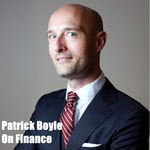
Patrick Boyle is a hedge fund manager, a university professor and a former investment banker. This channel is all about quantitative finance. By subscribing you will see videos explaining what is happening in markets right now, you will learn about financial derivatives, corporate finance and how traders use quantitative tools like statistics. You will see interviews with some of the most interesting people in the financial industry. In addition, you will see some longer form documentaries on the history of financial markets.To contact Patrick go to the website http://onfinance.orgDISCLAIMER:This channel is not affiliated with any financial institution. The videos on this channel are for entertainment purposes only and do not constitute financial advice. Those seeking investment advice should seek out a registered professional. Patrick is not responsible for investment actions taken by viewers and his content should not be used as a basis for investment.Links:Amazon Author Page: https://amzn.to/3bTeqedPatreon: https://www.patreon.com/PatrickBoyleOnFinanceWebsite: https://www.onfinance.org/Instagram: https://www.instagram.com/patrickeboyle/BlueSky: https://bsky.app/profile/pboyle.bsky.social
RSS
Apple
Data updated on 28/09/2026
Recent rankings
Latest chart positions across Apple Podcasts and Spotify rankings.
Shared links between episodes and podcasts
Links found in episode descriptions and other podcasts that share them.
What is Futures Margin? - What Is It? How Does It Work?
Monday, September 28, 2026 • Duration 09:10
What is Futures Margin? - What Is It? How Does It Work?These classes are all based on the book Trading and Pricing Financial Derivatives, available on Amazon at this link. https://amzn.to/2WIoAL0 Check out our website http://www.onfinance.org/Follow Patrick on twitter here: https://twitter.com/PatrickEBoyleMargin is a critical concept for those trading futures and derivatives in all asset classes. Futures margin is a good-faith deposit or an amount of capital one needs to post or deposit to control a futures contract. The margin is a down payment on the full contract value of a futures contract. Futures exchanges determine and set futures margin rates. At times, brokerage companies will add an extra premium to the minimum exchange margin rate to lower risk exposure. The margin is set based on the risk of market volatility. When market volatility moves higher in a futures market margin rates rise. When trading stocks, there is a simpler margin arrangement than in the futures market. The equity market allows participants to trade on up to 50% margin. Therefore, one can buy or sell up to $100,000 worth of stock for $50,000.Margin Rate for Future Contracts In the world of futures contracts, the margin rate is much lower. In a typical futures contract, the margin rate varies between 5 and 15% of the total contract value. Initial Futures Margin is the amount of money that is required to open a buy or sell position on a futures contract.Initial margin is original margin, the amount posted when the original trade takes place.Margin Maintenance or Variation MarginMargin Maintenance is the amount of money necessary when a loss on a futures position requires one to allocate more funds to return the margin to the initial or original margin level. Closing or liquidating a position eliminates the margin call requirement.
Learn more about your ad choices. Visit megaphone.fm/adchoices
Intrinsic value and Time Value of Financial Options
Monday, September 28, 2026 • Duration 08:56
What is Intrinsic value and Time Value of Financial Options?, In The Money, At The Money, Out Of The MoneyThese classes are all based on the book Trading and Pricing Financial Derivatives, available on Amazon at this link. https://amzn.to/2WIoAL0 Check out our website http://www.onfinance.org/Follow Patrick on twitter here: https://twitter.com/PatrickEBoyleThe price of an option is made up of a combination of intrinsic value and time value.The intrinsic value of an option is the value of exercising the option right now. If the price of the underlying stock is above a call option strike price, the option has a positive monetary value, and is referred to as being in-the-money. If the underlying stock is priced cheaper than the call option's strike price, the call option is referred to as being out-of-the-money. If an option is out-of-the-money at expiration, its holder simply allows the option to expire worthless. This is because a rational investor would choose to buy the underlying stock at market rather than exercise an out-of-the-money call option to buy the same stock at a higher-than-market price. For the same reasons, a put option is in-the-money if it allows the purchase of the underlying at a market price below the strike price of the put option. A put option is out-of-the-money if the underlying's spot price is higher than the strike price. The time value of an option is the premium a rational investor would pay over its current exercise value (intrinsic value), based on the probability it will increase in value before expiry.
Learn more about your ad choices. Visit megaphone.fm/adchoices
What Are Financial Derivatives?
Monday, September 28, 2026 • Duration 12:43
What Are Financial Derivatives?A Video Explaining what financial derivatives are, who trades them and why? Follow along using the book https://amzn.to/2WIoAL0 Check out our website http://www.onfinance.org/In this video we will learn who issues derivatives, are they a zero sum game and what are the various underlyings. We will learn a little bit about futures options swaps, credit derivatives etc. We will learn the difference between hedgers and speculatorsFollow me on Twitter here: https://twitter.com/PatrickEBoyle
Learn more about your ad choices. Visit megaphone.fm/adchoices
Order Types Used by Traders and Investors
Sunday, September 27, 2026 • Duration 08:15
Order Types Used by Traders and Investors - Market Order - Limit Orders - Stop OrdersThese classes are all based on the book Trading and Pricing Financial Derivatives, available on Amazon at this link. https://amzn.to/2WIoAL0 Check out our website http://www.onfinance.org/Follow Patrick on twitter here: https://twitter.com/PatrickEBoyleIf you are buying or selling financial products, when you use a market order, you are essentially just requesting the transaction to go through at the next available price. Limit orders are another order type but they limit the price at which the stock is bought or sold. You can place a limit order so that it will buy below a set price or sell above a set price. The main downside of a limit order is that the trade may not go through if the price never gets to the limit you have set. You therefore need to keep on top of your limit orders to ensure it does get bought or sold.The stop order orders the purchase or sale of a stock once it’s reached a certain price. Buy stop orders are put above the current market price and a sell stop order below the current price, with the potential benefit of reducing your loss or protecting your profits.You can also use a stop limit order, which releases a limit order once the stop price has been triggered.
Learn more about your ad choices. Visit megaphone.fm/adchoices
Are the Rich Really Leaving Britain?
Sunday, September 27, 2026 • Duration 34:29
Ad: 🔒Remove your personal information from the web at https://joindeleteme.com/BOYLE and use code BOYLE for 20% offAre Britain’s millionaires really fleeing the country—or is the “exodus” just a statistical mirage?This video digs into the numbers behind the headlines, from the much-quoted Henley & Partners migration report to the real impact of the UK’s non-dom reforms. We’ll look at what’s actually driving high earners to consider leaving, how tax policy shapes behavior, and why trust in government and value for money matter just as much as the top rate.Along the way, we’ll separate myth from reality, compare the UK’s approach to countries like Sweden and Switzerland, and ask what history can teach us about taxing globally mobile wealth.If you want to understand the real story behind the millionaire migration debate—and what it means for Britain’s future—watch now.Further reading:Tax Policy Associates - Why the rich paid less tax in the 1970s – despite 98% tax rates: https://taxpolicy.org.uk/2025/05/08/tax-rich-1970s-loopholes/Tax Policy Associates - Are Henley & Partners’ millionaire‑migration reports fabricated?: https://taxpolicy.org.uk/2025/07/27/henley-partners-millionaire-migration-report-analysis/Patrick's Books:Statistics For The Trading Floor: https://amzn.to/3eerLA0Derivatives For The Trading Floor: https://amzn.to/3cjsyPFCorporate Finance: https://amzn.to/3fn3rvC Ways To Support The ChannelPatreon: https://www.patreon.com/PatrickBoyleOnFinanceBuy Me a Coffee: https://www.buymeacoffee.com/patrickboyleVisit our website: https://www.onfinance.orgFollow Patrick on Twitter Here: https://bsky.app/profile/pboyle.bsky.socialBusiness Inquiries ➡️ sponsors@onfinance.orgPatrick Boyle On Finance Podcast:Spotify: https://open.spotify.com/show/7uhrWlDvxzy9hLoW0EYf0bApple: https://podcasts.apple.com/us/podcast/patrick-boyle-on-finance/id1547740313Google Podcasts: https://tinyurl.com/62862nveJoin this channel to support making this content:https://www.youtube.com/channel/UCASM0cgfkJxQ1ICmRilfHLw/join
Learn more about your ad choices. Visit megaphone.fm/adchoices
What is a Forward Contract?
Sunday, September 27, 2026 • Duration 06:30
What is a Forward Contract?In finance, a forward contract or simply a forward is a non-standardized contract between two parties to buy or to sell an asset at a specified future time at a price agreed upon today. The party agreeing to buy the underlying asset in the future assumes a long position, and the party agreeing to sell the asset in the future assumes a short position. The price agreed upon is called the delivery price, which is equal to the forward price at the time the contract is entered into.These classes are all based on the book Trading and Pricing Financial Derivatives, available on Amazon at this link. https://amzn.to/2WIoAL0 Check out our website http://www.onfinance.org/Follow Patrick on twitter here: https://twitter.com/PatrickEBoyle
Learn more about your ad choices. Visit megaphone.fm/adchoices
What are index options? What are currency options?
Sunday, September 27, 2026 • Duration 16:57
In todays video we will learn about options on foreign exchange and index options.These classes are all based on the book Trading and Pricing Financial Derivatives, available on Amazon at this link. https://amzn.to/2WIoAL0 Check out our website http://www.onfinance.org/Follow Patrick on twitter here: https://twitter.com/PatrickEBoyleOptions on Stock Indices - what are index options?A stock market index is a method of measuring the price movements of a basket of stocks in a market. Many indices are cited by the media and are used as benchmarks to measure the performance of portfolios such as mutual funds. Some are price indices and some are total return indices, meaning that they include reinvested dividends over time.There are a number of different index types. National indices represent the performance of the stock market of a given nation. Sector indices track the performance of specific industry sectors in the market. Ethical indices include only those companies that satisfy certain ecological, religious, or social criteria.Index options exist on broad-based indices like the S&P500 or the Russell 3000. They also exist on more narrowly based indices like mining indices or semiconductor indices. The global market for exchange-traded stock market index options is notionally valued by the Bank for International Settlements at hundreds of billions per year. When OTC options are added to that, you can see that it is a very large market indeed.An index option is a financial derivative that gives the holder the right, but not the obligation, to buy or sell a basket of stocks, such as the S&P500, at a pre-agreed price on a specified date. An index option is similar to other options contracts, the difference being the underlying instruments are indexes. Index options are typically cash settled.Uses of Index OptionsThere are two main reasons that investors will pursue index options.1. Portfolio insurance: Investors with large stock portfolios may wish to insure their downside risk by buying put options. 2. Speculation: Portfolio managers may wish to use index options to speculate on the direction of the overall market, or on the volatility of the overall market.Foreign Exchange Options - What are currency options?A foreign exchange option is a derivative where the owner has the right but not the obligation to exchange money denominated in one currency into another currency at a pre-agreed exchange rate on a specified date. European and American options on foreign exchange are actively traded on both exchanges and OTC. Companies frequently use them to hedge foreign exchange risk, and they are commonly used to speculate on the price and volatility of various foreign exchange pairs. The foreign exchange options market is mostly an OTC market. A GBP/USD foreign exchange call option, can also be viewed as being a USD/GBP put option, as they each give the option owner the right but not the obligation to exchange a certain amount of US dollars for British pounds at a pre-agreed exchange rate on a specified date. The Black-Scholes model can be modified to price options on foreign exchange. The modified Black-Scholes model was developed in 1983 by Garman and Kohlhagen and is known as the Garman-Kohlhagen model. It is a modification of the Black-Scholes model which accounts for the different interest rates of each currency.You can think of options on currencies as being an options position with an annual percentage dividend embedded in the form of the foreign currencies’ risk-free rate.
Learn more about your ad choices. Visit megaphone.fm/adchoices
The Real Reason You Can't Afford a House
Sunday, September 27, 2026 • Duration 36:15
Stop paying for GPT, Claude, and Gemini separately. 🙅♂️Genspark puts them all in one workspace. One subscription. Three killer features:🔍 Fact Check – 30 rounds of live verification with source proof📝 AI Meeting Notes – Record on your phone, auto-share professional notes🎨 AI Designer – Thumbnails, social graphics, anything you needNew users get free credits. Paid subscribers get unlimited AI Chat + AI Image for 2026.Try Genspark today 👉https://www.genspark.ai/?utm_source=yt&utm_campaign=PBoyle04@GensparkProduct #Genspark #ai #WorkWithGensparkA three-bedroom "dunger" in New Zealand with peeling paint and boarded-up windows sold for 1.81 million dollars at the peak of the boom. A few years later, prices had fallen by as much as a third in real terms, recent buyers were trapped in negative equity, and thousands of construction firms had gone under. In this video we look at how a national housing boom turns into a bust, why house prices became so unaffordable in the first place, and what it means for an economy when the family home stops being a place to live and becomes a leveraged investment.Along the way we cover the interest-rate math behind home affordability and why falling mortgage rates inflated prices for forty years, the politics of why governments keep house prices rising, why high housing costs drive young workers to emigrate, and the lessons from past property crashes in Japan, the United States, and Ireland. We also look at Henry George's argument for a land value tax, Edward Leamer's "Housing IS the Business Cycle," and why an efficient property market matters for the whole economy. Whether you're in the US, UK, Canada, Australia, or anywhere else watching house prices climb out of reach, the underlying dynamics are the same.Patrick's Books:Statistics For The Trading Floor: https://amzn.to/3eerLA0Derivatives For The Trading Floor: https://amzn.to/3cjsyPFCorporate Finance: https://amzn.to/3fn3rvC Ways To Support The ChannelPatreon: https://www.patreon.com/PatrickBoyleOnFinanceBuy Me a Coffee: https://www.buymeacoffee.com/patrickboyleVisit our website: https://www.onfinance.orgFollow Patrick on Twitter Here: https://bsky.app/profile/pboyle.bsky.socialBusiness Inquiries ➡️ sponsors@onfinance.orgPatrick Boyle On Finance Podcast:Spotify: https://open.spotify.com/show/7uhrWlDvxzy9hLoW0EYf0bApple: https://podcasts.apple.com/us/podcast/patrick-boyle-on-finance/id1547740313Google Podcasts: https://tinyurl.com/62862nveJoin this channel to support making this content:https://www.youtube.com/channel/UCASM0cgfkJxQ1ICmRilfHLw/join
Learn more about your ad choices. Visit megaphone.fm/adchoices
What are Currency Swaps?
Sunday, September 27, 2026 • Duration 07:57
In todays video we learn about currency swaps.These classes are all based on the book Trading and Pricing Financial Derivatives, available on Amazon at this link. https://amzn.to/2WIoAL0 Check out our website http://www.onfinance.org/Follow Patrick on twitter here: https://twitter.com/PatrickEBoyleWhat are currency swaps?A currency swap is a financial derivatives agreement in which two parties exchange the principal amount of a loan and the interest in one currency for the principal and interest in another currency.At the inception of the swap, the equivalent principal amounts are exchanged at the spot rate.During the length of the swap each party pays the interest on the swapped principal loan amount.At the end of the swap the principal amounts are swapped back at either the prevailing spot rate, or at a pre-agreed rate such as the rate of the original exchange of principals. Using the original rate would remove transaction risk on the swap.Currency swaps are used to obtain foreign currency loans at a better interest rate than a company could obtain by borrowing directly in a foreign market or as a method of hedging transaction risk on foreign currency loans which it has already taken out.
Learn more about your ad choices. Visit megaphone.fm/adchoices
What Is Options Delta? The Options Greeks
Sunday, September 27, 2026 • Duration 14:02
These classes are all based on the book Trading and Pricing Financial Derivatives, available on Amazon at this link. https://amzn.to/2WIoAL0 Check out our website http://www.onfinance.org/Follow Patrick on twitter here: https://twitter.com/PatrickEBoyleWhat is Options Delta?The first Greek we will learn about in this video series is Delta, which measures how much an option's price will change for a 1% change in the price of the underlying security or index. For example, a Delta of 0.40 means that the option's price will theoretically move $0.40 for every $1 move in the price of the underlying stock or index.Call optionsHave a positive Delta that can range from zero to 1.00.At-the-money options usually have a Delta near .50.The Delta will increase (and approach 1.00) as the option gets deeper in the money.The Delta of in-the-money call options will get closer to 1.00 as expiration approaches.The Delta of out-of-the-money call options will get closer to zero as expiration approaches.Put option DeltaPut options have a negative Delta that can range from zero to -1.00.At-the-money options usually have a Delta near -.50.The Delta will decrease (and approach -1.00) as the option gets deeper in the money.The Delta of in-the-money put options will get closer to -1.00 as expiration approaches.The Delta of out-of-the-money put options will get closer to zero as expiration approaches.You also might think of Delta, as the percent chance (or probability) that a given option will expire in the money.For example, a Delta of 0.40 means the option has about a 40% chance of being in the money at expiration. This doesn’t mean your trade will be profitable. That of course, depends on the price at which you bought or sold the option.You also might think of Delta, as the number of shares of the underlying stock, the option behaves like.A Delta of 0.40 also means that given a $1 move in the underlying stock, the option will likely gain or lose about the same amount of money as 40 shares of the stock.Tune in tomorrow for a video on Delta Hedging.
Learn more about your ad choices. Visit megaphone.fm/adchoices
Related Shows Based on Content Similarities
Discover shows related to Patrick Boyle, based on actual content similarities. Explore podcasts with similar topics, themes, and formats, backed by real data.