Nonprofit Executive Podcast with Joel Kessel and Mary Valloni – Details, episodes & analysis
Podcast details
Technical and general information from the podcast's RSS feed.
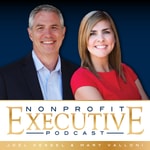
Nonprofit Executive Podcast with Joel Kessel and Mary Valloni
Joel Kessel & Mary Valloni
Frequency: 1 episode/7d. Total Eps: 18

Recent rankings
Latest chart positions across Apple Podcasts and Spotify rankings.
Apple Podcasts
🇺🇸 USA - nonProfit
14/02/2026#96🇨🇦 Canada - nonProfit
21/01/2025#93🇨🇦 Canada - nonProfit
20/01/2025#82🇨🇦 Canada - nonProfit
19/01/2025#68🇨🇦 Canada - nonProfit
18/01/2025#56🇨🇦 Canada - nonProfit
17/01/2025#21🇺🇸 USA - nonProfit
13/09/2024#81🇨🇦 Canada - nonProfit
10/09/2024#99🇨🇦 Canada - nonProfit
09/09/2024#84🇨🇦 Canada - nonProfit
08/09/2024#72
Spotify
No recent rankings available
Shared links between episodes and podcasts
Links found in episode descriptions and other podcasts that share them.
See all- http://maryvalloni.com/
55 shares

- http://www.maryvalloni.com/roadmap
43 shares
- http://www.maryvalloni.com/
22 shares
RSS feed quality and score
Technical evaluation of the podcast's RSS feed quality and structure.
See allScore global : 42%
Publication history
Monthly episode publishing history over the past years.
Episode 18 | Fundraising FREEDOM Step 7: Make Your Difference
Season 1 · Episode 18
jeudi 5 mars 2020 • Duration 28:17
This step is what all of your hard work has been leading up to. You’re raising funds, asking people to be part of your team, building out your branding and the reason is that you’re trying to make a difference in the world. Once you get here, this is the time to celebrate! You’re seeing lives changed and now you get to tell people all about it and thanking everyone who took part. This is a really fun step and one that too many people miss.
How do we celebrate with the team?
If you haven’t read the book The 5 Love Languages: The Secret to Love that Lasts by Gary Chapman, you should check it out. In the book, the author outlines 5 different love languages which are, Words of Affirmation, Acts of Service, Gifts, Quality Time, and Physical Touch. Everyone has a primary love language. You need to find ways to incorporate all these love languages with your team as well as donors. Thank you notes, awards or plaques, or even hugs and handshakes are ways to show appreciation to your people.
How do we know a donor’s love language?
People will typically tell you. It comes back to running your research and drawing broad observations from minute details. If they give you a gift, they like gifts. If they give you words of affirmation, they like words of affirmation. All you’re doing is watching how they communicate with you and that will tell you how to communicate with them. I had a donor tell me once that we should have given warm cookies at Christmas time – more than likely his love language is gifts.
What can we do to make sure we are thanking people the right way?
As much as I’m trying to pay attention to everyone, it is very challenging when you have hundreds of donors. It’s just not practical. So, I make sure at Christmas I do something special for the top sponsors like maybe a gift certificate and a bottle of wine as an example. And I hand-delivered them. After every fundraiser each year, I hosted a thank-you banquet. I had a chairperson for the thank-you party and they were responsible for printing out all the plaques, every sponsor got their recognition, anyone who gave over $10,000 got a special award, we incorporated all of that.
Do you have any other takeaways for success?
Freedom means to act, think, and speak without holding back. All 7 of my steps are leading to that. We talked last week about the power money has and I know how easy it is to go down a path because you had a donor who wanted to go down a path. I don’t ever want money to control your organization. I want your strategic plan to control your organization and you just happen to need money to fulfill that plan. My steps all come back to what freedom looks like for you and your cause. And then put your head down and go to work toward that. When it comes down to it, it’s about building relationships with the right people and inviting them to feel like this is their thing too.
Resources from this episode:
Connect with Mary:
Mary’s book: Fundraising Freedom
Connect with Joel:
Episode 17 | Fundraising FREEDOM Step 6: Organize the Ask
Season 1 · Episode 17
jeudi 27 février 2020 • Duration 40:32
What do you need to organize to make sure you’re in the best position to make the ask?
Depending on how you’re raising funds, everyone has a demographic they serve and tend to raise funds from. There is a process for every group of people, and you need to think it through before you just go in and ask for money. You should never do a blanket approach to fundraising because you want to be well-received by every group you get in front of.
Tell us more about dating and fundraising.
When you talk to someone about how they met their spouse it usually goes something like this, “we were in the same place at the same time and started talking.” And it was a slow, progressive process. We as fundraisers and nonprofit executives tend to jump in and immediately “go for the kill” and you’re pushing those donors and potential donors away because you reek of desperation. No one wants to date someone who is desperate. You have to get to know your donors by asking questions about what they are interested in, what do they like, etc. and you start to figure out if you like the same things or if you are compatible. Now, I’m not saying they have to be your best friend, but I want you to make sure that you care about the same thing aka, your cause.
What do you say to that organization that needs a specific amount of funds in the next six months?
You need money and you needed it yesterday. This is a very common concern and why it is vital that you have a strategic plan in place so that you never put yourself in this frantic place ever again. You should not be asking for the dollars you needed last month. When you’re putting on a fundraiser of any sort, it’s easy to say you want to get it done in the next three months. You glue it together, slap a coat of paint on it and call it good. But what would happen if you planned that fundraiser 12 months out? You can start accepting donations today for a fundraiser that’s in a year. The urgency is whatever you place on it, which is why I like to use the calendar to create urgency. If you plan out farther in advance, you can get the sponsorship dollars and then you aren’t frantically trying to do things last minute like picking up auction items and selling tickets.
Can you talk about the mindset around money?
This is probably the biggest issue when people say they don’t want to ask for money. Somewhere along the way, they gave money more power than it actually deserves. I’m a big Dave Ramsey fan and I used his plan to pay off all my student loan debt. He has a seven-step process which is what ultimately led to my seven steps. One thing Dave shares is how money is amoral – it’s not good, it’s not bad, it just is. You have to remove the emotion from money.
If you’re building a building, you don’t actually need cash, you need bricks and people to put those bricks together. Remember, you don’t actually have to go after cash with each ask, you can go for goods and services too. Back in the day, people didn’t exchange cash for services and they rarely exchanged cash at all. But in today’s age, we’ve given so much power to cash and it’s not necessary.
When you’re ready to go in for the ask, who should you go to?
Roughly 70% of donations come from individuals, but I always tell people that 100% of donations come from individuals. You’re asking humans to give money and it all comes back to relationships. You have to build relationships with people so when you ask for money, I tell people you have to send in the person who has the best relationship with the person sitting across the table. That does not matter what kind of money you’re asking for, it’s all the same philosophy. This once again goes back to step 3, enlist your team. You will be able to raise WAY more money if you have the right team members. If you have someone on your team who has built relationships with people in the community for the past 60 years (or more). Statistics show that people will give to a cause when they have someone they know and trust who asks them to give.
Resources from this episode:
Connect with Mary:
Mary’s book: Fundraising Freedom
Connect with Joel:
Episode 8 | Strategic Planning Step Four: Assess Your Organization
Episode 8
jeudi 26 décembre 2019 • Duration 33:02
On today’s show, we are talking about Step 4 of the strategic planning process, Assessing Your Organization. This step is important because it allows us to hit the pause button and really talk about ourselves and the organization as a whole. This allows to get all the players in the same room and discuss what they’re good at as well as areas that need improved. It forces you to have critical conversations and determine how your organization can grow.
What is a SWOT analysis?
A SWOT (Strengths, Weaknesses, Opportunities, Threats) analysis is a tool that anyone can apply to any part of their organization – fundraising, marketing efforts, past events, as well as programs and services. A SWOT analysis is NOT a strategic plan. Here are some questions to get you thinking about each area:
Strengths
- What are some advantages of your programs and services?
- What do you do better than anyone else out there?
- What are some unique resources you can draw upon that others can’t?
- What does your community see as your strengths?
- What factors mean you actually get the funding, donations, or support?
- What is your unique selling proposition?
Weaknesses (these can be turned into opportunities)
- What could we improve upon?
- What should be eliminated?
- What does your community see as your weaknesses?
- What’s missing or not working properly?
Opportunities
- What are some opportunities out there that exist for your organization?
- What would allow you to get more funding and have a greater impact?
- What areas of leverage could you exploit?
- What interesting trends did you find in your environmental scan?
Threats
- What obstacles do you face?
- What are your competitors doing?
- Are your quality standards changing for your programs and services?
- What outside factors could make your organization vulnerable?
- What risks do you need to prepare for?
- How do you protect your data from security breaches?
- Is there a linchpin that could potentially bring down the entire organization?
Who should be at the table when performing a SWOT analysis?
Core planning team, other stakeholders (volunteers, donors, staff members, board members)
How often should an organization do a SWOT analysis?
This is such a helpful tool that it should be used liberally throughout your organization because you can SWOT anything.
What happens after the SWOT analysis is complete?
A lot of organizations get through this exercise and then stop. I encourage you to go back to your strengths listed and determine how you can enlist the strengths. This is also a great opportunity to brainstorm around your weaknesses and find solutions that you may decide to incorporate into your strategic plan. And, now that you have a list of threats, you can talk about how the organization can either deal with or overcome those threats. This is the time to put a plan into action in order to make improvements.
We know being a nonprofit executive is a lonely job and we want you to know that you are not alone as you work toward your mission. If you like the content of the podcast, as well as the work we do, we invite you to join the Nonprofit Executive Club. The Executive Club is a monthly training program that gives you the ability to increase your influence through strategic planning and fundraising support. For more information and to join the Club, go to nonprofitexecutiveclub.com.
Download the Strategic Plan Toolkit
For more information about Mary Valloni, visit maryvalloni.com and to download our free Fundraising Freedom Roadmap, go to maryvalloni.com/roadmap. Get a copy of Mary’s book, Fundraising Freedom.
Interested in learning more about Joel Kessel? Visit kesselstrategies.com to find out how Joel helps growth-minded leaders gain clarity.
Episode 7 | Strategic Planning Step Three: Realize Your Future (Mission & Core Values)
jeudi 19 décembre 2019 • Duration 35:09
On today’s episode we are talking about the second half of step 3, Realize Your Future, which relates to your Mission and Core Values. Last week we talked about the first half of step 3, which is focused on your vision. The difference between your vision statement and your mission statement is the vision is the end result and the mission is what you’re going to do to get there.
Mission is our purpose and why we exist as an organization. It’s about the people we serve through our programs and services. When you’re thinking about your mission statement, you want to be specific with who you’re helping and where you’re helping (as in geographically). One of the mistakes a lot of organizations make is they feel like they only have one chance to tell people what they do, which leads to cramming all of this information into a mission statement. There are too many messages, it’s too long, it’s confusing, and people still don’t know what it is you do. Remember, simple is always better. If you can’t easily repeat your mission statement to someone while standing in the grocery line, chances are it’s just too much. The object is to keep the statement short and concise; not filled with jargon and fluff.
When you sit down to come up with your mission statement, there are 3 questions you should ask:
- Why do we exist?
- Whom do we serve?
- What do we produce as outcome benefits?
The first question addresses what makes your organization special or unique and how are you different from your competition. Think of this as the basis for building a reputation among those you serve. Why should they look to you instead of similar service providers? The second question relates to the primary beneficiaries of your organization. These are the people who are receiving direct, frequent services from your organization. Finally, once you know who you are and who the primary demographic is, the third question is about expectations. What do they (the beneficiaries) expect from us (the organization)? It could be service, solutions, education, information, etc. Once you’ve answered those 3 questions, it’s time to write out a statement. A typical mission statement should look something like this:
Our mission is to serve (client/people) with the (programs and services) in order to achieve (why we exist).
Keep in mind that mission statements can change and evolve over time. If your organization was founded 50 years ago, is the mission statement from then still relevant to the mission of today? If not, then it’s time to develop a new statement that better reflects the current organization. Remember, donors are interested in your relevance and keeping an outdated mission statement will affect the buy-in to your organization.
After you’ve gotten your statement down on paper, it’s time to focus on core values. Core values are simply what you believe in. If you’re clear on your core values, they become critically important in how you’re recruiting people. Knowing what’s important to you opens communication with potential volunteers and donors alike. It’s easy to spot red flags if there’s a misalignment in what you value and what your volunteers value; especially if this person is a candidate for your board.
Just as your mission statement, you should keep your core values simple by having no more than 3 words that have the most meaning to the organization. The reason for using 3 words to represent your beliefs is because it’s very easy to remember. A good exercise is to come up with a list of 50 values. Then, each participant on your team chooses their top 5. The key is for them to pick what’s important to them, not the organization. This is an awesome exercise because there is a level of vulnerability that will help build trust within that group. Once everyone has picked their top 5, then each person then shares with the group why these values are important to them. The facilitator collects all the answers and comes up with the most common, could be a list of 15 at this point. Then the group picks the top 5 from that list. From there, those top 3 that have the most votes become the core values of the organization. This is an easy process to walk through with your group and gets everyone to participate.
We know being a nonprofit executive is a lonely job and we want you to know that you are not alone as you work toward your mission. If you like the content of the podcast, as well as the work we do, we invite you to join the Nonprofit Executive Club. The Executive Club is a monthly training program that gives you the ability to increase your influence through strategic planning and fundraising support. For more information and to join the Club, go to nonprofitexecutiveclub.com.
Download the Strategic Plan Toolkit
For more information about Mary Valloni, visit maryvalloni.com and to download our free Fundraising Freedom Roadmap, go to maryvalloni.com/roadmap. Get a copy of Mary’s book, Fundraising Freedom.
Interested in learning more about Joel Kessel? Visit kesselstrategies.com to find out how Joel helps growth-minded leaders gain clarity.
Episode 6 | Strategic Planning Step Three: Realize Your Future (Vision)
jeudi 12 décembre 2019 • Duration 25:06
Step three of strategic planning is one of the most critical steps in the process because it can make or break your fundraising efforts and your organization as a whole. Clarity attracts and confusion repels. Everyone has people in their lives who communicate so clearly and effectively that you will follow them wherever they go. Likewise, you also know those who say good words, but you have no idea what they actually said and what’s going on. Today, we are talking about realizing your future. What does this mean?
This step is all about vision, mission, and core values of your organization. You have to have a clear vision so when you’re sitting in front of potential donors, they’re clear and can see how they can fit into where your organization is going. Habit number two of Steven Covey’s book, 7 Habits of Highly Effective People, says to begin with the end in mind. And that’s what we’re talking about here. Where do you want to be? What impact do you want to have in the world? If you have a clear vision of three years down the road for your organization and your others have a different vision, this can be a real problem when you’re trying to gain traction and move forward.
As you look at your vision, it needs to be aspirational. It needs to push you and almost make you feel like it’s impossible to achieve. This is not something you’ll be able to get done in a year. Oftentimes, we overestimate what we can do in a year and underestimate what we can do in ten. It’s time to dream big. Here are four questions the planning team should ask itself:
- What major accomplishments has our organization achieved by the year fill-in-the-blank?
- Based on question 1, how does our organization operate differently in 3-5 years than it does today?
- What will the people we serve, as well as our stakeholders, say about working with us?
- What will our staff or volunteers say about working for our organization?
As you’re having this great conversation and capturing your ideas, you then start to develop you vision statement within this framework: we will do by this date . Then you can begin honing your vision statement to incorporate these goals and the dreams you have for the future. Remember, your vision can and should change and you continue to grow. Once your vision statement is complete, everyone starts to feel the sense of urgency to accomplish that vision by getting to work.
We know being a nonprofit executive is a lonely job and we want you to know that you are not alone as you work toward your mission. If you like the content of the podcast, as well as the work we do, we invite you to join the Nonprofit Executive Club. The Executive Club is a monthly training program that gives you the ability to increase your influence through strategic planning and fundraising support. For more information and to join the Club, go to nonprofitexecutiveclub.com.
Download the Strategic Plan Toolkit
For more information about Mary Valloni, visit maryvalloni.com and to download our free Fundraising Freedom Roadmap, go to maryvalloni.com/roadmap. Get a copy of Mary’s book, Fundraising Freedom.
Interested in learning more about Joel Kessel? Visit kesselstrategies.com to find out how Joel helps growth-minded leaders gain clarity.
Episode 5 | Strategic Planning Step Two: Take a Look at Your World
jeudi 5 décembre 2019 • Duration 28:09
In strategic planning terminology, take a look at your world means to do an environmental scan. What’s happening out there has an impact on your organization. This is not to come up with a list of excuses of why you can’t get something done, but rather to help you make better decisions for the future of your organization.
You’ve gotten your foundation set, so taking a look at the world around you is going to include articles, research and data trends, conversations you’ve had with your key stakeholders, and other ways you can get information. What you need to be mindful of when you’re doing your environmental scan are socio-demographics; what is happening in society may affect the work your organization is doing in and for the community.
Another area to focus on is what’s happening with your competition. Competition doesn’t have to be a negative term, rather, it’s an honest look at what similar organizations are doing and what’s working for them. What’s going to be new or different in how your organization provides services and programs? Sometimes you determine that you should collaborate in order to serve more people in your community.
Next, it’s important to look at the economy and the effect it may have on your organization in the next few years. For example, if there is a downturn predicted, how will your organization weather that storm? Or better yet, how will it thrive? Knowing what’s happening economically is going to help you have that conversation when you get into the conference room to discuss strategy.
What’s happening politically? Are there new regulations that will impact your organization? Keeping your finger on this pulse is especially critical if you are in the advocacy realm and trying to get laws changed. It’s crucial to understand that there is a difference between observing what’s happening and getting sucked down the rabbit hole. The way you handle this is to surround yourself with good people who will help you keep your focus.
Understanding what’s going on with technology is absolutely vital. Technology is moving and changing so quickly that you can easily become paralyzed. Understanding the overall strategy – what you are doing and how are you doing it – will give you insights when determining what technology to deploy. Then you can find ways to leverage technology to help your organization become more efficient. Keep in mind that technology doesn’t just mean social media and marketing. It also includes how you are communicating internally with your team, keeping connected to one another, and project management systems. Don’t let technology work you, you need to work technology.
Finally, you need to take a look at your own clients and the people you’re looking to serve. What change in demands might put pressure on your organization to perform at a higher level? Your constituents may come to you asking for more support in a particular area. You have to listen to your audience so you can better serve their needs.
We know being a nonprofit executive is a lonely job and we want you to know that you are not alone as you work toward your mission. If you like the content of the podcast, as well as the work we do, we invite you to join the Nonprofit Executive Club. The Executive Club is a monthly training program that gives you the ability to increase your influence through strategic planning and fundraising support. For more information and to join the Club, go to nonprofitexecutiveclub.com.
Download the Strategic Plan Toolkit
For more information about Mary Valloni, visit maryvalloni.com and to download our free Fundraising Freedom Roadmap, go to maryvalloni.com/roadmap. Get a copy of Mary’s book, Fundraising Freedom.
Interested in learning more about Joel Kessel? Visit kesselstrategies.com to find out how Joel helps growth-minded leaders gain clarity.
Episode 4 | Strategic Planning Step One: Set the Foundation
jeudi 21 novembre 2019 • Duration 35:01
The number one reason most nonprofits do not have a strategic plan is because they think it’s going to be a daunting task. But all you’re really doing is gaining some clarity and focus in order to set the organization on the right path. If you go on vacation, you have to plan out how you are going to get there. Strategic planning is the same way; you’re mapping out the steps you need take to get to a desired future state. There are 3 questions you need to ask yourself:
- Where do you want to be?
- What do you need to do?
- How are you going to get there?
When you begin to think about strategic planning in the framework of those three questions, it is easy to put a plan in place. Today we are going to focus on step one of your strategic plan, set the foundation.
Setting the foundation should happen well before you ever set foot in the board room. First, you need to gather a planning team. You want a diverse group of 4-10 people, depending on the size of your organization, that includes a combination of the executive director, the board chair, major donors, other volunteers, etc. Once the planning team is in place, it’s time to set up a meeting to discuss how you are going to run the organization for the next 3-5 years. The first step in this process is to discuss the issues or challenges the organization is facing, which is what will set the tone for the 3-5 goals you will establish. Keep in mind that some of the topics discussed may actually be symptoms of a deeper issue happening within the organization itself.
Next on the list to discuss with the planning team are the obstacles that could stand in the way of effective planning. This could be how often you meet, the schedules of the team, or internal leadership support. Remember, you can easily come up with a bunch of excuses that halt the planning process. However, don’t let this stop you from building a strategy.
Finally, you want to wrap up the initial meeting with some ground rules like consensus decision making because we want to do this as a team. Actively support the group decision, even if it’s not the exact one you would personally make. Make sure you prioritize what matters most. Lastly, you need to take the time you need and not rush through the process and trust that this it does work. It’s going to feel messy and that’s ok because it gives you permission come up with creative ideas on how you are going to take your organization to the next level.
We know being a nonprofit executive is a lonely job and we want you to know that you are not alone as you work toward your mission. If you like the content of the podcast, as well as the work we do, we invite you to join the Nonprofit Executive Club. The Executive Club is a monthly training program that gives you the ability to increase your influence through strategic planning and fundraising support. For more information and to join the Club, go to nonprofitexecutiveclub.com.
Download the Strategic Plan Toolkit
For more information about Mary Valloni, visit maryvalloni.com and to download our free Fundraising Freedom Roadmap, go to maryvalloni.com/roadmap. Get a copy of Mary’s book, Fundraising Freedom.
Interested in learning more about Joel Kessel? Visit kesselstrategies.com to find out how Joel helps growth-minded leaders gain clarity.
Episode 1 | About This Podcast
jeudi 14 novembre 2019 • Duration 12:50
Welcome to the Nonprofit Executive Club podcast. This podcast is for growth-minded executives who are looking to take their nonprofits to the next level through strategic planning and fundraising. Meet your hosts:
Joel Kessel has spent the last 25 years in communications and public relations. He focuses on helping nonprofits get their message out into the world by casting a strong vision and creating a powerful strategy.
Mary Valloni has raised millions of dollars through her work as the development director for the American Cancer Society, the ALS Association and Special Olympics. Now she teaches and trains organizations around the world on how to raise more funds and have more freedom.
Currently, there are more than 568,000 nonprofits that are raising less than one million dollars. The reason why these nonprofits are not taking their fundraising to the next level is because they are lacking a strategic plan. You cannot raise money without a strategy and a clear vision. Only 49% of nonprofits have a strategic plan.
What you can expect from this weekly show:
- 30 minutes
- Joel’s STRATEGY Steps to create a successful strategic plan
- Mary’s FREEDOM guide to fundraising
- Q&A Sessions
We know being a nonprofit executive is a lonely job and we want you to know that you are not alone as you work toward your mission. If you like the content of the podcast, as well as the work we do, we invite you to join the Nonprofit Executive Club. The Executive Club is a monthly training program that gives you the ability to increase your impact through strategic planning and fundraising support. For more information and to join the Club, go to nonprofitexecutiveclub.com.
To submit your questions, please email mary@maryvalloni.com or joel@kesselstrategies.com
Episode 3 | Fundraising Freedom Overview
jeudi 14 novembre 2019 • Duration 37:06
On this episode we are talking about fundraising, on which Mary has literally written the book. We tend to raise our money by taking whatever we can get, however, there is a strategy behind fundraising. But first, a little background from Mary.
When I first took my position with the American Cancer Society, the town I worked in had a population around 150,000 with the surrounding area numbering near 250,000. Rather than solely focusing on my community, I latched on to what my counterparts were doing in their markets. One of those locations was Chicago. My friends in Chicago raised $1.8 million on a first-year event. No one raises that kind of money without a clear strategy! Another friend in the Tyler, Texas market raised $1 million in their most recent event and I modeled my event after an event in Dallas. I had access to all of my peers where I could call on them and ask for advice or materials. This is part of why we created the Nonprofit Executive Club. We created a community where executives aren’t competing against each other but can be there for one another to bounce ideas off of and find out what is working in other markets.
When I wrote the book, Fundraising Freedom, I was really focused on freedom. I want every nonprofit to have freedom, meaning to act, think, and speak without holding back. I want you to be so bold about your cause that you’re not negotiating or belittling your cause and just taking whatever money you can get because you’re so desperate. The FREEDOM process is a system that works for large-scale organizations as well as those organizations just getting started.
Step 1: Focus Your Vision. The first step I teach is the “F” of the word freedom. Joel will talk to you more about vision as it pertains to your vision statement and I will talk to you about vision as you look at how much money you want to raise. By having a clear mission and vision statement in your strategic plan, by the time you get to me to talk fundraising, you already know what you stand for and how much money it’s going to take to fulfill that vision and mission.
Step 2: Run Your Research. Once you know what you to, it’s time to start researching what your counterparts are doing, or what successes are happening in your community, and figuring out what our people want.
Step 3: Enlist Your Team. This is a process of inviting people in. When it comes to fundraising, you just need one volunteer who is going to be the face of the fundraiser or campaign. Fundraising should not be the sole responsibility of the staff person. There’s an old African proverb that says, “if you want to go quickly, go alone. If you want to go far, go together.” You can go fast if you want, but you are not going to raise hundreds of thousands of dollars if you go it alone.
Step 4: Enhance Your Brand. This is when you build out your print materials, get your logo and website designed; turn your fundraiser into something visual. The reason you need to enlist your team before building your brand is so your team can take part in the process. If your team has a say in this process, they will be more likely to sell the event because they have skin in the game. Just like Dale Carnegie said, “people support a world they helped create.”
Step 5: Deploy Your Team. Your volunteers and your staff go out and advocate on your behalf by scheduling meetings and getting out in front of people.
Step 6: Organize Your Ask. This is the reason why we fundraise. Go ask for your money. This the number one most difficult thing for boards to do. But this task is made so much easier if you’ve done all the previous work. You’ve already done your research, you have a great team, you feel really empowered, your print materials look great, this is what makes it easy to invite others to be a part of what you’re working toward. Remember, people love giving their money away.
Step 7: Make Your Difference. Let’s go make a difference and celebrate. So often when we raise money we immediately jump into the next act. What I want to see is for you to take a step back and you recognize all the people who made it possible. You’re thanking your donors; you’re acknowledging the impact you’re making on the world. This is where you start telling stories and talking about the success of the event because if you’re going to replicate this again next year, you have to make sure to acknowledge the incredible influence your cause is making.
As we move through the upcoming episodes, we are going to delve deeper into each step individually and answer any questions you may have. To submit a question about fundraising, email mary@maryvalloni.com.
We know being a nonprofit executive is a lonely job and we want you to know that you are not alone as you work toward your mission. If you like the content of the podcast, as well as the work we do, we invite you to join the Nonprofit Executive Club. The Executive Club is a monthly training program that gives you the ability to increase your influence through strategic planning and fundraising support. For more information and to join the Club, go to nonprofitexecutiveclub.com.
Download the Strategic Plan Toolkit
For more information about Mary Valloni, visit maryvalloni.com and to download our free Fundraising Freedom Roadmap, go to maryvalloni.com/roadmap. Get a copy of Mary’s book, Fundraising Freedom.
Interested in learning more about Joel Kessel? Visit kesselstrategies.com to find out how Joel helps growth-minded leaders gain clarity.
Episode 2 | Strategic Planning Overview
jeudi 14 novembre 2019 • Duration 33:08
On this episode, Joel will take you through a high-level overview of his STRATEGY steps to build your strategic plan. These 8 steps are built on industry best practices, books and courses, and real-life experiences in taking organizations through this process.
Step One: Set the Foundation. What are you planning for? Who is your core planning team?
Step Two: Take a Look at Your World. What is happening in the world around us – politically, demographically, economically, etc.? These issues are going to impact the decision-making for your organization. However, this is not an opportunity to create excuses on why you can’t raise “x” amount of dollars, or why you can’t hold an event, or do a specific program. It’s to arm you with the information you need to make the best decision possible for your organization in the mission.
Step Three: Realize Your Future. What is your vision? Where do you want to be in 3-5 years? What does success look like? Part of this step is drilling down into your mission and the things that are going to drive your day-to-day actions that will support your larger vision. Determining the organization’s core values are a part of this process as well. What do you believe in? Once you have clarity and alignment within your organization, you can then go out and recruit the right people to become staff members, volunteers, and donors.
Step Four: Assess Your Organization. Perform a SWOT analysis (Strengths, Weaknesses, Opportunities, and Threats). Whereas step two is taking an external view, step four includes taking an internal look at your organization through the strengths and weaknesses. There will be overlap with step two when you start to look at the opportunities and threats because these are external views as well. However, this allows for some checks and balances between the two steps.
Step Five: Tighten Your Focus. This step is where you create a balanced scorecard. Healthy and smart organizations have a balanced scorecard, meaning they aren’t skewed in one direction or another. The four areas of the scorecard are capacity, internal processes and systems, finance, and client stakeholder satisfaction.
Step Six: Establish Your Measurement. If you don’t know where you’re going, then how are you going to get there? Did you do it or didn’t you do it? Simple. For example, if part of your plan includes to create a marketing plan for year one, what actions are you going to take to make that happen? This is an action you can control. Establishing the measurement then comes back to did you take this action or not because we know that taking action will lead to growth and impact.
Step Seven: Gather Your Tactics. Tactics are new or continuing projects and actions designed to improve performance of one or more focus areas. Tactics reduce performance gaps in the focus area and help achieve results.
Step Eight: Your Plan to Execute. The worst thing you can do is go through this process and then put it away on a shelf. This is where a lot of organizations fail in their strategy; they have a plan but then it doesn’t get executed. Your plan to execute is how you are going to roll out your entire plan and put it into motion. Remember, this plan does not have to be overcomplicated. Start with a one-pager, then you can drill down from there into a quarterly, monthly, or weekly plan.
As we move through the upcoming episodes, we are going to delve deeper into each step individually and answer any questions you may have. To submit a question about strategic planning, email joel@kesselstrategies.com.
We know being a nonprofit executive is a lonely job and we want you to know that you are not alone as you work toward your mission. If you like the content of the podcast, as well as the work we do, we invite you to join the Nonprofit Executive Club. The Executive Club is a monthly training program that gives you the ability to increase your influence through strategic planning and fundraising support. For more information and to join the Club, go to nonprofitexecutiveclub.com
Download the Strategic Plan Toolkit
Interested in learning more about Joel Kessel? Visit kesselstrategies.com to find out how Joel helps growth-minded leaders gain clarity.
For more information about Mary Valloni, visit maryvalloni.com and to download our free Fundraising Freedom Roadmap, go to maryvalloni.com/roadmap.
Related Shows Based on Content Similarities