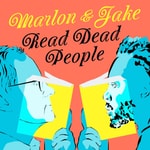
Marlon and Jake Read Dead People is a podcast hosted by the Booker Prize-winning and internationally bestselling author Marlon James and his editor, Jake Morrissey, Executive Editor at Riverhead Books. In each episode, Marlon and Jake talk about authors—specifically dead authors. Authors they like. Authors they hate. Great books, terrible books, and books they love that you’d never expect them to. As a writer and an editor, Marlon and Jake have read thousands of books between them, and they’re not shy in expressing their opinions about them. Sometimes they’ll agree, sometimes they won’t, but in every episode, they’ll tell you what they think— uncensored and with no holds barred. (That’s why the authors have to be dead.) So, listen along to hear about the spectacularly good, the hilariously bad, and the brutally honest.
Site
RSS
Spotify
Apple
Data updated on 15/09/2026
Recent rankings
Latest chart positions across Apple Podcasts and Spotify rankings.
Shared links between episodes and podcasts
Links found in episode descriptions and other podcasts that share them.
Discover shows related to Marlon and Jake Read Dead People, based on actual content similarities. Explore podcasts with similar topics, themes, and formats, backed by real data.
In our last episode of the season, Marlon and Jake take on the worst books by the best authors—or at least, authors they usually love. They discuss why a journalist’s instincts can be both a gift and a curse when writing fiction, the importance of a great editor, writers who seem more interested in ideas than people, and novels that try so hard to be current they end up aging badly. Tune in for a conversation about literary misfires and wasted genius.
Subscribe to our River-herd digital newsletter and our print newspaper, The Eddy, for sneak peeks of our upcoming books, free giveaways, and exclusive content: https://sites.prh.com/the-eddy-newspaper
The Devil and Sonny Liston by Nick Tosches
In the Hand of Dante by Nick Tosches
The Year of Magical Thinking by Joan Didion
Slouching Towards Bethlehem by Joan Didion
The Pickwick Papers by Charles Dickens
I Am Charlotte Simmons by Tom Wolfe
Orlando by Virginia Woolf
Wolf Hall by Hilary Mantel
A Tale of Two Cities by Charles Dickens
Barnaby Rudge by Charles Dickens
The Golden Notebook by Doris Lessing
The Golden Bowl by Henry James
My Son’s Story by Nadine Gordimer
Quicksand by Nella Larsen
The Spy Who Loved Me by Ian Fleming
The Day of the Jackal by Frederick Forsyth
Hotel by Arthur Hailey
Hollywood Wives by Jackie Collins
The Carpetbaggers by Harold Robbins
Peyton Place by Grace Metalious
Whirlwind by James Clavell
Gai-Jin by James Clavell
The Breast by Philip Roth
Portnoy’s Complaint by Philip Roth
Humboldt’s Gift by Saul Bellow
Mr. Sammler’s Planet by Saul Bellow
A Small Town in Germany by John le Carré
The Little Drummer Girl by John le Carré
A Perfect Spy by John le Carré
The Continental Op by Dashiell Hammett
The Far Pavilions by M. M. Kaye
Go Set a Watchman by Harper Lee
Until August by Gabriel García Márquez
Heartburn by Nora Ephron
Ancient Evenings by Norman Mailer
The Naked and the Dead by Norman Mailer
The Executioner’s Song by Norman Mailer
India: A Wounded Civilization by V. S. Naipaul
The Power Broker by Robert Caro
Terrorist by John Updike
English Teachers, Look Away
Episode 40
Tuesday, September 1, 2026 • Duration 44:11
Marlon and Jake discuss the books they’d banish from school reading lists—not ban but give a well-earned time out. They consider why the Bible shouldn’t make the cut, why mythology deserves to expand beyond the Greeks and Romans, and what kinds of books actually resonate with high school readers. Plus: why being a great book doesn’t necessarily make something a great book to teach—and whether length should matter.
Subscribe to our River-herd digital newsletter and our print newspaper, The Eddy, for sneak peeks of our upcoming books, free giveaways, and exclusive content: https://sites.prh.com/the-eddy-newspaper
Mythology by Edith Hamilton
Of Mice and Men by John Steinbeck
The Grapes of Wrath by John Steinbeck
The Pearl by John Steinbeck
“Who Am I This Time?” by Kurt Vonnegut
King Solomon’s Mines by H. Rider Haggard
Benito Cereno by Herman Melville
The Tempest by William Shakespeare
The Radiance of the King by Camara Laye
The Great Gatsby by F. Scott Fitzgerald
“The Library of Babel” by Jorge Luis Borges
“The Aleph” by Jorge Luis Borges
Wuthering Heights by Emily Brontë
The Monk by Matthew Gregory Lewis
The Woman in White by Wilkie Collins
The Moonstone by Wilkie Collins
Wide Sargasso Sea by Jean Rhys
Ethan Frome by Edith Wharton
The Hitchhiker’s Guide to Galaxy by Douglas Adams
The History of Tom Jones, a Foundling by Henry Fielding
The House of Mirth by Edith Wharton
The Age of Innocence by Edith Wharton
The Merry Wives of Windsor by William Shakespeare
The Comedy of Errors by William Shakespeare
As You Like It by William Shakespeare
Twelfth Night by William Shakespeare
You Can’t Take It with You by George S. Kaufman and Moss Hart
A Raisin in the Sun by Lorraine Hansberry
Death of a Salesman by Arthur Miller
Animal Farm by George Orwell
In Defense of Gratuitous Violence
Episode 39
Tuesday, August 25, 2026 • Duration 39:11
Marlon and Jake take on violence in fiction: what makes it effective, what makes it gratuitous, and whether “gratuitous violence” is even a useful distinction. Tune in as they discuss the difference between violence on the page and on screen and why extended cruelty can be harder to stomach than violence itself.
Subscribe to our River-herd digital newsletter and our print newspaper, The Eddy, for sneak peeks of our upcoming books, free giveaways, and exclusive content: https://sites.prh.com/the-eddy-newspaper.
Lord of the Flies by William Golding
All Quiet on the Western Front by Erich Maria Remarque
Cities of the Red Night by William S. Burroughs
Naked Lunch by William S. Burroughs
Blood Meridian by Cormac McCarthy
The Godfather by Mario Puzo
The Bluest Eye by Toni Morrison
A Clockwork Orange by Anthony Burgess
2666 by Roberto Bolaño
Wolf Hall by Hilary Mantel
Titus Andronicus by William Shakespeare
The Count of Monte Cristo by Alexandre Dumas
Hamlet by William Shakespeare
King Lear by William Shakespeare
Of Mice and Men by John Steinbeck
A Distant Mirror by Barbara W. Tuchman
Frankenstein by Mary Shelley
The Most Important Character Isn’t a Character
Episode 38
Tuesday, August 18, 2026 • Duration 48:16
Marlon and Jake explore the power of setting in novels—and why the best stories feel like they couldn’t have happened anywhere else. They discuss settings that become characters in their own right, fictional worlds they’d love (or absolutely hate) to inhabit, and books that made unexpected places fascinating. Plus: why a modern-day Captain Nemo might just be a tech bro.
Subscribe to our River-herd digital newsletter and our print newspaper, The Eddy, for sneak peeks of our upcoming books, free giveaways, and exclusive content: https://sites.prh.com/the-eddy-newspaper.
Amerika by Franz Kafka
Treasure Island by Robert Louis Stevenson
Mutiny on the Bounty by Charles Nordhoff and James Norman Hall
Moby-Dick by Herman Melville
Master and Commander by Patrick O’Brian
Robinson Crusoe by Daniel Defoe
The Long Ships by Frans G. Bengtsson
The Haunting of Hill House by Shirley Jackson
We Have Always Lived in the Castle by Shirley Jackson
Masters of Atlantis by Charles Portis
Wise Blood by Flannery O’Connor
The Last of the Mohicans by James Fenimore Cooper
Steppenwolf by Hermann Hesse
Gormenghast trilogy by Mervyn Peake
Dubliners by James Joyce
The Ballad of the Sad Café by Carson McCullers
Jane Eyre by Charlotte Brontë
Tinker, Tailor, Soldier, Spy by John le Carré
Journey to the Center of the Earth by Jules Verne
Twenty Thousand Leagues Under the Sea by Jules Verne
The Bridge of San Luis Rey by Thornton Wilder
One Hundred Years of Solitude by Gabriel García Márquez
The Catcher in the Rye by J. D. Salinger
From the Mixed-Up Files of Mrs. Basil E. Frankweiler by E. L. Konigsburg
The Merry Adventures of Robin Hood by Howard Pyle
The Swiss Family Robinson by Johann David Wyss
My Life in the Bush of Ghosts by Amos Tutuola
The Lord of the Rings by J. R. R. Tolkien
This Got More Personal Than We Expected
Episode 37
Tuesday, August 11, 2026 • Duration 37:02
Marlon and Jake explore the books that have helped define who they are, choosing four that capture different parts of their personalities and lives. They unpack how reading can shape our understanding of identity, community, and growing up—and change the way we see ourselves and each other. Tune in as they reflect on books they encountered at exactly the right (or wrong) time and the stories that made the world around them feel a little bigger.
Subscribe to our River-herd digital newsletter and our print newspaper, The Eddy, for sneak peeks of our upcoming books, free giveaways, and exclusive content: https://sites.prh.com/the-eddy-newspaper.
Amadeus by Peter Shaffer
Sleuth by Anthony Shaffer
The Lion in Winter by James Goldman
The Catcher in the Rye by J. D. Salinger
Franny and Zooey by J. D. Salinger
Mrs. Dalloway by Virginia Woolf
The Red and the Black by Stendhal
The Sorrows of Young Werther by Johann Wolfgang von Goethe
Don Quixote by Miguel de Cervantes
Giovanni’s Room by James Baldwin
The Aspern Papers by Henry James
Persuasion by Jane Austen
A Room of One’s Own by Virginia Woolf
Nicholas and Alexandra by Robert K. Massie
Pale Horse, Pale Rider by Katherine Anne Porter
Ship of Fools by Katherine Anne Porter
For Colored Girls Who Have Considered Suicide When the Rainbow is Enuf by Ntozake Shange
Sula by Toni Morrison
The Women of Brewster Place by Gloria Naylor
X-Men by Stan Lee and Jack Kirby
The Adventures of Tom Sawyer by Mark Twain
All Quiet on the Western Front by Erich Maria Remarque
A Single Man by Christopher Isherwood
Under the Volcano by Malcolm Lowry
The Poisoned Chocolates Case by Anthony Berkeley
Why Does Great Literature Have Such Bad Sex?
Episode 36
Tuesday, August 4, 2026 • Duration 35:56
Marlon and Jake dive into one of literature's trickiest subjects: sex. Why do some writers capture intimacy with honesty while others veer into the unintentionally hilarious? Along the way, they discuss why writing about sex is really writing about people, the differences between American and French attitudes toward sexuality in fiction, ghost stories as a vehicle for taboo desires, and the delicate balance between telling the truth and keeping readers engaged. Tune in for a conversation about why the best writing on sex is rarely just about sex.
Subscribe to our River-herd digital newsletter and our print newspaper, The Eddy, for sneak peeks of our upcoming books, free giveaways, and exclusive content: https://sites.prh.com/the-eddy-newspaper.
Portnoy’s Complaint by Philip Roth
“The Diamond Mine” by Nadine Gordimer
The Late Bourgeois World by Nadine Gordimer
Death of Venice by Thomas Mann
The Picture of Dorian Gray by Oscar Wilde
Kiss of the Spider Woman by Manuel Puig
Miracle of the Rose by Jean Genet
Maurice by E. M. Forster
The Age of Innocence by Edith Wharton
Ernesto by Umberto Saba
Tropic of Cancer by Henry Miller
London Fields by Martin Amis
The Best of Everything by Rona Jaffe
Sex and the Single Girl by Helen Gurley Brown
G. by John Berger
Flashman series
Lucky Jim by Kingsley Amis
The Old Devils by Kingsley Amis
The Pickwick Papers by Charles Dickens
The Bloody Chamber by Angela Carter
Blood Meridian by Cormac McCarthy
Wolf Hall by Hilary Mantel
The Godfather by Mario Puzo
Jaws by Peter Benchley
Writers We'll Never Read Again (Sorry, Faulkner)
Episode 35
Tuesday, July 28, 2026 • Duration 40:00
Marlon and Jake tackle the writers they have no interest in revisiting, asking when it's worth giving a beloved (or notorious) author another chance and when it's perfectly fine to walk away for good. Tune in as they debate literary canon, books that simply aren't for them, the difference between a difficult author and a difficult book, and why sometimes the most honest review is, "Nobody needs to go back to that"
Subscribe to our River-herd digital newsletter and our print newspaper, The Eddy, for sneak peeks of our upcoming books, free giveaways, and exclusive content: https://sites.prh.com/the-eddy-newspaper.
The Executioner series by Don Pendleton
Hotel by Arthur Hailey
Airport by Arthur Hailey
Wheels by Arthur Hailey
The Moneychangers by Arthur Hailey
Advise and Consent by Allen Drury
Shōgun by James Clavell
Tai-Pan by James Clavell
King Rat by James Clavell
Whirlwind by James Clavell
Fear and Loathing in Las Vegas by Hunter S. Thompson
The Rum Diary by Hunter S. Thompson
Light in August by William Faulkner
Absalom, Absalom! by William Faulkner
The Sound and the Fury by William Faulkner
As I Lay Dying by William Faulkner
Pylon by William Faulkner
In Cold Blood by Truman Capote
Music for Chameleons by Truman Capote
Answered Prayers by Truman Capote
“Where Is the Voice Coming from?” by Eudora Welty
The Ballad of the Sad Café by Carson McCullers
The Heart Is a Lonely Hunter by Carson McCullers
Tess of the d’Urbervilles by Thomas Hardy
Jude the Obscure by Thomas Hardy
The Return of a Native by Thomas Hardy
The Golden Notebook by Doris Lessing
The Summer Before the Dark by Doris Lessing
Children of Violence series by Doris Lessing
Pentimento by Lillian Hellman
Scoundrel Time by Lillian Hellman
Is Jane Eyre Okay?
Episode 34
Tuesday, July 21, 2026 • Duration 36:03
Marlon and Jake explore why we're so eager to revisit the worlds of our favorite stories, asking whether great characters are better left where their authors left them—or if there's value in imagining what came before or after. Tune in as they unpack the appeal of sequels, the pitfalls of origin stories, and why some fictional worlds are more powerful when they remain a mystery.
The History of Tom Jones, a Foundling by Henry Fielding
The Merry Wives of Windsor by William Shakespeare
Jane Eyre by Charlotte Brontë
Lost Horizon by James Hilton
Pride and Prejudice by Jane Austen
Rebecca by Daphne du Maurier
The Talented Mr. Ripley by Patricia Highsmith
Little Women by Louisa May Alcott
Little Men by Louisa May Alcott
David Copperfield by Charles Dickens
The Maltese Falcon by Dashiell Hammett
Catch-22 by Joseph Heller
Wide Sargasso Sea by Jean Rhys
A Streetcar Named Desire by Tennessee Williams
Oliver Twist by Charles Dickens
Bleak House by Charles Dickens
Kidnapped by Robert Louis Stevenson
Treasure Island by Robert Louis Stevenson
Big Blonde by Dorothy Parker
The Tempest by William Shakespeare
Calling Bullshit on Dystopias
Episode 33
Tuesday, July 14, 2026 • Duration 42:32
Marlon and Jake dive into the world of dystopian fiction, unpacking what truly makes a dystopia—and whether some of the genre’s biggest ideas hold up under closer scrutiny. Along the way, they discuss why some dystopias feel more believable than others, how our understanding of these stories changes over time, and the real-world parallels that make them resonate long after the final page. Tune in as they explore how history, power, and human nature shape the worlds we imagine.
Subscribe to our River-herd digital newsletter and our print newspaper, The Eddy, for sneak peeks of our upcoming books, free giveaways, and exclusive content: https://sites.prh.com/the-eddy-newspaper.
Planet of the Apes by Pierre Boulle
The Dawn of Everything by David Graeber and David Wengrow
The Last Man by Mary Shelley
1984 by George Orwell
Riddley Walker by Russell Hoban
Pilgermann by Russell Hoban
The Road by Cormac McCarthy
Lord of the Flies by William Golding
Pincher Martin by William Golding
Parable of the Sower by Octavia E. Butler
Clearing the Cobwebs
Episode 32
Tuesday, July 7, 2026 • Duration 37:33
Welcome back for a new season! Marlon and Jake catch up on what they’ve been reading, writing, and working on, including Marlon’s new novel, and explore the books they return to when it’s time to create. They discuss the stories that inspire rather than intimidate, the surprising value of giving up on a book, and the writers they revisit to clear the cobwebs from their minds. Tune in to hear how reading shapes their creative process, from finding the right voice to discovering what makes great dialogue.
Subscribe to our River-herd digital newsletter and our print newspaper, The Eddy, for sneak peeks of our upcoming books, free giveaways, and exclusive content: https://sites.prh.com/the-eddy-newspaper.
“A Trifle from Life” by Anton Chekhov
Three Sisters by Anton Chekhov
The Cherry Orchard by Anton Chekhov
“Hills Like White Elephants” by Ernest Hemingway
The House at Pooh Corner by A. A. Milne
War Music by Christopher Logue
The Odyssey by Homer
The Oresteia by Aeschylus
Letters from a Stoic by Seneca
Maurice by E. M. Forster
Ernesto by Umberto Saba
Memoirs of Hadrian by Marguerite Yourcenar
New Hampshire by Robert Frost
In Parenthesis by David Jones
Civil War by Lucan
1984 by George Orwell
The Trial by Franz Kafka
Gulliver’s Travels by Jonathan Swift
The Swiss Family Robinson by Johann David Wyss
Brave New World by Aldous Huxley
Look Back in Anger by John Osborne
Butley by Simon Gray
The Loneliness of a Long-Distance Runner by Alan Sillitoe
Lucky Jim by Kingsley Amis
The Circle by W. Somerset Maugham
Ragtime by E. L. Doctorow
A Room with a View by E. M. Forster
Macbeth by William Shakespeare
Dune by Frank Herbert
The Last Man by Mary Shelley
Little House in the Big Woods by Laura Ingalls Wilder