Instant Classics – Details, episodes & analysis

Podcast details

Technical and general information from the podcast's RSS feed.
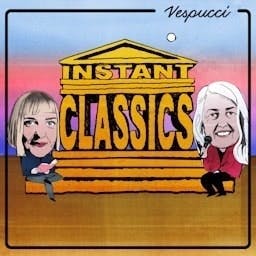
Instant Classics

Instant Classics

Vespucci

History

Frequency: 1 episode/6d. Total Eps: 49

Megaphone
Join world-renowned classicist Mary Beard and Guardian chief culture writer Charlotte Higgins for Instant Classics — the weekly podcast that proves ancient history is still relevant. Ancient stories, modern twists… and no degree in Classics required. Become a Member of the Instant Classics Book Club here: https://instantclassics.supportingcast.fm/
RSS
Spotify
Apple

Recent rankings

Latest chart positions across Apple Podcasts and Spotify rankings.

Apple Podcasts

  • 🇨🇦 Canada - history

    12/06/2026
    #65
  • 🇬🇧 Great Britain - history

    12/06/2026
    #30
  • 🇺🇸 USA - history

    12/06/2026
    #89
  • 🇫🇷 France - history

    12/06/2026
    #100
  • 🇬🇧 Great Britain - history

    11/06/2026
    #66
  • 🇬🇧 Great Britain - history

    10/06/2026
    #63
  • 🇬🇧 Great Britain - history

    09/06/2026
    #47
  • 🇬🇧 Great Britain - history

    08/06/2026
    #39
  • 🇬🇧 Great Britain - history

    07/06/2026
    #38
  • 🇬🇧 Great Britain - history

    05/06/2026
    #67

Spotify

  • 🇬🇧 Great Britain - trending

    10/11/2025
    #200
  • 🇬🇧 Great Britain - trending

    09/11/2025
    #168
  • 🇬🇧 Great Britain - trending

    08/11/2025
    #137
  • 🇬🇧 Great Britain - trending

    07/11/2025
    #134
  • 🇬🇧 Great Britain - trending

    06/11/2025
    #139
  • 🇬🇧 Great Britain - trending

    05/11/2025
    #140
  • 🇬🇧 Great Britain - trending

    04/11/2025
    #153
  • 🇬🇧 Great Britain - trending

    03/11/2025
    #159
  • 🇬🇧 Great Britain - trending

    02/11/2025
    #197
  • 🇬🇧 Great Britain - trending

    01/11/2025
    #196


RSS feed quality and score

Technical evaluation of the podcast's RSS feed quality and structure.

See all
RSS feed quality
To improve

Score global : 63%


Publication history

Monthly episode publishing history over the past years.

Episodes published by month in

Latest published episodes

Recent episodes with titles, durations, and descriptions.

See all

Instant Classics - Trailer

mardi 19 août 2025Duration 01:22

A new podcast hosted by Mary Beard and Charlotte Higgins. Ancient stories, modern twists… and no degree in Classics required. Episode 1 Available on Thursday, August 28th, 2025. Learn more about your ad choices. Visit podcastchoices.com/adchoices

Which Roman Emperor is Donald Trump?

jeudi 28 août 2025Duration 43:56

For a long time being a classicist didn’t exactly make you a hit at a party. Then along came Donald Trump and suddenly everybody wants to know: Which Roman emperor is he most like?  In this inaugural episode of Instant Classics, Mary Beard and Charlotte Higgins confront the question they are asked the most. And, as ever when Mary Beard is involved, the answer isn’t always as simple as you might think.  Mary and Charlotte explain how most of what we know about the emperors is unreliable. We do get some extraordinary glimpses behind the palace walls (Suetonius, the biographer of the first “12 Caesars” was a real insider – having worked as palace archivist and librarian). But almost all our accounts of them come from after their reign and are part of “posthumous reputation making”. Often, the way to keep bloke in power pleased was to trash his predecessors. Did Caligula really have all his soldiers pick up every shell on a beach or plan to make his favourite horse a consul?  These stories may be fanciful, but they are hugely important nevertheless and were repeated for generations. They are some of the best evidence for Romans thought of their emperors, about their fears of imperial power and how it falls.  So one to one, real life comparisons are always misleading (insists Mary!). But the wider patterns of political power can be similar then and now. Donald Trump plays many of the tunes that you find in the emperors’ playbook: capriciousness as a political tactic (they’re always changing their mind); Julius Caesar was one who made a point of speaking directly to the people to bypass political institutions (Trump does it through social media); wanton cruelty mixed with sudden acts of generosity.  Charlotte doesn’t let Mary off the hook. Yes, it’s hard to draw direct comparisons, but - come on Mary! - which emperor is Trump most like?  Answers are given!  @instaclassicpod for Insta, TikTok and YouTube @insta_classics for X email: instantclassicspod@gmail.com Mary and Charlotte’s recommended reads: Suetonius, Lives of the Caesars. Written in the second century CE. There’s a new translation by Tom Holland, but plenty of others are available. It was written to be read from start to finish, but new readers might choose to start with the lives of Caligula, Nero or Domitian. The Lives of the Later Caesars (available in Penguin translation: its Latin title is the rather more opaque Historia Augusta). Much less well known, this is a series of ancient biographies of emperors after Hadrian that make Suetonius look very “proper”, with lurid anecdotes that no one has ever thought were true. If you want a good start, go to the life of Elagabalus (also called Heliogabalus). For those wanting to explore Elagabalus, there’s an awful lot of modern gossip-mongering masquerading as history. For a more reliable start, try Martijn Icks, The Crimes of Elagabalus (this is great on how he was represented in later art and culture), or Harry Sidebottom, The Mad Emperor. Advert alert: Mary discusses the stories told about Roman emperors, and how we can understand them in her book, Emperor of Rome.  Instant Classics handmade by Vespucci Producer: Jonty Claypole  Executive Producer: Jo Meek  Senior Producer: Natalia Rodriguez Ford Video Editor: Jak Ford Theme music: Casey Gibson Learn more about your ad choices. Visit podcastchoices.com/adchoices

Introducing the Instant Classics Book Club - The Odyssey

lundi 1 septembre 2025Duration 03:37

Sign up here: https://instantclassics.supportingcast.fm/ Learn more about your ad choices. Visit podcastchoices.com/adchoices

The Odyssey#1: Journey Begins

mardi 2 septembre 2025Duration 17:23

In this first episode of the Instant Classics Book Club, Mary and Charlotte explain why The Odyssey is such a pleasure, as well as historically significant, and provide the basic facts necessary to get going.  Sign up here: https://instantclassics.supportingcast.fm/ Pick a translation - any translation - and get reading with us. The Odyssey, along with its sister text, The Iliad, is often considered the bedrock of western literature. In it are the seeds of the road movie, the family drama, fantasy fiction, the Western, and any number of genres. It’s also being adapted in a soon to be released film starring Matt Damon as the wily hero, Odysseus. So what better choice of text for the inaugural Instant Classics Book Club?  The Odyssey tells the story of Odysseus, King of Ithaca, and his (literally) epic journey home after the Greek war againstTroy. He encounters the man-eating cyclops, the dangerously alluring sirens (the original femmes fatales) – and he stops in the land of the lotus eaters, the land of blissful forgetfulness. But there is so much more to the story than a series of adventures. It’s also a story of what’s going on at home while he is away: his wife Penelope is trying to avoid being married off to one of a horde of ghastly “suitors” and his young son Telemachus learns how to be a man. The end is both happy and a grisly bloodbath.  Over the coming months, Mary and Charlotte are taking a deep dive into this greatest of all stories - and inviting you to read along with them. They’ll be sharing their lifetime’s enjoyment of it, putting it in context, and unpicking some occasionally tricky bits!  And send your thoughts to instantclassicspod@gmail.com  @instaclassicpod for Insta, TikTok and YouTube @insta_classics for X +email: instantclassicspod@gmail.com (We hope you enjoy this introduction to The Odyssey. To continue the journey, please join the Instant Classics Book Club at https://instantclassics.supportingcast.fm/ New episodes will be published every other Tuesday, and available exclusively for members beginning 30th September. Sign up now with the promo code EARLYBIRD25 to receive a 25% discount on membership). Mary and Charlotte’s recommended reads: The translation we will be quoting from is that of Emily Wilson. But really any will do (there is another even more recent version by Daniel Mendelsohn, which we will be keeping an eye on too). There are also plenty available free online. Most of those are rather old (and sometimes sound a bit stilted), but you can find a more up to date version here: https://johnstoniatexts.x10host.com/homer/odysseytofc.html Both Wilson and Mendelsohn start with very useful introductions to the poem. But try also: Barbara Graziosi, Homer: a very short introduction (OUP paperback, 2016) Edith Hall, The Return of Ulysses (IB Tauris paperback, 2012)  (you can download the whole book here: https://edithhall.co.uk/product/the-return-of-ulysses-a-cultural-history-of-homers-odyssey/) The Open University has a useful website (“free course”) on the Odyssey, with links all kinds of articles (including one by Charlotte on the theme of “warrior home-comings”): https://www.open.edu/openlearn/history-the-arts/exploring-homers-odyssey/content-section-3    Instant Classics handmade by Vespucci Producer: Jonty Claypole  Executive Producer: Jo Meek  Senior Producer: Natalia Rodriguez Ford Video Editor: Jak Ford Theme music: Casey Gibson Learn more about your ad choices. Visit podcastchoices.com/adchoices

A Day At The Races In Ancient Rome

jeudi 4 septembre 2025Duration 42:05

Think ‘Roman sport’ and images of Kirk Douglas, Russell Crowe, Paul Mescal and other Hollywood gladiators may come to mind. But while the Romans were partial to blood-sports, chariot-racing was the really big thing.  The archaeological remains of chariot-racing tracks have been found all over the Roman Empire, but none suggest a scale or grandeur close to the Circus Maximus in Rome. At full capacity, we think it could take a quarter of a million people - that’s twice the largest football stadium today.  In this episode, Mary and Charlotte recreate what a day at the races was actually like for the Romans. They describe how chariot-racing worked as a sport, what the experience may have been like for the spectators (courtesy of the poet Ovid), although remain stumped by the not insignificant issue of how a quarter of a million people went to the loo when archeological labour has - so far - only discovered one, solitary toilet.  They also describe how the chariot-racing industry worked, and the phenomenal wealth that prize charioteers acquired (Cristiano Ronaldo looks underpaid in comparison).  Ultimately, it is impossible to draw comparisons with sporting events today because chariot-racing at the Circus Maximus was far more than entertainment. It played a hugely important role in the political life of the empire as one of the few places where the people in large numbers could encounter the emperor . As a consequence, it was not only a site for chariot-racing but for mass public protest. How the emperor behaved, before the gaze of the city, was critical to his popularity. While no emperor was ever unseated at the Circus Maximus, it gave his enemies a chance to see whether the people would mind if something unpleasant happened to him later.  @instaclassicpod for Insta, TikTok and YouTube @insta_classics for X email: instantclassicspod@gmail.com To join the Instant Classics Book Club and share our trip into Homer’s Odyssey, go to  https://instantclassics.supportingcast.fm/ New episodes will be published every other Tuesday, and available exclusively for members beginning 30th September. Sign up now with the promo code EARLYBIRD25 to receive a 25% discount on membership.  Mary and Charlotte’s recommended reads: For good introductions to the “sport”, try: F. Meijer, Chariot Racing in the Roman Empire (Johns Hopkins, 2010) J. Toner, The Day Commodus Killed a Rhino: understanding the Roman Games (Johns Hopkins pb, 2015) The career of the super successful Diocles is the theme of an online article by Peter Struck: https://www.laphamsquarterly.org/roundtable/greatest-all-time Mary discusses the problems that emperors had at the races  in her book Emperor of Rome (Profile pb, 2024) Instant Classics handmade by Vespucci Producer: Jonty Claypole  Executive Producer: Jo Meek  Senior Producer: Natalia Rodriguez Ford Video Editor: Jak Ford Theme music: Casey Gibson Learn more about your ad choices. Visit podcastchoices.com/adchoices

What Sappho Still Teaches Us About Love

jeudi 11 septembre 2025Duration 51:31

In Ancient Greece, the Iliad was the poem above all other poems - an epic full of war and bloodshed that tells of the great heroes who fought and died for Troy.  But not so long after the supposed composition of the Iliad, a woman on the Mediterranean island of Lesbos, close to the coast of modern-day Turkey, introduced a new and enduring note to poetry: desire.  Her name was Sappho. She was revered through the Ancient World, but today only one work survives in its entirety: a poem usually known as the Hymn to Aphrodite. The rest is fragments - only about 600 lines of the 10,000 lines the Romans were still reading seven centuries after her death.  Sappho lived in the 7th Century BCE, long before the rise of Athens as the dominant city-state in Ancient Greece. It was before democracy, before the Parthenon and, arguably, before the extreme subjugation of women common in the later “classical” period. Women weren’t exactly liberated in seventh century Lesbos, but it looks like they were a lot freer than in fifth-century Athens.  From her poetry, we can tell she was an aristocrat, a singer, a lover, and a mother.  Sappho, famously, loved women. And in this episode, Charlotte and Mary explain why they also love Sappho. Not only is she the great poet of desire, but she also writes about nature, motherhood, middle-age, bad knees, and why war - despite what her brothers might say - is boring.  Charlotte and Mary recreate what they can of Sappho’s life and art. And they ask the big question: why is it that so little of her work survives compared to many male writers of the ancient world? Are medieval monks to blame? Was she, as Otis Redding sang, just too hot to handle?  @instaclassicpod for Insta, TikTok and YouTube @insta_classics for X email: instantclassicspod@gmail.com To join the Instant Classics Book Club and share our trip into Homer’s Odyssey, go to  https://instantclassics.supportingcast.fm/ New episodes will be published every other Tuesday, and available exclusively for members beginning 30th September. Sign up now with the promo code EARLYBIRD25 to receive a 25% discount on membership.  Mary and Charlotte’s recommended reads: There are hundreds of translations and adaptations of Sappho. Two of Mary and Charlotte’s recent favourites are: Anne Carson: If Not, Winter: Fragments of Sappho and Stanley Lombardo: Sappho, Poems and Fragments In her book, Eros, the Bittersweet, Carson also asks what makes Sappho the great poet of desire.  The world behind the poetry is the subject of Rosalind Thomas’s “Sappho’s Lesbos”, in The Cambridge Companion to Sappho. This is a fairly specialist collection of essays, but takes the story of Sappho’s influence right up to the present, from the USA to India, China and Latin America. For the controversies around the new discoveries of Sappho’s poetry made a decade ago, start with Roberta Mazza, Stolen Fragments (extraordinary detective work on the world of the illegal  trade in ancient papyri). Three articles by Charlotte also discuss that “new” Sappho and lift the lid on the problems: https://www.theguardian.com/world/2014/jan/29/sappho-ancient-greek-poet-unknown-works-discovered  https://www.theguardian.com/news/2020/jan/09/a-scandal-in-oxford-the-curious-case-of-the-stolen-gospel  https://www.theguardian.com/books/2021/mar/25/doubts-cast-over-provenance-of-unearthed-sappho-poems Instant Classics handmade by Vespucci Producer: Jonty Claypole  Executive Producer: Jo Meek  Senior Producer: Natalia Rodriguez Ford Video Editor: Jak Ford Theme music: Casey Gibson Learn more about your ad choices. Visit podcastchoices.com/adchoices

The Odyssey#2: "Tell Me About A Complicated Man, Muse"

mardi 16 septembre 2025Duration 25:08

Tell me about a complicated man, muse… In this episode of Instant Classics Book Club, Mary and Charlotte dwell on the first ten lines of The Odyssey (as translated by Emily Wilson) and show how it contains not only a summary of the story that follows, but introduces the themes, the subject, and the way the story will be told. Whoever Homer was, they were not a blind sage belting out rudimentary lyrics to listeners round a camp fire, but a sophisticated story-teller/s working and re-working their text to technical brilliance.  Sign up here: https://instantclassics.supportingcast.fm/ In particular, Mary and Charlotte introduce us to an ancient Greek word in the first line which is the key to everything that follows. Polytropos (πολῠ́τροπος) is almost untranslatable, but it is the secret to not only Odysseus’ character, but the story itself. Deciding how to interpret this word is amongst the biggest decisions a translator takes.  Our aim in this episode is to get everyone thinking about polytropos - and how you might interpret it over the course of this story. Is it a good thing to be polytropos? Who in your life is polytropos? Try dropping the word into conversation with your boss. Or maybe don’t.  Send your thoughts to instantclassicspod@gmail.com  And don’t worry - the pace will pick up from here on!  Mary and Charlotte’s recommended reads: You can find Emily Wilson’s discussion of “polytropos” (and her own debates about how to translate it) here: https://emily613.substack.com/p/on-complicated  Consistency alert: In the episode we sometimes refer to polytropos, sometimes to polytropon. That is because the main form of the word is polytropos, but it appears in these lines as polytropon (we’ll explain if you want!). Instant Classics handmade by Vespucci Producer: Jonty Claypole  Executive Producer: Jo Meek  Senior Producer: Natalia Rodriguez Ford Video Editor: Jak Ford Theme music: Casey Gibson Learn more about your ad choices. Visit podcastchoices.com/adchoices

Free Speech - An Ancient History

jeudi 18 septembre 2025Duration 47:48

In the wake of recent conflicts over free speech and acts of political violence, Mary and Charlotte discuss how - then as now - free speech dominated the political agenda in the ancient world, with wildly different interpretations about what it meant and who got to decide.  They discuss two distinct, yet complimentary principles in Ancient Athenian democracy: Parrhesia (free or frank speech) and isegoria (the equal right to speak). In theory, parrhesia preserved the right to speak truth to power, including the scandalous sexual jokes about public figures which pepper the comedies of the Greek stage. Tolerance of these plays suggested the Athenians generally recognised the validity of frank speech - and one of the state warships was even named parrhesia.  Isegoria embodied the principle that any free man had an equal right to participate in public discourse, although in practice this was rarely the case. Polished public speaking came with a good education and those who lacked it could be physically silenced.  The principles of free speech and equality are deceptively simple, and - as with today - interpretation and implementation varied wildly, depending on who held power. The life and death of the philosopher Socrates provides an interesting case study. He is often celebrated as a martyr of free speech, dying in its name, but on closer examination this isn’t exactly what happened.  They also look at free speech in Ancient Rome and the sobering story of Cicero’s final hours, in which his tongue - allegedly - was stitched into silence.  Join the Instant Classics Book Club here: https://instantclassics.supportingcast.fm/ Mary and Charlotte recommend some further reading Plato’s version of Socrates’ response to the charges against him is found in his Apology of Socrates (this, like all ancient works we mention here, is widely available in translation in print and online). NB in Greek apologia means “defence” not “sorry”.  An important debate in the Athenian assembly that we reference in our discussion (on how to punish the people on Mytilene) is described by Thucydides, History of the Peloponnesian War  Book 3, 36ff. The story of Cremutius Cordus is told in Tacitus Annals Book 3, 34-5; that of the tongue of Cicero by Cassius Dio, History of Rome Book 47, 8. Emily Wilson, The Death of Socrates (Profile/Harvard UP, 2008) is a good introduction to the issues of free speech in 399 BCE and their legacy. Content warning: references to political violence both in the ancient world and in the past week, and mild sexual innuendo.  @instaclassicpod for Insta, TikTok and YouTube @insta_classics for X email: instantclassicspod@gmail.com [To join the Instant Classics Book Club and share our trip into Homer’s Odyssey, go to  https://instantclassics.supportingcast.fm/ New episodes will be published every other Tuesday, and available exclusively for members beginning 30th September. Sign up now with the promo code EARLYBIRD25 to receive a 25% discount on membership.]  Instant Classics handmade by Vespucci Producer: Jonty Claypole  Executive Producer: Natalia Rodriguez Ford Video Editor: Jak Ford Theme music: Casey Gibson   Learn more about your ad choices. Visit podcastchoices.com/adchoices

Decoding The Parthenon

jeudi 25 septembre 2025Duration 52:47

The Parthenon is one of the most celebrated and recognisable buildings in the world, but what did it mean to the Ancient Greeks? What role did it play in Greek society? And what did it look like in its heyday? Together, Mary and Charlotte decode the Parthenon.  By happy coincidence, Mary is not just co-host of Instant Classics, but author of Charlotte’s favourite book on the subject: The Parthenon (Profile/Harvard University Press, 2002). In this episode, Mary and Charlotte pick their way through the stones of Parthenon, beginning with its construction in the middle of the 5th century BCE. The building work only took fifteen years (significantly faster than medieval cathedrals), but demanded a huge amount of labour, both enslaved and free.  Today, the Parthenon looks austere, pale and hardly decorated. A simple monument from a simpler age, perhaps. But what we see bears little relation to what the Greeks saw - and the building, its function and decoration retain many mysteries. For instance…  It was built as a temple to the city’s patron goddess Athena, but who was Athena and what exactly went on in a ‘temple’?  We know that it was painted and covered in sculptures - some of which survive - but whether the painting was subtle or gaudy is hard to say, while the significance of some of the sculptures continues to elude us – some of it was hardly even visible from the ground.  Inside, there were two rooms: one housed a giant, golden statue of Athena; the other was a treasury filled with riches. But where did all this loot come from and how was it guarded?   Finally, if you are lucky enough to visit, what is the best time of day to go and – is it really worth it – or are you better off going to the beach?  Find out the answer - or possible answers - to these questions in Decoding the Parthenon.  @instaclassicpod for Insta, TikTok and YouTube @insta_classics for X email: instantclassicspod@gmail.com To join the Instant Classics Book Club and share our trip into Homer’s Odyssey, go to  https://instantclassics.supportingcast.fm/ Mary and Charlotte’s recommended reads: Sorry to repeat the recommendation for Mary’s book, The Parthenon. But there’s more. You can find Pausanias’ second-century CE description of the temple in his Description of Greece I, 24, 5 ff (online here: https://www.perseus.tufts.edu/hopper/text?doc=Perseus:text:1999.01.0160:book=1:chapter=24) And various criticisms of the project are noted (again in the second century CE) by Plutarch in his Life of Pericles chap. 31 (online here: https://www.perseus.tufts.edu/hopper/text?doc=Perseus%3Atext%3A2008.01.0055%3Achapter%3D31) Even introductions to Greek religion for general readers can get pretty technical. There is a reasonably accessible discussion of the idea of the temple, in Simon Price, Religions of the Ancient Greeks (Cambridge, 1999). Instant Classics handmade by Vespucci Producer: Jonty Claypole  Executive Producer: Natalia Rodriguez Ford Video Editor: Jak Ford Theme music: Casey Gibson Learn more about your ad choices. Visit podcastchoices.com/adchoices

How did Rome begin?

jeudi 2 octobre 2025Duration 34:26

We all know what Rome became - largest empire of the ancient world, public bathing, gladiators, aqueducts, excellent roads and all that - but how did it begin? Who founded it? When? And why? Mary and Charlotte sift through the various myths that give some insight to these questions.  Peel back the layers of history and Rome’s origins are lost in the bog on which it was built. Archaeology offers us evidence of Bronze Age huts, burial practice and trade with neighbouring (and far-flung) lands, but leaves many of the big questions unanswered. This is a problem not only for classicists, but the countless men who apparently think of the Roman Empire several times a day. The Romans themselves struggled with their murky history. Even for them, the question of why they had risen to such extraordinary power was puzzling. The thought of humble origins sat uneasily with the grandeur and pomp of the imperial capital. So they did what many other cultures do and made up stories that explained their path to greatness.  If you’ve heard of outcast babies Romulus and Remus being suckled by a wolf, that’s just the icing on the cake. Accounts of the Romulus myth vary wildly. In some versions, he eventually ascends to heaven as a god. In others, he is hacked to death by his disgruntled subjects.  Other myths point elsewhere. The “Roman race” in Italy was founded by a Trojan exile called Aeneas, although he didn’t actually found the city of Rome itself. Maybe, that was a Greek called Evander, long before Romulus.  It’s easy to dismiss these stories, but Mary and Charlotte argue that they tell us a great deal about how the Romans understood themselves and their city (whether there is some grain of literal truth in them, who knows?). Most of all they point to the way that, at some deep level, they considered themselves to be an immigrant culture - outcasts, exiles and opportunists - searching for a better life.   @instaclassicpod for Insta, TikTok and YouTube @insta_classics for X email: instantclassicspod@gmail.com To join the Instant Classics Book Club and share our trip into Homer’s Odyssey, go to  https://instantclassics.supportingcast.fm/ Mary and Charlotte’s recommended reads: There are many ancient accounts of the origins of Rome. Best known is Book 1 of Livy’s History of Rome which tells the story from Romulus to the last of the seven early kings (translations in Penguin Classics or Oxford World Classics, as The Early History of Rome and The Rise of Rome).  For Aeneas, try Virgil Aeneid Books 2 and 8. Book 2 takes us to Aeneas’ flight from Troy. Book 8 pictures Evander, who is then living there, showing Aeneas around the future site of Rome).  The beginning of Mary’s SPQR, written for non specialists, busts a few myths about the origins of the city. The Italian archaeologist Andrea Carandini takes a completely different approach. Try his (short) Rome: Day One. Interesting, but rather more specialist, books are: Catharine Edwards, Writing Rome (she is very good on the “Hut of Romulus” which supposedly was authentically preserved in Rome for hundreds of years); T. P. Wiseman, Remus (which has an off-beat line about the role of Remus in Roman history, but gives an eye-opening account of all the very different Roman traditions about the world and twins). Instant Classics handmade by Vespucci Producer: Jonty Claypole  Executive Producer: Natalia Rodriguez Ford Video Editor: Jak Ford Theme music: Casey Gibson Learn more about your ad choices. Visit podcastchoices.com/adchoices

Related Shows Based on Content Similarities
Discover shows related to Instant Classics, based on actual content similarities. Explore podcasts with similar topics, themes, and formats, backed by real data.
Ancestral Kitchen
Be Good Broadcast
Mummies & Magic - Altägypten in der Popkultur
Here Be Monsters
Let's Talk About Myths, Baby! | Greek Mythology & the Ancient Mediterranean
Myths and Muses: A Mythik Camps Podcast
Chasing Stars
Unholy Histories: The Humanist Heritage Podcast from Humanists UK
© My Podcast Data