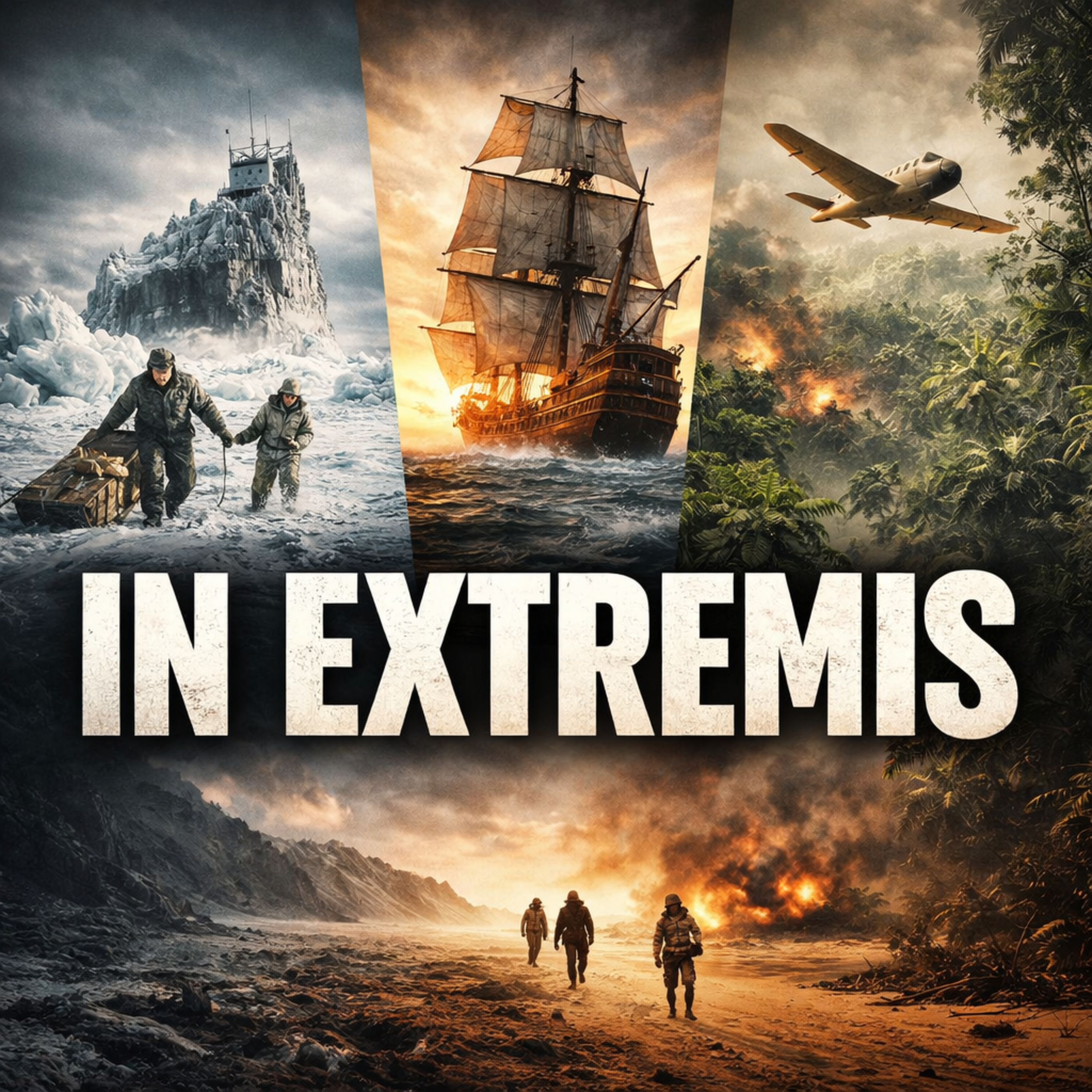
A narrative history podcast about people pushed to the absolute edge. Hosted by Australian author Tom Trumble (Penguin Random House), In Extremis tells longform stories from WWII, the Cold War, and beyond — survival, mutiny, betrayal, leadership under pressure. Military history told as gripping human narrative.
Coming soon: Shackleton and Mawson in Antarctica. Nancy Wake — the White Mouse. The assassination of Reinhard Heydrich. The Cuban Missile Crisis. Chernobyl. The Mutiny on the Batavia. Also coming: Amelia Earhart. Vivian Bullwinkel. Captain Richard de Crespigny. The Thai cave rescue.
Site
RSS
Apple
Data updated on 10/09/2026
Recent rankings
Latest chart positions across Apple Podcasts and Spotify rankings.
Shared links between episodes and podcasts
Links found in episode descriptions and other podcasts that share them.
Discover shows related to In Extremis - Stories from the Edge of History, based on actual content similarities. Explore podcasts with similar topics, themes, and formats, backed by real data.
Shackleton - Part 6: South Georgia Island: Shackleton's Last Ordeal
Season 3 · Episode 6
Friday, September 4, 2026 • Duration 45:35
After 17 days at sea, Shackleton and his five men reach South Georgia Island. But arrival is not salvation. The whaleboat James Caird is battered, and the only settlement lies on the opposite coast, separated by 30 miles of unexplored, unmapped mountainous terrain.
With three men too weak to attempt the crossing, Shackleton, Frank Worsley, and Tom Crean set out on foot across peaks reaching 10,000 feet, carrying three days' rations and no sleeping bags. Racing against weather that could trap them on the ice, they navigate false descents, near-fatal crevasses, and make a desperate decision to slide down an icy slope into the unknown.
Alexander, Caroline. The Endurance: Shackleton's Legendary Antarctic Expedition. Knopf, 1998.
Jarvis, Tim. Shackleton's Epic. BBC, 2009.
Shackleton, Sir Ernest. South: The Endurance Expedition. Penguin Classics, 1919.
Worsley, Frank Shackleton's Boat Journey , 1933
Shackleton - Part 5: The Voyage of the James Caird
Season 3 · Episode 5
Friday, August 28, 2026 • Duration 50:39
Ernest Shackleton and his crew of five men set sail from Elephant Island aboard the James Caird, a 22-foot wooden whaleboat, on a desperate 800-nautical-mile journey to South Georgia Island. IF they succeed, it will go down as one of the greatest small boat sea voyages in recorded history.
But their chances of success are minimal...
Navigating by sextant through constant cloud cover, Frank Worsley must plot a course with minimal data. The crew battles mountainous seas, freezing spray, and hurricane-force gales.
Ice accumulates on deck, threatening to sink the boat. Their only freshwater keg becomes contaminated. As they approach South Georgia, a tempest drives them toward a lee shore and jagged cliffs, threatening to dash the boat and end all hope of rescue.
Alexander, Caroline. The Endurance: Shackleton's Legendary Antarctic Expedition. Knopf, 1998.
Jarvis, Tim. Shackleton's Epic. BBC, 2009.
Shackleton, Sir Ernest. South: The Endurance Expedition. Penguin Classics, 1919.
Worsley, Frank Shackleton's Boat Journey , 1933
Shackleton - Part 4: Elephant Island
Season 3 · Episode 4
Friday, August 21, 2026 • Duration 44:12
Shackleton scours the seas for the missing Dudley Docker. She's still afloat, but out of sight. Skippering the Docker, Frank Worsley hasn't slept in 80 hours.
When the crew finally reaches solid ground, relief turns to despondency. There will be no rescue in this frozen wasteland.
Shackleton must prepare for another - more dangerous - open boat journey across the Drake Passage. As the 6 men selected prepare to depart immediately, Shackleton writes a letter to Frank Wild, instructing him to abandon the camp if rescue doesn't come.
Within days, the James Caird will sail 800 nautical miles across the Drake Passage, attempting one of the greatest small boat journeys in maritime history.
Alexander, Caroline. The Endurance: Shackleton's Legendary Antarctic Expedition. Knopf, 1998.
Jarvis, Tim. Shackleton's Epic. BBC, 2009.
Shackleton, Sir Ernest. South: The Endurance Expedition. Penguin Classics, 1919.
Worsley, Frank Shackleton's Boat Journey , 1933
Shackleton - Part 3: Of Salt, Sacrifice, Leadership and Floebergs
Season 3 · Episode 3
Friday, August 14, 2026 • Duration 46:17
When the ice beneath them fractures in the dead of night, Shackleton acts without hesitation—pulling Ernie Holness from the freezing water in a moment that sets the tone for everything that follows. But rescue from the ice is only the beginning.
As the three small boats—the James Caird, Stancomb Wills, and Dudley Docker—push into open water during a severe gale, the men face conditions that test not just their bodies but their minds. A floeberg that seems solid becomes a death trap. Navigation reveals they've drifted backward 30 miles. The ocean itself conspires against them: unseen currents, waves that freeze mid-air, temperatures dropping to -22°C.
Through it all, Shackleton stands visible at the bow without mittens—a symbol of endurance and an inspiration to the men. And as the three boats draw within 10 miles of Elephant Island, Shackleton makes a fateful decision...
Alexander, Caroline. The Endurance: Shackleton's Legendary Antarctic Expedition. Knopf, 1998.
Jarvis, Tim. Shackleton's Epic. BBC, 2009.
Koehn, Nancy. Forged in Crisis: The Power of Courageous Leadership in Turbulent Times. Crown Business, 2017.
Shackleton, Sir Ernest. South: The Endurance Expedition. Penguin Classics, 1919.
Shackleton - Part 2: The Drift of the Ice
Season 3 · Episode 2
Friday, August 7, 2026 • Duration 40:29
After the Endurance sank, Shackleton faced three possible drift patterns. None guaranteed rescue. What he could control was morale. Life on the floe brought constant suffering: constipation, sodden ice, eyes burned raw by wind and reflection, wind madness. When calculations showed they were drifting away from land, Shackleton ordered a march west dragging two boats. Progress: six miles in five days. Christmas came and went.
Carpenter Harry McNish turned on the commander, claiming the ship's sinking had terminated his contract. Shackleton lied, claiming the articles remained binding. McNish backed down. Days later, fearing the boats would be damaged, Shackleton abandoned the march and established Patience Camp.
Shackleton's strength lay not just in care for his men, but in understanding each one's psychology. He managed difficult personalities - the egotistical Hurley, the anxious storekeeper Orde-Lees - by isolating them strategically. Yet Orde-Lees, though eccentric, was possibly the strongest: a former Royal Marines PT director who survived a 12-foot, 1,100-pound leopard seal attack only by Frank Worsley's rifle.
By April, the floe had shrunk to 50 yards across. On April 9, Shackleton ordered the boats launched. They cleared the pack as a tide rip—150 feet of surging ice—roared past. That night on a new floe, Shackleton awoke at 11 p.m. A deep rumble. A crack opened directly beneath his tent. The men scrambled out unharmed. Then the shout: "Somebody's missing!!!"
Sources
"Endurance", By Alfred Lansing
"The Endurance", By Caroline Alexander
"Shackleton's Epic", By Tim Jarvis
"Forged in Crisis", By Nancy Koehn
Shackleton - Part 1: What the ice gets, the ice keeps
Season 3 · Episode 1
Friday, July 31, 2026 • Duration 45:37
EPISODE DESCRIPTION
November 21, 1915. The Endurance, trapped in Antarctic pack ice for months, finally breaks apart under impossible pressure. Sir Ernest Shackleton watches his ship—his home, his sanctuary—succumb to the ice and slip beneath the surface. The dream of crossing Antarctica is over. Now, 28 men face a new ordeal: survival on a drifting ice floe, hundreds of miles from any land, with no radio contact and no one knowing their fate. This is the moment Shackleton's true test begins—not conquest, but command of men in hopelessness. Part 1 of the Shackleton arc opens in the ice, where a 41-year-old explorer must decide who they will become when everything is stripped away.
PEOPLE
Sir Ernest Shackleton — 41-year-old expedition commander; Irish-born; haunted by his previous Antarctic failure and Amundsen's triumph; driven by ambition, financial pressure, and an unshakeable belief in his own leadership
Frank Worsley — Ship's captain, Endurance; masterful navigator; described as "delighted in nothing more than barreling into the ice"
Frank Hurley — Photographer and filmmaker; documented the expedition; conducted lantern slide shows during the long winter darkness
Dr. Alexander Macklin — Scottish surgeon; specialist in recognizing morale decline
The 28-man crew — Scientists, sailors, dog handlers; men of different nationalities, classes, and skills
Roald Amundsen — Norwegian explorer; first to reach the South Pole (1911); overshadowed Shackleton's achievements
Sir Robert Falcon Scott — British explorer; reached the South Pole a month after Amundsen; died on the return journey; iconic figure of the Heroic Age
Adrian de Gerlache — Belgian expedition commander; first to overwinter in Antarctica aboard the Belgica (1897-1899)
Frederick Cook — American photographer, surgeon, and fraud; relieved crew sanity during the Belgica winter through psychological tactics
RESOURCES
The Old Man and the Longest Race - Part 2: Shuffling to Glory
Friday, July 24, 2026 • Duration 42:13
Day 2 begins with chaos: Wally oversleeps, Cliff wakes at 2:30am instead of 6am, and runs unprepared on baked beans and two hours of sleep. What follows is an extraordinary five-day journey across 875 kilometres as a 61-year-old potato farmer defies every odd, battles injury and exhaustion, outwits his rivals, and becomes a national icon. This is the story of how Cliff Young won Australia's most grueling ultramarathon—and changed running forever.
The Old Man and the Longest Race - Part 1: The potato farming, gumboot wearing, ultradistance runner.
Friday, July 17, 2026 • Duration 33:57
SHOW NOTES - CLIFF YOUNG EPISODE 1
The Underdog
In April 1983, a 61-year-old potato farmer from Beech Forest lined up alongside elite ultramarathoners for the inaugural Westfield Sydney to Melbourne ultramarathon—864 kilometres across Australia. Nobody took him seriously. Except the runners themselves.
This is the story of how an old bloke in gumboots almost didn't make it through the first night, nearly hit by a semi-trailer and forced to rest on baked beans, setting up one of sport's greatest comebacks.
PEOPLE
Cliff Young – 61-year-old potato farmer, Beech Forest, Victoria
Siggy Bauer – 1000-mile record holder
Robert Bruner – 200km Sri Chinmoy Festival champion
George Perdon – Australian ultradistance runner, Fremantle to Sydney record
Tony Rafferty – Irish expat, rival ultramarathoner
John Hughes – New Zealand runner, cocky frontrunner
John Toleman – Running coach, race organiser
Martin Noonan – Westfield marketing executive
Wally Zunneberg – Cliff's trainer and support crew
Mary Young – Cliff's mother
TOPICS
The 1983 Westfield Sydney to Melbourne ultramarathon
Cliff's failed 1000-mile run attempt (November 1982)
The water tank incident (January 1983)
Ultramarathon training and preparation
Support crews and logistics
The psychology of the underdog
Running on the Hume Highway in 1983
TIMESTAMPS (approximate)
0:00 – Opening: Westfield Shopping Centre, April 26, 1983
3:45 – The field: Siggy Bauer, Robert Bruner, George Perdon, Tony Rafferty
7:20 – Cliff Young introduced
10:15 – How the race came to be: Toleman, Perdon, Rafferty rivalry
The Man Who Saved the World — Part 2: 85 Seconds to Midnight
Wednesday, July 1, 2026 • Duration 40:03
On the night of September 26th, 1983, Stanislav Petrov stood alone in a Soviet bunker outside Moscow while every alarm in the building screamed that America had launched its missiles.
He didn't make the call.
This is the second and final part of the story of the man who may have saved human civilisation.. and was punished for it.
In this episode:
What was the Perimeter system — and why did the Soviets build it? The answer reveals everything about how close the world came to automated annihilation, and why the decision that night rested on one man's shoulders rather than a machine's.
Why was Petrov different from every other officer in that bunker? His upbringing, his education, and the family trauma that shaped him all suggest the system had produced exactly one person capable of doing what he did.
What happened when he was proved right? A reprimand.
And what became of Petrov after the Soviet Union collapsed is covered.
Primary and secondary sources for this episode:
The principal secondary sources for this episode and its companion are:
Taylor Downing, 1983: Reagan, Andropov and a World on the Brink (2018) — the most comprehensive single-volume account of the 1983 war scare.
Nate Jones (ed.), Able Archer 83: The Secret History of the NATO Exercise that Almost Triggered Nuclear War (2016) — a collection of declassified primary documents, including CIA assessments, NSA intercepts, and internal NATO communications, assembled by the National Security Archive.
Additional material drawn from:
Petrov's own interviews, particularly his 2013 BBC interview on the thirtieth anniversary of the incident, and the 2014 documentary .
The Man Who Saved the World — Part 1: Stanislav Petrov and the most dangerous moment of the Cold War
Thursday, June 25, 2026 • Duration 37:18
Shortly after midnight on the 27th of September 1983, a forty-four-year-old Soviet military officer named Stanislav Petrov was sitting in a reclining chair in a bunker eighty miles south of Moscow when his early warning system told him that the United States had launched a nuclear missile at the Soviet Union.
He had minutes to decide whether to believe it.
This is the first of a two-part episode on Stanislav Petrov and the most dangerous moment of the Cold War that almost nobody has heard of. In this episode we set the scene: who Stanislav Petrov was, what he was doing in that bunker, and why the autumn of 1983 was the most terrifying season of the entire Cold War.
Along the way we cover:
The OKO satellite network — the Soviet early warning system that Petrov had helped build, and that he was now being asked to trust with the fate of civilisation.
The near-misses that preceded 1983 — Vasili Arkhipov and the Soviet submarine B-59 during the Cuban Missile Crisis, the man who refused to authorise a nuclear torpedo launch when his captain was convinced the war had already started. And Zbigniew Brzezinski, who in 1979 got out of bed at 3am and decided not to wake his wife before calling the president to recommend a retaliatory nuclear strike — only to be told, thirty seconds later, that someone had accidentally loaded a training tape into a NORAD computer.
The state of the world in 1983, Reagan's Evil Empire speech, the Strategic Defense Initiative, the deployment of Pershing II missiles to West Germany, and why the Soviet Union read all of these not as defensive posturing but as the systematic assembly of a first-strike capability.
Yuri Andropov: the former KGB chief who succeeded Nikita Brezhnev as General Secretary in November 1982. A dying man, conducting the business of running a nuclear superpower from a hospital clinic, connected to a dialysis machine, watching Ronald Reagan describe his country as the focus of evil in the modern world.
Korean Air Lines Flight 007: shot down by a Soviet interceptor on the 1st of September 1983, killing 269 people including a US Congressman. The event that poisoned an already toxic relationship just weeks before Petrov's night in the bunker.
Books:
Alfred Lansing, Endurance: Shackleton's Legendary Antarctic Expedition (1959) — Definitive narrative account; based on expedition diaries and crew interviews
Nancy Koehn, Forged in Crisis: The Power of Courageous Leadership in Turbulent Times (2017) — Analytical framework for Shackleton's leadership psychology
Tim Jarvis, Shackleton's Epic (2014) — Modern expedition retracing Shackleton's journey; first-hand understanding of the conditions
Caroline Alexander, The Endurance: Shackleton's Iconic Antarctic Expedition (1998) — Illustrated history; combines narrative with Frank Hurley's photographs
Julian Sancton, Madhouse at the End of the Earth: The Belgica's Journey into Darkness (2021) — Historical precedent; psychology of polar crews
The "Cliff Young Shuffle" – revolutionary running technique
Celebrity and adulation: Goulburn, Jugion, media coverage
Support crew dynamics: Wobbles' drinking, Wally's frustration
Neil Kearney's TV moment: Cliff eating pears straight from can
Channel 10 coverage and newspaper articles during the race
Burke Street finish: kids nearly killing him with encouragement
The 10,000-person Melbourne CBD crowd (11:34pm Monday night)
Cliff's $10,000 prize and decision to split it with other runners
Reactions from elite runners: Hughes, Rafferty, Bauer, Perdon
Post-race celebrity: Don Lane Show, Michael Parkinson, Parliament House
The gumboot statue memorial in Beach Forest
Debunking myths: gumboots training, no formal training, the tortoise-and-hare fallacy
Legacy: the Young-Shuffle adopted by subsequent winners
Cliff's later career: subsequent races, marriage to Mary Howell, decline, stroke (2000), death (2003)
Sources:
Julietta Jameson, "Cliffy: The Cliff Young Story", Text, 2010
Cliff Young, "Cliffy's Book", High Country Publishing, 1995
Australian Story, ABC, How potato farmer Cliff Young outran the world’s best athletes | Australian Story
15:30 – Martin Noonan's vision
18:00 – The test run: Noonan and Cliff
22:15 – The gumboots press conference
26:00 – The 1000-mile run (November 1982)
30:15 – The water tank disaster (January 1983)
34:00 – Race day begins
36:45 – The mad dash: Hughes, the cracking pace
38:30 – The semi-trailer near-miss and Wally's alarm mistake
40:00 – END OF PART 1
RESOURCES
"Cliffy: The Cliff Young Story" by Julietta Jameson
"Cliffy's Book" by Cliff Young
The Man Who Saved the World
David Hoffman, The Dead Hand (2009) — Pulitzer Prize-winning account of the Soviet nuclear programme and the 1983 war scare.
And Reagan himself: who despite his bellicose rhetoric was privately horrified by Pentagon officials who believed nuclear war was winnable. "I can't believe that this world can go on beyond our generation," he said in a radio address from Camp David, "without someday some fool or some maniac or some accident triggering the kind of war that is the end of the line for all of us."
The episode ends where it began — in Serpukhov-15, with Stanislav Petrov staring at a screen that now reads not launch, but missile attack.
What he does next is the subject of Part 2.
Content note: this episode contains discussion of nuclear weapons, mass casualty scenarios, and Cold War geopolitical history. No graphic content.
Primary and secondary sources for this episode:
The principal secondary sources for this episode and its companion are:
Taylor Downing, 1983: Reagan, Andropov and a World on the Brink (2018) — the most comprehensive single-volume account of the 1983 war scare.
Nate Jones (ed.), Able Archer 83: The Secret History of the NATO Exercise that Almost Triggered Nuclear War (2016) — a collection of declassified primary documents, including CIA assessments, NSA intercepts, and internal NATO communications, assembled by the National Security Archive.
Additional material drawn from:
Petrov's own interviews, particularly his 2013 BBC interview on the thirtieth anniversary of the incident, and the 2014 documentary The Man Who Saved the World.
The Reagan Presidential Library's archive of public papers and radio addresses.
David Hoffman, The Dead Hand (2009) — Pulitzer Prize-winning account of the Soviet nuclear programme and the 1983 war scare.