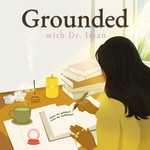
Each week, we answer a big question, finding grounding somewhere between the spiritual and the intellectual.
I’m Dr. Iman, your professor-friend who turns to my work as a scholar of religion, spirituality, and Black intellectual history to think through questions big and small about how we make sense of our lives.
Some weeks, that means digging into Black thought, religion, spirituality, and culture. Other weeks, I’m thinking out loud about something I’m researching, teaching, reading, or finding grounding in. And sometimes I’m joined by scholars, creators, friends, and listeners who give us something new to think about.
Wherever the question takes us, the goal is the same: to think together about the ideas, people, and traditions that might help us see ourselves and our world a little differently.
Let’s get grounded.
Site
RSS
Apple
Data updated on 28/10/2026
Recent rankings
Latest chart positions across Apple Podcasts and Spotify rankings.
Shared links between episodes and podcasts
Links found in episode descriptions and other podcasts that share them.
Is Black beauty culture just about what we buy? Or is there something much deeper happening when Black women get dressed, do their makeup, lay their edges, and show up in the world?
Inspired (more triggered because it PMO) by a viral conversation between Nara Smith and Emma Grede about why they wouldn't spend their money on a Birkin bag, I'm asking what we miss when we reduce Black women's relationships to beauty and fashion to consumption, wealth, and materialism.
From Evelyn Brooks Higginbotham's work on respectability politics in the Black Baptist Church to Kayla Renée Wheeler's scholarship on the Nation of Islam's beauty politics, we're exploring how Black women have historically used beauty and fashion to negotiate political power, challenge white beauty standards, and articulate their own visions of Black womanhood.
Then, we're bringing the conversation into the present with two thinkers I LOVE: Dr. Kiy and the Zorine Truly (aka the Hoochie Historian). Through Black feminine cultural mysticism and hoochie history, they help us think about Black beauty culture as a kind of secret language between Black women and femmes. If you know, you know!
Chapters
00:00 Teaser
00:36 Welcome & Where I'm Finding Grounding
3:37 Is Beauty Culture More Than What We Buy? 12:16 Not Buying a Birkin is Not Relatable...
19:18 Respectability Politics & Political Access in the Church
23:05 The Nation of Islam & "Black Is Beautiful"
29:20 The Secret Language Between Black Femmes: Black Feminine Cultural Mysticism and Hoochie History
REFERENCES
Higginbotham, Evelyn Brooks. Righteous Discontent: The Women's Movement in the Black Baptist Church, 1880–1920. Cambridge, MA: Harvard University Press, 1993.
Wheeler, Kayla Renée. “Becoming the ‘Mothers of Civilization’: Constructing Black Beauty and Sartorial Modesty in the Nation of Islam.” Critical Studies in Fashion & Beauty 16, no. 1 (2025): 59–76.
Griffin, Farah Jasmine. “Ironies of a Saint.”
Dr. Kiy (@pinkiysensei) — Black feminine cultural mysticism (thefemininecitation.com) and the intellectual significance of Black women's beauty and aesthetic practices.
Zorine Truly (@thee_hoochie_historian) — The Hoochie Historian; Black feminine aesthetics, hoochie culture, and Black women's cultural expression.
Ep. 33: How to Be Spiritual (According to Black Feminist Theory) | Part 1
Episode 33
Monday, October 19, 2026 • Duration 35:28
What happens when you recognize spiritual lessons in Black feminist theory?
* And pardon my voice, I am losing it this week*
This week on Grounded, we're back to a 1:1 conversation, and I'm thinking about what Black feminist theorists have taught me about spirituality, how we see the world, and what it means to be human.
But before we get there, I'm also thinking through something a little more personal: why, as someone who studies religion and spirituality, I sometimes hesitate to speak about my own spiritual life without grounding myself in scholarship. What does it mean to move between being a scholar of spirituality and someone who is actively trying to live a spiritual life? And why am I so worried about sounding like a guru? 😭
Inspired by Jenn M. Jackson's Black Women Taught Us, I'm sharing two lessons from Black feminist thinkers whose work has fundamentally changed how I understand and inhabit a spiritual life. We get into Christina Sharpe's In the Wake and what it means to see the unseen, not just in a metaphysical sense, but in the histories, structures, and forces that shape our everyday lives. Then we turn to Sylvia Wynter, whose work challenges us to rethink what it means to be human and imagine ways of living beyond the values that have historically dehumanized Black people.
This is the first of what I'm hoping will be more conversations about what Black women have taught me about living a spiritual life.
Chapters
00:00 — Teaser: Is Black Feminist Theory Spiritual?
00:49 — Welcome to Grounded + Finding Grounding in Burnout
07:01 — Why I Worry About Sounding Like a Guru
17:11 — Lesson 1: Seeing the Unseen | Christina Sharpe
26:13 — Lesson 2: Imagining New Ways of Being Human | Sylvia Wynter
Ep. 32: What Do Islam + Modern Spirituality Have In Common? | Shaif
Episode 32
Monday, October 12, 2026 • Duration 01:01:04
What if some of the practices we associate with modern spirituality have much longer histories in the Muslim world?
This week, I'm joined by content creator, educator, and one of my favorite people to learn from on the internet, Shaif (@hotboyshaif), to ask: What do Islam + modern spirituality have in common?
We get into the histories of astrology, crystals, spirit possession, Sufism, and other practices that complicate the distinctions we often make between Islam and modern spirituality. But we also spend a lot of time thinking about a question at the heart of Religious Studies: What makes something a religion in the first place?
Shaif shares why he prefers to think about Islam as a living tradition and a way of life rather than simply a religion. We talk about the colonial histories of the category of religion, why I think we need better language than “cult,” and how colonialism, reform movements, and globalization have shaped what many of us now understand as Islam.
And, of course, we get into Muslimness. Who gets to decide what makes someone a “real Muslim”? What happens when the Islam you inherited doesn't look like the Islam someone else insists is authentic? And how might studying the history of your own tradition actually deepen your relationship to it?
One of my favorite parts of our conversation is thinking about how much of what gets dismissed as “cultural Islam” is part of a much longer history of Muslim spiritual and intellectual life. And what possibilities open up when we understand traditions as living, changing, and continuously being made.
Chapters
00:36 — Where Are You Finding Grounding?
5:14 — Islam & Modern Spirituality
13:48 — On the Word 'Cult'
22:08 — Black Muslims Labeled a 'Cult'
24:26 — Response to the Videos
36:47 — Hadith & Debate in Islam
Ep. 31. Where Do Islam + the Occult Meet? | Blaze-Maximus Al-Hakimiyya
Episode 31
Monday, October 5, 2026 • Duration 01:00:01
What if astrology, magic, and the occult aren’t as outside of Islam as we’ve been taught to think?
This week, I’m joined by astrologer and student of the Islamic occult sciences Blaze-Maximus Al-Hakimiyya (@AstroByMax) to ask: Where do Islam + the occult meet?
Blaze takes us into a history of Islam and the occult sciences that complicates the idea that astrology, magic, divination, and Islam have always existed in opposition to one another. We talk about what it means that Islam takes the unseen for granted, the difference between licit and illicit magic, and how colonialism + modern reform movements helped change the way many of us understand the occult in the first place.
We get into astrology in the medieval Islamicate world, geomancy as the “science of the sands,” divination, bibliomancy, the astrology embedded in everyday life, and the possibility that some of us are already engaging practices connected to the occult sciences without thinking of them that way.
One of my favorite parts of our conversation is thinking about astrology as an intellectual tradition. Blaze walks us through a history of astrology that decenters Europe and instead takes us through Baghdad, Cairo, Alexandria, Timbuktu, Marrakesh, Delhi, and the larger Afro-Asiatic world. We talk about what gets lost when astrology becomes a consumer product rather than something we actually study, inherit, debate, and learn in community.
Chapters
00:00 — Teaser: Lifestyle Astrology vs. an Intellectual Tradition
00:59 — Welcome to Grounded + Meet Blaze-Maximus Al-Hakimiyya
03:13 — Where Blaze Is Finding Grounding
04:39 — Where Do Islam + the Occult Meet?
12:39 — Magic Is All Around Us
19:31 — How Blaze Discovered Astrology
28:32 — Old Astrology vs. New Astrology
Ep. 30: What Does Magic Look Like in Everyday Life?
Episode 30
Monday, September 28, 2026 • Duration 37:07
When I was a little girl, I was CONVINCED my magic was just around the corner. Like at any moment my hands were going to start sparkling, some unseen being was going to reveal itself to me, and I was going to discover that I had magical powers.
Turns out, magic was a part of the world, I just coulldn’t see it then.
This week, I’m thinking with Yvonne Chireau’s Black Magic about what magic actually looks like in everyday Black religious life. We get into the history of conjure + hoodoo, rootworkers, mojo bags, divination, healing and harming practices, and why the distinction between “magic” and “religion” has never mapped neatly onto Black religious history. Chireau’s work traces how conjure and Christianity have historically operated alongside and through one another, including as sources of protection and spiritual power.But we also get into the little things. The kinda things I talked to my students about this week. Don’t put your purse on the ground. Don’t let somebody sweep your feet. Honey on the tongue. Throwing salt when the vibes are off. All the things you might have heard growing up without ever thinking of them as having a relationship to conjure, hoodoo, or Black religious history.
And finally, I’m thinking about one of my favorite things magic gives us: a different way of imagining our relationships with higher powers. What if relationships with the unseen can also be collaborative, conspiratorial, and a way of asserting agency in a world where so much is outside of our control?Basically, lil Iman was right. The magic did come. I just didn’t know it would look the way it did.
Chapters
00:00 — Teaser: I Built an Altar in Elementary School 😭
00:38 — Finding Grounding: Feeling Hopeful About the World
03:54 — I Always Thought My Magic Was Coming
11:07 — What’s the Difference Between Magic and Religion?
23:55 — What Does Magic Look Like in Everyday Life?
30:09 — A Different Way to Think About Higher Powers
34:04 — The Magic Did ComeReferencesARC
Ep.29 How to Find + Build a Spiritual Space That Nourishes You? | Reverend Ryan Lindsay Arrendell
Episode 29
Monday, September 21, 2026 • Duration 47:45
What should a spiritual space make you feel?
This week, I’m joined by the incredible Rev. Ryan Lindsay Arrendell, the founder and pastor of Salt and Light Ministries DC to think about what it means to build and find religious + spiritual spaces that nourish.
Rev Ryan is doing something I find so awe-inspiring: building the kind of church she wants to exist. At Salt and Light, that means a space organized around radical acceptance, where addiction, mental illness, incarceration, abortion, sexuality, or any of the experiences we’re often taught to carry shame around do not make you any less loved by God or any less lovable.
And our conversation goes everywhere. We talk about building a church as a Black queer woman, hearing from God and following divine intuition, finding the altar wherever you are, and Rev’s experience observing Ramadan and attending Jummah. We also get into what to look for when finding a spiritual community: transparency. You shouldn’t have to guess whether all of you will be welcomed somewhere.
Rev. Ryan helped me think about church beyond the building, worship beyond Sunday morning, and how to find and build spiritual spaces that actually nourish us.
Follow + Support Salt and Light:
Instagram: @SaltandLightDC
Website: tinyurl.com/saltlightdc
Rev. Ryan Lindsay Arrendell is a preacher, writer, Emmy Award-winning journalist, and graduate of Yale Divinity School. She is the founder and pastor of Salt and Light Ministries in Washington, DC. Salt and Light currently gathers for monthly worship and community programming, and will celebrate its one-year anniversary on November 1.
Who Is a Bad Muslim, and Why Will Mayor Mamdani Always Be One?
Episode 28
Monday, September 14, 2026 • Duration 26:02
Mayor Mamdani was publicly disinvited from 9/11 memorial services, and his dad wrote a book that helps us understand why.
We’re thinking about a framework that has shaped how scholars think about Islam, terrorism, and American politics for more than twenty years: Mahmood Mamdani’s Good Muslim, Bad Muslim. Mamdani argues that the distinction between “good” and “bad” Muslims doesn’t actually have much to do with religion, despite terrorism so often being framed as an outcome of religious belief. Instead, the goalpost moves according to Muslims’ relationship to U.S. and Western political interests, both domestically and abroad.
And, of course, there’s something pretty incredible about revisiting that argument now, as Mamdani’s own son, Zohran Mamdani, is navigating what it means to be a Muslim elected official who remains unapologetic about his Muslim identity while being critical of the political establishment.
We get into the post-9/11 origins of the “good Muslim/bad Muslim” framework, Juliane Hammer’s work on gendered Islamophobia, and then go further back to Malcolm X to think about another historical moment when someone who critiqued American politics, domestically and abroad, was also rendered a “bad Muslim.”
Both Mamdanis help us see that who gets rendered a “bad Muslim” tells us much less about Islam than it tells us about power, politics, and who is allowed to critique the United States.
Chapters
00:00 — Teaser: Why Mamdani Will Always Be a “Bad Muslim”
00:38 — Where I’m Finding Grounding: Being Back Home
02:52 — Who Is a Good Muslim? Who Is a Bad Muslim?
03:59 — Mamdani’s Dad Told Us This 20 Years Ago
07:03 — Who Gets to Be a “Good Muslim”?
10:55 — Gendered Islamophobia
Ep. 27 What Do People Do When They Disagree With Scripture?
Episode 27
Monday, September 7, 2026 • Duration 29:21
What do people do when they don’t agree with scripture? Especially when a sacred text, or the way it has been interpreted, doesn’t align with their own sense of justice, equality, or human flourishing?
This week, I’m taking you into my Intro to the Study of Islam classroom to think about that question. I start with an exercise I give my students using two passages about slavery, one from the New Testament and one from the Quran, and the little “gotcha” moment that happens when I ask them to imagine building a society based on those texts. Because the point is to get them to see that sacred texts don’t simply tell people what to do. People give sacred texts meaning.
From there, we get into Aysha Hidayatullah’s Feminist Edges of the Qur’an and some of the strategies Muslim feminist theologians have used when interpretations of the Quran don’t align with their commitments to gender justice, including historical contextualization, holistic reading, and the Tawhidic paradigm.
Ultimately, I’m thinking about something I really want my students to leave my classes understanding: critique, disagreement, struggle, and debate are not necessarily departures from religious traditions. They are part of how religious traditions are made, sustained, and transformed.
And maybe disagreeing with scripture is a much more religious thing to do than we think.
Chapters:
00:00 — Teaser: What Do You Do When You Disagree With Scripture?
01:55 — Finding Grounding: Taking Things One Day at a Time
03:40 — The Classroom Exercise: What Would You Do With These Verses?
06:04 — Disagreement Is Part of Religious Tradition
10:50 — Feminist Edges of the Qur’an
14:16 — Strategy #1: Is the Past the Past?
— Strategy #2: Sacred Texts Have Contradictions
Ep. 26: What'd I Learn From Seeing 5 GLP-1 Ads a Day?
Episode 26
Monday, August 31, 2026 • Duration 28:39
Is it my manifest destiny to lose 40 pounds in 3 weeks?
I started keeping track. And on average, I get 5 GLP-1 ads DAILY. When I started really paying attention to them, I noticed that what they were selling me wasn’t just the normal skinny = health = beauty formula. A formula Sabrina Strings’ research shows has been used to racialize Black bodies for centuries. Instead, its promise to me was: You’ll finally be who you’ve always been meant to be. And that is where my scholar of religion brain starts kicking in. Because whenever you start talking about destiny and who someone has always been meant to be, you’re talking about religion, especially American religion.
This week, I’m thinking through three things that being inundated with GLP-1 advertising has taught me: what these ads reveal about our ideas of becoming and the self and why Serena William’s as the face of Ro is diabolically genius, why its feels spiritually unsettling to my own sense of self + embodied knowledge when the same platforms used to learn+connect are constantly telling me not to trust my body, and how GLP-1 marketing has hard launched an entire genre of social media content organized around being your final form (5 Things I Did To Be XYZ), rather than life as a continual process of becoming. AND IT’S SO BORING.
Chapters
00:00 — Teaser: What Are GLP-1 Ads Actually Selling?
00:31 — Welcome to Grounded
01:28 — Finding Grounding: Learning How to Be Unstressed
03:36 — What I Learned From Seeing 5 GLP-1 Ads a Day
07:45 — Why GLP-1 Marketing Feels Different From Earlier Weight-Loss Marketing
17:50— You Go Looking For Info, And Are Told Not To Trust Your Body
22:24 — GLP-1 Marketing Has Become Its Own Content Genre & ITS BORING
References
Strings, Sabrina. "How the use of BMI fetishizes white embodiment and racializes fat phobia." 25, no. 7 (2023): 535-539.
Ep. 25: Why Does Reading Someone Feel So Intellectual and Spiritual? | Jools Lebron vs. Jeffree Star
Episode 25
Monday, August 24, 2026 • Duration 28:10
Why does hearing somebody get read for filth feel so intellectually and spiritually satisfying?
This week, I’m thinking through Jools Lebron’s read of Jeffree Star and asking what a read actually does. What distinguishes it from a reaction, insult, belittling someone, etc.? Because to me, those are their own things, separate from the kind of speaking-truth-to-power, punching up, and critical analysis that makes a read *a read.*
I also think about how there is something spiritual happening here too. We get into the read as catharsis and collective processing, the flow state of reading someone down, and what it might mean to understand that flow as a form of channeling memory, experience, and a part of Black history long before there was a term for it.
Chapters
00:00 Teaser
00:27 Welcome to Grounded
01:03 Finding Grounding: Back in Atlanta
02:20 Jools Lebron vs. Jeffree Star
07:38 What Makes a Read a Read?
11:07 A Read Is Intellectual
15:22 Why a Read Feels Spiritual
Works Referenced
W. E. B. Du Bois, The Souls of Black Folk (1903).
bell hooks, Talking Back: Thinking Feminist, Thinking Black (1989).
Sojourner Truth, “Ain’t I a Woman?” (1851).
Malcolm X, “Message to the Grass Roots” (1963).
Jools Leabron @joolslebron
References mentioned
Carter, J. Kameron. The Anarchy of Black Religion: A Mystic Song. Durham, NC: Duke University Press, 2023.
Jackson, Jenn M. Black Women Taught Us: An Intimate History of Black Feminism. New York: Random House, 2024.
Pollan, Michael. A World Appears: A Journey into Consciousness. New York: Penguin Press, 2026.
Sharpe, Christina. In the Wake: On Blackness and Being. Durham, NC: Duke University Press, 2016.
Wynter, Sylvia. “Unsettling the Coloniality of Being/Power/Truth/Freedom: Towards the Human, After Man, Its Overrepresentation—An Argument.” CR: The New Centennial Review 3, no. 3 (2003): 257–337.
Asad, Talal. “The Idea of an Anthropology of Islam.” Qui Parle 17, no. 2 (2009): 1–30.
Kugle, Scott Siraj al-Haqq. Homosexuality in Islam: Critical Reflection on Gay, Lesbian, and Transgender Muslims. Oxford: Oneworld Publications, 2010.
McCloud, Sean. Making the American Religious Fringe: Exotics, Subversives, and Journalists, 1955–1993. Chapel Hill: University of North Carolina Press, 2004.
Find + Support Shaif
Shaif (@hotboyshaif) is a New York based content creator, educator, and 12th-grade history teacher with a background in Religious Studies. His public-facing educational content explores Islamic history, spirituality, cultural commentary, and popular culture.
Chireau, Yvonne P. Black Magic: Religion and the African American Conjuring Tradition. Berkeley: University of California Press, 2003.
Saif, Liana. The Arabic Influences on Early Modern Occult Philosophy. Basingstoke: Palgrave Macmillan, 2015.
Zadeh, Travis. Wonders and Rarities: The Marvelous Book That Traveled the World and Mapped the Cosmos. Cambridge, MA: Harvard University Press, 2023.
Find + Support Blaze
Blaze-Maximus Al-Hakimiyya is a professional astrologer and student of the Islamic occult sciences whose work specializes in pre-modern astrological traditions from the Hellenistic and medieval Islamicate worlds.
Chireau, Yvonne P. Black Magic: Religion and the African American Conjuring Tradition. Berkeley: University of California Press, 2003.
Manigault-Bryant, LeRhonda S. Talking to the Dead: Religion, Music, and Lived Memory among Gullah/Geechee Women. Durham, NC: Duke University Press, 2014.
Greene-Hayes, Ahmad. "Hair, Roots, and Crystal Balls: Archival Viscerality, Black Conjuring Traditions, and the Study of American Religions." Journal of the American Academy of Religion 91, no. 4 (2023): 798-819.
Stewart, Lindsey. The Conjuring of America: Mojos, Mermaids, Medicine, and 400 Years of Black Women's Magic. Hachette UK, 2025.
Wells-Oghoghomeh, Alexis. The Souls of Womenfolk: The Religious Cultures of Enslaved Women in the Lower South. Chapel Hill: University of North Carolina Press, 2021.
Wells-Oghoghomeh, Alexis. "Engendering Slave Religion: Methodology Beyond the Invisible Institution." Journal of the American Academy of Religion 90, no. 3 (2022): 579-598.
Pop culture: Monaleo, “Sexy Soulaan”; Sinners (2025).
15:05 — The First “Bad Muslim” People’s Mayor of NYC: Malcolm X
21:20 — Rahma Duwaji + the Moving Goalpost of the “Good Muslim”
24:58 — Where I’m Looking for Grounding Right Now
References:
Mamdani, Mahmood.Good Muslim, Bad Muslim: America, the Cold War, and the Roots of Terror. New York: Pantheon Books, 2004.
Hammer, Juliane. “Center Stage: Gendered Islamophobia and Muslim Women.” In Islamophobia in America: The Anatomy of Intolerance, edited by Carl W. Ernst, 107–144. New York: Palgrave Macmillan, 2013.
Said, Edward W.Orientalism. New York: Pantheon Books, 1978.
Wallace, Mike, and Louis E. Lomax.The Hate That Hate Produced. WNTA-TV, 1959.
[Islamophobia, Islam in America, Muslims in America, Zohran Mamdani, Malcolm X, good Muslim bad Muslim, Mahmood Mamdani, religion and politics, gendered Islamophobia, Black Muslims, Nation of Islam, and post-9/11 Islam]
19:14
20:25 — Strategy #3: Can Humans Be Gods?
References
Talal Asad, “The Idea of an Anthropology of Islam,” Qui Parle 17 no .2 (2009): 1-30.
Aysha Hidayatullah, Feminist Edges of the Qur’an. New York: Oxford University Press, 2014.
Kathryn Lofton, “Religion,” in Critical Terms for Religious Studies, edited by Sarah Hammerschlag (University of Chicago Press, 2025), 349-365.
--
[religion, scripture, sacred texts, Bible, Quran, Islam, Christianity, religious studies, Quran interpretation, Biblical interpretation, disagreeing with scripture]
AMA Journal of Ethics
Strings, Sabrina. Fearing The Black Body. New York University Press, 2020.
About Grounded
Grounded with Dr. Iman is a podcast for people who like their big questions grounded in research. Each week, Dr. Iman AbdoulKarim, professor and scholar of religion and spirituality, takes on a question about this human experience we’re all having, finding grounding somewhere between the spiritual and the intellectual.
Expect religion, spirituality, Black thought, culture, history, and whatever else the question requires.
New episodes every Monday.
—
Grounded with Dr. Iman is a podcast for people who like their big questions grounded in research. Each week, Dr. Iman AbdoulKarim, professor and scholar of religion and spirituality, takes on a question about this human experience we're all having, finding grounding somewhere between the spiritual and the intellectual.
Expect religion, spirituality, Black thought, culture, history, and whatever else the question requires.
Related Shows Based on Content Similarities
Discover shows related to Grounded, based on actual content similarities. Explore podcasts with similar topics, themes, and formats, backed by real data.