Financial Thought Exchange Podcast – Details, episodes & analysis
Podcast details
Technical and general information from the podcast's RSS feed.
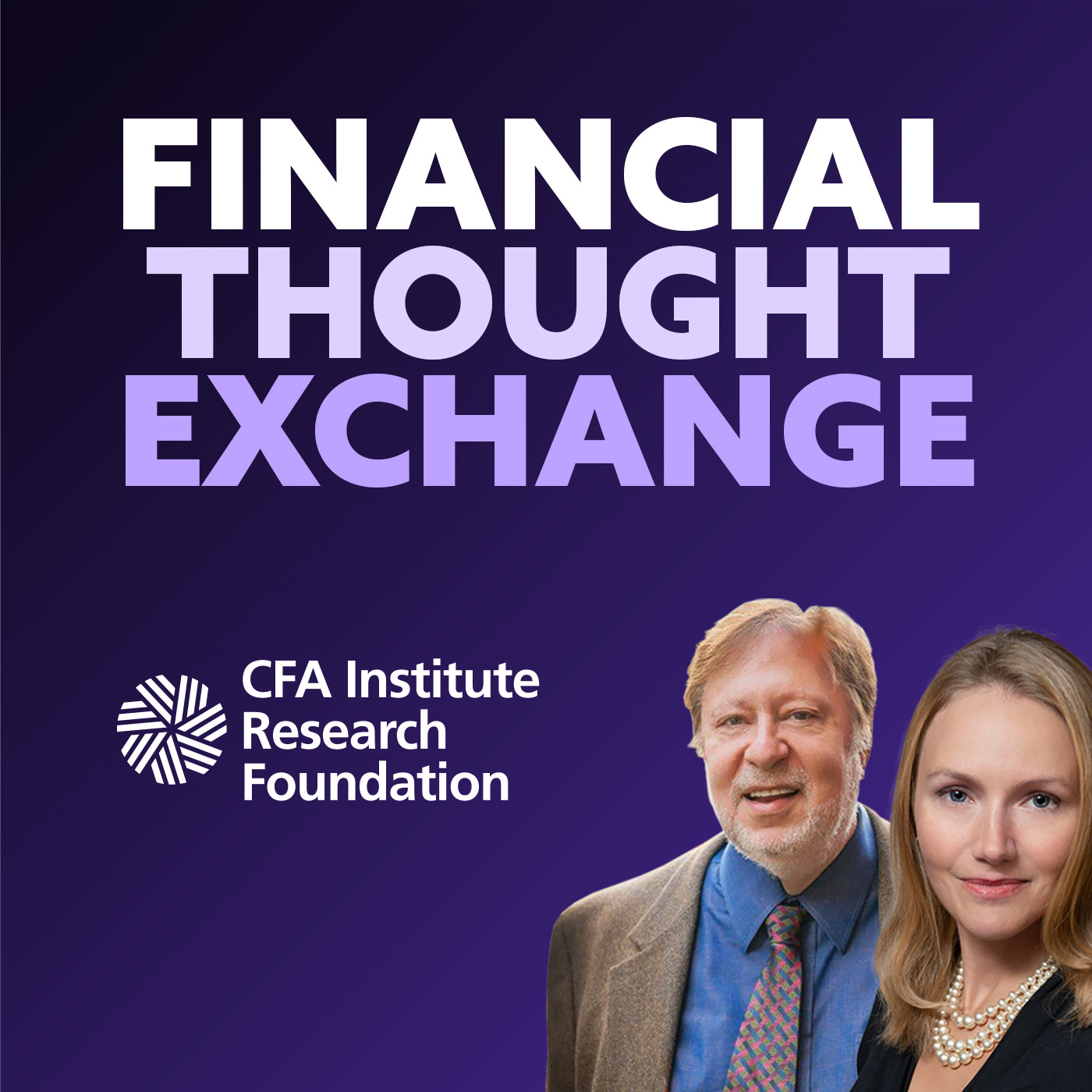
Financial Thought Exchange Podcast
CFA Institute Research Foundation
Frequency: 1 episode/16d. Total Eps: 50

Recent rankings
Latest chart positions across Apple Podcasts and Spotify rankings.
Apple Podcasts
No recent rankings available
Spotify
No recent rankings available
Shared links between episodes and podcasts
Links found in episode descriptions and other podcasts that share them.
See allRSS feed quality and score
Technical evaluation of the podcast's RSS feed quality and structure.
See allScore global : 38%
Publication history
Monthly episode publishing history over the past years.
De-risking Global Pension Systems with David Knox, PhD
jeudi 13 novembre 2025 • Duration 26:18
In this episode of the Financial Thought Exchange podcast, host Lotta Moberg, CFA, PhD, speaks with David Knox, PhD, former senior partner at Mercer and author of the Research Foundation brief De-risking Global Pension Systems. Knox explores the complexities of global pension structures, the shift from defined benefit to defined contribution plans, and the growing reliance on private pensions. He discusses demographic pressures, funding challenges, and the importance of governance, regulation, and communication in securing retirement outcomes. A timely conversation for professionals navigating the future of pension policy and retirement planning.
Leadership, Storytelling & Investing: Insights from Sébastien Page, CFA
jeudi 9 octobre 2025 • Duration 30:36
Sébastien Page, CFA, Head of Global Multi-Asset and CIO at T. Rowe Price, joins the FTE Podcast to explore the intersection of leadership psychology and investment strategy. Drawing from his books Beyond Diversification and The Psychology of Leadership, Page shares how storytelling enhances financial education, the importance of resilience in investing, and how personality traits like openness and agreeableness shape portfolio management. He also reflects on goal-induced blindness, the underrated skill of quitting, and the deeper meaning behind active management. A must-listen for finance professionals and aspiring leaders.
Elroy Dimson on a Hundred Years (or More) of International Investing
jeudi 17 juillet 2025 • Duration 23:11
Elroy Dimson, who co-authored the first very long-term study of worldwide asset returns, explains to Larry Siegel how he was inspired by Roger Ibbotson to research the topic. Then, he and Larry discuss the relative merits of investing in the United States, other developed markets, and emerging markets as their economies have evolved. While U.S. stocks now form the dominant market in the world, that has not always been the case and may not be in the future. Dimson concludes by recalling how World War II reshaped the world's capital markets and set the stage for the economic boom that followed.
U.S. Fiscal Dominance and Sovereign Default Scenario
jeudi 10 juillet 2025 • Duration 39:13
This episode of the Financial Thought Exchange Podcast features a discussion between host Lotta Moberg and James Grant, founder and editor of Grant's Interest Rate Observer. They explore the U.S. fiscal situation, potential default scenarios, and the implications for interest rates and bonds, highlighting the complexities of fiscal dominance and historical precedents in U.S. monetary policy. This episode is the second of a two-part series. Check out the previous one, which focused on the fundamentals of interest rates.
A Fundamental Deep-Dive into Interest Rates
jeudi 3 juillet 2025 • Duration 38:00
In the Financial Thought Exchange podcast, host Lotta Moberg interviews James Grant, founder and editor of Grant's Interest Rate Observer, about interest rates and their fundamental nature. They dig into the fundamental nature of interest rates and how they reflect scarcity, opportunity cost, and the human tendency to prioritize immediate gratification over future benefits. The discussion also touches on the complexities of credit risk and the historical context of interest rates. This episode is the first of a two-part series, with the next focusing on U.S. debt and potential defaults.
Tom Coleman on Inflation, Inequality, and Risk
jeudi 12 juin 2025 • Duration 51:17
Thomas Coleman, an economics professor at the University of Chicago, discusses a novel theory of money and inflation, inequality, and risk management with the CFA Institute Research Foundation's Larry Siegel.
The "money" referred to in monetary economics is a thing of the past, says Tom, because nobody has any "money" (cash, checking accounts, savings accounts). They have marketable assets instead. So monetarism is outdated as a theory of inflation. Instead, Tom argues inflation is better explained by the Fiscal Theory of the Price Level (FTPL), which relates the price level to the value of government-issued securities (bonds and cash) as determined by the cash flows backing them. These cash flows are taxes minus government spending.
The FTPL explains the low inflation of 2008 and high inflation of 2022 better than any other theory.
Coleman also discusses inequality. While conventional measures of inequality look at taxable incomes, he takes a broader view, including transfer payments and other items not reported on tax returns as income. When you do this, inequality – while still worse than in the 1980s – is less severe than it appears. In fact, households in the bottom half of the income distribution face a tax rate that is negative!
Tom concludes with thoughts on risk, a topic on which he has written two excellent books.
Frontier Investing with Larry Speidell: Diamonds, Mobile Money & Exotic Opportunities (Part 1)
jeudi 29 mai 2025 • Duration 19:22
In this two-part episode, Lawrence Speidell, founder and CIO of Frontier Global Partners, discusses his Indiana Jones-like foray into frontier markets in search of stocks to buy for his firm's clients. Frontier markets are countries that are less developed than those in emerging market indexes.
Larry's interest in frontier markets began during a lecture trip to China in the 1980s.
Frontier markets include Vietnam, Bangladesh, Romania, Colombia, and many countries in Africa. Speidell argues that, despite political instability, such markets are not necessarily riskier than developed ones, which have also seen increasing volatility. Frontier markets, he says, are highly varied with a low correlation to developed markets, so they are a good diversifier.
While frontier-market economies are a significant share of global GDP, their stock markets remain underdeveloped. Speidell believes this gap will close over time, offering long-term investment opportunities. Progress in frontier markets is slow, however, and requires patience, which Speidell argues is a good approach to investing generally.
Frontier Investing with Larry Speidell: Diamonds, Mobile Money & Exotic Opportunities (Part 2)
jeudi 29 mai 2025 • Duration 29:03
In this second episode segment, Larry Speidell, founder and CIO of Frontier Global Partners focuses on personal stories, travel experiences, and deeper insights into frontier markets.
For example, Speidell praises Botswana's development, aided by diamond discoveries, but also discusses the "resource curse," where reliance on natural resources can hinder broader economic growth.
Speidell's firm does not shy away from politically unstable countries such as Peru and Georgia. In such environments, he says, strong companies can thrive, and investors must be patient.
Larry describes the transformative impact of mobile technology in frontier markets, such as Kenya's M-PESA, a banking app that greatly helps the previously "unbanked" to make a living.
The episode blends investment insights with cultural reflections, emphasizing patience, optimism, and the human side of global investing.
David Booth on Founding a Firm Based On Revolutionary Academic Innovations (Part 2)
lundi 28 avril 2025 • Duration 23:52
In Part 2, David Booth reflects on how Dimensional Fund Advisors expanded by partnering with fee-only financial advisors, helping to bring academic investing principles to individual clients. He emphasizes the importance of low fees both in appealing to personal investors and in delivering superior results to them. Booth discusses how his collaboration with leading finance professors led him to regard the University of Chicago as a business partner and describes his gift to the school as a "partnership distribution."
David Booth on Founding a Firm Based On Revolutionary Academic Innovations
lundi 28 avril 2025 • Duration 26:52
David Booth, one of the best-known investors in the world, founded Dimensional Fund Advisors (DFA) along with Rex Sinquefield and brought asset-class investing, a description that embraces both index funds and the index-based but value-added strategy that DFA pursues, to individual investors as well as institutions. David, who received a PhD from the University of Chicago's Graduate School of Business, also made the largest donation in the University of Chicago's history and, in recognition of that gift, the university renamed its business school the Booth School of Business.
In building DFA, David pioneered the use of finance academics as advisors and board members. Eugene Fama, the Nobel Prize-winning economist associated with the efficient market hypothesis, was his dissertation chairman, an early investor in DFA, and a current director of the firm. Other noted academics associated with the firm include Robert Merton, Roger Ibbotson, and Kenneth French.
In Part 1 of his interview, Booth joins Larry Siegel to reflect on the academic revolution that reshaped investing, the launch of Dimensional's first small-cap strategies, and the challenges of selling a new idea to skeptical markets at a time when index and index-like funds were in its infancy. He shares stories from the University of Chicago's golden age of financial economics and explains why investing in an index with an eye to adding value through trading and inventory management – not strictly passive indexing – became Dimensional's guiding philosophy.
Related Shows Based on Content Similarities