Engines of Creation | Applied Complexity & Systems Thinking with Christian Mastrodonato – Details, episodes & analysis
Podcast details
Technical and general information from the podcast's RSS feed.
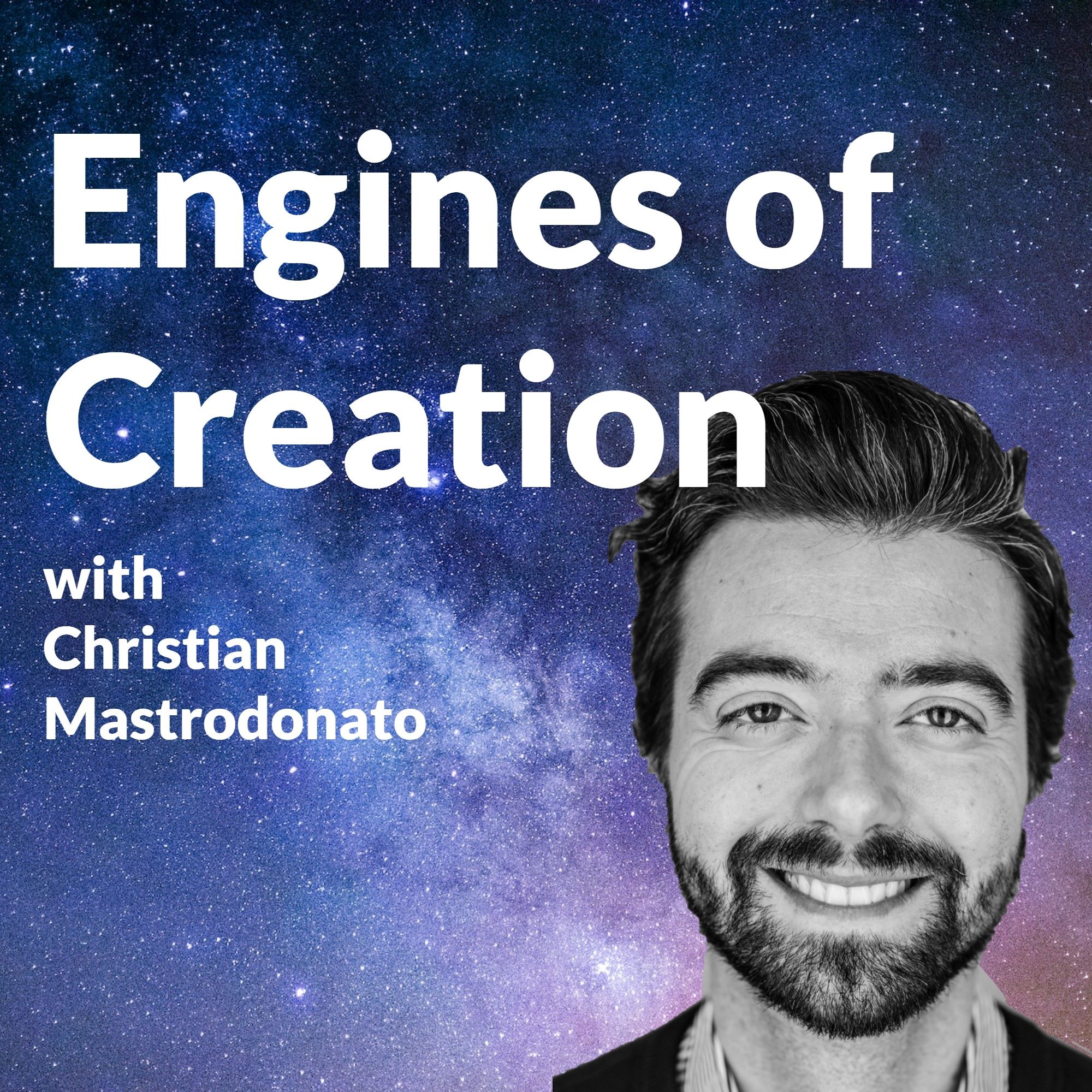
Engines of Creation | Applied Complexity & Systems Thinking with Christian Mastrodonato
Christian Mastrodonato
Frequency: 1 episode/278d. Total Eps: 33

Engines of Creation: Where Complexity Meets Reality
What do quantum computing, the evolution of democracy, and modern product strategy have in common? They are all emergent phenomena of complex systems.
Hosted by Christian Mastrodonato, Engines of Creation is a sanctuary for the anti-disciplinary thinker. We move beyond tech buzzwords to explore the applied systems theory and deep patterns that actually shape our world.
Whether we are analyzing the ethics of future-tech, unpacking collective intelligence, or applying ergodicity to daily decision-making, our goal is to understand how successful creations truly come to life.
Expect deep-dive conversations focusing on:
- The Frontiers of Tech: Navigating first principles in AI, quantum mechanics, and technological progress.
- Social Innovation: Designing better frameworks for education, democracy, and collective intelligence.
- The Builder’s Mindset: Exploring flow states, asymmetric risk, and the philosophy of creation.
If you are a systems thinker, social innovator, or future-tech scout, join us to cut through the noise and discover the hidden engines driving our complex world.
Recent rankings
Latest chart positions across Apple Podcasts and Spotify rankings.
Apple Podcasts
No recent rankings available
Spotify
No recent rankings available
Shared links between episodes and podcasts
Links found in episode descriptions and other podcasts that share them.
See all- https://lexfridman.com/podcast
755 shares
- https://headliner.app
485 shares
- https://www.exponentialview.co/
200 shares
- https://youtu.be/1m7bXNH8gEM
4 shares
RSS feed quality and score
Technical evaluation of the podcast's RSS feed quality and structure.
See allScore global : 73%
Publication history
Monthly episode publishing history over the past years.
#32 | On Signal vs. Noise: Why the "Extrovert Ideal" Breaks Down in Complex Systems | Greg Weinger
mardi 5 mai 2026 • Duration 34:58
We have built corporate environments that heavily index on volume and speed, often mistaking the loudest voice in the room for the most insightful one. In an increasingly complex world, this bias isn't just an annoyance—it is a massive systemic blind spot that makes companies fundamentally fragile.
In this episode, we unpack the mechanics of quiet leadership with seasoned tech executive Greg Weinger. We explore the dynamics of innovation by dissecting why the traditional brainstorming meeting actually represses idea generation, and how shifting to asynchronous pre-work yields better results for both introverts and extroverts. By applying systems theory to team dynamics, Greg explains how introverted leaders act as critical signal filters in noisy environments, leveraging deep processing to stabilize chaotic situations. We also discuss how senior leadership can intentionally re-architect their collective intelligence frameworks so organizations don't leave half of their intellectual capacity on the table.
The Complexity Framework (Actionable Mental Models):
- The "Puppy Exhaustion" Strategy: In highly chaotic meetings, let the fast-paced, high-energy dialogue tire itself out. Once the energy drops, inject a single, high-leverage strategic question to completely shift the context of the conversation.
- Asynchronous Ideation: Traditional, loud brainstorming meetings reliably underperform. Move the creative act of idea generation outside of the meeting as pre-work, and reserve synchronous time strictly for triaging and sifting through the best concepts.
- The Contemplation Premium: Resist the cultural addiction to chaos and the dopamine of immediate action. Business is not a battlefield; it is extremely rare that a decision cannot wait an hour or two for deeper data gathering and reflection. Taking time is almost always the optimal strategy for managing complexity.
Listen & Explore:
Greg Weinger's podcast https://www.powerfulintrovertpodcast.com/
Find more episodes and map out the deep patterns of innovation at www.enginesofcreation.co.
#31 | Designing for Entropy: Why Complex Systems Fail and Innovation Dies | Margaret Wheatley
mardi 31 mars 2026 • Duration 49:41
We are obsessed with scaling systems, but we are dangerously blind to how they decay. You cannot build a resilient organization without understanding the physics of its eventual collapse.
In this episode of Engines of Creation, we sit down with pioneer Margaret Wheatley to perform an autopsy on modern institutions.
Meg has spent decades mapping how human networks behave as biological, interconnected living systems. Today, we explore the natural lifecycle of complex systems and the underlying physics of human relationship. We discuss how the "biology of fear" actively dismantles collective intelligence frameworks, why our current models of leadership are accelerating institutional entropy, and how builders can return to first principles to design structures that acknowledge—rather than fight—the natural laws of systemic decay.
📍 The Episode Map (Timestamps)
- 00:00 - Cold Open: The Pattern of Collapse and "Internecine Warfare."
- 05:15 - Introduction: Why builders must study entropy.
- 12:30 - The Biology of Fear: How stress biologically shuts down our capacity for innovation.
- 24:45 - Ergodic Autopsy: Why optimizing for efficiency makes systems fragile.
- 36:20 - The Physics of Relationship: "Nothing living lives alone."
- 48:10 - Navigating the current "season" of systemic breakdown.
- 55:00 - The Builder's First Principle: Where do we go from here?
🛠️ The Builder’s Blueprint (Core Mental Models)
- The Biology of Fear Threshold: Understand the mechanical reality of stress. When a system is driven by fear, individuals lose access to their frontal lobes. You cannot mandate innovation in a system where the biological hardware for creativity has been shut down by threat.
- Embracing Institutional Entropy: Stop trying to freeze a successful system in place. All living systems go through natural cycles of emergence, stabilization, and decay. The goal of a builder is not to prevent entropy, but to design absorbing barriers that allow the system to adapt and regenerate without catastrophic collapse.
- The Physics of Relationship: Recognize the ultimate first principle: Nothing living lives alone. Innovation is not a product of isolated genius; it is an emergent property of network density and relational health. If you are optimizing for isolated efficiency, you are killing the system's capacity to evolve.
📚 Resources & Intersections Mentioned
- Book: Leadership and the New Science by Margaret Wheatley (Meg's foundational text on quantum physics, chaos theory, and biology in leadership).
- Book: Who Do We Choose To Be? by Margaret Wheatley.
🔗 About The Guest Margaret Wheatley is a writer, teacher, and speaker who has spent her career applying the lenses of science and biology to human behavior and organizational dynamics. She is the co-founder of the Berkana Institute and the author of nine books.
- Explore her work at: https://margaretwheatley.com/
🌐 Connect with Engines of Creation If you value conversations that cut through the hype and explore the deep patterns shaping our world, join the community:
- The Hub: Explore all episodes, transcripts, and the full Builder's Toolkit at www.enginesofcreation.co
- Host: Connect with Christian Mastrodonato on [LinkedIn] / [Twitter/X]
#4 | On Survival and Adaptation | Interview with Luca Dellanna
Episode 4
mercredi 17 mai 2023 • Duration 41:01
In this episode we are going to meet Luca Dellanna, an expert in people and operations management, and one of my favourite contemporary authors, who can cover extremely complex topics alway providing clear and practical examples to relate them to our daily experience, as you will soon find out.
In this conversation we will mainly discuss about 2 of his books, which cover topics strictly related to the field of complexity.
One book is titled Ergodicity, and it explains very clearly how this Statistical Physics and Chaos Theory concept has deep implications in our daily life and decisions. We will start from a practical example that will lead us to a clear definition, and we will learn what can be the strategies to keep non-ergodicity under control, in particular talking about the value of redistribution. Finally in this first part we will discuss how ergodicity plays an important role in survival fitness, and that you have to push natural selection as deep as you can within you, to have less chances it will apply over you.
In the second part we will discuss another of his books, Teams are Adaptive Systems, where we will delve into the concept of Complex Adaptive Systems, and we will learn how ethical and value based behaviour can provide a competitive advantage to managers. Furthermore we will find out how feedback loops, so important to define intelligence in human beings (and possibly also in artificial beings), play a good part in team management to avoid stupid behaviours.
We will conclude by discussing how a leader who embraces complexity needs to focus on managing it rather than controlling it, by managing risks and looking at the adaptations she promotes.
Links to:
#2 | On Feeling Uncomfortable | Interview with Sudha Jamthe
Episode 2
mercredi 22 mars 2023 • Duration 48:54
For the second episode of the podcast we are going to meet a very special person, Sudha Jamthe, as you will hear from her own introduction, she is a true innovator, and she is an inspiration for me as a true leader who appreciates and embraces complexity, in particular with her passion for communicating complex business and technology topics in engaging and effective ways.
We are going to discover with her what are the patterns that enable innovation, and how a data driven approach can unlock the creation of innovative products.
Also, we will be diving into Artificial Intelligence, understanding its adoption trends and challenges, in particular taking into account the business skills and ethical concerns surrounding it, and, finally we’ll understand with her how the ability to embrace uncertainty, by feeling uncomfortable and by being vulnerable, are the superpowers to be a modern leader.
#1 | On Embracing Change
Episode 1
mercredi 22 mars 2023 • Duration 09:50
Change is at the core of everything, that's what I've learnt from the experience of all the people I've interacted with and that managed to become successful.
If we really understand it and we can change our beliefs according to this fundamental assumption, the way we work can completely change.
On Engines of Creation | Trailer
mercredi 8 février 2023 • Duration 01:30
Through Engines of Creation episodes, we will understand the culture, the mindset, and the ways to identify and manage complexity in evolving businesses and organisations. We’ll explain how, by creating the right conditions for the individuals and the teams, innovation and creation emerge naturally and spontaneously.
#23 | On Creative Problem Solving, Overcoming Distraction and Embracing Flow: Strategies from Steven Puri
Episode 23
mardi 15 juillet 2025 • Duration 39:50
In this engaging episode of Engines of Creation, we welcome Steven Puri, the founder of Sukha, who brings a unique blend of experience from both the film industry and technology. Steven shares his fascinating journey from being a software engineer to becoming a senior executive in motion picture studios, and now leveraging that interdisciplinary knowledge to develop AI-driven solutions.
We dive into the concept of anti-disciplinarity, exploring how crossing boundaries between fields can unlock creativity and innovation, especially in an age dominated by AI. Steven discusses the importance of context and conditions that foster success, emphasizing how constraints can actually enhance creativity rather than stifle it.
The conversation shifts to the challenges of maintaining focus in a world filled with distractions, particularly from technology. Steven introduces his vision for Sukha, an AI-powered app designed to help users reclaim their time and attention, allowing them to focus on what truly matters in their lives. He shares insights on how to create a productive work environment and the significance of self-awareness in achieving flow states.
Join us for this thought-provoking discussion that not only highlights the intersection of technology and creativity but also offers practical strategies for enhancing focus and productivity in our increasingly distracted lives.
1. Introduction to Steven Puri and his background
2. The value of anti-disciplinarity in leadership
3. The role of constraints in fostering creativity
4. The impact of technology on attention and focus
5. Overview of Sukha and its mission
6. Practical strategies for maintaining focus in a distracted world
7. The importance of self-awareness and flow states
8. Conclusion and listener engagement
References:
#9 | On Megaprojects | Book UnReview on How Big Things Get Done
Episode 9
lundi 27 novembre 2023 • Duration 12:32
And now, for something completely different, as Monty Python would say, we are going to experiment with a different kind of episode: a book UnReview. I've been toying with this idea for quite some time. There are some books that have really helped me shape new ideas and better frame and link old ones. Although it would be great to discuss those books with the authors, I'm not always able to get in contact with them and have them on the podcast. On the other hand, simply giving you a simple review of the book would be redundant, as you can easily go to Amazon or Kobo and read it yourself.
But for me, reading a book is an experience, one that I try to convey every time I talk with an author. I believe it is valuable to discuss the content of these books and possibly convince you that they are worth your time to read. In fact, you should never be satisfied with what I'm going to say; reading the books is always the best choice.
We will start with a book that I recently read, which has been truly eye-opening for me. The book is called How Big Things Get Done by Bent Flyvbjerg and Dan Gardner. The subtitle of the book is "The Surprising Factors Behind Every Successful Project, from Home Renovations to Space Exploration". Interestingly enough, these factors were not that surprising to me, as I have encountered most of them in the different projects I have worked on throughout my career. However, seeing them all presented in this clear and concise way brought a completely different perspective, which was indeed surprising!
Furthermore, I am excited to delve deeper into Megaprojects, which are a great example of applied complexity. I plan to have some future guests who can provide insights on this topic, and this book serves as a perfect backdrop for those future conversations. Stay tuned to find out more, and if you haven't already, please hit the subscribe button now!
Instead of discussing the core takeaways or sharing my impressions about the book, I will start from the end - specifically, the final chapter known as the coda. I want to focus on the 11 heuristics for better project leadership that are presented in this chapter, and how they relate to concepts of complexity thinking and effective management in a broader sense. I encourage you to read the book to fully understand how the authors developed these heuristics, as that is the true strength of the book. By discussing the end, I aim to provide you with some food for thought without spoiling any major details.
References and Links
>> How Big Things Get Done by Professor Bent Flyvbjerg and Dan Gardner
>> Episode 4 | On Survival and Adaptation | Interview with Luca Dellanna
>> Ergodicity by Luca Dellanna
>> Thinking Fast and Slow by Daniel Kahneman
#3 | On Openness | Interview with Kevin Marks
Episode 3
mercredi 19 avril 2023 • Duration 50:35
On today’s episode we are going to meet a real Web pioneer, Kevin Marks, if you don’t know him I suggest you look at the Wikipedia page dedicated to him, because, yes the guests of this podcast do have their own Wikipedia page :)
Kevin is a SW Engineering expert who worked in companies like Apple, Google and Salesforce and have been at the forefront of Digital Innovation from the 90s. He brings a look that spans the whole horizon of how the digital industry has evolved so far and can evolve in the future.
During our conversation we will discuss how abstraction layers can commodify industry sectors, and how this evolution towards commodities can be described using tools like Wardley Maps, but also how looking into what didn’t work can help making sense of the complex fractals of these nested abstraction layers.
In the second part of our conversation we will turn our attention towards Open models, looking at examples in the web like micro-formats as well as in the larger digital industry how open source set a standard for distributed governance, and we will close talking about what the approaches from companies like Apple, Google and Microsoft can tell us about how to find the right balance.
#24 | On Balancing Innovation and Execution in the Age of AI: Insights from Stephen Hinch
Episode 24
mercredi 27 août 2025 • Duration 41:32
In this enlightening episode of Engines of Creation, we are joined by Stephen Hinch, a veteran of the high-tech industry with over three decades of experience, including significant roles at Hewlett Packard and Agilent Technologies. Steve shares his insights from his extensive career and discusses his newly published book, "Winning through Innovation," which explores the intricacies of navigating complexity in the realm of innovation.
We delve into the complexity paradox, where Steve highlights the importance of balancing the intricate nature of problems with the need for simple, actionable solutions. He shares practical frameworks for prioritizing issues and making effective decisions in high-pressure environments, emphasizing that a good decision today often outweighs the pursuit of perfection.
The conversation also touches on the role of generative AI in modern business, with Steve discussing how AI can assist leaders in sifting through vast amounts of data to identify key insights while recognizing its limitations. He draws parallels between historical shifts in technology, such as the transition from steam to diesel locomotives, and the current landscape influenced by AI, urging companies to remain vigilant and adaptable.
Steve emphasizes the characteristics of effective leadership in embracing complexity, advocating for an empowering environment that fosters innovation and collaboration among teams. Join us for a thought-provoking discussion that provides valuable lessons on innovation, decision-making, and the evolving role of technology in business.
1. Introduction to Stephen Hinch and his background
2. The complexity paradox in innovation
3. Frameworks for prioritizing and decision-making
4. The impact of generative AI on business strategies
5. Historical lessons from technological transitions
6. Characteristics of leaders who embrace complexity
Reference: https://www.stephen-w-hinch.com/
Related Shows Based on Content Similarities