Engines of Creation | Applied Complexity & Systems Thinking with Christian Mastrodonato – Details, episodes & analysis
Podcast details
Technical and general information from the podcast's RSS feed.
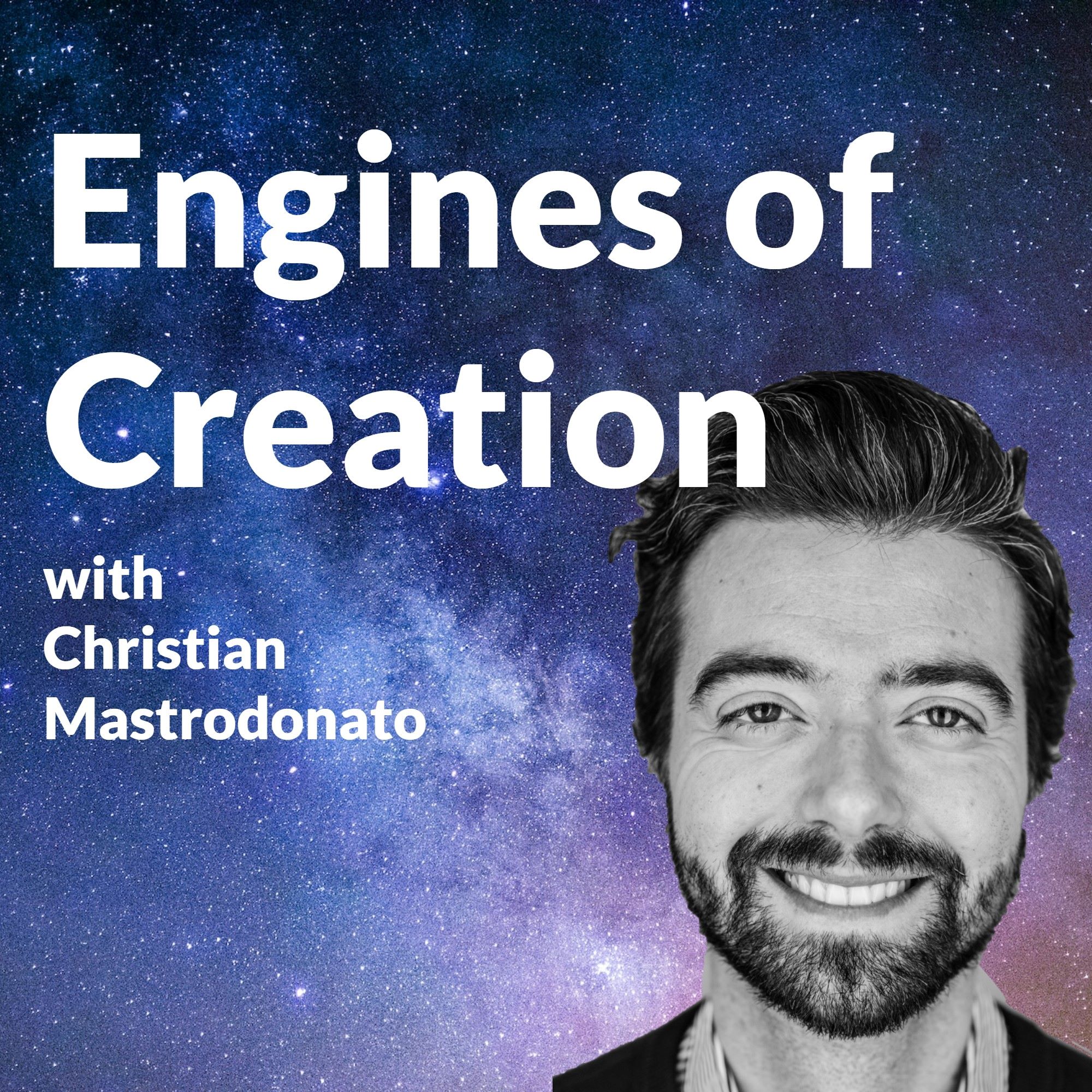
Engines of Creation | Applied Complexity & Systems Thinking with Christian Mastrodonato
Christian Mastrodonato
Frequency: 1 episode/38d. Total Eps: 33

Engines of Creation: Navigate our complex, constantly changing world. Host Christian Mastrodonato explores how successful products, organizations, and ideas emerge from intricate complex systems behaviours, intertwining psychological, social, and technological elements. The podcast empowers you to become a modern leader by embracing complexity and thriving with it, equipping you with the right tools.
Gain insights into innovation, digital transformation, and essential leadership qualities like adaptability, vision, and resilience. Dive into key concepts such as:
- Artificial Intelligence (AI) and Generative AI
- Internet of Things (IoT) and Digital Twins
- Ergodicity and Complex Adaptive Systems
- Collective Intelligence
- Co-creation
Discover patterns that create trends across diverse sectors, from startups to public services, and explore topics like unexamined technologies. Join Christian's journey to understand how creations truly come to life.
Recent rankings
Latest chart positions across Apple Podcasts and Spotify rankings.
Apple Podcasts
🇬🇧 Great Britain - management
01/06/2026#75🇬🇧 Great Britain - management
16/11/2025#99
Spotify
No recent rankings available
Shared links between episodes and podcasts
Links found in episode descriptions and other podcasts that share them.
See all- https://lexfridman.com/podcast
755 shares
- https://headliner.app
485 shares
- https://www.exponentialview.co/
200 shares
- https://youtu.be/1m7bXNH8gEM
4 shares
RSS feed quality and score
Technical evaluation of the podcast's RSS feed quality and structure.
See allScore global : 62%
Publication history
Monthly episode publishing history over the past years.
#26 | On The Quantum Revolution: Understanding Hardware, Algorithms, and Applications with Sergio Gago
Episode 26
mardi 4 novembre 2025 • Duration 56:31
In this insightful episode of Engines of Creation, we welcome back Sergio Gago, a leading voice in the quantum computing realm. This time, Sergio dives deep into the complexities of quantum computing, expanding on themes from his previous appearance that captivated our listeners. With years of experience in the field, he unpacks the current landscape of quantum technologies, from superconducting qubits to neutral atoms, and discusses the challenges and breakthroughs in hardware development.
Sergio provides a comprehensive overview of the various types of quantum systems, explaining how each technology approaches the creation of qubits and the implications for computational power. He emphasizes the importance of understanding noise in quantum systems and the engineering hurdles that must be overcome to achieve practical quantum computing capabilities.
The discussion also touches on the algorithms that are central to quantum computing, including Shor's algorithm, and the skepticism surrounding their current applicability compared to classical computing solutions. Sergio shares his perspective on the future of quantum algorithms, highlighting the niche problems that quantum computers are best suited to solve and the potential for industry-specific applications.
As we explore the intersection of quantum computing and cybersecurity, Sergio outlines the ongoing efforts in post-quantum cryptography and the importance of preparing for the implications of quantum advancements on encryption methods. He encourages listeners to engage with the quantum community, offering resources for those interested in diving deeper into this fascinating field.
Join us for a thought-provoking conversation that demystifies quantum computing and inspires a new generation of thinkers and innovators in the realm of technology.
1. Introduction to Sergio Gago and his journey in quantum computing 2. Overview of current quantum technologies and qubit types 3. The challenges of noise and engineering in quantum systems 4. Exploring quantum algorithms and their applications 5. The future of quantum computing in industry-specific contexts 6. Insights on post-quantum cryptography and cybersecurity 7. Resources for further exploration in quantum computing 8. Conclusion and reflections on the future of quantum technology
#25 | On Bitcoins and Rethinking Value, Money, and Community: An Exploration with Benjamin De Waal
Episode 25
mardi 7 octobre 2025 • Duration 01:11:40
In this captivating episode of Engines of Creation, we are joined by Benjamin De Waal, an eclectic thinker and expert in Bitcoin, who shares his unique journey from software development to exploring the complexities of money and value. Originally from New Zealand, Ben's diverse background includes interests in political systems, linguistics, and even private investigation, which he believes enriches his understanding of the world. We embark on an enlightening discussion about Bitcoin, examining its properties as a form of money and what makes it superior to traditional fiat currencies and precious metals like gold. Ben breaks down the essential characteristics of effective money, such as fungibility, verifiability, portability, and scarcity, while emphasizing Bitcoin's fixed supply and decentralized nature. The conversation delves into the philosophical underpinnings of value, exploring how societal narratives shape our understanding of worth. Ben argues that Bitcoin not only facilitates a more equitable exchange of value but also fosters a society with less hierarchy and greater autonomy. He presents examples of Bitcoin-driven communities across the globe that are embracing this new form of money to create alternative economic systems. As we explore the technical aspects of Bitcoin mining and the Lightning Network, Ben provides insights into the future of transactions within the Bitcoin ecosystem. He also addresses the broader implications of Bitcoin for society, advocating for a decentralized approach that empowers individuals and communities. Join us for a thought-provoking conversation that challenges conventional notions of money, governance, and societal structures, while inspiring listeners to consider the transformative potential of Bitcoin and decentralized systems.
1. Introduction to Benjamin De Waal and his diverse background 2. Understanding Bitcoin and its properties as money 3. The philosophical implications of value and societal narratives 4. Bitcoin communities and alternative economic systems 5. Technical overview of Bitcoin mining and the Lightning Network 6. The future of transactions and decentralized governance 7. Conclusion and reflections on leadership and complexity
#16 | On Innovating Democracy | Interview with Claudia Chwalisz
Episode 16
mardi 24 septembre 2024 • Duration 45:42
In this captivating episode, we delve into the intricacies of democratic innovation with Claudia Chwalisz, founder and CEO of Democracy Next. Claudia's organization is pioneering a global platform aimed at transforming governance by incorporating principles of sortition and deliberation, not just in government, but across various institutions like schools, universities, and workplaces.
We discuss the importance of moving away from the oversimplification of complex issues, a prevalent problem in current democratic systems. She explains how creating deliberative spaces, such as citizens' assemblies, allows for a deeper engagement with complexity.
One of the key highlights is the role of face-to-face interactions in these deliberative processes. She argues that while technology can enhance these processes, it cannot replace the depth of in-person engagement.
In discussing the evolution of democracy, Claudia touches on historical perspectives and the need for continuous experimentation and innovation in governance. In fact societies have always experimented with different forms of governance, challenging the notion of a static, inevitable democratic system.
We also touched on the concept of social acceleration, as theorized by Hartmut Rosa. She believes that creating intentional spaces for deliberation can help address feelings of alienation and disconnection, ultimately leading to a more resonant and cohesive society.
Join us for this enlightening conversation that challenges conventional views on democracy and offers a fresh perspective on how we can create a more inclusive and effective system of governance.
References
The Dawn of Everything - David Graeber and David Wengrow
Social Acceleration: A New Theory of Modernity -Hartmut Rosa
Resonance: A Sociology of Our Relationship to the World - Harmut Rosa
#15 | On Summertime Reflections | Reading and Listening Recommendations
Episode 15
lundi 12 août 2024 • Duration 10:47
Hello everybody, Welcome to Engines of Creation podcast, I’m your host, Christian Mastrodonato. In this podcast I bring together my knowledge in complex systems. with my experience in leading technology innovation and new product development, to explore how successful products, organizations and ideas emerge.
Greetings from the Italian Maritime Alps, apologies if you may hear in the background the sounds of fresh water springs or birds singing, but while working on an incredible line up of interviews that will be available to you over the upcoming months, I thought why don’t share some ideas on what to read and listen during these vacation period? I’m sure many of you, as I do, take advantage of the summer break to refresh your minds with new and interesting ideas. So in addition to all the interesting episodes that Engines of Creation offers you, and please share this podcast to anyone you think might enjoy it, here some of the interesting ideas of I’ve been recently discovering and I’m happy to share with you. So let’s go!
The first reading worth to share is a longstanding friend sitting on my bedside table, Epictetus. I’ve been slowly reading his complete works for quite some time now, and while, at least for my personal preference, it does cater for an occasional deep reading of one of his discourses versus a single gulp of all his writings, the summer is usually a period where I can spend a bit more time in company of this old friend.
For the ones, many possibly, who never heard of him, he is one of main representatives of the Late Stoics, that is the ones mainly active during the Roman Empire period, others being Marcus Aurelius and Seneca (who btw was a man).
Personally I’m reading the Complete Works, but I’d say if anybody is interested should at least look at its discourses. His teachings really force the reader to think deeply about what she often takes for granted, that is what she can control, and therefore really matters, and what she can’t, and therefore shouldn’t bother with. Just to give a taste, one passage that deeply resonated with me lately was
- Why, do you not know, then, that the origin of all human evils, and of baseness, and cowardice, is not death, but rather the fear of death?
I’ve compared this passage discussing it with a friend of mine (a real one I mean, not Epictetus ) as a Mic Drop, very true and very uncomfortable.
it is interesting to note how recently Stoic philosophy has had quite of a renaissance, most likely one of the reasons this book has ended up in my reading list, and I believe Stoics have a lot to teach us, but to be honest some recent interpretations of Stoicism are at least shallow, if not questionable, so my suggestion is to read the real ones and make up your own mind :)
If you tell me, as I probably could have said some years ago, philosophy books are hard and I don’t really understand them, well, while I hope you are going to change your mind, I think you can absolutely start into Stoicism by reading Marcus Aurelius’s meditations. This might actually be the book that is going to change your mind about reading philosophy books. Written as a personal notebook not meant to be shared with others, is a very accessible treasure trove of deep thoughts and a great entry point to Stoicism. Give it a go and you won’t regret it.
Now moving into more recent times, but still with an interesting time perspective, I’m in the midst of reading Life After Google by George Gilder, a book suggested to me by Jeff Skelton, ICIS Managing Director. George Gilder is a very provocative writer, with a very distinctive style. Why did I say the time perspective of this book is interesting? Well, This book has been written in 2018, and the main thesis of the book is that blockchain is a foundation of a new model of economy and society. Many people would therefore probably have dropped this book after 5 pages, since think I’d be rich if I’ve been given a penny every time I have heard blockchain has failed over the last couple of years. But even assuming that Blockchain did fail, that might be a conversation for another time with a proper expert as guest, many of the reasons because the Big Data business model are flawed and dangerous are still valid, and many of the reasons why a economic and societal values enabled by blockchain can be a great option are still true ( whatever technology we want to use to build it, or not to use as my previous guest Aki Järvinen would argue). So I think this book is a useful refresher that we can build a different worldview if we want, even more useful in the days of Huge Data business models enabled by Large Language Models and Generative AI.
Of course it wouldn’t be an Engines of Creation episode if we didn’t mention complexity at least once. And I believe one of the foundational books of the modern definition of complexity is Stuart Kauffman’s At Home in the Universe.
The main scientific (possibly scientistic) thought school taught us to believe that the reason because we are here is solely due to Darwinian natural selection, which gives chance an incredibly important role in our existence, we here because we are absurdly lucky basically. A great book that explains very well this view is Chance and Necessity by Nobel Prize Jacques Monod btw. While there is a lesson to learn from it that we shouldn’t discount, given human hubris and self-absorption is possibly killing this planet with us on it, the reality might a bit more complex than that, pun intended.
In fact Kauffman posits that self-organization is a fundamental source of order in the universe, working alongside natural selection. This principle suggests that complex systems can spontaneously organize themselves without external direction, and this can explain the emergence of order and structure in biological systems, and possibly beyond to societies and economies. Kauffman uses computer simulations and models to illustrate how systems can evolve to higher levels of complexity by balancing on the edge between order and chaos, this balancing behaviour is often called self-organised criticality.
This has very interesting implications, for examples systems with redundancy (multiple components performing similar functions) are more robust and can evolve gradually. This robustness allows for the stable accumulation of variations, facilitating the evolution of complex structures. I recommend to listen to my interview with Luca Dellanna On Survival and Adaptation to have another perspective on this issue.
I think this is great book that shows how complexity thinking can completely redesign our assumptions of the world.
Closing about complexity readings , I’ve recently shared on LinkedIn and I’ll put a link to it in this episode description, to a very interesting article that defines anti fragility very rigorously but also very clearly. I know Anti-fragility is a concept, firstly introduced by Taleb, that I often mention, so it is always good to be able to refer to proper definitions.
Now enough about readings, and why don’t we rest our eyes, tired of endless hours of screen work, and we listen to interesting conversations instead? Maybe while driving on a road trip or laying on a beach, or looking at a beautiful landscape (ok you are also using your eyes in this case, but I’m sure they’d be relaxing, so it doubles the effect).
I like to think you are doing it right now, since you are listening to this episode. As usual, don’t forget to hit the like button, to follow it and to share it to your community, so they also can have interesting ideas for the summer.
I would start my listenings suggestion from a whole podcast to follow, and it is the Complexity: Physics of Life podcast, from the Santa Fe Institute for Complexity. Being run and curated by a scientific organization, it is definitively very deep, and in this sense very complementary to Engines of Creation, where we try to keep a more business and technology look at complexity, but whatever is your topic of interest, I’m sure you can find one or more episodes in this podcast that touches it from a complexity standpoint, it is worth a try if Complexity is stimulating your curiosity.
Going back to philosophy, but much more modern one, I thoroughly recommend the episode from Curt Jaimungal‘s Theories of Everything podcast when Doland Hoffman and Stephen Wolfram discuss their respective theories of Consciousness and The Ruliad, which is a computational theory of the universe. The episode is 3 hours plus long, but if you want to have a good idea of what some of most exciting and recent views of how our universe might look like, this is a great starter. An interesting fact is that these 2 theories have been developed completely independently and this is the first time these two thinkers meet, I’ve been following them for quite some time and I kept saying, these 2 guys should talk, for sure I wasn’t the only one, and in fact eventually someone made them talk to each other!
Finally, in a podcast that I have already recommended, Mindscape by Sean Carrol, there are 3 among the last episodes that stood out to me: the one with the Google’s researcher Francois Chollet on Deep Learning and Large Language models, which is a sobering and clear overview of the current situation, without marketing and sensationalism and with honest some reality checks instead; the one with Daron Acemoglu, very interesting for people working in innovation, showing the effects of technological innovation on society, not always that good apparently, and the importance of institutions to govern it; finally I really enjoyed Ellen Langer’s interview on Mindfullness and the Body, she is great at explaining mindfulness beyond the usual confinements of meditative practises, and how it can be a powerful and transformative tool in our daily activities.
I think that’s all for today, Thanks for listening to this episode of Engines of Creation, I hope to have given you enough interesting sources for new ideas and inspirations, hoping that the rest of your summer is going to be relaxing, joyous and full of new learnings.
And if you want to learn even more, be sure to follow Engines of Creation, and leave us a rating and a review. And don’t hesitate to share this episode on social media and with friends and colleagues who might be interested, this podcast counts on you to grow and help other people to understand and embrace complexity to innovate and create. If you have any questions, comments or feedback, feel free to reach out to enginesofcreation@mastrodonato.co, I’ll be glad to continue the conversation.
References:
- Epictetus - The Complete Works
- Marcus Aurelius - Meditations
- George Gilder - Life After Google
- Stuart Kauffman - At Home in the Universe
- Jacques Monod - Chance and Necessity
- Antifragility in complex dynamical systems - https://www.nature.com/articles/s44260-024-00014-y
- Complexity: Physics of Life from Santa Fe Institute
- Theories of Everything by Curt Jaimungal - Consciousness vs The Ruliad | Stephen Wolfram Λ Donald Hoffman https://youtu.be/1m7bXNH8gEM
- Mindscape Podcast https://www.preposterousuniverse.com/podcast/
- Francois Chollet on Deep Learning
- Daron Acemoglu On Technology, Inequality and Power
- Ellen Langer on Mindfullness and the Body
#14 | On Examining Technology | Interview with Aki Järvinen
Episode 14
lundi 17 juin 2024 • Duration 54:50
In this thought-provoking episode, we venture beyond the typical paths of our podcast with Aki Jarvinen, a technologist and designer who brings a unique perspective to the intersection of technology, ethics, philosophy and spirituality. Aki's rich background spans game design, interactive media, and immersive technologies, and he shares his journey from Finland to the UK, weaving in his philosophical musings along the way.
Aki introduces his newsletter, "Unexamined Technologies," inspired by Socratic philosophy, and discusses the importance of examining our relationship with technology. He highlights the concept of technological somnambulism, where society sleepwalks through technological advancements without fully understanding their implications.
The conversation delves into the magical qualities attributed to technology and the dichotomy between makers and users. Aki emphasizes the need for a more nuanced approach to technology development, one that incorporates ethical and spiritual considerations. He proposes the idea of "critical technical awakenings," where technologists are encouraged to integrate spiritual traditions and ethical frameworks into their work.
We explore the possibility of creating a new foundation for civilization that respects nature and acknowledges the limits of technology. Aki suggests that indigenous thinking and spiritual traditions can guide us in building technologies that promote human flourishing and harmony with the environment.
Throughout the episode, Aki underscores the importance of self-inquiry, introspection, and a deeper understanding of our inner selves. He argues that true happiness and peace arise from within and that our current technology-driven culture often distracts us from this truth.
The episode concludes with a discussion on the characteristics of leaders who can navigate the complexities of technology and ethics. Aki advocates for leaders who embrace systems thinking, resilience, and a compassionate approach to both people and the planet.
Join us for this enlightening conversation that challenges conventional views on technology and offers a fresh perspective on how we can create a more balanced and meaningful relationship with the digital world. So, let’s go!
References:
- Aki Järvinen - Unexamined Technology Newsletter
- Langdon Winner - Technology as forms of life
- Hans Jonas - The Imperative of Responsibility
- Jan M. McGilchrist - The Master and His Emissary
- Duogald Hine - At Work in the Ruins
#13 | On Doing Innovation | Interview with Karsten Lumbye
Episode 13
mardi 9 avril 2024 • Duration 54:57
This is a special episode, since it is Engines of Creation birthday, one year ago we started this interesting journey and I have to thank all of you for listening and supporting this project. Please don’t forget to like, follow and share our Episodes to help this podcast grow.
As you know innovation is a recurrent topic of this podcast, and to celebrate the birthday properly I decided to invite a real Chief Innovation Officer, so today we delve into the innovative mind of Karsten Lambai Lumbye Jensen, a seasoned pioneer in the realm of new business development and creation. Karsten kicks off the interview with an introduction to his intriguing career trajectory, highlighting his early adoption of groundbreaking technologies such as personal computers, 3D printing, and blockchain. His journey from consulting on PCs at the Danish Technological Institute to exploring the potential of water management as a critical resource showcases his ability to stay ahead of the curve
With Karsten we then address the unique challenges of fostering innovation within a utility company, a sector traditionally perceived as conservative due to the high stakes associated with water safety and quality. He shares his company's ambitious goal to slash the time from concept to market impact from the industry average of 20 years down to just five. This is achieved through a culture that encourages all employees to contribute ideas and a methodology that embraces co-creation with partners and suppliers
The conversation shifts to the concept of controlled chaos in innovation, where Karsten draws on the concept of "Walking in Wilderness" . He advocates for an environment of psychological safety and a balance between maintaining core operations and allowing the periphery of the organization to experiment and innovate. This approach ensures that new ideas can be safely tested and gradually integrated into the main business, fostering a dynamic yet stable environment for change
Karsten also shares his insights on leading innovation, emphasizing the importance of vision, enthusiasm, and the ability to adapt direction as necessary. He stresses the significance of assembling a team smarter than oneself, granting them autonomy, and resisting the urge to micromanage. This leadership style not only accelerates the innovation process but also captures unforeseen opportunities that arise along the way
Lastly, the interview touches on the broader implications of innovation for organizational change. Karsten introduces the concept of Teal Organisation and he discusses the need for agility in decision-making and the decentralization of authority to empower teams. By doing so, companies can become more responsive and evolve more effectively, ultimately leading to a culture that embraces complexity and thrives on continuous improvement.
#12 | On Responsibility in AI and Technology | Interview with Ricardo Baeza-Yates
Episode 12
lundi 4 mars 2024 • Duration 55:36
Last time I promised you and Episode in February, and I just about missed the target, but I’m sure this insightful episode is worth the wait, as we delve into the multifaceted world of AI with an extraordinary guest, Ricardo Baeza-Yates, whose extensive background in computer science and research sets the stage for a deep dive into the ethical and practical dimensions of artificial intelligence. Among many things Ricardo has been VP of Research at Yahoo! Labs, he wrote one of the most influential books on Information Retrieval and he is now one of the most influential voices in the Responsible AI field.
Responsible AI is the central topic of this fascinating conversation, and Ricardo emphasizes its importance, advocating for systems that are not only legally and ethically sound but also beneficial to society at large. He underscores the necessity of possessing the right competencies to develop AI responsibly, including technical expertise and a thorough understanding of the domain in question. The conversation touches on the need for transparency, privacy, and non-discrimination in AI systems, highlighting the potential risks and the imperative to mitigate them.
The principles of "Legitimacy & Competence" are introduced as a cornerstone of responsible AI development. Ricardo argues that any AI application must demonstrate its societal legitimacy and the developers' competence to execute it effectively. This includes ensuring legal and ethical compliance, as well as having the necessary permissions and expertise to tackle the project.
We also discuss the critical role of quality management and risk assessment in AI, drawing attention to the real-world consequences of algorithmic decisions, including life-threatening scenarios. The conversation acknowledges the complexity of these systems and the importance of rigorous evaluation to prevent harm.
In particular we explore the concept of "Non-human Errors," where AI systems may inadvertently create categories or biases that do not exist in reality, such as racial classifications. This segues into a discussion on the risks posed by AI, where flawed systems can lead to significant political and social upheaval, as exemplified by the Dutch government's resignation over a scandal exacerbated by algorithmic decision-making.
Ricardo shares his vision of what an “AI Utopia" might look like, shaped by the positive impacts of AI, imagining a future where technology enhances human capabilities and addresses pressing global issues. The discussion invites listeners to consider whether the current direction of AI development aligns with these ideals.
Finally, the interview underscores the importance of taking a long-term view when considering the development and implementation of AI. It highlights the need for ongoing conversations and understanding about complex systems and their implications, ensuring that AI evolves in a way that is beneficial and sustainable for future generations.
This is my longest interview so far, but I’m sure it is worth it since it left me, and I’m sure it will leave you all, with a comprehensive understanding of the nuanced and critical considerations that must be addressed as we navigate the evolving landscape of artificial intelligence.
#11 | On Business Value and Digital Twins | Interview with Bruce Sinclair
Episode 11
mardi 23 janvier 2024 • Duration 49:20
I’m so happy to come back with a great new conversation, in this episode we are going to meet Bruce Sinclair, a seasoned expert in digital transformation, who will unveil a wealth of knowledge and practical wisdom in navigating the complexities of modern business. With a background in IoT and private equity investments, Bruce brings a unique perspective to the discussion, emphasizing the pivotal role of business imagination in driving successful digital transformations. As the founder of several start-ups and writer of 2 books IoT-Inc. and Digital Operating Partner, Bruce has a wealth of experience guiding organizations through the intricacies of adopting emerging technologies, aligning diverse perspectives, and unlocking value in the digital landscape.
The interview begins with Bruce emphasizing the crucial role of business imagination in driving successful digital transformation. He stressed the need to understand the business value before delving into technology solutions. According to Bruce, technology should be viewed as an enabler to achieve business objectives. He discussed the challenges of gaining consensus within large organizations, highlighting the importance of aligning diverse perspectives toward a common goal. Bruce also pointed out how private equity firms, due to their focus on results, can act as effective catalysts for change.
The conversation then shifts towards the digital realm, with a focus on AI, data science, and analytics. Bruce emphasizes the importance of collecting and transforming data to create value. He introduces the concept of the digital twin, explaining how it serves as a virtual representation of a physical object or system. Digital twins contribute to understanding and optimizing value creation by providing insights into various aspects of a system.
Bruce elaborated on building simulation models, utility models, usability models, and monetization models. All these models help in creating an effective digital representation of a system, enabling better decision-making. The discussion extended to the challenges of implementing live digital twins and closing the loop for automated decision-making, predicting a future where augmentation of human capabilities would be more prevalent than full replacement.
The conversation also touches upon the alignment between technology and regulations. Bruce emphasizes the need for regulations to catch up with rapidly evolving technologies to foster innovation. He notes that regulations can sometimes lag behind technological advancements, potentially stifling innovation.
The interview concludes with highlighting the importance of imagination, stating that leaders with imagination can see beyond the presented challenges and envision innovative solutions.
Throughout the interview, Bruce Sinclair provides valuable insights into the intricacies of digital transformation. His emphasis on imagination, understanding business value, and leveraging technology as enablers reflected a holistic approach to successful leadership in the face of complexity.
References:
#10 | On Festive Readings and Listenings | Recommendations for Winter Break Learnings
Episode 10
mardi 12 décembre 2023 • Duration 13:42
There are lot of interesting interviews lined up, but life gets in the way, so they will be released in 2024, please subscribe to the channel to get them as soon as they are published.
I thought it would be nice to drop some suggestions for reading and listenings during the Festive break.
Here some books:
- Incerto Series by Nassim Nicholas Taleb
- The Black Swan: The Impact of the Highly Improbable by Nassim Nicholas Taleb
- Antifragile: Things that Gain from Disorder by Nassim Nicholas Taleb
- The (Mis)Behaviour of Markets: A Fractal View of Risk, Ruin and Reward by Benoit Mandelbrot
- Thinking, Fast and Slow by Daniel Kahneman
- What's Our Problem?: A Self-Help Book for Societies by Tim Urban
- The Dawn of Everything: A New History of Humanity by by David Graeber and David Wengrow
- Why Information Grows: The Evolution of Order, from Atoms to Economies by Cesar Hidalgo
- How to Measure Anything: Finding the Value of Intangibles in Business by Douglas W. Hubbard
- Godel, Escher, Bach: An Eternal Golden Braid by Douglas Hofstadter
Here some podcasts and Newsletters:
- Wait but Why by Tim Urban
- Exponential View by Azeem Azhar
- Mindscape Podcast by Sean Carroll
- Lex Fridaman's Podcast
I hope you will enjoy them and let me know your thoughts at enginesofcreation@mastrodonato.co.
Please share this episode if you enjoyed it to let this podcast grow.
#9 | On Megaprojects | Book UnReview on How Big Things Get Done
Episode 9
lundi 27 novembre 2023 • Duration 12:32
And now, for something completely different, as Monty Python would say, we are going to experiment with a different kind of episode: a book UnReview. I've been toying with this idea for quite some time. There are some books that have really helped me shape new ideas and better frame and link old ones. Although it would be great to discuss those books with the authors, I'm not always able to get in contact with them and have them on the podcast. On the other hand, simply giving you a simple review of the book would be redundant, as you can easily go to Amazon or Kobo and read it yourself.
But for me, reading a book is an experience, one that I try to convey every time I talk with an author. I believe it is valuable to discuss the content of these books and possibly convince you that they are worth your time to read. In fact, you should never be satisfied with what I'm going to say; reading the books is always the best choice.
We will start with a book that I recently read, which has been truly eye-opening for me. The book is called How Big Things Get Done by Bent Flyvbjerg and Dan Gardner. The subtitle of the book is "The Surprising Factors Behind Every Successful Project, from Home Renovations to Space Exploration". Interestingly enough, these factors were not that surprising to me, as I have encountered most of them in the different projects I have worked on throughout my career. However, seeing them all presented in this clear and concise way brought a completely different perspective, which was indeed surprising!
Furthermore, I am excited to delve deeper into Megaprojects, which are a great example of applied complexity. I plan to have some future guests who can provide insights on this topic, and this book serves as a perfect backdrop for those future conversations. Stay tuned to find out more, and if you haven't already, please hit the subscribe button now!
Instead of discussing the core takeaways or sharing my impressions about the book, I will start from the end - specifically, the final chapter known as the coda. I want to focus on the 11 heuristics for better project leadership that are presented in this chapter, and how they relate to concepts of complexity thinking and effective management in a broader sense. I encourage you to read the book to fully understand how the authors developed these heuristics, as that is the true strength of the book. By discussing the end, I aim to provide you with some food for thought without spoiling any major details.
References and Links
>> How Big Things Get Done by Professor Bent Flyvbjerg and Dan Gardner
>> Episode 4 | On Survival and Adaptation | Interview with Luca Dellanna
>> Ergodicity by Luca Dellanna
>> Thinking Fast and Slow by Daniel Kahneman
Related Shows Based on Content Similarities