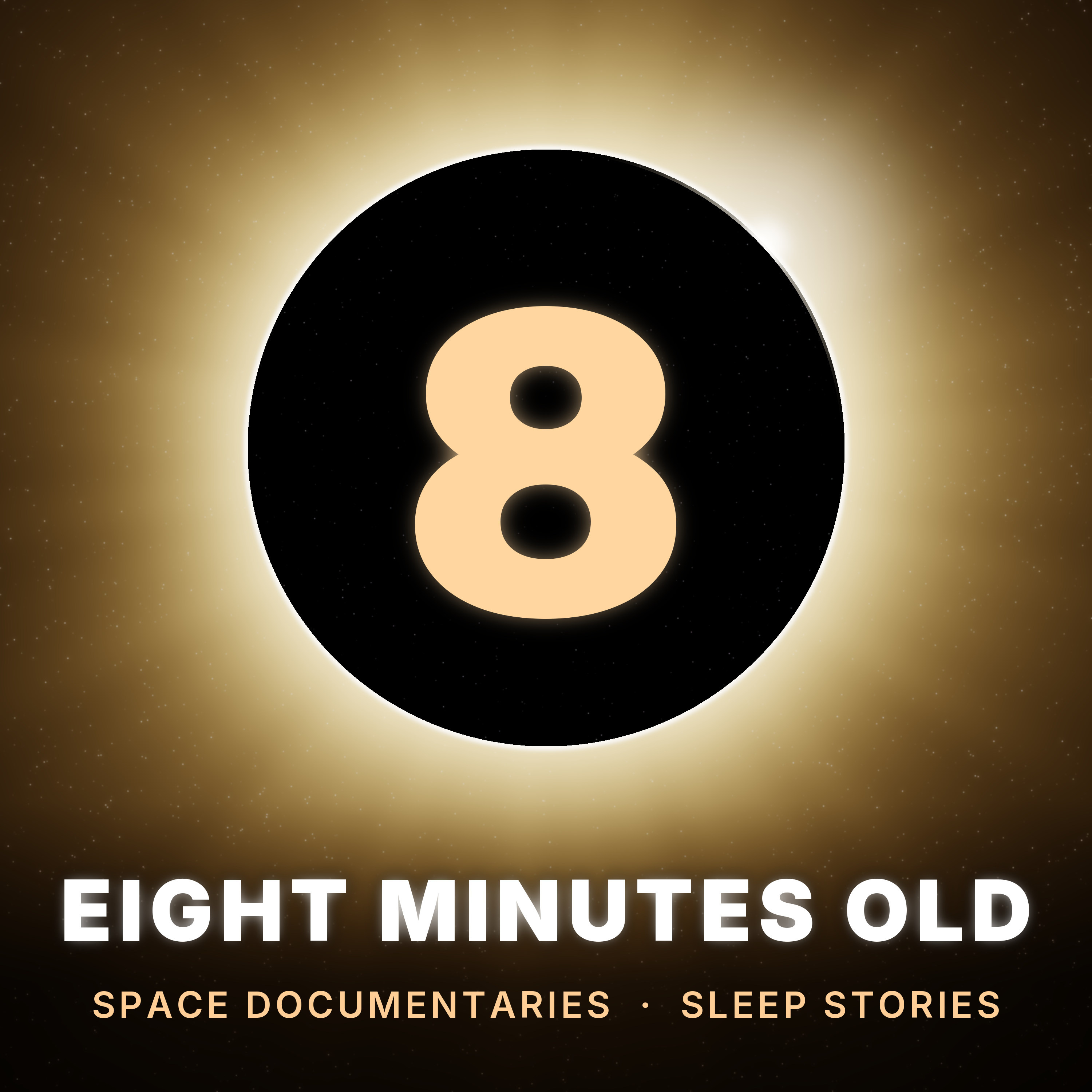
Sunlight is about eight minutes old when it reaches you. Everything we know about space arrives late, from the past, and incomplete. Eight Minutes Old turns that gap into calm, carefully sourced audio: documentaries on black holes, dying stars, gravitational waves and the Fermi paradox, plus Sleep Science, long slow journeys through real astronomy to fall asleep to every Sunday. Every claim is checked against NASA, ESA, ESO and peer-reviewed research, and speculation is named as such. Narration: synthetic voice. Music: original.
Site
RSS
Apple
Data updated on 17/11/2026
Recent rankings
Latest chart positions across Apple Podcasts and Spotify rankings.
Shared links between episodes and podcasts
Links found in episode descriptions and other podcasts that share them.
The Leonids peak with well-timed moonset, so the early hours of Wednesday are best (about 15 an hour at most under ideal skies). Mercury reaches its best morning showing, Mars, Jupiter and Regulus form a tight triangle, and the Moon passes Saturn. Object of the week: the Ring Nebula, found in 1779, and what the James Webb Space Telescope saw in it.
All times are for Dublin, in Greenwich Mean Time. In Britain, rising and setting times are earlier, by up to about half an hour in London. Sky positions were computed with PyEphem for 53.35° N and checked against published 2026 calendars.
Chapters
0:00 Welcome
0:39 The Moon
1:12 Shooting stars
2:17 The planets
3:34 Also this week
3:44 The Ring Nebula
4:27 Twenty thousand knots
Sources
• Positions, rise and set times: computed with PyEphem (Dublin, 53.35° N, 6.26° W)
• Cross-checks: Sky at Night, "Planet alignment Nov–Dec 2026": https://www.skyatnightmagazine.com/news/planet-alignment-november-december-2026
• Star Walk, Astronomy Calendar 2026: https://starwalk.space/en/news/astronomy-calendar-2026
• Space station passes: NASA Spot the Station https://spotthestation.nasa.gov/ and https://www.heavens-above.com/
• NASA, Messier 57: https://science.nasa.gov/mission/hubble/science/explore-the-night-sky/hubble-messier-catalog/messier-57/
• ESA/Webb, Ring Nebula (weic2320, 21 Aug 2023): https://esawebb.org/news/weic2320/
Narration: synthetic voice. Music: original.
Eight Minutes Old on YouTube: https://www.youtube.com/@EightMinutesOld
Listen on Spotify: https://open.spotify.com/show/6Ac2pRp4qYvJ2C7NLenHr3
She Worked Out What Stars Are Made Of. Then Called It "Almost Certainly Not Real."
Season 1 · Episode 21
Friday, November 13, 2026 • Duration 06:52
In 1925 Cecilia Payne, a 24-year-old Harvard student, read in starlight that the stars are overwhelmingly hydrogen and helium. Told by America's leading astrophysicist that this was impossible, she wrote in her own thesis that the result was "almost certainly not real". This is the story of how we know what stars are made of, from Fraunhofer's dark lines and the spectroscope to the James Webb Space Telescope.
🎧 Listen on Spotify: https://open.spotify.com/show/6Ac2pRp4qYvJ2C7NLenHr3
▶ Watch the video, with every source and image credit: https://youtu.be/3O0ttHzsquM
Eight Minutes Old on YouTube: https://www.youtube.com/@EightMinutesOld · TikTok: https://www.tiktok.com/@eightminutesold · Instagram: https://www.instagram.com/eightminutesold
Chapters
0:00 The answer she doubted
0:23 "We could never know"
1:11 An element found in the Sun first
1:34 Why star spectra were confusing
1:55 The Harvard plates
2:29 Cecilia Payne
2:58 The key: temperature
3:40 What she found
4:04 "Clearly impossible"
4:41 Four years later
4:58 Recognition
5:35 The Sun's recipe today
5:59 Her method today
6:25 The truth will prevail
Sources
• C. H. Payne 1925, Stellar Atmospheres (Harvard Observatory Monographs No. 1): https://archive.org/details/in.ernet.dli.2015.212833
Fall Asleep Along the Milky Way
Season 4 · Episode 3
Wednesday, November 11, 2026 • Duration 30:51
A long, slow journey through our own galaxy: from a dark field under the Milky Way, past the nearest stars, the Pleiades and the Orion Nebula, along the spiral arms to the hidden centre, then up above the disc to see the whole spiral, and gently home. A calm, factual story to fall asleep to.
Every fact is checked against NASA and ESA sources; where something is an estimate or still uncertain, the narration says so.
• NASA Imagine the Universe, The Milky Way: https://imagine.gsfc.nasa.gov/science/objects/milkyway1.html
• NASA, Sun facts: https://science.nasa.gov/sun/facts/
• NASA, The Milky Way galaxy (Spitzer): https://science.nasa.gov/resource/the-milky-way-galaxy/
• NASA, Black holes: https://science.nasa.gov/universe/black-holes/
• NASA, A celestial snow globe of stars (M13): https://science.nasa.gov/missions/hubble/a-celestial-snow-globe-of-stars/
• ESA, Gaia DR3: https://www.esa.int/ESA_Multimedia/Images/2022/06/Gaia_Milky_Way_stars
The Wow! Signal: 72 Seconds Nobody Has Explained
Season 1 · Episode 20
Tuesday, November 10, 2026 • Duration 08:16
On 15 August 1977 the Big Ear radio telescope in Ohio recorded a narrow burst of radio waves near the hydrogen frequency, and a volunteer astronomer circled it on a printout and wrote "Wow!". It lasted about 72 seconds and has never been seen again. This case file covers what the printout really says, every explanation that has been tried, and the 2024–25 hypothesis that a dead star's flare briefly lit up a cold cloud of hydrogen.
🎧 Listen on Spotify: https://open.spotify.com/show/6Ac2pRp4qYvJ2C7NLenHr3
▶ Watch the video, with every source and image credit: https://youtu.be/iiSW59CQFsA
Eight Minutes Old on YouTube: https://www.youtube.com/@EightMinutesOld · TikTok: https://www.tiktok.com/@eightminutesold · Instagram: https://www.instagram.com/eightminutesold
Chapters
0:00 Six characters on a printout
0:34 Big Ear
1:21 What 6EQUJ5 means
1:56 Why it stood out
2:40 Two receivers, one detection
3:17 Looking again
3:52 Explaining it away
4:30 A Sun-like star?
4:56 Arecibo's archive
5:29 The maser hypothesis
6:11 Re-reading the original records
6:43 A signal that was ruled out
7:18 What happens next
7:43 Still open
The hydrogen-cloud explanation is a hypothesis in preprints not yet through peer review (the narration says so at 6:36).
Night Sky This Week: 9 to 15 Nov
Season 3 · Episode 3
Monday, November 9, 2026 • Duration 06:11
New Moon and the darkest skies of the month. Mars and Jupiter draw together before dawn, closest on the night of Sunday 15th into Monday, Mercury starts to appear in the morning, Venus is near Spica, and the Northern Taurids peak at a low rate. Object of the week: the Triangulum Galaxy, a hard target, and the Hubble mosaic of it with about 25 million stars.
All times are for Dublin, in Greenwich Mean Time. In Britain, rising and setting times are earlier, by up to about half an hour in London. Sky positions were computed with PyEphem for 53.35° N and checked against published 2026 calendars.
Chapters
0:00 Welcome
0:37 The Moon
1:12 The planets
2:49 Shooting stars
3:18 Also this week
3:28 The Triangulum Galaxy
4:25 Twenty-five million stars
Sources
• Positions, rise and set times: computed with PyEphem (Dublin, 53.35° N, 6.26° W)
• Cross-checks: Sky at Night, "Planet alignment Nov–Dec 2026": https://www.skyatnightmagazine.com/news/planet-alignment-november-december-2026
• Star Walk, Astronomy Calendar 2026: https://starwalk.space/en/news/astronomy-calendar-2026
• Space station passes: NASA Spot the Station https://spotthestation.nasa.gov/ and https://www.heavens-above.com/
In 1859, the Sun Hit Earth So Hard the Telegraph Ran Without Batteries
Season 1 · Episode 19
Friday, November 6, 2026 • Duration 07:38
On 1 September 1859 Richard Carrington watched a solar flare erupt, and within a day auroras lit skies from Cuba to Chile while telegraph operators sent messages on current from the geomagnetic storm itself. This is the true story of the Carrington Event, the 2012 near miss and the May 2024 storm that brought auroras to Ireland. We also ask what a storm like 1859 would really do today, how likely one is, and how we watch the Sun now.
🎧 Listen on Spotify: https://open.spotify.com/show/6Ac2pRp4qYvJ2C7NLenHr3
▶ Watch the video, with every source and image credit: https://youtu.be/wb8ByTpUAis
Eight Minutes Old on YouTube: https://www.youtube.com/@EightMinutesOld · TikTok: https://www.tiktok.com/@eightminutesold · Instagram: https://www.instagram.com/eightminutesold
Chapters
0:00 Batteries unplugged
0:32 The first solar flare ever recorded
1:17 The needles at Kew
1:39 A cloud of plasma, 17.6 hours later
2:08 The night the sky caught fire
2:40 The telegraph goes haywire
3:15 Why long wires matter
3:36 How big was it?
4:14 The near miss of 2012
4:34 May 2024
5:18 What would it do today?
5:59 How likely is it?
6:27 How we watch the Sun now
7:09 Eight minutes
The size of the 1859 storm is a reconstruction from historical records, and the odds of another are estimates.
Fall Asleep to Rain on Titan
Season 4 · Episode 2
Wednesday, November 4, 2026 • Duration 31:14
Follow a single drop of methane rain through its slow life on Titan, Saturn's largest moon: from a still sea near the pole, up into the clouds, down onto the hills, and along the rivers home. With the Huygens probe's landing in a dry riverbed, the storm Cassini watched in 2010, and NASA's Dragonfly. A calm, factual story to fall asleep to.
Every fact is checked against NASA and ESA sources; where something is an estimate or still uncertain, the narration says so.
• NASA, Why NASA is sending Dragonfly to Titan: https://science.nasa.gov/solar-system/planets/saturn/why-is-nasa-sending-dragonfly-to-titan-here-are-five-reasons/
• NASA JPL, Cassini reveals clues about Titan's seas (2013): https://www.jpl.nasa.gov/news/nasas-cassini-spacecraft-reveals-clues-about-saturn-moon/
The Brightest Explosion Ever Recorded Hit Earth in 2022
Season 1 · Episode 18
Tuesday, November 3, 2026 • Duration 08:18
On 9 October 2022 a flash of gamma rays from a star that died about two billion years ago swept over Earth: GRB 221009A, the brightest gamma-ray burst ever recorded, nicknamed the BOAT. It disturbed radio signals in our upper atmosphere. We cover how these explosions were first found by accident during the Cold War, how they work, and what a burst in our own galaxy would actually do to Earth.
🎧 Listen on Spotify: https://open.spotify.com/show/6Ac2pRp4qYvJ2C7NLenHr3
▶ Watch the video, with every source and image credit: https://youtu.be/Wl91oh4NhXY
Eight Minutes Old on YouTube: https://www.youtube.com/@EightMinutesOld · TikTok: https://www.tiktok.com/@eightminutesold · Instagram: https://www.instagram.com/eightminutesold
Chapters
0:00 9 October 2022
0:37 The BOAT
1:02 A Cold War accident
1:44 Two ways to make a burst
2:18 A lighthouse that flashes once
2:51 Two billion years of travel
3:34 It reached our atmosphere
4:18 What if one went off nearby?
5:11 Did one cause a mass extinction?
5:54 How likely is it?
6:24 The star that got the blame
6:59 Who's watching now
7:44 Old light
A gamma-ray burst behind the Ordovician mass extinction is a hypothesis, and the claimed upper-ionosphere effect is disputed.
Night Sky This Week: 2 to 8 Nov
Season 3 · Episode 2
Monday, November 2, 2026 • Duration 07:07
Moon-free evenings this week. Venus returns to the morning sky and meets a thin crescent Moon on Saturday, the Moon passes Mars, Jupiter and Regulus before dawn, Saturn is in the evening sky, and the Taurids peak (slow, sparse, sometimes a fireball). Object of the week: the Andromeda Galaxy, and the night in 1923 when Edwin Hubble wrote VAR! on a photographic plate.
All times are for Dublin, in Greenwich Mean Time. In Britain, rising and setting times are earlier, by up to about half an hour in London. Sky positions were computed with PyEphem for 53.35° N and checked against published 2026 calendars.
Chapters
0:00 Welcome
0:37 The Moon
1:51 The planets
3:07 Shooting stars
3:48 Also this week
4:04 The Andromeda Galaxy
5:01 The letter that changed the universe
Sources
• Positions, rise and set times: computed with PyEphem (Dublin, 53.35° N, 6.26° W)
• Cross-checks: Sky at Night, "Planet alignment Nov–Dec 2026": https://www.skyatnightmagazine.com/news/planet-alignment-november-december-2026
• Star Walk, Astronomy Calendar 2026: https://starwalk.space/en/news/astronomy-calendar-2026
• Space station passes: NASA Spot the Station https://spotthestation.nasa.gov/ and https://www.heavens-above.com/
Fall Asleep Travelling to the Edge of the Observable Universe
Season 2 · Episode 1
Sunday, November 1, 2026 • Duration 01:28:49
Fall asleep to a calm, 89-minute journey from the Earth and Moon, past the planets and the nearest stars, across the Milky Way and the cosmic web to the oldest light in the universe, and then gently home again. Slow narration of real astronomy, with an original ambient score. Sleep Science, episode 1. Every fact is checked against NASA, ESA, ESO and peer-reviewed sources.
🎧 Listen on Spotify: https://open.spotify.com/show/6Ac2pRp4qYvJ2C7NLenHr3
▶ Watch the video, with every source and image credit: https://youtu.be/JpAZHEo32PM
Eight Minutes Old on YouTube: https://www.youtube.com/@EightMinutesOld · TikTok: https://www.tiktok.com/@eightminutesold · Instagram: https://www.instagram.com/eightminutesold
Chapters
0:00 Welcome, the Earth and the Moon
11:40 The Sun
18:43 The inner planets
27:17 The giant planets
35:51 The edge of the Sun's realm
45:01 The nearest stars
51:53 The Milky Way
58:14 The Local Group
1:04:11 Laniakea and the cosmic web
1:10:07 The oldest light
1:21:58 Home again
Sources
• NASA (science.nasa.gov, nasa.gov, JPL, SVS), ESO, ESA/Hubble, ESA/Webb, ESA Gaia, NOIRLab, STScI, the IAU, the NASA Exoplanet Archive, the Minor Planet Center, Nobel Prize press releases, Nature and peer-reviewed papers on arXiv. The full list, page by page, is in the YouTube description.
• Nature review of the thesis, 10 Oct 1925: https://www.nature.com/articles/116530a0
• AIP oral history interview with Cecilia Payne-Gaposchkin (1968): https://www.aip.org/history-programs/niels-bohr-library/oral-histories/4620
• Recio-Blanco et al. 2023 (Gaia DR3 stellar chemistry): https://arxiv.org/abs/2206.05541
Labels: in the video every claim carries an on-screen label (FACT, THEORY, ESTIMATE, HYPOTHESIS, SPECULATION); in this audio edition the narration says out loud when something is an estimate or a thought experiment.
Narration: synthetic voice. Music: original.
#space #astronomy #science #eightminutesold
• NASA, Messier 31, 42, 45 and 57: https://science.nasa.gov/mission/hubble/science/explore-the-night-sky/hubble-messier-catalog/messier-31/
• ESA/Webb, Ring Nebula: https://esawebb.org/news/weic2320/
• NASA Exoplanet Archive: https://exoplanetarchive.ipac.caltech.edu/
• Méndez et al. 2025, Arecibo Wow! II (preprint): https://arxiv.org/abs/2508.10657
Labels: in the video every claim carries an on-screen label (FACT, THEORY, ESTIMATE, HYPOTHESIS, SPECULATION); in this audio edition the narration says out loud when something is an estimate or a thought experiment.
Narration: synthetic voice. Music: original.
#space #astronomy #science #eightminutesold
• NASA, Messier 33: https://science.nasa.gov/mission/hubble/science/explore-the-night-sky/hubble-messier-catalog/messier-33/
Narration: synthetic voice. Music: original.
Eight Minutes Old on YouTube: https://www.youtube.com/@EightMinutesOld
Listen on Spotify: https://open.spotify.com/show/6Ac2pRp4qYvJ2C7NLenHr3
Sources
• Carrington 1859, MNRAS (the flare): https://adsabs.harvard.edu/pdf/1859MNRAS..20...13C
• Cliver & Dietrich 2013, J. Space Weather Space Clim.: https://www.swsc-journal.org/articles/swsc/pdf/2013/01/swsc130015.pdf
• Hayakawa et al. 2023, ApJL: https://iopscience.iop.org/article/10.3847/2041-8213/acd853
• Baker et al. 2013, Space Weather (the 2012 near miss): https://agupubs.onlinelibrary.wiley.com/doi/full/10.1002/swe.20097
• NOAA SWPC, May 2024 G5 storm: https://www.spaceweather.gov/news/g5-conditions-observed
• Riley & Love 2017 (extreme storm odds): https://www.usgs.gov/publications/extreme-geomagnetic-storms-probabilistic-forecasts-and-their-uncertainties
Labels: in the video every claim carries an on-screen label (FACT, THEORY, ESTIMATE, HYPOTHESIS, SPECULATION); in this audio edition the narration says out loud when something is an estimate or a thought experiment.
Narration: synthetic voice. Music: original.
#space #astronomy #science #eightminutesold
• NASA/JPL, Cassini sees seasonal rains transform Titan's surface (2011)
• ESA, Huygens: the top 10 discoveries at Titan: https://www.esa.int/ESA_Multimedia/Images/2015/01/Huygens_The_top_10_discoveries_at_Titan
• ESA, Huygens results release (21 Jan 2005): https://nssdc.gsfc.nasa.gov/planetary/text/huygens_pr_20050121.txt
Narration: synthetic voice. Music: original.
Eight Minutes Old on YouTube: https://www.youtube.com/@EightMinutesOld
Listen on Spotify: https://open.spotify.com/show/6Ac2pRp4qYvJ2C7NLenHr3
Sources
• Lesage et al. 2023 (Fermi GBM discovery of GRB 221009A): https://arxiv.org/abs/2303.14172
• Burns et al. 2023, "GRB 221009A, the BOAT": https://arxiv.org/abs/2302.14037
• Hayes & Gallagher 2022 (ionospheric disturbance): https://arxiv.org/abs/2210.15284
• Thomas et al. 2005, ApJ 622 (ozone loss from a nearby burst): https://arxiv.org/abs/astro-ph/0411284
• Melott et al. 2004 (Ordovician gamma-ray-burst hypothesis): https://arxiv.org/abs/astro-ph/0309415
Labels: in the video every claim carries an on-screen label (FACT, THEORY, ESTIMATE, HYPOTHESIS, SPECULATION); in this audio edition the narration says out loud when something is an estimate or a thought experiment.
Narration: synthetic voice. Music: original.
#space #astronomy #science #eightminutesold
• NASA, Messier 31: https://science.nasa.gov/mission/hubble/science/explore-the-night-sky/hubble-messier-catalog/messier-31/
• NASA, Hubble's famous "VAR!" plate: https://science.nasa.gov/?p=24539
Narration: synthetic voice. Music: original.
Eight Minutes Old on YouTube: https://www.youtube.com/@EightMinutesOld
Listen on Spotify: https://open.spotify.com/show/6Ac2pRp4qYvJ2C7NLenHr3
Narration: synthetic voice. Music: original.
#space #astronomy #science #eightminutesold
Related Shows Based on Content Similarities
Discover shows related to Eight Minutes Old: Space Documentaries and Sleep Stories, based on actual content similarities. Explore podcasts with similar topics, themes, and formats, backed by real data.