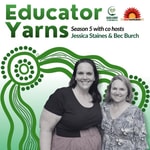
Educator Yarns serves as an informative and insightful discussion about the importance of embedding Aboriginal perspectives in early childhood education and the need for ongoing education and support in alignment with the Early Years Framework 2.0. Jessica Staines, Director of Koori Curriculum is back for season five with new co-host Bec Burch from Bush Kindy Australia. Together the dynamic duo provide practical advice and resources focusing on the intersection of nature play and Aboriginal culture for early childhood educators who are wanting to delve deeper into Aboriginal programs and explore opportunities for rich and meaningful nature play experiences.
Site
RSS
Apple
Data updated on 04/07/2026
Recent rankings
Latest chart positions across Apple Podcasts and Spotify rankings.
Shared links between episodes and podcasts
Links found in episode descriptions and other podcasts that share them.
S5 EP11: Country, Connection & Kindergarten: An Educator's Journey in Aboriginal Education
Sunday, June 15, 2025 • Duration 39:18
In this deeply insightful episode of Educator Yarns, we journey with Kat Fulford, a passionate early childhood educator from Ararat, Victoria, who shares her transformative approach to embedding Aboriginal perspectives in kindergarten education.
From her unique background transitioning from agricultural industry to early childhood education, Kat brings a profound connection to Country that permeates every aspect of her teaching practice. She candidly discusses the challenges of finding Aboriginal education resources in regional Victoria, the powerful moments that shaped her commitment to this work, and practical strategies for creating meaningful connections between children and Country.
Kat reveals how simple acts like wearing clothing with Indigenous patterns can signal safety and inclusion to Aboriginal families, and shares moving stories about five-year-olds becoming advocates for acknowledging traditional owners in their primary schools. This conversation offers invaluable insights into slow pedagogy, seasonal learning through Aboriginal perspectives, and the importance of building authentic relationships with local Aboriginal communities.
Key Takeaways:
Plant the seeds early: Children as young as five can understand and advocate for Aboriginal recognition, becoming champions for respect of traditional owners in their future schools and communities
Embrace slow pedagogy: Following Miriam Rose Ungunmerr-Baumann's Dadirri philosophy allows children to deeply connect with Country and develop organic, meaningful relationships with Aboriginal perspectives
Learn through Aboriginal seasons: Grounding curriculum in local Aboriginal seasonal calendars creates authentic place-based learning that connects children to the natural cycles of their environment
Every element can include Aboriginal perspectives: From nature play to sustainability projects, there's no aspect of early childhood education that can't incorporate Indigenous knowledge
Start where you are: Even without extensive knowledge, beginning the journey and being open about learning alongside children creates powerful educational moments
Build community networks: In regional areas, 'local' may mean travelling hours to connect with Aboriginal organisations, but these relationships are invaluable for authentic practice
Use multiple resources: Organisations like VAEAI (Victorian Aboriginal Education Association Incorporated), local AECGs, and Koorie Education Support Officers provide essential support and guidance
Language preservation matters: Understanding the devastating impact of language loss helps educators appreciate why maintaining and reviving Aboriginal languages is crucial for cultural survival
Small gestures have big impacts: Simple actions like displaying Aboriginal flags or wearing Indigenous patterns can signal to Aboriginal families that their children will be culturally safe
Mistakes are learning opportunities: Following the principle that "you can't get it wrong by trying," educators should start their journey without fear, adjusting their approach as they learn
This episode demonstrates how one educator's commitment to sharing Country's story has created ripple effects throughout her community, inspiring children, families, and fellow educators to engage more deeply with Aboriginal perspectives.
Kat's practical examples, from growing rare native plants with children to developing child-led Acknowledgements of Country, provide a roadmap for educators seeking to embed authentic Aboriginal content in their programs. Her emphasis on relationship-building, continuous learning, and the courage to begin despite uncertainty offers both inspiration and practical guidance for early childhood professionals at any stage of their reconciliation journey.
Have a question for Educator Yarns? Call 02 5300 0306 and leave a voicemail with your early childhood query about embedding Aboriginal perspectives, and you might hear your question answered in a future episode.
S5 EP10: From Intention to Connection: A Guide to Engaging with Local Aboriginal Communities
Monday, June 9, 2025 • Duration 32:30
Educator Yarns Season 5 Episode 10: From Intention to Connection: A Guide to Engaging with Local Aboriginal Communities
In this episode of Educator Yarns, hosts Jessica Staines and Bec Burch tackle one of the most frequently asked questions in early childhood education: how to appropriately and respectfully connect with local Aboriginal communities.
Prompted by a heartfelt voicemail from Kate at Little Saints at Tallebudgera, who runs a Bush Kindy program seeking guidance on community engagement, the hosts dive deep into the nuanced process of building authentic relationships with Aboriginal elders and knowledge holders.
Drawing from years of personal experience, including both inspiring successes and confronting challenges, Jess and Bec unpack why the journey to meaningful connection requires far more than a simple phone call or email.
They explore the critical importance of understanding your 'why', ensuring cultural safety within your service, and demonstrating genuine reciprocity through community involvement before seeking support for your programs.
Key Takeaways:
Start with your 'why' - Before reaching out to Aboriginal community members, clearly define what knowledge or support you're seeking (language, local history, flora/fauna knowledge, cultural perspectives) as different people hold different expertise
Build relationships before making requests - Attend local Aboriginal community events, volunteer at cultural festivals, visit markets, and participate in reconciliation activities to establish genuine connections over time
Ensure cultural safety in your service - Examine whether your centre truly welcomes Aboriginal visitors through proper introductions, hospitality, comfortable spaces, and respectful engagement from all staff members
Connect through established pathways - Utilise resources like local council Aboriginal liaison officers, inclusion support services, reconciliation groups, school liaison officers, and community organisations rather than expecting direct elder contacts
Demonstrate reciprocity - Offer your time and services to community events, run activity stalls at NAIDOC celebrations, provide transport for elders, and show you're invested in giving back before asking for support
S5 EP09: How One Kindergarten Transformed Their Approach to Aboriginal Education
Sunday, June 1, 2025 • Duration 28:44
In this episode of Educator Yarns, we chat with Taylar Malouf, an inspiring early childhood educator from Hopscotch Kindergarten.
Over the past two years, Taylar has embarked on a transformative journey to embed First Nations perspectives into her teaching practices, creating meaningful learning experiences for children under her care.
From her initial "Caring for Country" project that began with children's concern about rubbish in their local park, to developing a Bush Tucker Garden and exploring Indigenous seasons, Taylar shares how these initiatives have become central to her pedagogy.
Her authentic approach demonstrates how early childhood settings can move beyond tokenistic representations to create genuine connections with Aboriginal perspectives that resonate with children, families and the broader community.
Taylar's story highlights the power of sustained commitment, relationship-building, and using frameworks like the Aboriginal Eight Ways of Learning to create rich, culturally responsive learning environments.
Key Takeaways:
· Taylar's journey began with a professional development workshop that opened her eyes to Aboriginal perspectives in education, highlighting the gaps in her own schooling and inspiring her to create different learning experiences for children.
· The "Caring for Country" project evolved organically from children noticing rubbish in their local park, leading to community advocacy, poster creation, collaboration with the local primary school, and publishing a book that was displayed at their local library.
· Children's learning was deepened through multiple modes of expression—creating posters, composing songs, writing books—demonstrating how passionate they became about environmental stewardship through an Aboriginal lens.
· Taylar utilises the Aboriginal Eight Ways pedagogy as a framework for her teaching, incorporating diverse learning approaches like storytelling, symbols, and community connections to reach all children.
· Building and maintaining genuine relationships with Aboriginal organisations like Koori Curriculum has been essential to Taylar's success, showing the importance of sustained connections rather than one-off consultations.
S5 EP08: The Heart of Reconciliation: An Educator's Journey Building a Living Reconciliation Action Plan
Sunday, May 25, 2025 • Duration 36:02
In this episode of Educator Yarns, we speak with Stephanie Watson, an inspiring early childhood educator and nominee for the Koori Curriculum Early Childhood Educator of the Year awards.
Based at Happy Hearts Academy Early Learning Centre in Helensburgh, Stephanie has transformed her service's approach to embedding Aboriginal perspectives through developing a meaningful Reconciliation Action Plan from scratch.
With over ten years of experience in early childhood education, Stephanie shares her journey from wanting to work with the Starlight Foundation to becoming an educational leader passionate about ensuring Aboriginal and Torres Strait Islander cultures and perspectives are authentically integrated into daily practice.
Her story reveals how dedicated research, community connections, and persistent advocacy can create meaningful cultural learning experiences for both educators and children.
Key Takeaways
• Stephanie developed a Reconciliation Action Plan (RAP) from scratch at her service, transforming it from a token gesture into a living, breathing document that staff engage with daily.
• She emphasises the importance of embedding Aboriginal perspectives with meaning and passion, rather than just including them because they're required.
• When seeking local Aboriginal connections, Stephanie found it beneficial to look beyond immediate geographical boundaries to find community members and resources in neighbouring areas.
• Creating a visible RAP display in the centre hallway increased staff and family interest and participation in reconciliation initiatives.
• Stephanie recognises that educators can contribute to reconciliation work within their own rooms through simple changes like incorporating Aboriginal artwork and thoughtful use of colours.
• She highlights the distinction between cultural appropriation and cultural appreciation in the early childhood setting, ensuring respectful engagement with Aboriginal cultures.
S5 EP07: Beyond the Fence: Transforming Early Learning Through on Country Experiences
Sunday, May 18, 2025 • Duration 39:59
In this episode of Educator Yarns, host Jessica Staines, Director of Koori Curriculum, is joined by Bec Burch, founder of Bush Kindy’s Australia, to explore the transformative power of "On Country" program for early childhood education.
This thoughtful dialogue delves into how venturing beyond the confines of traditional learning environments enriches children's development through meaningful connection to place. The conversation weaves together Aboriginal perspectives, particularly the concept of "land links" where learning connects back to country, with the principles of nature pedagogy.
Both share their wealth of experience in creating powerful outdoor learning experiences that support children's wellbeing, foster curiosity, and provide sensory-rich environments that manufactured classroom materials simply cannot replicate. This episode offers practical insights for educators seeking to incorporate Aboriginal perspectives and nature-based learning into their practice, highlighting the profound benefits for all children, including those with additional needs.
Key Takeaways
On country program provide valuable opportunities for smaller group interactions compared to busy early learning centres, creating space for deeper engagement and more focused learning experiences.
Children demonstrate significantly improved self-regulation when learning in natural environments, particularly those with complex needs who may struggle with sensory overstimulation in traditional indoor settings.
The Aboriginal concept of "land links" within the eight ways of learning naturally aligns with nature-based program, bringing all learning back to connection with country.
Nature pedagogy embraces a "slow pedagogy" approach where child-led play flourishes as children make their own decisions and engage deeply with open-ended natural materials.
When outdoors in nature, children typically demonstrate longer attention spans and sustained focus, engaging in deeper play for extended periods compared to indoor activities with predetermined outcomes.
The natural environment inherently fosters curiosity and wonder, prompting children to ask questions that spark learning and passion for understanding their world.
Outdoor learning engages the whole body and all senses, providing hands-on experiences that support diverse learning styles and preferences.
S5 EP06: Connecting Children to Country: Urban Nature Play with Aboriginal Perspectives
Sunday, May 11, 2025 • Duration 23:55
In this episode of Educator Yarns, Jess Staines speaks with Linda Wilson, a dedicated early childhood teacher at Sentia Early Learning in Melbourne CBD.
Originally from Sweden, Linda shares how her childhood experiences exploring Swedish forests shaped her deep appreciation for nature as a teacher and guide. Now living and working on Wurundjeri Country, Linda beautifully intertwines her background in Nordic Forest pedagogy with Aboriginal perspectives in her teaching practice.
Despite being based in Melbourne's urban centre, Linda has led her kindergarten children on more than 30 excursions to connect with Country, learn about local Aboriginal history, and develop meaningful relationships with the land. Her approach demonstrates how educators can follow children's natural curiosity to explore Aboriginal perspectives, even in city-based settings.
Linda's journey from knowing very little about Aboriginal culture upon arriving in Australia to embedding it meaningfully in her practice offers valuable insights for educators seeking to deepen their understanding and approach to cultural connections.
Key Takeaways:
The Swedish approach to early childhood education emphasises consistent time in nature, with some kindergartens located entirely outdoors where children cook on open fires and engage with natural resources.
Revisiting the same natural spaces repeatedly is crucial for deepening children's connection and learning, allowing them to move beyond initial excitement to more meaningful engagement.
Linda's personal experience of spending days exploring Swedish forests as a child shaped her teaching philosophy and her belief that nature can provide a grounding, calming influence in our fast-paced society.
Children's questions about their local environment (like "Who made the Yarra River?" and "Where does it flow?") can serve as powerful starting points for exploring Aboriginal perspectives and connections to Country.
The Aboriginal 8 Ways of Learning framework, particularly the 'land links' approach, provides a valuable structure for educators wanting to connect teaching through culture rather than just about culture.
Each year, Linda's program focuses on different aspects of Country based on the children's interests—from the Yarra River's history to food sources at Birrarung Marr to land caring at Port Phillip Bay.
S5 EP05: Cultivating Country: Why Bush Tucker Gardens Matter in Early Learning Environments
Sunday, May 4, 2025 • Duration 23:12
In this illuminating episode of Educator Yarns, we welcome back Bec from Bush Kindy’s Australia for an in-depth conversation about Bush Tucker Gardens in early learning environments. Together, Jessica & Bec explore the profound educational value these spaces offer and address a common challenge observed across many services: the tendency for Bush Tucker plants to be underutilised, neglected, or misunderstood.
Bec shares her wealth of knowledge about why these gardens matter, how they connect children to Country, and practical approaches to establishing and maintaining meaningful native plant spaces that authentically reflect local ecosystems.
Drawing from their extensive experience working on Country and witnessing successful implementations in educational settings, they offer invaluable insights for educators wanting to move beyond tokenistic inclusion of native plants towards genuine engagement with Aboriginal perspectives through place-based learning experiences.
Key Takeaways:
· Bush Tucker Gardens create meaningful connections to place-based pedagogy, allowing children and educators to learn about their local community, ecosystems, and Indigenous knowledge systems.
· Native plant spaces in early learning environments establish essential green corridors for wildlife, particularly important in urban areas or regions affected by environmental events like fires or cyclones.
· Rather than creating isolated "Bush Tucker sections," consider integrating native plants throughout your entire outdoor learning environment for a more inclusive and authentic approach.
· Research what's endemic to your specific area by connecting with local nurseries, community organisations, Elders, or using apps like iNaturalist to identify local species.
· Involve children in the entire process - from researching local plants, mapping garden spaces, tracking sunlight patterns, identifying ideal locations, and creating signage for plants.
· Start small with quality over quantity – seven mature plants are more valuable than numerous seedlings, especially as many native species grow slowly.
S5 EP04: Beyond Tokenism: Creating Authentic Indigenous Partnerships in Early Childhood
Sunday, April 27, 2025 • Duration 48:46
In this powerful episode of Educator Yarns, we sit down with Kimmi, an award-winning early childhood teacher, mentor, and National Indigenous Perspectives partner at Greenleaves. As a proud Māori woman, Kimmi shares her deeply personal journey of using her own cultural roots to build meaningful connections with Aboriginal and Torres Strait Islander peoples across Australia.
Working with over 65 Greenleaves services nationwide, she supports educators and leadership teams to develop authentic knowledge of how to incorporate Indigenous cultures and histories while avoiding tokenistic approaches.
Kimmi's candid discussion about navigating her role within a colonial context, her approach to self-care whilst carrying cultural responsibilities, and her practical strategies for centres to develop genuine partnerships with local communities offers invaluable insights for educators at any stage of their reconciliation journey.
Key Takeaways:
Understanding the importance of meaningful connections rather than transactional relationships when working with Aboriginal and Torres Strait Islander communities
Recognising the emotional labour and potential burnout for Indigenous educators carrying cultural responsibilities in early childhood settings
Acknowledging Australia as a colonial country and how this framework helps us understand current relationships and power dynamics
The value of amplifying authentic Indigenous voices rather than speaking for Aboriginal and Torres Strait Islander peoples
Practical approaches to establishing what partnership looks like in early childhood services through environmental audits
Developing self-awareness about tokenistic gestures versus meaningful representation in educational settings
The significance of knowing the Country you're on and learning to say "hello" in the local Indigenous language
Balancing professional growth with personal wellbeing through career transitions and stepping back when needed
Using resources from Aboriginal and Torres Strait Islander authors to deepen understanding and create meaningful narratives
Creating Indigenous Perspectives Partners within each service to champion and sustain culturally responsive practices
S5 EP03: Custodians of Country: The Seven R's of Sustainability in Aboriginal Early Childhood Education
Sunday, April 20, 2025 • Duration 33:39
In this enlightening episode of Educator Yarns, host Jess Staines is joined by Bec Burch, founder of Bush Kindy Australia, to explore the powerful intersection between Aboriginal perspectives and sustainability practices in early childhood education.
Together, they unpack the seven Rs of sustainability—rethink, refuse, reduce, reuse, repair, regift, and recycle—and how these principles can guide educators in teaching children to become mindful custodians of Country.
This conversation delves deep into practical strategies for moving away from wasteful classroom practices towards more meaningful, culturally respectful approaches that honour Aboriginal connections to land.
Bec and Jess share inspiring examples of how natural materials can become rich learning resources, the importance of ethical procurement that supports Aboriginal businesses, and how educators can critically reflect on their environmental impact in ways that respect the traditional owners of the land on which centres operate.
Key Takeaways:
The concept of "borrowing, using and returning" rather than "taking, making and wasting" provides a framework for sustainable practice that aligns with Aboriginal perspectives on caring for Country.
Natural materials like fallen leaves, flowers, and branches offer open-ended learning opportunities that manufactured resources cannot match, supporting child-led practices central to both nature pedagogy and Aboriginal approaches.
Rethinking conventional practices includes questioning whether maintenance routines (like removing fallen leaves and sticks) might be eliminating valuable natural learning resources.
When using natural materials, educators should consider their impact—for example, covering gum nuts in glitter and glue prevents them from being respectfully returned to Country.
Sustainability encompasses environmental, social, and economic dimensions, requiring educators to balance all three in their decision-making processes.
Refusing to purchase from non-ethical sources or businesses that don't equitably remunerate Aboriginal people for their cultural knowledge supports social sustainability.
Engaging with local Aboriginal community markets and events provides opportunities to procure authentic, place-based resources while building meaningful relationships.
S5 EP02: The Ally's Journey: Building Reciprocal Relationships in Aboriginal Education
Sunday, April 13, 2025 • Duration 37:29
In this enlightening episode of Educator Yarns, we sit down with Aaron Johnston, recipient of the Primary School Teacher of The Year Award at the Koori Curriculum Educator Awards in 2024.
Aaron, an Assistant Principal at a K-6 school on the Central Coast of NSW (Darkinjung Country), shares his profound journey of becoming an active ally for Aboriginal and Torres Strait Islander education. From his awakening during the Black Lives Matter movement to supporting a student discovering their Aboriginal heritage, Aaron candidly discusses how his ignorance transformed into passionate advocacy.
As the leader of his school's Aboriginal Education team, creator of Mr. J's Learning Space on social media, and co-host of the Teacher Takeaway podcast, Aaron demonstrates how educators can authentically embed First Nations perspectives in their pedagogy and influence their communities.
This conversation offers practical insights for early childhood educators seeking to begin or deepen their journey of embedding Aboriginal perspectives in their teaching practice.
Key Takeaways:
Aaron's journey began with acknowledging his own ignorance about First Nations histories and cultures, highlighting the importance of personal reflection for all educators.
How being approached by a family seeking to reconnect with their Aboriginal heritage became a catalyst for deeper engagement with First Nations education.
Why starting small with "one authentic thing a week" provides a practical approach for educators beginning their journey of embedding Aboriginal perspectives.
Consultation with First Nations educators and community members is essential before implementing Aboriginal education initiatives.
Supporting children's cultural identity and sense of belonging should be a central focus, particularly for Aboriginal children who may be disconnected from their culture.
Reciprocity in relationships with First Nations educators and communities creates sustainable partnerships.
Children's literature, such as "Sorry Day" and "Walking Together" by Coral Vass and Dub Leffler, offers accessible entry points for teaching complex historical topics.
Social media platforms can be powerful tools for amplifying First Nations voices and sharing practical educational resources.
Consider diverse engagement models - Move beyond traditional 'incursion' formats to explore mentoring for educators, informal yarning sessions, small group interactions, or recorded stories using QR codes for ongoing access
Respect cultural protocols - Understand that not every Aboriginal person can speak on all topics; knowledge sharing has specific custodians, and cultural integrity must be maintained
Budget for proper remuneration - Allocate funds to appropriately compensate Aboriginal community members for their time, knowledge, and travel when engaging with your service
Create authentic rather than performative experiences - Focus on natural interactions like elders sharing stories during play rather than expecting formal presentations to large groups of children
Amplify Aboriginal voices when community members aren't present - Purchase books by local Aboriginal authors, display Aboriginal artwork, and integrate recorded stories or songs into your daily program
Building meaningful connections with Aboriginal communities isn't about finding quick contacts or ticking boxes—it's about embarking on a genuine journey of relationship building that enriches your educational program whilst honouring Aboriginal knowledge and culture.
As Jess and Bec remind us, this process takes time, authenticity, and a commitment to reciprocity, but the rewards for children, educators, and communities are immeasurable.
Start by examining your motivations, engaging with your local Aboriginal community events, and creating a culturally safe environment that truly welcomes Aboriginal voices into your educational space.
Have a question for Educator Yarns? Call 02 5300 0306 and leave a voicemail with your early childhood query about embedding Aboriginal perspectives, and you might hear your question answered in a future episode.
· The initiative extended beyond the service walls, with children becoming advocates who taught their families about caring for Country, showing how embedded Aboriginal perspectives can influence the broader community.
· Taylar acknowledges the challenge of avoiding tokenistic approaches, emphasising the importance of education, respectful integration, and ensuring Aboriginal perspectives become core values rather than "tick-box" exercises.
· Projects evolved naturally over time, with initial caring for Country work expanding into exploring Indigenous seasons and creating a Bush Tucker Garden, demonstrating how one concept can lead to rich, interconnected learning.
· Taylar's approach shows how acknowledgment of Country becomes meaningful when translated into action—teaching children to be custodians and caretakers of the land they play on every day.
· Embedding Aboriginal perspectives has transformed Taylar's teaching practice over five years, showing how educators can grow in confidence and knowledge through consistent engagement with First Nations ways of knowing, being and doing.
Taylar's journey demonstrates that embedding Aboriginal perspectives is not a destination but an ongoing process of learning, connection and growth. Her experiences highlight the importance of starting from authentic interests, building meaningful relationships with First Nations organisations, and using culturally responsive pedagogical frameworks.
For early childhood educators across Australia, this episode offers practical insights and inspiration for moving beyond tokenistic approaches to create learning environments where Aboriginal perspectives are truly valued and integrated.
Listen to the full episode to discover how you can begin or deepen your own journey of embedding Aboriginal perspectives in your early childhood setting and see the profound impact it can have on children's learning and connection to Country.
• The centre successfully organised a remote Christmas drive, collecting five large tubs of donated toys for Aboriginal communities in the Northern Territory.
• Fundraising efforts for the Aboriginal Literacy Foundation raised over £400, demonstrating practical commitment to supporting Indigenous education.
• Non-Indigenous families have shown enthusiastic support for Aboriginal perspectives being embedded in the curriculum, providing positive feedback and engagement.
• Stephanie's approach includes continuous professional development, ensuring educators have access to accurate information and appropriate resources.
Stephanie's journey demonstrates how one passionate educator can transform an entire service's approach to embedding Aboriginal perspectives in early childhood education.
By creating meaningful connections, engaging all stakeholders, and maintaining a commitment to continuous learning, she has developed a model that other services can aspire to.
If you're looking to enhance your own practice and create more authentic cultural experiences for children, this episode provides practical strategies and inspiration to begin your own reconciliation journey.
"Risky play" is a valuable component of nature-based learning, allowing children to develop confidence and resilience through activities like climbing trees or navigating uneven terrain.
Even infants and toddlers benefit tremendously from on country experiences through sensory-rich engagement with natural elements like water, sand, leaves, and sounds.
Nature-based learning provides authentic opportunities for children to develop understanding of ecosystems, interdependence, and respect for the environment as they learn to see natural spaces as homes for wildlife rather than merely human playgrounds.
The powerful intersection between Aboriginal perspectives and nature-based learning creates rich opportunities for meaningful education that connects children deeply with country and their own learning capabilities.
By embracing "on Country" experiences, educators can foster environments where learning is not only more engaging but fundamentally more connected to place, culture and holistic development.
We encourage you to take that first step beyond your fence—whether through regular bush excursions, bringing natural elements into your existing spaces, or reimagining your approach to outdoor play.
Your journey toward embedding Aboriginal perspectives through nature-based learning will not only enrich children's educational experiences but help nurture the next generation's connection to and respect for country.
Despite challenges in maintaining ongoing relationships with local Aboriginal communities in urban settings, educators can access ethical resources like the mapping tool developed by Melbourne Council in collaboration with Wurundjeri and Boon Wurrung peoples.
Children in urban settings can develop meaningful connections to Country through regular excursions that help them recognise the Aboriginal history and significance of familiar places.
There is a natural synergy between nature-based pedagogies (like the Swedish forest school approach) and Aboriginal perspectives on connection to land that educators can draw upon in their practice.
Stories such as that of Bunjil the Eagle become powerful tools for children to understand Creation stories and develop respect for Traditional Owners, even when learning occurs primarily in urban environments.
Linda Wilson's journey from the forests of Sweden to teaching on Wurundjeri Country demonstrates how educators can weave together different cultural approaches to nature-based learning. By following children's natural curiosity, revisiting significant places, and drawing on ethical resources, educators can foster meaningful connections to Country even in urban settings.
As you reflect on your own practice, consider how you might incorporate regular experiences on Country that allow children to develop deeper relationships with the land and greater understanding of Aboriginal perspectives. How might you use mapping tools and local resources to enhance your knowledge and confidence in embedding Aboriginal perspectives in your program?
· Consider practical factors when planning: sun exposure, accessibility, traffic patterns, and which age groups will interact with the plants.
· Native plants often require less maintenance than introduced species – sometimes "neglect" is better than over care, as they're adapted to local conditions.
· Establish rhythms and routines for observing and engaging with the plants through regular visits that involve sensory exploration and documentation of seasonal changes.
· Dead or neglected Bush Tucker Gardens send problematic messages to both children and community members about valuing Indigenous knowledge and perspectives.
Bush Tucker Gardens represent a powerful opportunity to move beyond tokenistic approaches to embedding Aboriginal perspectives by creating authentic connections to Country right within your learning environment. By thoughtfully planning, researching local ecosystems, involving children meaningfully, and embracing the natural rhythms of native plants, educators can create spaces that honour First Nations knowledge while fostering deep environmental stewardship in young learners.
We encourage you to start your Bush Tucker journey today—whether beginning with a small collection of mature plants or revitalising an existing garden—and witness how these living educational resources transform both your physical space and pedagogical practice.
Kimmi's approach demonstrates that embedding Aboriginal perspectives requires ongoing commitment, deep listening, and genuine partnership. Her work with Greenleaves exemplifies how organisations can support educators to move beyond surface-level inclusion to meaningful engagement with Indigenous cultures.
For anyone working in early childhood education, this conversation provides practical wisdom and heartfelt inspiration to deepen your own reconciliation journey.
Listen now to discover how you can transform your practice and create spaces where Aboriginal and Torres Strait Islander perspectives are authentically honoured and celebrated.
Many natural materials can serve multiple purposes in play scenarios (leaves as play money, food, or art materials), reducing the need for single-use commercial resources.
Reducing consumption involves critical reflection about whether new purchases are necessary, as children often engage deeply with minimal materials, particularly in natural settings.
Reusing and repurposing items (like turning old drawers into garden beds) demonstrates sustainable practices while sparking creativity and problem-solving.
The seven Rs of sustainability offer early childhood educators a practical framework for embedding Aboriginal perspectives into everyday practice, moving beyond tokenistic approaches to deep, meaningful engagement with sustainability principles.
By reimagining our relationship with materials, consumption, and waste through an Aboriginal lens, we can create more culturally responsive, environmentally conscious learning environments.
Take time this week to audit one area of your practice—perhaps your art supplies or outdoor maintenance routines—and consider how you might apply these sustainability principles in ways that honour Aboriginal connections to Country and teach children to become the next generation of custodians.
School leadership positions provide opportunities to champion Aboriginal education across entire school communities.
The importance of breaking cycles of ignorance to ensure future generations grow up with knowledge and appreciation of Aboriginal cultures.
Aaron Johnston's journey from a place of acknowledged ignorance to becoming a recognised ally in Aboriginal education offers a powerful model for educators across Australia. His practical approach emphasises starting small, building genuine relationships, seeking guidance from First Nations educators, and consistently working to amplify Aboriginal voices and perspectives.
Whether you're just beginning your journey or looking to deepen your practice, this episode provides valuable insights and practical strategies.
Listen now to be inspired and equipped to make meaningful changes in your educational setting that honour and celebrate the world's oldest living cultures.
Discover shows related to Educator Yarns with Jessica Staines & Bec Burch, based on actual content similarities. Explore podcasts with similar topics, themes, and formats, backed by real data.