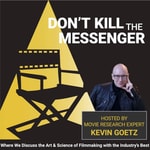
Don’t Kill the Messenger dives deep into the careers of Hollywood’s most influential voices including executives and filmmakers alike. Hosted by entertainment research expert Kevin Goetz, the interviews are more than story-sharing, they are intimate conversations between friends and a powerful filmmaking masterclass. Discover what it really takes to bring your favorite movies to life. Find Don’t Kill the Messenger on Apple, Spotify, or your favorite podcast platform. Learn how movies begin, and end—with the audience.
Host: Kevin Goetz Producer: Kari Campano Writers: Kevin Goetz, Darlene Hayman, Nick Nunez, & Kari Campano Audio Engineer: Gary Forbes Produced at DG Entertainment, Los Angeles CA
Marketing Team: Kari Campano, Dax Ross, Daniel Gamino, & Ashton Brackett
Guest Booking: Kari Campano & Kathy Manabat
Site
RSS
Apple
Data updated on 22/10/2026
Recent rankings
Latest chart positions across Apple Podcasts and Spotify rankings.
Shared links between episodes and podcasts
Links found in episode descriptions and other podcasts that share them.
Gerry Rich has led marketing at Columbia Pictures, Miramax, MGM/United Artists, Paramount Pictures, and Amazon MGM Studios. He joins host Kevin Goetz to talk about his new memoir, Chasing Hollywood: A Marketing Chief’s Lessons on Breaking Through. Ad Age has named him one of the Top 100 Marketers in America. His campaigns range from independent breakouts like The Crying Game and Leaving Las Vegas to Mean Girls, Iron Man, and the James Bondfranchise. Rich shares hard-won lessons on finding a campaign’s hook, creating urgency, and choosing who to work with.
Selling a Movie in a Four-Week Window (02:44): Rich likens movie marketing to a weekend retail sale, with most media now packed close to opening weekend. He explains why live sports and high-impact digital buys like TikTok still drive reach, and why more of the budget now goes to content creators, the new journalists.
Coming Out, Guy Pearce, and Writing the Book (08:33): After the pandemic and Amazon’s acquisition of MGM, Rich felt it was the right moment to look back on a career spanning more than a thousand films. He explains why he wove his personal story into his book, from meeting lifelong friend Guy Pearce on a film shoot in Fiji to coming out, which he says made him more authentic in his work.
Rebuilding MGM and Reinventing Bond (24:25): Frank Mancuso brought Rich in to help rebuild a bankrupt MGM, where GoldenEye had to revive a franchise audiences saw as “my father’s Bond.” The campaign introduced Pierce Brosnan as a new Bond for a new generation, with help from a Nintendo 64 game.
Rapid Fire: The Crying Game, The Birdcage, Mean Girls, and Chicago (27:57): Goetz runs through some of Rich’s most memorable campaigns. Rich explains how the Miramax team turned The Crying Game’s twist into its hook and persuaded critics not to spoil it. He recalls repositioning Mean Girls around the fear of the first day at a new school, and bringing audiences who didn’t usually see musicals to Chicago.
Mentors and Moguls (42:32): Rich shares mentor Hal Gaba’s rule to avoid people who would never visit you in the hospital. He also reflects on Harvey Weinstein’s complicated legacy, crediting his impact on independent film while condemning the abuse and hostile environment he created.
Going Against the Algorithm (47:26): Rich agrees audience research has a role once a script exists but warns that greenlighting by data models produces sameness. He argues that a shortage of films in certain genres is an opportunity, pointing to originals like Ted, Tropic Thunder, and Sinners.
Host: Kevin Goetz Guest: Gerry Rich Producer: Kari Campano Writers: Kevin Goetz, Darlene Hayman, Nick Nunez, and Kari Campano Audio Engineer: Gary Forbes (DG Entertainment)
For the 100th episode of Don't Kill the Messenger, host Kevin Goetz welcomes back his very first guest, Oscar-winning producer Graham King. King's films, including The Departed, The Aviator, Hugo, Argo, Blood Diamond, The Town, and Bohemian Rhapsody, have collected 61 Academy Award nominations, and he won Best Picture for The Departed. His latest, Michael, took seven years to reach the screen and has since surpassed Bohemian Rhapsody as the highest-grossing biopic of all time. King traces the film back to a chance meeting at a gas station in 1982 and explains why the real win is the audience showing up.
A Mother’s Blessing (03:33): King recalls showing Katherine Jackson and Michael's sister Rebbie the first hair and makeup test of Jaafar Jackson. Michael’s mother’s emotional response ranks among the top five moments of his career.
The Gas Station and the Softball Game (05:30): While pumping gas in Sherman Oaks, a young King hummed "Let's Get Serious" to Jermaine Jackson and was invited to the family's softball game. There, Michael introduced himself by tapping King on the shoulder, saying "You're it," and running off.
Learning from Scorsese (11:55): King prefers to let the film do the talking. He credits his years with Martin Scorsese for teaching him how to excite an audience, work with actors, run a set, and layer music into the story.
Previews, Critics, and the Real Win (20:21): Scorsese taught King the value of fresh eyes from outside the business. He admits he has ignored warnings and paid for it, and he argues that reviewers critiqued Michael Jackson rather than the movie. King tells filmmakers that the green light isn't the win; the audience showing up is.
Casting and Testing Michael (29:52): King shares how his daughter suggested Colman Domingo would make a great Joe Jackson. He tells the story about the lunch where he told Jaafar Jackson he was auditioning to play his uncle, the three years of preparation that followed, and the boundless energy of first-time actor Juliano Krue Valdi. Unable to preview publicly, he leaned on Goetz's and editor John Ottman’s reactions.
Bob Greenblatt (Television Executive & Producer, Tony-Winning Broadway Producer) on Building Hits at Fox, Showtime, NBC, and Broadway
Bob Greenblatt joins host Kevin Goetz for a conversation that follows the television executive through four separate turnarounds, from a struggling young Fox Network to the top of Showtime, NBC, and WarnerMedia Entertainment. Greenblatt helped develop Beverly Hills, 90210, The X-Files, and Party of Five at Fox, produced Six Feet Under, turned Showtime into a creative rival to HBO with Weeds and Dexter, ran NBC during the network's return to number one with The Voice and This Is Us, and later helped launch HBO Max. He's also a five-time Tony-winning Broadway producer.
Learning the Business from Peter Chernin and Scott Rudin (06:28): After an MBA and film school, Greenblatt credits his mentors Scott Rudin and Peter Chernin for the real education in how to give notes and run a company without losing the creative instinct.
Launching Fox with Beverly Hills, 90210 (15:36): Greenblatt walks through developing 90210 from Barry Diller's original idea, hiring an unproven Darren Star to write it, and watching the 90-minute pilot test through the roof. Its breakout success helped define the young-adult demo strategy that built the network.
American Beauty, and the Birth of Six Feet Under (24:13): Greenblatt recounts partnering with David Janollari to launch their production company, signing sitcom writer Alan Ball without realizing he'd also written a script called American Beauty, and sending that script to HBO right as the film became an Oscar-winning phenomenon. HBO ordered Six Feet Under straight off the page.
Turning Around Showtime and NBC (34:55): Greenblatt explains his pattern of leaving a job once it stops changing, his preference for buying over developing, and how he rebuilt Showtime around original series like Dexter and Weeds. He also details how gave NBC the lead-ins it needed to climb back to number one.
Billy Ray (Oscar-Nominated Screenwriter & Director) on The Hunger Games, Great Characters, and the Craft of Storytelling
Billy Ray, the Oscar-nominated screenwriter behind Captain Phillips, The Hunger Games, Shattered Glass, Richard Jewell, State of Play, Breach, and Flight Plan, joins host Kevin Goetz for a candid conversation about the throughline of integrity in his work and the mechanics of great storytelling. Ray lays out his theory of what every protagonist and villain requires using Jaws, Rocky, The Wizard of Oz, and Ordinary People as case studies, and shares stories from Donald Sutherland, Jennifer Jones, and the making of The Hunger Games.
Integrity and the Stories Billy Ray Tells (01:41): Ray identifies integrity as the recurring theme in his work, and explains why the best screenwriting is an intellectual exercise designed to create an emotional response rather than an impressive one.
The Untold Story of Ukraine's Abducted Children (10:20): Kevin and Billy discuss Ash and Crayons, a documentary about children abducted from Ukraine into Russia during the war. He calls it the great untold story of the conflict.
Knowing Your Audience: Messaging and Persuasion (13:35): A discussion about political communication becomes a broader conversation about audiences. Ray argues that effective messaging begins by understanding where people are emotionally and moving them from there, a principle Goetz connects directly to movie marketing and persuasive advertising.
What Makes a Great Screenplay? (22:38): Ray recalls being handed Ordinary People by his literary-agent father as the standard to aspire to, and lays out his fundamental rule of character: a protagonist needs an external problem to solve and an internal problem only the story can fix.
Great Characters, Great Villains, and the Cathartic Contract (26:29): Using Ordinary People, Rocky, One Flew Over the Cuckoo's Nest, and Schindler's List, Ray and Goetz examine character construction. Ray argues a great antagonist needs a defensible point of view.
Roy Lee (Prolific Producer & Industry Innovator) on Weapons, Barbarian, The Departed, and Trusting His Instincts
Roy Lee, the producer behind some of Hollywood’s most successful horror films, franchises, and international adaptations, joins host Kevin Goetz to explore the unconventional path that took him from law school to building one of the most prolific producing careers in Hollywood. Lee has produced or executive produced The Ring, The Grudge, The Departed, It, Doctor Sleep, The Lego Movie, How to Train Your Dragon, Barbarian, Weapons, and A Minecraft Movie, among dozens of others. Through his company Vertigo Entertainment, he's built a reputation for spotting opportunity where others see risk, whether that means Asian horror remakes, emerging filmmakers, or video game IP.
From Law School to Script Tracker (02:56): Lee describes going from law school to taking a job at a production company after moving to Los Angeles, where he was a development executive and script tracker responsible for knowing virtually every script and manuscript circulating around town.
Twenty-Five Asian Films in Twenty-Five Months (10:20): Lee explains how he acquired the rights to twenty-five Asian titles, including The Ring, The Grudge, and The Departed. Eighteen of the twenty-five eventually made it to the screen.
Reading by Instinct: What Makes Roy Lee Say Yes (15:54): Lee lays out his process, reading scripts between 4 and 6 a.m., abandoning any that don't make him care about the characters after the first act, and passing on stories he can predict in full.
It, Reinvented (17:52): Lee recounts discovering that Warner Bros. quietly owned the rights to Stephen King's It, and pitching his producing partner Dan Lin on isolating the kids' story as its own film.
The Barbarian Gamble (22:57): Every studio passed on Barbarian, but Lee was certain from the first act that it worked. It became a sleeper hit that also launched his ongoing partnership with writer-director Zach Cregger on and the upcoming .
Jim Orr (Universal Pictures) & Brandon Purdie (Angel Studios) on Distribution Strategy in Hollywood, Angel's Audience-First Model, & Why Content Is Still King
Jim Orr is President of Domestic Theatrical Distribution at Universal Pictures. He began his career at Paramount and joined Universal in 2016 after leading distribution at Focus Features and MGM. Brandon Purdie is Executive Vice President and Head of Theatrical Distribution at Angel Studios, the audience-funded studio behind Sound of Freedom, where he helped build a community-driven model that puts greenlight decisions in the hands of its 2.4 million members. Host Kevin Goetz brings the two together for a wide-ranging conversation on how films find audiences in an era of theaters, streaming, VOD, and direct fan engagement.
From Del Monte to Distribution (08:41): Orr recounts talking his way into a sales job at Del Monte out of college, then cold-calling studio distribution heads until Paramount hired him on the spot.
The Roadshow Era and the First Wide Break (11:36): Orr traces distribution's earliest days, when prints traveled by car with regional reps, through to the thousand-plus theater breaks standard by the time of Star Trek.
Content Is Still King (23:02): Both guests agree the movie itself remains the deciding factor in box office success, with Purdie noting a quiet week usually just means there isn't a film people want to see yet.
Building Angel Studios from a Membership, Not a Subscription (30:02): Purdie explains Angel's founding principle: no executive can greenlight a film without approval from the Angel Guild, whose members vote on projects and get free tickets to every release.
Pay It Forward and the Sound of Freedom Phenomenon (34:06): Purdie details how Angel's "Pay It Forward" ticketing model generated more than $20 million in donated tickets, helping turn Sound of Freedom into a summer 2023 box office surprise.
The Green Book Playbook (44:27): Orr points to Green Book as his proudest Universal moment, explaining how a deliberately limited release avoided split grosses and let the film build week over week toward a Best Picture win.
Lauren Shuler Donner (Legendary Producer) on X-Men, Pretty in Pink, and the Producer's Job of Protecting the Vision
Lauren Shuler Donner, one of Hollywood's most influential and adaptable producers, joins host Kevin Goetz for a wide-ranging career retrospective. Over nearly five decades, Shuler Donner has produced roughly 40 films that have grossed more than $5 billion worldwide — including Mr. Mom, St. Elmo's Fire, Pretty in Pink, Dave, Free Willy, and the X-Men franchise she helped build years before Marvel became Marvel. She talks with Goetz about breaking into a male-dominated industry, her 38-year love story and creative partnership with director Richard Donner, her philanthropic work with the Motion Picture & Television Fund, and her latest chapter producing the Broadway musical adaptation of The Lost Boys.
Breaking Into a Male-Dominated Industry (06:10): Shuler Donner recalls knocking on doors with no connections, becoming one of only three women among 300 men in NBC's camera department, and working her way into producing.
Discovering John Hughes and Making Mr. Mom (12:29): Shuler Donner recalls cold-calling John Hughes, championing his unproduced script Mr. Mom, and casting an unknown Michael Keaton after seeing him in Night Shift.
Falling for Dick Donner on the Set of Ladyhawke (16:43): Shuler Donner describes pursuing Richard Donner to direct Ladyhawke, working with him as a producer, and falling in love with him during the Italian shoot.
Radio Flyer, Free Willy, and the Power of Testing (24:53): Shuler Donner discusses Radio Flyer's heartbreaking low box office despite strong scores, and how a fan's $10 donation "for the whales" inspired Free Willy's end-credit hotline.
The Midwest Gut Check and the Search for Real Villains (28:01): Shuler Donner explains testing projects against whether "a kid from Cleveland" would pay to see them, and demanding villains like Magneto have real, human motivations.
Bob Bookman (Literary Agent, Manager & Producer) on Adapting Great Books, Discovering Hollywood Classics, and Why the Best Movies Aren't Always Based on the Best Books
Bob Bookman, one of Hollywood's most respected literary agents, managers, and producers, joins host Kevin Goetz for a masterclass on the art of discovering stories that successfully make the leap from page to screen. Over a remarkable career, Bookman has represented authors and filmmakers including Michael Crichton, John Irving, Thomas Harris, Jonathan Demme, Cameron Crowe, and Tom Stoppard, helping bring to the screen films like Jurassic Park, The Silence of the Lambs, Hannibal, The Cider House Rules, A Beautiful Mind, and Jerry Maguire. In recent years he's brought that same eye for material to producing, including the Best Picture nominee A Complete Unknown.
Running the Yale Law School Film Society (06:54): Bookman recalls building an underground film education out of 16mm prints borrowed from historian Bill Everson, bringing legends like Frank Capra, Fritz Lang, and Miloš Forman to campus for free screenings.
Landing the Job and Skipping the Mailroom (18:26): Bookman shares how his father connected him with Abe Lastfogel, how a chance introduction from agent Jack Gilardi led to an interview with David Begelman, and how he ultimately landed at IFA, bypassing the mailroom.
Becoming "The Book Guy" (23:24): Bookman describes how agency head Marvin Josephson handed him ICM's entire literary publications franchise,launching his decades-long reputation as Hollywood's go-to book agent.
What Makes a Book Cinematic (27:09): Bookman breaks down why great novels rarely make great films, and what he actually looks for: three-act structure, character conflict, and a story that takes audiences somewhere new.
The Secret to a Great Adaptation (29:15): Using John Irving's Oscar-winning adaptation of his own novel The Cider House Rules as the gold standard, Bookman explains why most authors shouldn't adapt their own books, and why Irving was the exception.
Sid Ganis (Veteran Studio Executive, Producer) on Marketing Lucas and Spielberg's Biggest Films, Running Studios, & Leading the Academy
Sid Ganis, former President of the Motion Picture Group at Paramount Pictures, former Vice Chairman of Columbia Pictures, and four-term President of the Academy of Motion Picture Arts and Sciences, joins host Kevin Goetz for a wide-ranging conversation spanning more than five decades in Hollywood. Ganis traces his path from an office-boy job won through a chance connection, to marketing campaigns for The Empire Strikes Back and Raiders of the Lost Ark, to greenlighting Ghost and Fatal Attraction, and to acquiring the rights to Forrest Gump during his years running Paramount.
Brooklyn Roots and Greek Jewish Heritage (03:14): Ganis traces his Romaniote Jewish heritage to Ioannina, Greece, and his grandparents' flight to New York's Lower East Side. Ganis recalls his first solo trip to the movies, seeing Gunga Din for 25 cents at a neighborhood theater.
Quitting College and a Lucky Break (08:50): After dropping out of Brooklyn College, Ganis landed his first publicity job thanks to a chance connection from his Uncle Phil.
Joining 20th Century Fox (12:57): Ganis describes his early years in publicity, working for Lee Solters and later joining Fox while Cleopatra was in production.
Working with Joseph L. Mankiewicz (17:44): Ganis remembers collaborating with the director years later and calls him one of Hollywood's greats.
Testing Ghost (28:01): Ganis shares a test-screening story from Ghost that captures how unpredictable audiences can be.
Meeting George Lucas and Joining Lucasfilm (31:34): Ganis recalls being introduced to a young George Lucas by Francis Ford Coppola, then later joining Lucasfilm as Empire Strikes Back went into production.
Marketing Raiders of the Lost Ark and Meeting Nancy (33:40): While promoting , Ganis met his future wife, Nancy Hult, through a PBS fundraiser project that later won him an Emmy.
Jeff Annison & Paul Scanlan (Co-Founders, Legion M) on Democratizing Hollywood, Fan Ownership, and the Power of the Audience
Jeff Annison and Paul Scanlan, Emmy-winning co-founders of the world's first fan-owned entertainment company, Legion M, join host Kevin Goetz for a conversation about disrupting industries, building communities, and betting on the audience. Annison and Scanlan pioneered mobile television at MobiTV and launched the very first equity crowdfunding campaign in U.S. history. The duo have spent two decades proving that the audience is the most powerful force in entertainment.
Chicago, Boston, and a Love of Film (01:48): Paul Scanlan traces his passion for filmmaking to the University of Wisconsin-Madison, and to a family trip to Cape Cod where seeing Jaws at age five both terrified and captivated him. Jeff Annison arrived at storytelling through an unlikely path: a mechanical engineering degree at UCLA and a series of screenwriting classes taken on a lark.
MobiTV: Putting Television on a Flip Phone (07:18): The two founders recount how a mutual friend with a micro-display technology brought them together in 1999 to build what would become MobiTV, the first company to stream live television to mobile phones.
Colossal (25:49): Legion M's first major move was a small P&A investment alongside the distributor Neon on the Anne Hathaway film Colossal. With just 3,500 investors and a million dollars, they organized screenings and community meetups.
Community as Marketing Engine (29:54): Annison and Scanlan explain how Legion M's 60,000-plus investors are an organic grassroots marketing force. As Scanlan puts it, communicating with their community costs nothing but can drive millions in box office.
Saving Coyote vs. Acme (35:25): One of the most discussed projects in recent Hollywood history found new life through Catchup Entertainment. Legion M is partnering on its release, and the trailer has already surpassed 50 million views.
Advice for the New Filmmaker (43:22): Annison urges emerging creators to start with the end in mind, thinking not just about the key scene but about how to communicate a story in a brief window of attention. Scanlan adds a hard truth: the industry is more entrepreneurial than most people expect, and selling to a major studio is rarely the path.
Michael
The Departed at 20 and Dancing Audiences (49:47): King calls The Departed the hardest and most memorable film he has produced, and says his goal was to be the producer when Scorsese finally won his Oscar. Seeing audiences around the world dance through Michael's end credits, he says, is higher than any award.
Host: Kevin Goetz Guest: Graham King Producer: Kari Campano Writers: Kevin Goetz, Darlene Hayman, Nick Nunez, and Kari Campano Audio Engineer: Gary Forbes (DG Entertainment)
Executive Mentors and the One That Got Away (39:53): Asked to name the greatest network executive in television history, Greenblatt points to Brandon Tartikoff and Grant Tinker's "first be best, then be first" philosophy. He also revisits Profit, his short-lived anti-hero drama that paved the way for Dexter, and his famous pass on Buffy the Vampire Slayer.
The Green Room and The Rockford Files (48:54): Greenblatt previews current projects at his production company The Green Room. He closes by discussing his Broadway work on Ragtime, and his memoir, The Rockford Files.
Host: Kevin Goetz Guest: Bob Greenblatt Producer: Kari Campano Writers: Kevin Goetz, Darlene Hayman, Nick Nunez, and Kari Campano Audio Engineer: Gary Forbes (DG Entertainment)
Outworking the Competition and Shattered Glass (42:01): Ray discusses early influences including Rod Serling, and his realization that he couldn't control talent or the industry, only how hard he worked. He names Shattered Glass, his directing debut, as the film he's proudest of.
The Hunger Games and the Art of Reverse Engineering (46:30): Ray remembers reading Suzanne Collins' novel overnight and recognizing its potential. He shares changes that strengthened the adaptation, and the security measures involved in writing the franchise's newest installment.
Failure, Audience Testing, and the Oscar Chase (51:15): Ray speaks candidly about directing Secret in Their Eyes, losing an investor's money, and his Oscar nomination for Captain Phillips, including why chasing that recognition can be dangerous for a career.
Host: Kevin Goetz Guest: Billy Ray Producer: Kari Campano Writers: Kevin Goetz, Darlene Hayman, Nick Nunez, and Kari Campano Audio Engineer: Gary Forbes (DG Entertainment)
The Departed: A Home Run from the Start (29:11): Lee remembers watching Infernal Affairs, the Hong Kong film that would become The Departed, and knowing immediately it was a sure thing that went on to win the Best Picture Oscar.
Common Sense, No Regrets, and Advice for the Next Generation (35:44): Asked about his superpower, Lee points to good judgment and the ability to capitalize on opportunity. He tells aspiring filmmakers that talent, not just passion, should determine who tries to break in.
Where AI Fits In (40:06): Lee predicts AI will cut visual effects budgets, streamline storyboarding and animatics, and reshape script reading, even as he doubts audiences will see fully AI-generated lead performances anytime soon.
Host: Kevin Goetz Guest: Roy Lee Producer: Kari Campano Writers: Kevin Goetz, Darlene Hayman, Nick Nunez, and Kari Campano Audio Engineer: Gary Forbes (DG Entertainment)
What Keeps Them Up at Night, and the Next Five Years (49:26): Purdie names human apathy as Angel's biggest threat. Orr predicts modest theater consolidation and growth in premium formats, while Purdie sees Angel continuing to scale its guild and slate.
Host: Kevin Goetz Guests: Jim Orr and Brandon Purdie Producer: Kari Campano Writers: Kevin Goetz, Darlene Hayman, and Kari Campano Audio Engineer: Gary Forbes (DG Entertainment)
Finding Hugh Jackman (30:40): Shuler Donner recounts spotting Hugh Jackman in a self-taped Oklahoma! audition, flying him to LA, and sending him to read for Bryan Singer in Toronto sight unseen.
Getting X-Men Made (34:07): After Warner Bros. passed, Shuler Donner pitched X-Men to Fox's Bill Mechanic, who, unbeknownst to her, had sold his own comic collection to pay for college.
The Lost Boys on Broadway (37:02): Shuler Donner talks about bringing The Lost Boys, and eventually Dave, to the Broadway stage.
Testing Pretty in Pink's Ending (43:53): Shuler Donner explains how test audiences rejected the original ending of Pretty in Pink, leading to a reshoot that paired Molly Ringwald with Andrew McCarthy instead of Jon Cryer.
Host: Kevin Goetz Guest: Lauren Shuler Donner Producer: Kari Campano Writers: Kevin Goetz, Darlene Hayman, Nick Nunez, and Kari Campano Audio Engineer: Gary Forbes (DG Entertainment)
The Best Adaptations, and a Hawks-Hemingway Bet (33:00): Bookman names The Silence of the Lambs and A Beautiful Mind among the best adaptations he's seen, then tells the story of how Howard Hawks turned Ernest Hemingway's self-described worst book into To Have and Have Not.
Rapid-Fire on the Legends (37:43): Bookman gives quick, candid impressions of the writers and directors he's worked with — Michael Crichton, Jonathan Demme (including his own cameo in The Silence of the Lambs), Cameron Crowe, Tom Stoppard, and Paul Greengrass.
Originality, AI, and What's Next (40:24): Bookman argues that algorithms can imitate stories but not replicate the human heart, and discusses his new venture producing low-budget original films.
Host: Kevin Goetz Guest: Bob Bookman Producer: Kari Campano Writers: Kevin Goetz, Darlene Hayman, and Kari Campano Audio Engineer: Gary Forbes (DG Entertainment)
Columbia Pictures and a Career in Marketing (37:20): Recruited to Columbia by Peter Guber and Jon Peters, Ganis explains why he stayed in marketing rather than move into production.
Four Terms as Academy President (42:26): Ganis reflects on his proudest achievement: spearheading the 17-year effort to build the Academy Museum of Motion Pictures.
Sid Ganis's career is a reminder that cultivating relationships and a willingness to stay close to the audience can carry someone through every era of a changing industry. In his own words, his story is one of gratitude for the people who opened doors for him, and for a business he never stopped loving.
Host: Kevin Goetz Guest: Sid Ganis Producer: Kari Campano Writers: Kevin Goetz, Darlene Hayman, Nick Nunez, and Kari Campano Audio Engineer: Gary Forbes (DG Entertainment)
On Being on the Side of the Audience (56:44): Annison reflects on what keeps him grounded amid industry uncertainty and the rise of AI: the belief that no matter what technology produces, only human beings pay to watch movies. Building a company on the side of the audience, he argues, is the most defensible position in entertainment.
Host: Kevin Goetz Guest: Jeff Annison and Paul Scanlan Producer: Kari Campano Writers: Kevin Goetz, Darlene Hayman, and Kari Campano Audio Engineer: Gary Forbes (DG Entertainment)
Discover shows related to Don't Kill the Messenger with Movie Strategist Kevin Goetz, based on actual content similarities. Explore podcasts with similar topics, themes, and formats, backed by real data.