Don DeLillo Should Win the Nobel Prize – Details, episodes & analysis
Podcast details
Technical and general information from the podcast's RSS feed.
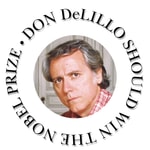
Don DeLillo Should Win the Nobel Prize
Jeffrey Severs & Michael Streit
Frequency: 1 episode/23d. Total Eps: 15

Recent rankings
Latest chart positions across Apple Podcasts and Spotify rankings.
Apple Podcasts
🇨🇦 Canada - books
13/09/2024#75
Spotify
No recent rankings available
Shared links between episodes and podcasts
Links found in episode descriptions and other podcasts that share them.
See allRSS feed quality and score
Technical evaluation of the podcast's RSS feed quality and structure.
See allScore global : 58%
Publication history
Monthly episode publishing history over the past years.
Episode 15: The Names
Episode 15
mardi 20 août 2024 • Duration 02:28:07
In Episode Fifteen, DDSWTNP take on The Names, a Greece-based story of a strange “abecedarian” murder cult, a novel regarded by DeLillo as his turn toward more “serious” writing and placed at or near the top of many a reader’s list of favorites. We discuss The Names as an examination of the “Depravities” and guilt of being an American in the complex late-1970s world of corporations, risk analysis, bank loans, and intelligence covers that narrator James Axton navigates, and we ask why The Names puts this geopolitical tumult (including the 1979 Iranian Revolution) in the context of ancient languages, ritual sacrifice, and a dissolving marriage and family life for James. Language-obsessed Owen Brademas (the archeologist and “epigraphist” who is drawn relentlessly to the fascinating cult) and filmmaker Frank Volterra (perhaps a sly satire of a certain American auteur?) figure in this story of religion, aesthetics, and the enduring appeal of violence, but we turn at the end of this episode to the nine-year-old author Tap, Axton’s son, whose misspelled, highly spirited tale of the spirit to which his tongue might “yeeld” lets DeLillo showcase all the ways to use the alphabet to salutary and generative ends. #getwet #themindslittleinfinite
We also announce the winner of our Amazons raffle and say thanks to all who have supported and continue to support us at buymeacoffee.com/delillopodcast.
Texts mentioned and discussed in this episode:
Burn, Stephen J. “‘A Paradigm for the Life of Consciousness’: The Pale King.” David Foster Wallace and “The Long Thing”: New Essays on the Novels, ed. Marshall Boswell. New York: Bloomsbury, 2014. 149-168.
“Don DeLillo: The Art of Fiction CXXXV,” Interview with Adam Begley, The Paris Review 128 (1993): 274-306.
“A Talk with Don DeLillo,” Interview with Robert Harris, in Thomas DePietro, ed., Conversations with Don DeLillo, University of Mississippi Press, 2005, 16-19.
The Godfather (1972) and Apocalypse Now (1979), dir. Francis Ford Coppola. (We have the dates on both films slightly wrong in the episode.)
Hearts of Darkness: A Filmmaker’s Apocalypse (1991), dir. George Hickenlooper and Fax Bahr
Viet Thanh Nguyen, The Sympathizer. Grove Press, 2015.
Episode 14: Mother
Episode 14
dimanche 21 juillet 2024 • Duration 02:20:47
In Episode Fourteen, DDSWTNP turn our attention for the first time to DeLillo’s drama – and to a largely unknown work by DeLillo as playwright, a 1966 radio play and disturbing take on U.S. race relations titled Mother. We cover the circumstances of the play’s original broadcasts, its re-emergence in an internet archive recording more than 50 years later, and the strange way in which this story’s armchair progressives and Billie Holiday fans, Ralph and Sally, end up making a fetishizing travesty of civil rights and racial integration in the play’s brief 27 minutes. Topics include the importance of radio to Mother’s themes of media occlusion, moral numbness, and erasure; what DeLillo means by Ralph’s “white malady” of transparency and how it reworks images from another Ralph’s Invisible Man; and what this play has to do with contemporaneous issues like interracial marriage in Loving v. Virginia. We talk extensively as well about how Mother presages parts of the early novels, from jazz love in Americana to Taft in End Zone and Azarian in Great Jones Street. Before (and after) listening to our analysis, take in this troubling 27-minute play at https://archive.org/details/pra-BB3830.01
Our raffle for a hardcover Amazons has been extended to August 1 – donate and enter to win at https://buymeacoffee.com/delillopodcast
Texts mentioned and discussed in this episode:
James Baldwin, The Fire Next Time. Dial Press, 1963.
Samuel Beckett, Endgame. 1957.
Don DeLillo, The Mystery at the Middle of Ordinary Life. 2000.
https://muse.jhu.edu/article/30660/pdf
Ralph Ellison, Invisible Man. Random House, 1952.
“The writer is driven by his conviction that some truths aren’t arrived at so easily, that life is still full of mystery, that it might be better for you, Dear Reader, if you went back to the Living section of your newspaper because this is the dying section and you don’t really want to be here.” (Thomas LeClair, “An Interview with Don DeLillo,” Contemporary Literature 23.1 (1982): 19-31)
Eugene Ionesco, Rhinoceros. 1959.
Mark Osteen. “Chronology.” In Don DeLillo, Three Novels of the 1980s. Library of America, 2022.
Jean-Paul Sartre, No Exit. 1944.
Episode 5: The Lives of DeLillo (1)
Episode 5
lundi 20 novembre 2023 • Duration 01:32:48
Happy 87th birthday, Don DeLillo. In Episode 5: The Lives of DeLillo (1), the first in a planned series about biography, DDSWTNP offer long-time and first-time readers alike new avenues into his work by discussing the first 30 years of his life, as he grew from the son of Italian immigrants and student of Jesuit scholars to the writer of his first published stories. This episode’s many topics include teenage DeLillo reading the modernist canon in a New York park, his time as “failed ascetic” during college at Fordham, the weight of the Bronx on his earliest fiction, his pivotal copywriting work under advertising guru David Ogilvy, and how the eventual author of Libra reacted on the day JFK was shot. #mythologyofamerica #spaghettiandmeatballs #howtowriteabiography #catholicritual #quittingtowrite #dregsofhiswork
We also announce in this episode our call for recorded contributions from our listeners! Be a part of our end-of-2023 tribute to our favorite DeLillo passages by heading to Speakpipe and recording yours, in two minutes or less. Deadline is December 10. Go to https://www.speakpipe.com/delillopodcast
Critical texts, stories, and essays referred to in this episode:
Don DeLillo, “The River Jordan,” Epoch 10.2 (Winter 1960): 105-120.
---, “Take the ‘A’ Train,” Epoch 12.1 (Spring 1962): 9-25.
---, “Spaghetti and Meatballs,” Epoch 14.3 (Spring 1965): 244-250.
---, “Coming Sun. Mon. Tues.,” Kenyon Review 28.3 (June 1966): 391-394.
---, “Baghdad Towers West,” Epoch 17.3 (Spring 1968): 195-217.
---, “A History of the Writer Alone in a Room.” Acceptance speech for the Jerusalem Prize for the Freedom of the Individual in Society, 1999.
DeRosa, Aaron, “Don DeLillo, Madison Avenue, and the Aesthetics of Postwar Fiction,” Contemporary Literature 59.1 (Spring 2018): 50-80.
Veggian, Henry. Understanding Don DeLillo. Columbia: University of South Carolina Press, 2014.
Interviews with DeLillo referred to in this episode:
Tom LeClair (1979) and Anne Arensberg (1988):
Collected in Thomas DePietro, ed., Conversations with Don DeLillo, University Press of Mississippi, 2005.
Vince Passaro (1991):
https://www.nytimes.com/1991/05/19/magazine/dangerous-don-delillo.html
Gordon Burn (1991):
“Wired Up and Whacked Out,” The Sunday Times (London), August 25, 1991 (magazine): 6-39.
Adam Begley (1993):
https://www.theparisreview.org/interviews/1887/the-art-of-fiction-no-135-don-delillo
Mark Binelli (2007):
https://www.guernicamag.com/intensity_of_a_plot/
PEN (2010):
https://pen.org/an-interview-with-don-delillo/
Robert McCrum (2010):
https://www.theguardian.com/books/2010/aug/08/don-delillo-mccrum-interview
Finally, a great source for interview excerpts and so many other things DeLillo:
Don DeLillo’s America: http://perival.com/delillo/delillo.html
Episode 4: Great Jones Street
Episode 4
mercredi 1 novembre 2023 • Duration 02:07:22
In Episode 4: Great Jones Street, DDSWTNP listen in on a rock icon in retreat on the Lower East Side, Bucky Wunderlick, who leaves his fame and music career behind as other characters descend into terrorism and fascism in pursuit of a drug said to wipe out language itself. Will Bucky “return with a new language,” fall prey to a violent hippie commune that seems to evoke the Weather Underground, or engage some other “terminal fantasy”? Subjects include the aesthetics of poetry, silence, and guttural sounds; the contradictory American quest for “revolutionary solitude”; and what a “counter-archeology” of 1970s New York has to offer. #dogboys #preemptingthemarket #beastislooseleastisbest #diamondstylus #pulseredactor #yapplesyapplesyapples #doubledfeat
Texts referred to in this episode:
Definition of “nonce” words: https://en.wikipedia.org/wiki/Nonce_word
One rendering of Hugo Ball’s Dadaist poem “Gadji Beri Bimba”: https://www.youtube.com/watch?v=aiKHSeDlU1U
John Cage on visiting an anechoic chamber in “Indeterminacy”: https://www.lcdf.org/indeterminacy/s/6
DeLillo reads from a CIA memo on torture (“here several lines are redacted”) at the 2009 PEN event “Reckoning With Torture”: https://www.youtube.com/watch?v=4ZFf6NYTkrM&t=26s
DeLillo and Greil Marcus discuss Bob Dylan and Great Jones Street at the 2005 Telluride Film Festival: https://greilmarcus.net/2014/10/17/greil-marcus-and-don-delillo-discuss-bob-dylan-and-bucky-wunderlick-2005/
Rainer Maria Rilke, “Ninth Duino Elegy”: https://web.ics.purdue.edu/~felluga/eng241/rilke.html
William Butler Yeats, “The Second Coming”:
https://www.poetryfoundation.org/poems/43290/the-second-coming
Episode 3: The 2023 Nobel Prize & Global DeLillo
Episode 3
jeudi 12 octobre 2023 • Duration 01:04:42
In this special episode timed to the 2023 Nobel Prize announcement, DDSWTNP do a brief history and theorization of the Nobel, talk about DeLillo as a global author, and read in detail his astonishing, Kafka-inspired 1997 speech in support of a Chinese dissident writer, “The Artist Naked in a Cage.” #hungerartists #communalmakebelieve #bitingtheswede
Texts referred to in this episode:
Don DeLillo, “The Artist Naked in a Cage.” May 26, 1997. The New Yorker. https://www.newyorker.com/magazine/1997/05/26/the-artist-naked-in-a-cage
Cornelius Collins, “The World: DeLillo Abroad.” Don DeLillo in Context, ed. Jesse Kavadlo. Cambridge University Press, 2022. 39-46.
James F. English, The Economy of Prestige: Prizes, Awards, and the Circulation of Cultural Value. Harvard University Press, 2005. https://www.hup.harvard.edu/catalog.php?isbn=9780674030435
Episode 2: End Zone
Episode 2
mardi 10 octobre 2023 • Duration 01:53:52
In Episode 2: End Zone, DDSWTNP do not so much tackle as infringe upon DeLillo’s 1972 novel of “footbawl,” nuclear wargames, and jargon-addled, surprisingly human characters in wasted desert spaces. Topics include race and sports in American culture, football’s dependence on the “word signal,” Rilke’s Ninth Duino Elegy, and some alternate titles for the novel from DeLillo’s archive. #getfetal #hokethatbickie #theuntellable #lowlyformofamericansainthood
Texts referred to in this episode:
Don DeLillo, “An Interview with Don DeLillo” by Thomas LeClair. Conversations with Don DeLillo, ed. Thomas DePietro. University Press of Mississippi, 2005. 3-15.
Rainer Maria Rilke, “The Ninth Elegy” (Duino Elegies): https://web.ics.purdue.edu/~felluga/eng241/rilke.html
“There were many words that you could not stand to hear and finally only the names of places had dignity. Certain numbers were the same way and certain dates and these with the names of the places were all you could say and have them mean anything. Abstract words such as glory, honor, courage, or hallow were obscene beside the concrete names of villages, the numbers of roads, the names of rivers, the numbers of regiments and the dates” (Ernest Hemingway, A Farewell to Arms).
Episode 1: Americana
Episode 1
vendredi 29 septembre 2023 • Duration 02:10:51
Episode 13: Amazons
Episode 13
lundi 20 mai 2024 • Duration 02:15:10
In Episode Thirteen, DDSWTNP follow the puck into the corners with Cleo Birdwell, first female NHL player and ostensible author of the farcical, sex-fueled, “intimate” memoir Amazons, the 1980 satire of a “pseudo-profound” America that DeLillo co-wrote with Sue Buck. Amazons is a sports novel with perhaps more interest in “strip Monopoly” than hockey, more investment by Cleo in her Badger Beagles youth softball team than the New York Rangers. We discuss how this odd book came to be, how it was marketed, how DeLillo never fully owned up to it, and its nevertheless surprising place in his career’s development, a comedic lark and palate cleanser in which he makes significant moves toward the vision of White Noise. These include a disease called Jumping Frenchman, simulated death in the American home, and the character Murray Jay Siskind, seen here writing about athletes and a deeply corrupt snowmobile industry before becoming the Elvis scholar readers of the later novel know. In an episode with insights for those who have read this rare book and those who haven’t, we show that Amazons, least-discussed of DeLillo’s works, really should not be that!
Support our work and enter the raffle to win a hardcover Amazons: buymeacoffee.com/delillopodcast
Discussed in this episode:
Gerald Howard, “The Puck Stopped Here” (2008)
David Marchese, “We All Live in Don DeLillo’s World. He’s Confused By It Too” (2020)
https://www.nytimes.com/interactive/2020/10/12/magazine/don-delillo-interview.html
An excerpt:
You know who else shows up in two of your books? Murray Jay Siskind. Both times described as having an “Amish” beard.
Murray Jay! Remind me, what book is he in?
“White Noise.”
And where else?
“Amazons.”
Oh god. How do you remember that? I don’t remember that.
I think I just got a scoop. I don’t know if you’ve ever publicly acknowledged that you wrote “Amazons.”
I probably did, somewhere or other. [Laughs.] Maybe to an interviewer from Thailand.
Susan Sontag, “The Pornographic Imagination” (1967), in Styles of Radical Will (1969).
Idries Shah: https://en.wikipedia.org/wiki/Idries_Shah
Jumping Frenchmen of Maine: https://en.wikipedia.org/wiki/Jumping_Frenchmen_of_Maine
Episode 12: Don DeLillo's America: An Interview with Curt Gardner
Episode 12
lundi 29 avril 2024 • Duration 01:32:43
In Episode Twelve, DDSWTNP interview Curt Gardner, creator and keeper of “Don DeLillo’s America,” a prolific and comprehensive website that for nearly 30 years has been the go-to spot for information about DeLillo, from reviews, appearances, and novel publication histories to news of film adaptations and play performances. We cover Curt’s stories of first discovering DeLillo in 1981, what he learned about the writing of Amazons at the Harry Ransom Center, and the letters he’s exchanged with the man himself as he’s built his site. We had a really fun time trading stories, insights, and interpretive connections with Curt. After listening to this in-depth interview, check out the riches of “Don DeLillo’s America” at http://www.perival.com/delillo/delillo.html
Support our work: https://buymeacoffee.com/delillopodcast
Mentioned and discussed in this episode:
Ant Farm, “The Eternal Frame” (1975):
https://www.youtube.com/watch?v=Mg1FCjvZ_jA
DeLillo, Don. “Notes Toward a Definitive Meditation (By Someone Else) on the Novel ‘Americana.’” Epoch 21.3 (Spring 1972): 327-29.
---. “The Sightings.” Weekend Magazine (Toronto) 4 August 1979: 26-30.
---. “Total Loss Weekend.” Sports Illustrated Nov. 27, 1972.
“Is cyberspace a thing within the world or is it the other way around? Which contains the other, and how can you tell for sure?” (Underworld)
Game 6: https://www.imdb.com/title/tt0425055/
LeClair, Thomas. “Missing Writers.” Horizon Oct. 1981: 48-52.
Episode 11: Running Dog (2)
Episode 11
vendredi 22 mars 2024 • Duration 55:22
Episodes Ten and Eleven: Running Dog (1 and 2) unpack DeLillo’s frightening post-Vietnam War vision of a nation marked by pornographic personhood, corrupt politics, and an openness to fascistic fantasy, all centered on the quest for a rumored film of an orgy in Hitler’s crumbling Berlin bunker. Pornographers and their well-armed henchmen, obsessive collectors of erotic art, and military men driven by profit saturate this narrative of New York and the Texas desert, while attempts to expose and subvert their cons by a journalist and a strangely spiritual intelligence agent reveal that all who resist these forces may end up mere lackeys and running dogs. DDSWTNP also draw clear links to U.S. politics in 2024, with orange make-up on a senator and a satire-proof dictator who dons the look of a clownish entertainer turning Running Dog, read now, into another of DeLillo’s uncanny prophecies of an image-mad American culture’s very grim potentials. #imperialistlackeys #thegreatdictator #hitlerhumanized #acourseindying
In this episode we also announce your chance to support our podcasting work and contribute to our trip this year to DeLillo’s huge archive at the Harry Ransom Center in Austin, Texas! If you enjoy this podcast we hope you’ll support us at https://www.buymeacoffee.com/delillopodcast
Texts and sites referred to in this episode:
Mark Binelli, “Intensity of a Plot” (interview with Don DeLillo), Guernica, July 17, 2007. https://www.guernicamag.com/intensity_of_a_plot/
Don DeLillo, “Silhouette City: Hitler, Manson, and the Millennium.” Dimensions 4:3 (1989: 29-34. Rpt. In Mark Osteen, ed., White Noise: Text and Criticism (Penguin Books, 1998), 344-352.
“Don DeLillo’s America – A Don DeLillo Site”: http://perival.com/delillo/delillo.html
Vince Passaro, “Dangerous Don DeLillo.” New York Times Magazine, May 19, 1991. https://www.nytimes.com/1991/05/19/magazine/dangerous-don-delillo.html
Related Shows Based on Content Similarities