Conversations for Financial Professionals – Details, episodes & analysis
Podcast details
Technical and general information from the podcast's RSS feed.
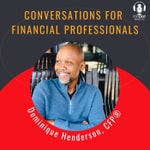
Conversations for Financial Professionals
Dominique Henderson, CFP®
Frequency: 1 episode/8d. Total Eps: 278

Recent rankings
Latest chart positions across Apple Podcasts and Spotify rankings.
Apple Podcasts
🇨🇦 Canada - careers
22/10/2024#97
Spotify
No recent rankings available
Shared links between episodes and podcasts
Links found in episode descriptions and other podcasts that share them.
See allRSS feed quality and score
Technical evaluation of the podcast's RSS feed quality and structure.
See allScore global : 42%
Publication history
Monthly episode publishing history over the past years.
HUGE Podcast Announcement: Guess what is about to happen?
Season 7
mercredi 7 décembre 2022 • Duration 01:58
Thanks to all the Conversations for Financial Professionals listeners!
CFFP #71 - The Benefits of Community in Mentorship
Season 7
vendredi 2 décembre 2022 • Duration 02:10
On this week's episode of Conversations for Financial Professionals, I chat with Amanda Raymond about how impactful psychological fear can be when transitioning into a new career.
In the full episode, you'll discover:
🎙️Amanda's story and origin in financial planning
🎙️The unique challenges career changers face when making a career switch
🎙️How best to deal with obstacles when making a career change
🎙️How The American College is supporting the financial planning profession?
🎙️Interesting trends you've noted during the pandemic about the workforce
Resources:
Are you a current or aspiring financial professional? Click here to join the Jumpstart community! Listen to previous podcast episodes, clicking here.
Join our weekly newsletter, click here.
Don't forget to subscribe to the show on iTunes to get automatic episode updates for our "Conversations for Financial Professionals!" by clicking here. If you enjoyed this episode, please share it with your friends by using the social media buttons you see at the bottom of the post.
And, finally, please take a minute to leave us an honest review and rating on iTunes. They really help us out when it comes to the ranking of the show and I make it a point to read every single one of the reviews we get.
Please leave a review right now, click here.
Thanks again for listening, reading, and watching!
If you enjoyed this podcast, I would love to hear your thoughts (CLICK HERE).
CFFP #67 -The Career Changer Dilemma: The Long Journey Towards Becoming a CFP ft. Dr. Dave Yeske, CFP®
Season 7 · Episode 67
mercredi 2 novembre 2022 • Duration 48:17
Welcome to another episode of the Conversations for Financial Professionals podcast where we are shaping the next generation of financial advice.
Dave holds a doctorate in finance from Golden Gate University, as well as an M.A. in Economics and a B.S. in Applied Economics from the University of San Francisco. He has been practicing financial planning since 1990 and is a past Chair of the Financial Planning Association (US) (FPA), being named a top advisor by Bloomberg Wealth Manager. He has been quoted in national media including The Wall Street Journal, The New York Times, Businessweek, Newsweek, USA Today, Investors Business Daily, San Francisco Chronicle, and The Journal of Financial Planning. Dave has appeared on CBS, CNBC, CNN and NBC News. Dave and the Yeske Buie approach to investing were profiled in the Wall Street Journal in 2009 and Dave was again profiled in the Wall Street Journal in 2010 on “The Science of Financial Advising.” In 2019, Dave was recognized by InvestmentNews as one of the most influential people in helping to shape the financial planning profession. In October 2017, Dave was awarded the prestigious P. Kemp Fain, Jr. Award, the Financial Planning profession’s lifetime achievement award. Dave’s contributions as a thought leader in the profession through his writing, presenting, and teaching and his dedication to mentoring future generations of planners through his longtime role as a mentor and Dean of FPA’s Residency program and his involvement at Golden Gate University spanning more than two decades were highlighted as he received the award.
In this episode, you'll discover:
🎙️Dr. Yeske's story and origin in financial planning
🎙️Why financial planning is here to stay as a profession
🎙️The cost of the journey
🎙️What makes the journey worth the cost
🎙️3 things all career changers should keep in mind before making the switch
🎙️"Skinny" certificate programs vs. traditional programs
🎙️In your own words, what does the phrase "career changer dilemma" mean to you?
Resources:
Are you a current or aspiring financial professional? Click here to join the Jumpstart community! Listen to previous podcast episodes, clicking here.
Join our weekly newsletter, click here.
Don't forget to subscribe to the show on iTunes to get automatic episode updates for our "Conversations for Financial Professionals!" by clicking here. If you enjoyed this episode, please share it with your friends by using the social media buttons you see at the bottom of the post.
And, finally, please take a minute to leave us an honest review and rating on iTunes. They really help us out when it comes to the ranking of the show and I make it a point to read every single one of the reviews we get.
Please leave a review right now, click here.
Thanks again for listening, reading, and watching!
If you enjoyed this podcast, I would love to hear your thoughts (CLICK HERE).
Preparing For A Job Interview - Tips for Aspiring Financial Advisors
Episode 47
lundi 27 janvier 2020 • Duration 13:40
How To Make Money As A Financial Advisor - Breaking Down the Pricing Models
Episode 46
lundi 20 janvier 2020 • Duration 12:53
There are so many ways to make money as a financial advisor, I want to break down some of the more popular models to make money as a financial advisor.
Previously, you might have wondered do all financial advisors, planners, coaches get paid the same?
Is it from products sold?
Services rendered?
How does that AUM thing work? Let's tackle all of that today.
- For traditional financial professionals that are regulated by the 1940 Act, just find the ADV. Within that, you will see the various compensation models. Here's a video I've done describing this with my own ADV down below. Once you find that ADV, you'll likely come across a few different models... AUM Flat Fee Products/Commissions (life insurance, 12b-1 fees) Hourly
- If no ADV, this would be a more non-traditional route and means that you could see a different variety... subscription - probably the most popular (i.e. Financial gym) courses,
- Ultimately what you charge for and how much that will be up to: (1) your expertise and the (2) of client you will serve. But keep in mind flexibility and fit.
Thanks for listening, reading and watching.
Are you a current or aspiring financial professional? Click here to learn more about how I'm helping you jumpstart your career!
Want to connect with me? Send me a DM on Linkedin (@dhendersonsr) or Instagram (@dominiquehendersonsr).
--- Send in a voice message: https://anchor.fm/dom-the-maven/messageUnpacking the Financial Professional Career Path
Episode 45
lundi 13 janvier 2020 • Duration 10:24
Have you ever thought of a financial services career?
What is the career path of a financial professional? How do you move through the ranks?
When it comes to terms like "analyst", "lead service advisor" or "senior advisor" what do they mean? And even more so, what do those jobs look like?
Although I've talked about my fairly non-linear path as a financial professional, there are career paths that are more linear in nature.
If you're contemplating a career as a financial professional, check it out to see what you might expect.
- Years 0-3. This job role/description can take on many names but you are basically an analyst. By definition, you will see a lot of data and you will be challenged to synthesize mainly for YOUR sake. There's not a lot of liability on you from a client standpoint because you're still learning. Owners don't want you with that level of responsibility quite yet. Tasks may include: inputting data into software, running reports, sitting in meetings and having things go over your head.
- Years 3-5. You might have the title as "associate, lead" advisor but you are basically a service advisor. Having been in the game for some time you may be bumped up in PAY and RESPONSIBILITY for a few reasons. Hopefully, you've deepened your knowledge and invested in yourself to earn a master's degree, designation or both. You've got more experience so you will likely have migrated from synthesizing data for YOUR sake to OTHER stakeholders like firm owners and clients. Tasks may include: running joint or solo in client meetings, managing client relationships within the business, finding new business for the firm, etc.
- Beyond year 5. You have a lot of flexibility. This is where some advisors with a less certain upside decide to go on their own. If you have a good opportunity you may start down a partnership track which could present you with some interesting opportunities beyond just compensation--like ownership during a succession event. Tasks will likely include a fair amount of business development for (finding and retaining client relationships), you may also wind up portfolio management responsibilities depending on your expertise, or other high-level responsibilities like operations, compliance, marketing, etc.
Thanks for listening, reading and watching.
Are you a current or aspiring financial professional? Click here to learn more about how I'm helping you jumpstart your career!
Want to connect with me? Send me a DM on Linkedin (@dhendersonsr) or Instagram (@dominiquehendersonsr).
--- Send in a voice message: https://anchor.fm/dom-the-maven/messageHow To Stop Procrastinating And Get Work Done Productivity Tips & Hacks
Episode 44
lundi 6 janvier 2020 • Duration 13:59
Have you ever wished you had more time in a day?
Understanding how to stop procrastinating and get work done can be liberating for you.
As a financial advisor to clients and a coach to financial advisors, I've put together a system that allows me to seemingly squeeze more hours out of my day.
Getting more done and being more productive will only help you procrastinate less and thereby be more effective.
I share the method to my madness in the video below...
- Have a morning routine. I have a whole philosophy around mindset and how that dictates our result. I strongly advocate employing a system or framework to start your day. Whether it's exercise, meditation, reading, prayer, et. Some level of consistency provides you with the discipline and momentum you'll need to finish your day. My routine is made up of a mosaic of techniques like using the Life SAVERS technique introduced by Hal Elrod in The Miracle Morning.
- Develop a capture system. This was probably one of my biggest wins going back to 2018 was finding a way to capture my thoughts. (EXPLAIN... You know when you have an idea and then your brain goes into the stage where you can't remember it because you didn't write it down. This is why you need a capture system. Some may use sticky notes, but the goal of any capture system should be EFFICIENCY. When the idea/thought/to-do hits you capture it for processing later. This is how you keep the maximum amount of RAM available for higher-level activities.
- Stay out of your email. This seems a little weird, right? As a financial advisor, you're like well I might miss something from a client or prospective client. Although that can happen you can use an autoresponder during the day. If this is a concern you can turn this on when necessary. Generally speaking, though you should stay out of email because of how much a time-suck it can be. Most are there least productive stuck inside their email inbox marking things read/unread, dragging to folders and contemplating. Set a time in the morning and the end of your day to process your email.
Thanks for listening, reading and watching.
Are you a current or aspiring financial professional? Click here to learn more about how I'm helping you jumpstart your career!
Want to connect with me? Send me a DM on Linkedin (@dhendersonsr) or Instagram (@dominiquehendersonsr).
--- Send in a voice message: https://anchor.fm/dom-the-maven/messageCareer Change At 40 - 4 Tips for Future Financial Advisors
Episode 43
lundi 30 décembre 2019 • Duration 11:36
To all my career changers out there... what do you need to know in order to make it as a financial professional?
As a coach to financial advisors, I run across a lot of career changers from all walks of life and all ages.
I get a very common question, what steps should I take to make it as a financial advisor? It's not an easy question, but I'm going to do my best to help you out. Because this is a great profession in need of really great people.
If you haven't already, navigate here and download my free guide that gives you 10 tips to help you jumpstart your career as a financial professional.
- Decide on your route. I've mentioned the traditional vs. the non-traditional route before, but it involves the degree to which you want to be regulated.In short, as a financial coach that just specializes in budgeting and/or debt reduction or student loan counseling that doesn't not advise on investments you can avoid being regulated.
- Decide on your build. What does this mean? Well, what are you trying to accomplish? I've gotten a lot of "Hey Dominique, can I be a financial advisor as a side hustle?"Some want to actually quit their current career cold turkey and start. Others might be the "go-to" for friends and family and are considering a switch. Any of these are valid reasons but they lead to the inevitable questions of "what should you build?" If you want a full list of what to consider check out this video.
- Build some runway. This can be done in a lot of forms including (1) Reducing your expenses for "x" months while still working your job, or (2) having a working spouse while you save.In either case, you will need margin and runway while you transition. The biggest mistake I see aspiring financial professionals make is not considering how long this will take and not having enough margin to get up and running. This should be 18-24 months of expenses to help you transition.
- Hire a coach. I can't stress this enough. You need someone that can help you through some of the strategy involved in building a successful practice and making the pivot from your previous career.A coach is helpful in deciding the following:(1) How will you focus your energy? What gets done now vs. later? (2) Developing your marketing plan. Which type of clients will you target or go after and how? (3) How should you price your services?
Thanks for listening, reading and watching.
Are you a current or aspiring financial professional? Click here to learn more about how I'm helping you jumpstart your career!
Want to connect with me? Send me a DM on Linkedin (@dhendersonsr) or Instagram (@dominiquehendersonsr).
--- Send in a voice message: https://anchor.fm/dom-the-maven/messageClient Experience Vs Customer Service - 5 Tips for Financial Professionals
Episode 42
mercredi 25 décembre 2019 • Duration 10:19
I want to break down my 5 steps to creating a great client experience—what I call the WOW factor (wonderfully overwhelmed) What is the difference between customer service and client experience.
What makes that interaction good or bad? It is how you feel. Feelings influence buying decision and then we use our logic to justify our decisions. So whenever you can provide a great experience it will be remembered. So how do you do that?
- Be Comprehensive- I like the comprehensive approach because it leaves no stone unturned. If you have a siloed approach you can miss opportunities to provide great service. I like to focus on 4-5 aspects of an individual's financial picture and they are the following: (1) Cash mgmt, (2) Investment positioning, (3) Tax strategy, (4) Asset protection, and (5) Non-Cash Compensations & Benefits. This allows me to see all the different pieces of a client's life and help them "talk" so that wealth and utility can be maximized.
- Be Curious- If you are genuinely interested in forming a deep relationship with your clients, it will show. You can't expect them to have a good experience if every interaction results in some type of transaction. What about birthdays, anniversaries? How do you react to their wins/losses/challenges in life? Are you empathetic?
- Be Ready to go above and beyond- I think this goes without saying, but the goal is to provide more value than what you are receiving as payment. My honest belief is that as financial advisors we have the power to change the trajectory of someone's life and that cannot be valued. But it is imperative that we create a process or framework by which to deliver that type of experience. A lot of this comes in the form of proactive vs. reactive service to the client. Can you get the answer faster? Or do something that saves them time on their end?
- Be Straightforward- Beyond honesty and integrity be firm on any positions you take. This definitely means that when you screw up, be the first to apologize when you make a mistake. I've found that clients don't require perfection, just honesty. You won't have a spotless record but you must be the time of person that your client can trust will do the right thing when called upon whether it is uncomfortable for you or not.
- Be Thinking of What you Like- This may seem a bit counterintuitive but think of how you like to be treated and do the same. It is the golden rule (more or less). If you like quick responses to your inquiries develop a system to respond to client inquiries and provide them with status updates on items you are working on or they are waiting on.
Thanks for listening, reading and watching.
Are you a current or aspiring financial professional? Click here to learn more about how I'm helping you jumpstart your career!
Want to connect with me? Send me a DM on Linkedin (@dhendersonsr) or Instagram (@dominiquehendersonsr).
--- Send in a voice message: https://anchor.fm/dom-the-maven/messageHow To Attract Your Ideal Client - 3 Things ALL Humans Want and Desire
Episode 41
lundi 23 décembre 2019 • Duration 09:39
As a financial professional you're going to need to know how to attract your ideal client. There are 8 biologically programmed needs that every human wants or desires that revolve around 3 basic life themes...let's see how those fit into developing your marketing plan.
So in a previous video, I talked about the importance of finding a niche market and the 5 elements of how you would create content to market your services to them. And no matter if you feel you are good or bad at selling or marketing your services it will be helpful to understand that there are some common themes to use when doing so. Do people want to be in relationships? Feel safe? Feel significant?
The answer is YES...but how do you package that in a way that feels natural and genuine.
- Life Theme #1 - Relationship - Everyone wants community. We've been wired to care about what others think in a way that will promote our survival. We care about the protection of our loved ones and we desire a level of companionship.
- Life Theme #2 - Safety- Going all the way back to Maslow's hierarchy of needs we have to feel safe. This means that the basics of food, clothing, and shelter have to be provided before other things gain importance.
- Life Theme #3 - Significance- Despite how hard we try we all want to gain the approval of something or someone. Being accepted for who we are and what we do is a big thing in modern society. This need for significance is evident in many different areas of life which is probably where the notion of "keeping up with the Joneses" came from. Regardless there are many different ways to use this as a positive in your marketing strategy...
Thanks for listening, reading and watching.
Are you a current or aspiring financial professional? Click here to learn more about how I'm helping you jumpstart your career!
Want to connect with me? Send me a DM on Linkedin (@dhendersonsr) or Instagram (@dominiquehendersonsr).
--- Send in a voice message: https://anchor.fm/dom-the-maven/messageRelated Shows Based on Content Similarities