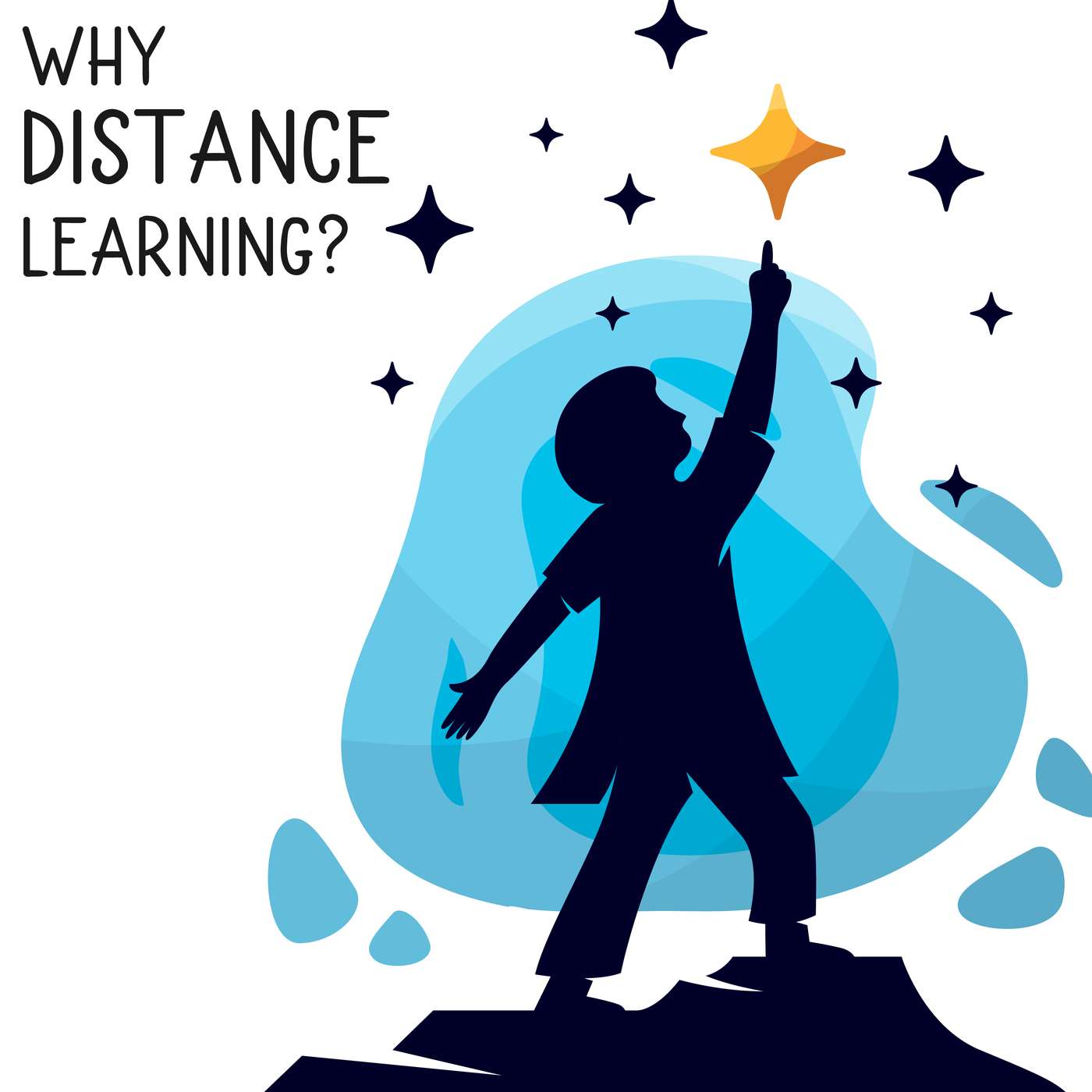
Why Distance Learning? is a podcast about the decisions, design choices, and assumptions that determine whether live virtual learning becomes shallow and transactional—or meaningful, relational, and effective at scale.
The show is designed for education leaders, instructional designers, and system-level practitioners responsible for adopting, scaling, and sustaining virtual, hybrid, and online learning models. Each episode examines the structural conditions under which distance learning actually works—and the predictable reasons it fails when it doesn’t.
Through conversations with researchers, experienced practitioners, and field-shaping leaders, Why Distance Learning? translates research, field evidence, and lived experience into decision-relevant insight. Episodes surface real tradeoffs, near-failures, and hard-won lessons, equipping listeners with clear framing and language they can use to explain, defend, or redesign distance learning models in real organizational contexts.
Hosted by Seth Fleischauer of Banyan Global Learning, and Allyson Mitchell and Tami Moehring of the Center for Interactive Learning and Collaboration, the podcast challenges outdated narratives about distance learning and explores what becomes possible when live virtual education is designed intentionally, human-centered, and grounded in evidence.
Site
RSS
Apple
Données mises à jour le 01/08/2026
Classements récents
Dernières positions dans les classements Apple Podcasts et Spotify.
Liens partagés entre épisodes et podcasts
Liens présents dans les descriptions d'épisodes et autres podcasts les utilisant également.
#85 Hot Takes: What Five Episodes of Research Taught Us with Seth, Allyson, and Tami
Épisode 85
lundi 20 juillet 2026 • Durée 41:55
In this special episode of Why Distance Learning, hosts Seth Fleischauer, Allyson Mitchell, and Tami Moehring skip the guest interview and trade hot takes drawn from their recent run of research conversations — with Michael Barbour, Bobbi Sandberg, Jered Borup, and Kristen DeBruler. Each host came in with their own list, then picked which ones to dig into together. What surfaces is a set of specific, evidence-backed reframes: where parents' instincts to help go wrong, why remote isolation is a design failure rather than an inherent cost of distance learning, and what's actually breaking down when students sense their teachers are using AI on their feedback.
Together, the hosts work through the Academic Communities of Engagement framework's head/heart/hands distinction, and why the "heart" and "hands" work — trust, executive-functioning support — protects kids more than parents jumping in on academic content. They connect a CBS News piece on remote-worker isolation to Michael Barbour's finding that logging into school was, for some students, the most normal part of their pandemic day, arguing that isolation is what happens when culture isn't designed on purpose, not something baked into the medium. And they spend the back half of the episode on AI: not the cheating problem schools have mostly focused on, but the mirror-image trust break when students catch teachers using it on feedback without saying so — and why an honest, disclosed, assignment-by-assignment AI policy beats a blanket ban nobody actually follows.
Key topics:
Head, heart, hands: the Academic Communities of Engagement (ACE) framework
Why parental "head" support (re-teaching content) can do more harm than good
Remote work isolation as a design failure, not a modality problem
Michael Barbour's finding on pandemic remote learning and student mental health
Teacher-student trust and AI-generated feedback
Assignment-by-assignment AI disclosure as an alternative to blanket bans
Note: this is a hosts-only episode, so there's no guest bio or guest-provided links to confirm — just the items above referenced on air.
About the Hosts: Seth Fleischauer is the founder of Banyan Global Learning and host of Why Distance Learning. Through Banyan, he designs live virtual programs that connect K-12 classrooms to global peers and expert facilitators — building the kind of structured, human-centered distance learning the podcast explores. See https://banyangloballearning.com/
Tami Moehring and Allyson Mitchell work with CILC, the Center for Interactive Learning and Collaboration, to help educators implement high-quality live virtual learning experiences across grade levels. Discover more at CILC.org.
#84 Why Is Teaching Online Still Not Part of Teacher Prep? with Michael Barbour
Épisode 84
lundi 6 juillet 2026 • Durée 45:51
In this episode of Why Distance Learning, your hosts talk again with Michael Barbour — the most-cited researcher in K-12 online and distance learning — about what it would actually take to fix how teachers are prepared to teach online, and why thirty years of K-12 virtual learning hasn't produced that change yet. Drawing on his 2024 paper with Charles Hodges, Michael lays out six concrete steps — two focused on building the research base, four focused on teacher preparation programs — and explains why none of it happens without explicit mandates from states and accreditation bodies. The assumption under examination: that teacher prep programs will gradually incorporate online pedagogy on their own as demand grows. The evidence suggests they won't, for the same reason they never properly integrated technology in the first place.
Together, the hosts and Michael explore the structural reasons teacher preparation programs can't make room for online pedagogy without a mandate, even when they want to. They dig into a counterintuitive finding from Newfoundland and Labrador — where students with K-12 online learning experience actually performed worse in college online courses than their peers, not because online experience is harmful, but because of how that particular program's heavy synchronous structure coddled students in ways that didn't transfer. They examine what the research actually shows about online learning and mental health (short version: the modality isn't the problem, and during the pandemic, logging into school may have been the most normal part of a child's day). And they work through the affordances and tradeoffs of synchronous versus asynchronous instruction — a framework any practitioner can apply immediately. Michael closes with the two big questions currently driving his research: where is the field of K-12 online learning thirty years in, and how much of what gets regulated in the US is driven by ideology rather than evidence?
Why teacher prep programs don't change without state or accreditation mandates
The Newfoundland counterintuitive finding: when prior online experience hurts
Site-based facilitators / e-deans and the role of on-site support in distance programs
#83 Can Flexibility Hurt Online Learners? What Pacing Data Reveals with Kristen DeBruler
Épisode 83
lundi 22 juin 2026 • Durée 33:59
In this episode of Why Distance Learning, your hosts talk with Kristen DeBruler — Assistant Director of the Michigan Virtual Learning Research Institute — about what makes online learning work for K-12 students, and what quietly undermines it. Drawing on survey data from over a thousand virtual teachers and fresh findings on student and teacher AI perceptions, her work reveals where the conventional promises of online learning diverge from what the data actually shows. The episode centers on a tension that practitioners rarely name directly: the flexibility that makes online learning valuable for some students can work against those who are still developing the self-regulation skills to use it well.
Together, the hosts and Kristen explore how a researcher inside a state virtual learning organization sets and pursues a research agenda — including the unusual advantage of having direct access to student data. They examine common failure modes in classroom-level research, particularly how vague research questions leave teachers vulnerable to the biases they're trying to surface. Kristen walks through her team's findings on the gap between how students and teachers define acceptable AI use, and why that ambiguity is already showing up in the classroom. The conversation turns to teacher feedback as the connective tissue of asynchronous online learning — and what the data shows about what makes it work and what makes it hollow. And Kristen makes a pointed case about applying adult learning research to K-12 populations: the data doesn't transfer as cleanly as the field sometimes assumes, and the consequences land on students who are still building the executive functioning skills that adult learners already have. Her pacing research is illustrative: students who cross unit boundaries — not just move around within one — end up with final grades 9.5 points lower on average, a gap large enough that teachers should treat it as a warning signal, not background noise.
Key topics:
Researcher role inside a state virtual learning organization
Setting a research agenda: legislative directives vs. internal needs
Avoiding bias in classroom-level research
The AI acceptable-use gap between students and teachers
Teacher feedback as the primary relationship-building mechanism in async courses
#82 All Learning Is Social: Jered Borup on Social Presence in K-12 Online Learning (Part 2)
Épisode 82
lundi 8 juin 2026 • Durée 31:58
In this episode of Why Distance Learning, your hosts continue their conversation with Jered Borup — professor at George Mason University and one of the most-cited researchers in K-12 online learning — about what AI in education is actually doing to relationships, what social presence requires when "build a video lecture" can be done by a chatbot, and why teacher burnout is the real bottleneck the field doesn't want to talk about. Borup connects his earliest 2012 work on asynchronous video to his 2025 Open Praxis research on combining AI-generated text with human-created video, and argues that AI used to offload feedback erodes the very thing online learners need: the felt sense that the teacher is real and knows them.
Together, the hosts and Jered explore the conflation of social media, video games, and ed tech in the parental imagination after the pandemic; how to use AI without replacing the relational core of teaching; why one-on-one asynchronous video may build social presence more reliably than synchronous Zoom classes; the DLAC Phase 2 research agenda Borup co-authored with Michael Barbour and Kristen DeBruler; the mental-health gap between teachers and other professionals with comparable education; and Borup's one-line answer to the show's title question — that personalization and Universal Design for Learning are easier to do online than off.
This is Part 2 of a two-part conversation. Listen to Part 1 for the foundational ACE framework, the on-site mentor model, and the parent question.
Key Topics
"Emergency remote learning" vs. real online learning — what parents are still confusing
Social presence — old research, new tools (asynchronous video, AI-plus-human-video)
The risk of offloading teacher feedback to AI
Asynchronous one-on-one video as a relationship lever (vs. one-to-many Zoom)
DLAC Research Agenda Phase 2 — what's keeping researchers up at night
Teacher mental health and the AI strain on top of pandemic strain
Authentic assessment and "we're too in love with the five-paragraph essay"
#81 School and Personal Communities Must Work Together to Make Online Learning Engaging with Jered Borup (Part 1)
Épisode 81
mardi 26 mai 2026 • Durée 31:58
In this episode of Why Distance Learning, your hosts talk with Jered Borup — professor at George Mason University, co-creator of the Academic Communities of Engagement framework, and one of the most-cited researchers in K-12 online learning — about why student engagement isn't a property of the student or a skill the teacher unlocks, and why most online programs are leaving the work undone. Borup's framework distinguishes the course community (teachers, designers, mentors) from the personal community (parents, family, on-site adults) and argues engagement is what those two produce together. The assumption on the table: that "more parental involvement" is what fixes online learning — when in fact, untrained involvement, his research shows, can hurt about as often as it helps.
Together, the hosts and Jered explore the ACE framework's two communities, the on-site mentor model from Mountain Heights Academy and Michigan's mentor mandate, what it actually takes to teach a student how to learn online, the equity gap in who gets meaningful support, and where parents fit (and don't). Along the way: the Michigan administrator who tapped someone on the shoulder and said "you're now Sally's mentor," the parent with only a high-school diploma who turned out to be one of the 12 most successful mentors in the study, and the parent who confessed to Jered that she does her kid's online discussion-board posts because they're "busy work."
This is Part 1 of a two-part conversation.
Key Topics
The Academic Communities of Engagement (ACE) framework
Course community vs. personal community
On-site mentors as the missing link in K-12 online learning
Michigan's mentor mandate — and why fidelity varies by school
Why "improved" parental engagement matters more than "more"
Designing parent support: a trickle of just-in-time tips, not a class
The equity gap in self-regulation and "how to learn online"
#80 Parents: the Co-Teachers No One Trained with Bobbie Sandberg
Épisode 80
lundi 11 mai 2026 • Durée 49:31
In this episode of Why Distance Learning, Seth and Allyson speak with Bobbie Sandberg — an educational researcher who recently completed her PhD in instructional psychology and technology at BYU — about what's actually happening in the household when a K-12 student learns online, and why most programs aren't designed for the answer. Bobbie's research, grounded in Jered Borup's Academic Communities of Engagement framework, reframes engagement as a three-dimensional challenge — cognitive, behavioral, and affective — that K-12 students can't sustain alone. When the school is online, the support system shifts to whoever is home. And most programs haven't reckoned with what that means.
Together, Seth, Allyson, and Bobbie explore how parents naturally divide the labor of support, why more involvement isn't the same as better involvement, and what happens when families arrive at virtual school not by choice but because nothing else worked. Bobbie also shares what she's learned about the critical first weeks of enrollment, why explicit role invitations from programs make a surprisingly big difference, and the underrated power of affective engagement — including a story about refugee mothers whose aspirational storytelling did what tutoring couldn't.
Key topics discussed: - the three dimensions of student engagement and who owns each one - why cognitive support from parents can actually backfire - mooring factors and why families don't always "choose" online school - the fire hose problem in onboarding; designing for autonomy instead of dependence - why affective engagement might be the most underestimated variable in online learning.
"Behind the Screen: Exploring Parental Roles in K-12 Online Education" (Journal of Research on Technology in Education, 2024) -
#79 Eight Steps To Make Synchronous Online Learning Really Work with Dr. Helaine Marshall
Épisode 79
lundi 27 avril 2026 • Durée 45:03
In this episode of Why Distance Learning, your hosts talk with Dr. Helaine Marshall — retired professor of education at Long Island University Hudson and creator of SOFLA, the Synchronous Online Flipped Learning Approach — about the pedagogy most online courses never get around to designing, and what it costs when they don't. Drawing on five years of development work, Community of Inquiry theory, and her own linguistics teaching, Helaine walks through an eight-step cycle that treats synchronous virtual instruction as its own medium rather than a degraded version of in-person teaching. The reframe at the center of the conversation: online learning isn't a tool problem, it's a design problem — and empowerment isn't something teachers do to students, it's what happens when the conditions are built for it.
Together, the hosts and Helaine explore why most virtual classrooms default to lecture-over-Zoom, the eight-step SOFLA cycle that weaves asynchronous pre-work with structured synchronous sessions, the two steps that actually determine whether it succeeds (the SHAC share-out protocol and "preview and discovery"), the control issues that make teachers resist the model, and how SOFLA adapts across content areas — from linguistics to Boyle's Law — and age groups. They also work through Helaine's four E's framework — equity, enrichment, engagement, empowerment — and a single linguistic observation that reframes how to think about agency in virtual classrooms: empowerment is not a transitive verb.
Key Topics
The eight-step SOFLA cycle: pre-work, sign-in, whole group application, breakouts, share-out, preview and discovery, assignment instructions, reflection
Why pedagogy outlasts tech tools — and why most online teaching skips pedagogy entirely
The SHAC protocol for accountable, substantive peer feedback
"Preview and discovery" as the motivational hinge between lessons
The four E's: equity, enrichment, engagement, empowerment
P-P-R-R (patience, persistence, reflection, renewal) for teachers new to the model
Adapting SOFLA across content areas, age groups, and even in-person classrooms
4. Links & Resources
#78 The Next Shutdown Is Coming. Are You Ready? with Michael Barbour (Part 2 of 2)
Épisode 78
lundi 13 avril 2026 • Durée 33:51
This is the second of a two-part conversation with Michael Barbour, one of the most cited researchers in K-12 distance and online learning. Michael is assistant dean for academic innovation and integration at Touro University California, and has spent nearly three decades studying the design, delivery, and support of K-12 distance, online, and blended learning — as well as the policy and governance structures that shape it. If you haven't listened to part one yet, start there.
In this episode, we examine an assumption that surfaced repeatedly during the pandemic: that because distance learning has been around for decades, schools should have been ready. Michael has the data on why they weren't — and why, despite a global wake-up call, most still aren't. The numbers are striking: less than 10% of teacher preparation programs included any meaningful content on K-12 online learning even after COVID. And as Michael makes clear, the next disruption — whether pandemic, weather event, or political unrest — is not a question of if, but when.
From there, the conversation takes a surprising turn. Michael shares a counterintuitive research finding: students who had K-12 online learning experience actually performed worse as online learners at the university level — and he unpacks exactly why that happened and what it reveals about the difference between synchronous and asynchronous program design. He also walks through one of the most compelling real-world models of synchronous distance learning in K-12 — the Center for Distance Learning and Innovation in Newfoundland — and what it would actually take to replicate that kind of intentional design at scale.
"Every single one of your listeners, unless they plan on retiring in the next year or two, will likely experience another regional or global pandemic. And that's just on the pandemic side." — Michael Barbour
Topics covered:
~1:30 — Bridging policy, pedagogy, and technology: why hopes and prayers aren't a strategy
~3:20 — What the National Education Technology Plans have been saying since 1996
~4:20 — The teacher preparation gap: the numbers before, during, and after COVID
~7:20 — The history of pandemics and why every educator needs distance learning skills
#77 Stop Looking for Best Practices: What the Research Actually Says with Michael Barbour (Part 1 of 2)
Épisode 77
lundi 30 mars 2026 • Durée 37:33
This is the first of a two-part conversation with Michael Barbour, one of the most cited researchers in K-12 distance and online learning. Michael is assistant dean for academic innovation and integration at Touro University California, and has spent nearly three decades studying the design, delivery, and support of K-12 distance, online, and blended learning — as well as the policy and governance structures that shape it. His work has brought him before legislatures and policymakers around the world.
In this episode, we put a foundational assumption on the table: that research gives teachers answers. Michael makes a clear and generous case that it doesn't — and that both researchers and classroom teachers share responsibility for that misunderstanding. The distinction he draws between best practices and promising practices isn't semantic. It has real consequences for how leaders build cultures of evidence-informed decision-making, and how teachers are trained to engage with research in the first place.
From there, the conversation moves into some of the most persistent misconceptions in the field — including the idea that distance learning only works for certain types of students, and the often-overlooked role that local support plays in whether any online program succeeds or fails. Michael also challenges the assumption that face-to-face teachers have a natural engagement advantage over their online counterparts, and makes a compelling case for why the distance environment may actually offer more tools for meaningful connection — not fewer.
"The best that we can hope for in all honesty is that research might lead us to a promising practice as a starting point." — Michael Barbour
Topics covered:
00:00 — Michael's origin story in K-12 distance learning
~04:00 — Why teachers don't engage with research, and why researchers share the blame
~10:00 — Best practices vs. promising practices: why the distinction matters
~17:00 — Who distance learning actually works for
~21:00 — The role of local support in online program design
~24:00 — Engagement, belonging, and the myth of the visual cue
REWIND #30 Empathy Across Continents with Shared Studios' Virtual Portals
lundi 16 mars 2026 • Durée 46:25
About Our Guests
Dr. Brandon Ferderer is Head of Programming at Shared Studios and honors faculty at Arizona State University. A writer, performer, storyteller, and expert facilitator, Brandon holds a doctorate in intercultural communications from Arizona State University. His work spans private, education, and nonprofit sectors, harnessing communication technology to bridge cultural divides through dynamic educational and arts programs. His academic and creative works have been featured in Critical Studies in Media Communication and The Seventh Wave, and he has performed at the Scottsdale Museum of Contemporary Art, Phoenix Art Museum, the Moth Main Stage, and the Dixon Theater in New York City.
Ross Phillips is a social studies teacher at Winnacunnet High School in Hampton, New Hampshire. Holding a master's degree in education from the University of New Hampshire, Ross is passionate about bringing the world into his classroom through live virtual connections. An avid world traveler who has explored Thailand, Cambodia, Vietnam, Egypt, Italy, Iceland, and beyond, Ross uses real-world application to ignite students' curiosity for non-Western history, law, and geography.
What Is Shared Studios?
Shared Studios is best known for its immersive portals — repurposed shipping containers equipped with audiovisual technology that place users in a full-body, face-to-face conversation with someone in a similar container in one of 20–25 countries around the world. But at its core, Shared Studios is a network of people: trained facilitators and community members around the globe — from community activists to UN officials — brought together to create meaningful educational connections. Programming can be delivered through the immersive portal environment or via video conferencing.
Key Topics Discussed
Why immersive portals go beyond video conferencing Brandon explains that 65–75% of a message's meaning is communicated nonverbally. While video conferencing restored face-to-face visibility, it also introduced "Zoom fatigue" — the tendency to monitor how we to be connecting rather than actually connecting. The portal creates full-body presence and a sense of accountability to your conversational partner, which is essential for building genuine empathy.
Synchronous vs. asynchronous instruction: affordances, tradeoffs, and how to choose
Online learning and student mental health: what the research actually shows
Governance and regulation of K-12 online learning in the US vs. other jurisdictions
Michael Barbour is widely cited as the most prolific researcher in K-12 online and distance learning. His work spans student success and persistence in virtual environments, teacher preparation for online instruction, and the governance and regulation of K-12 online programs across jurisdictions. He is currently focused on building a research agenda for the field and examining how political ideology shapes online learning policy in the United States compared to other countries. Barbour holds a faculty position and has previously held posts at Wayne State University, among others.
About the Hosts: Seth Fleischauer is the founder of Banyan Global Learning and host of Why Distance Learning. Through Banyan, he designs live virtual programs that connect K-12 classrooms to global peers and expert facilitators — building the kind of structured, human-centered distance learning the podcast explores. See https://banyangloballearning.com/programs/global-cohorts
Tami Moehring and Allyson Mitchell work with CILC, the Center for Interactive Learning and Collaboration, to help educators implement high-quality live virtual learning experiences across grade levels. Discover more at CILC.org.
What makes feedback substantive (personal, formative, actionable) vs. hollow
AI-generated feedback and trust erosion in online learning
Student pacing deviation and its effect on learning outcomes
Executive functioning support for K-12 online learners
Cautions in applying adult learning research to adolescents
Make It Mindful Michigan Virtual Episodes: See list from Seth's other podcast for episodes with Karle Delo and two with Aaron Baughman. https://mim.bepodcast.network/episodes
Guest Bio: Kristen DeBruler
Kristen DeBruler is the Assistant Director of the Michigan Virtual Learning Research Institute, where she has spent more than 14 years studying K-12 online learning — including student pacing, teacher communication, mentor support, special populations, and AI use in virtual environments. Her research is oriented toward practitioners: she publishes findings in formats designed for teachers, administrators, and program leaders to act on, not just cite. She holds a PhD in Educational Psychology and Educational Technology from Michigan State University.
About the Hosts
Seth Fleischauer is the founder of Banyan Global Learning and host of Why Distance Learning. Through Banyan, he designs live virtual programs that connect K-12 classrooms to global peers and expert facilitators — building the kind of structured, human-centered distance learning the podcast explores. See https://banyangloballearning.com/
Tami Moehring and Allyson Mitchell work with CILC, the Center for Interactive Learning and Collaboration, to help educators implement high-quality live virtual learning experiences across grade levels. Discover more at CILC.org.
Part 1 of this conversation: [LINK — add when published]
Guest Bio: Jered Borup
Jered Borup is a professor in the Division of Learning Technologies at George Mason University and co-coordinator of the Learning Technologies in Schools graduate program. His research, grounded in six years of junior-high history teaching, focuses on K-12 online and blended learning: the support communities that surround a learner, the parental role in online education, and how generative AI can extend personalized support to historically underserved students. He earned his Ph.D. in Instructional Psychology and Technology from Brigham Young University and has been recognized as one of the top 2% most-cited researchers in his field.
About the Hosts
Seth Fleischauer is the founder of Banyan Global Learning and host of Why Distance Learning. Through Banyan, he designs live virtual programs that connect K-12 classrooms to global peers and expert facilitators — building the kind of structured, human-centered distance learning the podcast explores. See https://banyangloballearning.com/
Allyson Mitchell works with CILC, the Center for Interactive Learning and Collaboration, to help educators implement high-quality live virtual learning experiences across grade levels. Discover more at CILC.org.
Jered Borup is a professor in the Division of Learning Technologies at George Mason University and co-coordinator of the Learning Technologies in Schools graduate program. His research, grounded in six years of junior-high history teaching, focuses on K-12 online and blended learning: the support communities that surround a learner, the parental role in online education, and how generative AI can extend personalized support to historically underserved students. He earned his Ph.D. in Instructional Psychology and Technology from Brigham Young University and has been recognized as one of the top 2% most-cited researchers in his field.
About the Hosts
Seth Fleischauer is the founder of Banyan Global Learning and host of Why Distance Learning. Through Banyan, he designs live virtual programs that connect K-12 classrooms to global peers and expert facilitators — building the kind of structured, human-centered distance learning the podcast explores. See https://banyangloballearning.com/
Allyson Mitchell works with CILC, the Center for Interactive Learning and Collaboration, to help educators implement high-quality live virtual learning experiences across grade levels. Discover more at CILC.org.
Guest Bio: Bobbie Sandberg is an educational researcher who recently completed her PhD in instructional psychology and technology at Brigham Young University. Her work focuses on parental roles in K-12 online education, with published research on how families navigate school choice, how parents construct their support roles, and where programs most commonly fail to design for the home environment. She holds a BA in linguistics and a TESOL master's certification from BYU.
About the Hosts: Seth Fleischauer is the founder of Banyan Global Learning and host of Why Distance Learning. Through Banyan, he designs live virtual programs that connect K-12 classrooms to global peers and expert facilitators — building the kind of structured, human-centered distance learning the podcast explores. See https://banyangloballearning.com/global-learning-live/
Tami Moehring and Allyson Mitchell work with CILC, the Center for Interactive Learning and Collaboration, to help educators implement high-quality live virtual learning experiences across grade levels. Discover more at CILC.org.
SOFLA® (book, forthcoming May 2026) — Helaine W. Marshall and Ilka Kostka, University of Michigan Press, Brief Instructional Guide Series: https://press.umich.edu/Books/S/SOFLA-R
Helaine's SOFLA hub — overview, training team, and resources: https://malpeducation.com/sofla/
Helaine's bio and full publication list — https://malpeducation.com/our-experts/helaine-w-marshall/
"Fostering Teaching Presence through the Synchronous Online Flipped Learning Approach" — Marshall & Kostka, TESL-EJ, Vol. 24 (open access): https://tesl-ej.org/wordpress/issues/volume24/ej94/ej94int/
Breaking New Ground for SLIFE: The Mutually Adaptive Learning Paradigm, 2nd ed. (2023) — Helaine's other signature framework (MALP), University of Michigan Press
Meeting the Needs of SLIFE: A Guide for Educators, 2nd ed. — Marshall, DeCapua, and Tang, University of Michigan Press
Perusall — the social annotation platform Helaine uses for pre-work: https://www.perusall.com/
Flipped Learning Network — founded by Jon Bergmann and Aaron Sams, referenced as the origin of flipped learning: https://flippedlearning.org/
Community of Inquiry framework — Garrison, Anderson & Archer, the theoretical grounding for teaching presence: https://coi.athabascau.ca/
CILC — Center for Interactive Learning and Collaboration: https://cilc.org
Banyan Global Learning — https://banyangloballearning.com/global-learning-live/
Guest Bio: Dr. Helaine W. Marshall
Dr. Helaine W. Marshall is the creator of two instructional frameworks — SOFLA (Synchronous Online Flipped Learning Approach) and MALP (Mutually Adaptive Learning Paradigm) — and currently serves as president of MALP, LLC, where she trains educators on both models. Her work centers on culturally responsive-sustaining education and online flipped learning, particularly for teachers working with language learners and students whose prior schooling has been disrupted. She is retired Professor of Education and Director of Language Education Programs at Long Island University – Hudson, has published three books with University of Michigan Press, and received the 2023 Lifetime Achievement Award from New York State TESOL.
About the Hosts: Seth Fleischauer is the founder of Banyan Global Learning and host of Why Distance Learning. Through Banyan, he designs live virtual programs that connect K-12 classrooms to global peers and expert facilitators — building the kind of structured, human-centered distance learning the podcast explores. See https://banyangloballearning.com/
Tami Moehring and Allyson Mitchell work with CILC, the Center for Interactive Learning and Collaboration, to help educators implement high-quality live virtual learning experiences across grade levels. Discover more at CILC.org.
~13:20 — A counterintuitive finding: why K-12 online experience made university online learners worse
~19:20 — Synchronous vs. asynchronous design and the CDLI model
~28:20 — Why distance learning matters for every educator, not just virtual school teachers
Part 1 of this conversation is available now — start there if you haven't already.
Discover more virtual learning opportunities at CILC.org with hosts Tami Moehring and Allyson Mitchell.
Seth Fleischauer's Banyan Global Learning combines live virtual field trips with international student collaborations for a unique K12 global learning experience. See https://www.banyangloballearning.com/
~30:00 — What "personalized learning" actually looks like in K-12 online contexts
Discover more virtual learning opportunities atCILC.org with hosts Tami Moehring and Allyson Mitchell.
Seth Fleischauer’s Banyan Global Learning combines live virtual field trips with international student collaborations for a unique K12 global learning experience.
appear
The origin story of Shared Studios Founder Amar Bakshi originally built the portal concept to help his grandmother feel connected to her native Pakistan — imagining her sharing a chai in a café. The first portals debuted at a New York art gallery and in Tehran, Iran, where the profound emotional responses (women dancing freely behind closed doors, a young man coming out) revealed the technology's transformative potential.
How Ross uses the portal at Winnacunnet High School Ross has built years of relationships with curators in Mexico City, Kigali, and other sites. Students recognize facilitators by name, ask about their lives, and engage in deeply personal conversations — including discussions about the Rwandan genocide with survivors and their families, a topic directly tied to New Hampshire's state curriculum standards.
The role of the facilitator On-site facilitators like Ross help students acclimate to the unique, distraction-free environment of the portal. The shared studios curators on the other end are trained to handle sensitive or culturally awkward moments as teachable opportunities rather than offenses — creating a space where students can "trip up" and grow.
Reaching reluctant learners Rather than leading with heavy topics, Brandon and Ross recommend starting with common ground — video games, food, music, daily life. A memorable example: skeptical Arizona State students connected with young men in Herat, Afghanistan over football and video games, and ended up in a 45-minute conversation about U.S.-Afghan relations.
Preparing students for cross-cultural conversations Shared Studios uses "shared understandings" drawn from the Mejlis style of dialogue — an approach rooted in Arab cultures emphasizing equity in speaking time, active listening, and respectful engagement. Brandon also discusses the importance of teaching students the difference between cultural relativism and universalism before entering conversations.
Why distance learning matters Both guests emphasize that the problems facing the next generation — climate change, refugee crises, global poverty, genocide — are deeply interconnected and cannot be solved by any one nation or culture. Distance learning, especially in immersive forms, is how we build the global citizens equipped to meet those challenges together.
Quotable Moments
"Video conferencing has been really great for connecting us. It has not been so good at creating connection between us." — Dr. Brandon Ferderer
"I've never walked away from a connection being like, 'Well, that didn't go well.' There's always a nugget." — Ross Phillips
"We have to find ways to put young people into conversation with people who are different than them... distance learning is the way that we do that." — Dr. Brandon Ferderer
Enjoyed this episode? Tell a friend, follow the podcast, and leave us a review! Editing by Lucas Salazar.
Podcasts Similaires Basées sur le Contenu
Découvrez des podcasts liées à Why Distance Learning?. Explorez des podcasts avec des thèmes, sujets, et formats similaires. Ces similarités sont calculées grâce à des données tangibles, pas d'extrapolations !