The Tiny Typecast – Détails, épisodes et analyse
Détails du podcast
Informations techniques et générales issues du flux RSS du podcast.
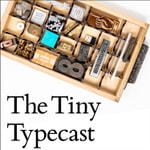

We have conversations about the history of printing and type paired with how this gives insight to people today. What does the past still have to teach us? And what are we learning fresh today about things that happened 20, 50, 500 years ago? Each episode, new guests. Hosted by Glenn Fleishman.
Classements récents
Dernières positions dans les classements Apple Podcasts et Spotify.
Apple Podcasts
🇬🇧 Grande Bretagne - design
04/11/2025#83🇬🇧 Grande Bretagne - design
03/11/2025#57🇬🇧 Grande Bretagne - design
02/11/2025#42🇬🇧 Grande Bretagne - design
25/03/2025#96🇬🇧 Grande Bretagne - design
24/03/2025#62🇬🇧 Grande Bretagne - design
23/03/2025#51🇨🇦 Canada - design
29/10/2024#95🇨🇦 Canada - design
28/10/2024#80🇨🇦 Canada - design
27/10/2024#65🇨🇦 Canada - design
26/10/2024#51
Spotify
Aucun classement récent disponible
Liens partagés entre épisodes et podcasts
Liens présents dans les descriptions d'épisodes et autres podcasts les utilisant également.
See all- https://www.theallusionist.org/
51 partages
- https://emojipedia.org/
30 partages
Qualité et score du flux RSS
Évaluation technique de la qualité et de la structure du flux RSS.
See allScore global : 59%
Historique des publications
Répartition mensuelle des publications d'épisodes au fil des années.
Dennis Duncan and Paula Clarke Bain on Indexing
Épisode 17
mardi 22 février 2022 • Durée 52:46
We talk about indexes with the author of the book Index, a History of the, Dennis Duncan, and its indexer, Paula Clarke Bain. Modern indexes date back eight centuries, and Dennis’s book takes us from the beginning to the present. Paula has worked for over 15 years as a professional indexer and produced nearly 900 indexes. She explains her working methods and the value of an index to the reader—and as an element of a book’s appeal.
This episode is sponsored by my book Six Centuries of Type & Printing. Find out more about the book and read an excerpt.
Dennis is a writer, translator, and lecturer in English at University College London, and the author also of Book Parts. He has appeared in the Guardian, the Times Literary Supplement, and the London Review of Books.
Paula is an indexer, copy editor, and proofreader. She has performed her indexing work on books covering such varied topics as Winston Churchill, Fry and Laurie, horror movies, Ted Hughes, musical modernism, the Peterloo Massacre, pigs in America, and the history of the vampire.
Show notes:
Paula’s website and on Twitter
Purchase Index, a History of the
The Society of Indexers, through which Paula trained for her career
Monograph on Walt Whitman as a printer
Peter Schoeffer’s sales catalog noting an index
Paula’s index in the book Soupy Twists! about the careers of Hugh Laurie and Stephen Fry, separately and together
Reading the Reprintings, my essay on how a book appears across printings within editions
An essay by scholars of the Lord of the Rings series on the authoritative version of the 50th anniversary editions
The indexical novel by Vladimir Nabokov, Pale Fire
Kurt Vonnegut’s indexers on a plane in Cat’s Cradle
Paula’s index-minded review of Susanna Clarke’s Piranesi
A 19th Century 3D Printer: an Audiobook Chapter
Épisode 16
mardi 9 novembre 2021 • Durée 10:02
Electrotyping was the 3D printing of its day. An electro-chemical process that deposited dissolved copper or other metals onto a prepared object, it effectively allowed creating exact duplicates of a page of type to create a durable printing plate, or to produce a mold (a “matrix”) from type punches or existing pieces of type. This allowed foundries to expand typeface production dramatically, allowing far easier creation of the master forms from which matrices were made—and enabled piracy.
In this episode of the Tiny Typecast, there’s no interview—just me reading a chapter on electrotyping, “A 19th Century 3D Printer,” from my book Six Centuries of Type & Printing. I picked this chapter as I am currently raising funds related to electrotyping on Kickstarter: I have an active campaign through 18 November 2021 to underwrite creating a detailed digital 3D model of a Monotype Electro Display Matrix, a mold created by that company in the early part of the 20th century to allow rapid casting of metal type for handsetting. Rewards include the digital file, a 3D-printed matrix, and historic Monotype matrices. Six months after the digital file is delivered to backers, I’ll re-license it broadly and distribute it widely to help preserve cultural and technological knowledge.
Briar Levit, a Historian of Forgotten Figures of Design Past
Épisode 7
lundi 5 avril 2021 • Durée 50:38
Briar Levit is a book designer, filmmaker, and former art director of Bitch magazine. She has taught graphic design for years, and is an associate professor of graphic design at Portland State University in Portland, Oregon. She directed the film Graphic Means about the phototype and paste-up period that acted as a transition between metal and digital production processes. That movie also delved into the way in which printing shops acted as gatekeepers to communication, and how women were severely underpaid during this period as they entered a previously nearly all-male industry.
With founder Louise Sandhaus, she and Brockett Horne are collaborating on fostering an amazing online gathering place, The People's Graphic Design Archive. And she's at work on Baseline Shift: Untold Stories of Women in Graphic Design History, a collection of essays due out later this year (not yet available for pre-order). We talk about all that and much more in this episode.
Jim Moran, Hamilton Wood Type & Printing Museum (The Tiny Typecast)
Épisode 6
lundi 1 mars 2021 • Durée 57:34
On this first episode in the new run in 2021, please welcome Jim Moran, the master printer and collections officer at the Hamilton Wood Type & Printing Museum in Two Rivers, Wisconsin. Hamilton is a unique institution in all sorts of ways. It preserves the manufacturing history and remaining wood type assets of the historical Hamilton Wood Type Company, the dominant producer of wood type in America from the late 1800s through the 1990s.
But it’s a lot more. Hamilton perpetuates the knowledge of the past by being an active printing museum. Volunteers cut wood the old-fashioned way and train apprentices. Hamilton has commissioned the design of new wood faces that can then be produced with vintage equipment, but also in conjunction with P22 Type Foundry releases versions of historic faces from their collection and newly made ones in digital form.
The museum has also expanded its collection by acquiring massive collections of hand-carved billboard and poster pieces from the Cincinnati Enquirer. It’s also acquired a lot more wood type than it started with, having the largest collection of wood type in the world.
Jim and other staff members, board members, affiliated friends, volunteers, and workshop participants print with historic type on historic presses. Each November for the last decade-plus, hundreds of people gather for the Hamilton Wayzgoose, the traditional name for the annual dinner a printing shop would have to celebrate its apprentices moving up. In 2020, that gatherings was virtual—the Awayzgoose—but it went on.
Over the pandemic year of 2020, Hamilton reached out to its community and immediately started up the Hamilton Hangs, informal gatherings via Zoom that started around no topic in particular, and quickly shifted to feature printers and artists from around the world. Thousands of attendees across the more than 50 Hangs so far include old friends of the museum and people who might never be able to get to Two Rivers, but have discovered the joy of letterpress, history, and community online.
Jim talks about his background, returning to his printing roots, and making lemonade during a year that might seem fallow of lemons.
Jeremy Burge, Chief Emoji Officer of Emojipedia (The Tiny Typecast)
Épisode 5
mardi 26 mai 2020 • Durée 50:31
Emoji are the first kind of symbolic element designed to read only online that’s also difficult, sometimes impossible, to reproduce accurately in print—or in a static electronic document, like a PDF. In this episode, I talk with Jeremy Burge, the chief emoji officer of Emojipedia, a site that exhaustively documents the past and present of those popular pictographs. He also helps chart the future as a member of the Unicode Consortium group that considers adding new emoji to the official Unicode set.
Sponsored by the Tiny Type Museum & Time Capsule and the associated book, Six Centuries of Type & Printing. Find out more.
David Sax, Revenge of Analog and the Soul of an Entrepreneur (The Tiny Typecast)
Épisode 4
dimanche 26 avril 2020 • Durée 47:49
David Sax, the author of three books—on delis, on the revival of analog culture, and on the right way to look at entrepreneurship—offers insights into the joy people feel in letterpress printing and the way in which cottage businesses dominated the world, and still do. Printing and letterpress aficionados will particularly like his 2016 title, The Revenge of Analog. His new book is The Soul of an Entrepreneur (April 2020).
Amy Redmond and Jenny Wilkson (The Tiny Typecast)
Épisode 3
jeudi 26 mars 2020 • Durée 46:37
In this installment of the Tiny Type Cast, I speak with artists, designers, and educators Amy Redmond and Jenny Wilkson, who work primarily in letterpress. Jenny founded the letterpress program at the School of Visual Concepts in Seattle, Washington, and Amy studied typecasting, typesetting, and letterpress printing in an apprenticeship with Chris Stern and Jules Faye.
The vibrant local community of printers keep traditions alive while also stoking the fires of a new generation and trying new kinds of printing, mixing different techniques onto the press, and new methods of making material for press, like laser cutters.
Keith Houston on His Book, The Book (The Tiny Typecast)
Épisode 2
samedi 29 février 2020 • Durée 42:26
Keith Houston talks about the past and present of the book, which has remained a remarkably consistent form since its invention millennia ago. We talk about bookiness, elements of a book, ebooks, and emoji, among other topics.
Keith is the author of Shady Characters and The Book, and maintains an active blog at which he posts ongoing articles on his current subject of interest. Right now, that’s been a long-running series on emoji that’s great reading, like all of his work.
A Visit to Letterform Archive (The Tiny Typecast)
Épisode 1
mercredi 26 février 2020 • Durée 39:06
Recorded live at Letterform Archive, Glenn Fleishman speaks with founder and executive director Rob Saunders, assistant curator and editorial director Stephen Cole, and then librarian Amelia Grounds. We talk about the archive history and mission, and how designers of today draw inspiration.
Phil Abel & Nick Gill, Two UK Printers Across an Era
Épisode 15
lundi 26 juillet 2021 • Durée 01:11:06
Phil Abel is a letterpress printer in London, who started his Hand and Eye Press in 1985 with a modest array of printing gear on the road towards his current set up with Heidelberg presses, and the ability to use both metal and wood type and produce modern photopolymer plates in house. He produces limited-edition fine-art books and we’ll talk about the album business.
Nick Gill worked for Phil, and eventually acquired his Monotype hot-metal casting gear to form Effra Press in North Yorkshire, England, where he and his wife are raising their children. Effra is one of the few remaining typefounders in the world. Nick trained at the Type Archive’s Monotype Hot-Metal Ltd operation, learning how to cut Monotype punches and matrices from Parminder Kumar Rajput, the only person ever learned all the jobs in the plant at the Monotype factory. Nick is also a musician, which we’ll get into how print and music meet in modern times.
Notes for this episode:
Six Centuries of Type & Printing by yours truly, composed by Nick and printed by Phil
Robert Pirsig’s Zen and the Art of Motorcycle Maintenance
Wind in the Willows editions from Hand and Eye
Frank Romano and the Museum of Printing in Massachusetts
Martin Zaltz Auswick, the link between Nick and myself, and Helen Zaltzman and her podcast, The Allusionist
Pneumatic aspects of Monotype casting system
Bill Welliver’s CompCAT system installed at Hand and Eye, back in 2013
Kumar & the Lost Art of Punchcutting
Richard Ardagh, New North Press
“The Vinyl? It’s Pricey. The Sound? Otherworldly. The Electric Recording Co. in London cuts albums the way they were made in the 1950s and ’60s — literally.”
Podcasts Similaires Basées sur le Contenu